
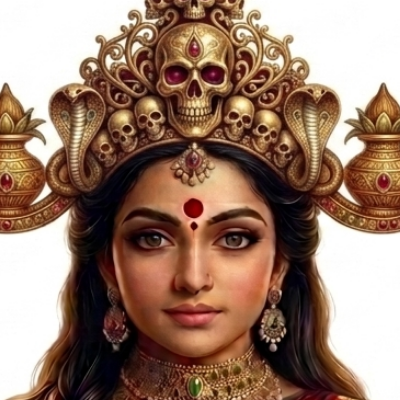
About
Niyuta — One of the Eleven Rudranis, Consort of the Rudra Vilohita
Niyuta · Niyut · Niyuta Rudrani · Shakti of Vilohita · Rudrani of Siva · Vilohitasakti
Niyuta is a divine feminine figure named in both the Vishnu Purana and the Bhagavata Purana as one of the eleven Rudranis — the female counterparts and consorts assigned to the eleven Rudras, the group of fierce divine beings who are forms or close attendants of the Vedic deity Rudra, identified in later tradition with Shiva. She is among the few Rudranis whose name appears, in closely cognate form, in both of the two principal Puranic lists of Rudranis: she is named Niyuta in the Vishnu Purana (Book I, Chapter VIII) and Niyut in the Bhagavata Purana (Canto 3, Chapter 12, Verse 13). In both lists she occupies the fifth position. In the Vishnu Purana's own Rudra enumeration, the fifth-named Rudra is Siva — here used as a specific individual name within the group of eleven rather than as a title for the supreme deity — and Niyuta is accordingly his consort within that framework. In the parallel tradition drawn from the Shiva Purana and Matsya Purana, where the eleven Rudras are named Kapali, Pingala, Bhima, Virupaksha, Vilohita, Shasta, Ajapada, Ahirbudhnya, Shambhu, Chanda, and Bhava, the fifth Rudra is Vilohita, and Niyuta is accordingly identified as his Shakti and consort. Vilohita is the deep-red or crimson Rudra, associated with the colour of blood, fire, and the purifying and transformative energies of that hue.
✦ The Name
The Sanskrit word Niyuta (written in Devanagari as नियुत or नियुता) is derived from the prefix ni, meaning down, into, or thoroughly, combined with the past passive participle yuta from the verbal root yu, meaning to join, to unite, to fasten, or to bind. The primary meaning of niyuta as an adjective is joined, fastened, bound, or attached — something held firmly in place or yoked to a purpose. As a noun, niyuta also carries a well-attested numerical meaning in classical Sanskrit, denoting a very large number, variously given in different texts as one hundred thousand, one million, or ten million, depending on the numeral system employed. This numerical sense appears in both the Rigveda and in later Puranic and mathematical texts. As a shortened or variant form, Niyut appears in the Bhagavata Purana list, preserving the same essential meaning. As a divine name, Niyuta may be understood as she who is bound or she who binds — the power of yoking, of fastening together, or of the bond that holds cosmic and vital forces in their proper relations. The name thus personifies the principle of binding, attachment, or the ordered yoking of powers as a divine feminine force.
It is notable that among all the Rudrani names, Niyuta is one of the very few that appears in closely cognate form across both principal Puranic lists — as Niyuta in the Vishnu Purana and as Niyut in the Bhagavata Purana — suggesting a more stable transmission of this name across the two textual traditions than is the case for several of her fellow Rudranis.
✦ Lineage
- Origin: According to the Vishnu Purana (Book I, Chapter VIII), Niyuta arose from the female half of Rudra's primordial androgynous form when he divided himself into male and female at Brahma's creative instigation. The Bhagavata Purana (3.12.13) presents the same moment as Brahma formally pronouncing the eleven Rudranis as belonging to Rudra. In either account, the Rudranis are not born of a specific parental lineage but are simultaneous individualisations of a single primordial feminine source, each assigned as consort to one of the eleven male Rudras.
- Spouse (Vishnu Purana tradition): Siva — the fifth-named Rudra in the Vishnu Purana's own enumeration of the eleven Rudras, where Siva is used as an individual name within the group rather than as a title for the supreme deity. The cosmological station allocated to this Rudra named Siva within the Vishnu Purana's scheme is one of the eleven bodily and cosmic positions distributed among the Rudras by Brahma.
- Spouse (Shiva Purana / Matsya Purana tradition): Vilohita — the fifth-named Rudra in the Shiva Purana (Shat-Rudra Samhita, Chapter 18) and Matsya Purana enumerations. The name Vilohita is compounded of the intensifying prefix vi and lohita, meaning red or of the colour of blood, yielding the sense deeply red, intensely crimson, or suffused with red. This Rudra is associated with the colour and qualities of blood and fire, with purification through the burning away of impurity, and with the fierce transformative energy of the Rudra group. He is distinct from the Rudra named Lohita or the epithet Vilohita that appears as one of the names of Shiva in certain sahasranama texts, though all these usages share the same root meaning of redness.
- Fellow Rudranis (Vishnu Purana list): Dhi, Vritti, Usana, Urna, Sarpis, Ila, Ambika, Iravati, Sudha, and Diksa — the ten other Rudranis named in the same passage of the Vishnu Purana, each assigned as consort to one of the remaining ten Rudras.
- Fellow Rudranis (Bhagavata Purana 3.12.13 list): Dhi, Dhrti, Rasala, Uma, Sarpi, Ila, Ambika, Iravati, Svadha, and Diksa — the ten other Rudranis named alongside Niyut in the Bhagavata Purana passage.
✦ The Cosmogonic Narrative of Origin
The narrative in which Niyuta appears is the same cosmogonic account that generates all eleven Rudranis simultaneously. The Vishnu Purana (Book I, Chapter VIII) narrates that at the beginning of the present world-cycle, Brahma desired to create a son in his own likeness, and from that creative intention Rudra arose in an androgynous form — half male, half female. Rudra then divided this form: from the male half arose eleven distinct Rudras, varying among themselves in complexion and temperament, some luminous and gentle, others dark and fierce; from the female half arose eleven Rudranis who were assigned as wives to those eleven Rudras. Brahma then allocated to each Rudra one of eleven specific cosmic and bodily stations — the heart, the five organs of sense, the five organs of action, and the mind. Niyuta, as the fifth Rudrani in this scheme, is associated with the station and domain corresponding to the fifth-named Rudra of the same enumeration.
The Bhagavata Purana (3.12.13) presents the same essential moment from a different narrative vantage. Here, Brahma addresses Rudra directly and pronounces the names of the eleven Rudranis as his wives, in a list that includes Niyut in the fifth position. The slight difference in form — Niyuta in the Vishnu Purana, Niyut in the Bhagavata — represents one of the more minor variations between the two lists, the underlying name being recognisably the same in both cases, unlike the more substantial divergences at other positions in the two lists.
✦ Textual Variants and Inconsistencies
Niyuta is among the more textually stable of the Rudrani names, appearing in cognate form in both principal Puranic lists and in the fifth position in each. This stability is notable by contrast with several of her fellow Rudranis — such as the divergence between Usana and Rasala at the third position, or between Uma and Urna at the fourth — where the two lists give wholly unrelated names at the same position. The variant between Niyuta and Niyut is one of grammatical form rather than of identity, and does not represent a substantive textual inconsistency.
The more significant inconsistency affecting Niyuta's profile concerns, as with all the Rudranis, the identification of her specific consort. The fifth-named Rudra in the Vishnu Purana is Siva — a name used here as an individual designation within the group rather than as the supreme divine title — while the fifth-named Rudra in the Shiva Purana and Matsya Purana is Vilohita. These are not the same figure. The pairing of Niyuta with Vilohita arises from cross-referencing the Bhagavata Purana Rudrani list — or equivalently the Vishnu Purana list, since both give Niyuta or Niyut fifth — with the Shiva Purana Rudra list, and is not stated explicitly within any single primary text as such. Within the Vishnu Purana's own internal logic, Niyuta's consort would be the Rudra named Siva in that text's fifth position.
It should further be noted that the Rudra named Siva in the Vishnu Purana's group of eleven is explicitly distinguished in later commentarial tradition from Shiva the supreme deity. The Vishnu Purana's cosmogonic account presents this Siva as one of several Rudras — some white and gentle, some dark and fierce — who are allocated specific bodily and cosmic stations by Brahma. The use of the name Siva for one of these eleven individual beings, while the same name simultaneously serves as the highest divine title, is a source of potential confusion in reading the passage, and Wilson's commentary on the Vishnu Purana explicitly notes this in his footnotes.
A further variant is found in some secondary compilations of the Rudrani list, which render the fifth name as Niyuta, Niyut, or occasionally Neeyut, reflecting differences in transliteration convention rather than in the underlying Sanskrit.
✦ Theological and Philosophical Significance
As a personification of the principle of binding, yoking, or fastening — the force that holds things joined and in their proper relation — Niyuta as a divine feminine power occupies a conceptually significant place among the Rudranis. In the framework of the Rudra theology, where each Rudrani is the Shakti or activating energy of her corresponding Rudra, Niyuta's role as the consort of Vilohita carries a particular resonance. Vilohita, the deeply red and crimson Rudra, is associated with the intense transformative energies of blood and fire — forces that are inherently volatile and potentially dispersive. The Shakti of binding and yoking that Niyuta personifies is thus theologically appropriate as the power that channels and holds together those fierce energies, preventing their dissipation and directing them toward their cosmic function.
In the broader context of Sanskrit philosophical usage, the concept encoded in the name Niyuta — binding, attachment, the ordered yoking of forces — connects to the ancient Vedic concept of rita, the cosmic order or right arrangement of things, and to the later Puranic notion of the cosmic functions being held in their proper stations by divine assignment. Brahma's act of allocating stations to the Rudras in the cosmogonic account is itself an act of niyuta in this sense — a binding of divine powers to specific domains. Niyuta as a Rudrani may thus be understood as the feminine embodiment of precisely that principle of ordered allocation and binding that the cosmogonic narrative enacts.
In the broader Shakta Puranic framework, the Rudranis collectively are understood as partial manifestations of the supreme Goddess, each expressing one specific modality of the divine feminine power. Niyuta's position as fifth in the traditional list, following Dhi, Vritti, Usana or Rasala, and Uma or Urna, places her within a sequence that several commentators have read as progressing from the cognitive faculties of the mind outward toward the forces of vital action and cosmic operation. The principle of binding and yoking may represent the power that makes that outward progression coherent — the force that keeps the sequence itself in order.
✦ Connection to the Wider Genealogy
Niyuta belongs to the collective of eleven Rudranis whose origin is inseparable from the cosmogonic act that simultaneously produced the eleven Rudras. The Rudras themselves are traced to differing ultimate parentages across the major Puranas: the Ramayana and Vamana Purana make them children of the sage Kashyapa — one of the seven great primordial sages, a son of Marichi who is himself a mind-born son of Brahma, and the progenitor of a vast range of divine, human, and demonic beings — and his wife Aditi, the boundless mother of the gods and daughter of Daksha; the Matsya Purana and Harivamsa name Surabhi, the divine wish-granting cow, as their mother, either as wife of Brahma or of Kashyapa; the Vishnu Purana derives them directly from Rudra's own self-division; the Bhagavata Purana (Canto 6, Chapter 6) names them as the sons of Sarupa, a daughter of Daksha the progenitor and lord of created beings, and her husband Bhuta. Niyuta's own origin is tied to whichever of these genealogical frameworks governs the account of her consort's generation, as she arises from the same creative act. The eleven Rudras and their eleven Rudrani consorts together constitute a distinct collective within the Puranic divine order, presiding over the eleven stations of the heart, the senses, the organs of action, and the mind, and governing the second stage of cosmic creation and the middle stage of human life from the twenty-fourth to the sixty-eighth year, as the Chandogya Upanishad prescribes.
✦ References
- Vishnu Purana, Book I, Chapter VIII — Primary source naming Niyuta as the fifth of the eleven Rudranis, in the context of the cosmogonic account of Rudra's self-division and the allocation of stations. H. H. Wilson's English translation and footnotes consulted, including his notation of the Bhagavata Purana's variant list and his remarks on the name Siva as an individual Rudra within the group.
- Bhagavata Purana, Canto 3, Chapter 12, Verse 13 — Names Niyut as the fifth of the eleven Rudranis in Brahma's pronouncement to Rudra; one of the two primary sources for Niyuta's name, and notable for presenting a cognate form of the name rather than a wholly different one as at several other positions.
- Bhagavata Purana, Canto 6, Chapter 6, Verses 17–18 — Names the eleven Rudras as sons of Sarupa and Bhuta with a list differing from both the Vishnu Purana and Shiva Purana; relevant to the genealogical variants of the Rudras who form Niyuta's consort-group.
- Shiva Purana, Shat-Rudra Samhita, Chapter 18 — Names the eleven Rudra incarnations with Vilohita fifth, providing the basis for identifying Niyuta as consort of Vilohita when the Rudrani list of the Vishnu Purana or Bhagavata Purana is aligned positionally with this enumeration.
- Matsya Purana, chapters on the Rudras — Provides a further enumeration of the Rudras placing Vilohita among the named figures, contributing to the tradition that establishes Vilohita in the fifth position and by extension Niyuta as his consort.
- Mahabharata, Adi Parva — Provides distinct enumerations of the eleven Rudras in multiple passages; relevant for establishing the range of variation in Rudra nomenclature across the epic and Puranic traditions and for the broader context of the Rudra group to which Vilohita belongs.
- Chandogya Upanishad, relevant passages — Prescribes propitiation of the Rudras in cases of sickness during the middle stage of life, defining the Rudras as presiding over the period from the twenty-fourth to the sixty-eighth year; relevant for understanding the cosmic and physiological domain over which Niyuta and her consort jointly preside.
- Rigveda, relevant hymns — Contains the word niyuta in its numerical sense denoting a very large number; relevant to the etymological and semantic background of the name Niyuta as used for the Rudrani.
- Monier-Williams Sanskrit–English Dictionary (M. Monier-Williams, 1899) — Entry for Niyuta records both the participial meaning of bound or joined and the numerical meaning of a large number, establishing the full semantic range of the name.
- Puranic Encyclopaedia (Vettam Mani, 1975) — Reference work consulted for cross-referencing variant Rudra and Rudrani lists across the Puranas, and for entries on Vilohita and related figures.
- Wikipedia, "Rudras" article — Secondary source compiling variant Rudra and Rudrani lists from primary texts; used to verify cross-textual patterns and the relative stability of the name Niyuta across the two lists.
- Sacred-texts.com, Vishnu Purana Book I Chapter VIII (Wilson translation) — English translation and footnotes consulted directly for the passage naming Niyuta in the fifth Rudrani position and for Wilson's commentary on the name Siva as an individual Rudra in the same text.
- Wisdomlib.org, definitions of Niyuta and Vilohita — Secondary aggregator of Sanskrit lexicographical and Puranic sources; consulted for confirming the semantic range of niyuta and the descriptive attributes of Vilohita as a Rudra figure.