
About
Bhava — Eleventh of the Eleven Rudras, the King of All Beings and the Ground of Existence
Bhava · Bhaava · Bhava Rudra · Ekadasha Rudra No. 11 · Son of Kashyapa and Surabhi
Bhava is the eleventh and last of the eleven Rudras, the Ekadasha Rudras, named in the Shata-Rudra Samhita of the Shiva Purana as incarnations of Shiva born through Surabhi, the divine wish-fulfilling cow and wife of the sage Kashyapa Prajapati. The name Bhava means existence, becoming, the world, and the one who generates all things at the very beginning — and this Rudra is the most cosmologically encompassing of all eleven, representing Shiva as the ground of existence itself, the totality of being from which all manifest reality arises and into which it returns. Of all the names in the Ekadasha Rudra series, Bhava has the deepest and most widely distributed Vedic antecedents: it is attested as a name of Rudra in the Atharvaveda, the Shatapath Brahmana of the Shukla Yajurveda, the Taittiriya Brahmana, the Mahabharata, and across multiple Puranas. The Atharvaveda calls Bhava the king of all beings. Sayanacharya, the great medieval commentator on the Atharvaveda, derives the name as meaning one who generates the entire world at the very beginning — identifying Bhava as the creative, originating impulse of existence itself. His consort among the eleven Rudranis is Svadha in the Vishnu Purana listing — though an alternate pairing found in secondary sources associates him with Bhavani, the feminine form of his own name. His skin colour is described in the Atharvaveda commentary as nilapitadivarna — a blue and yellowish hue combining the colours of sky and earth, storm and harvest, the full spectrum of the living world.
✦ The Name
The Sanskrit name Bhava derives from the root bhu, meaning to be, to become, to exist, and to originate. The noun bhava formed from this root carries meanings of existence, being, origination, the world, becoming, and welfare or good fortune. It is one of the most philosophically fundamental words in the Sanskrit lexicon: bhava is the fact of existence itself, the bare ontological ground from which everything arises. Sayanacharya's derivation in his commentary on the Atharvaveda — that bhava denotes the one who generates all things at the very beginning — identifies the deity with the originating creative impulse underlying cosmic manifestation. The Shatapatha Brahmana of the Shukla Yajurveda includes Bhava in the list of the eight names bestowed upon Rudra by Prajapati, where each name corresponds to a specific cosmic domain: Sarva corresponds to water, Pasupati to plants, Ugra to wind, Ashani to lightning, Bhava to parjanya (the rain-cloud and rain itself), Mahadeva to the moon, and Ishana to the sun. Bhava as parjanya — the life-giving rain — positions this name within the cosmic domain of nourishment, fertility, and the renewal of the world. In later Vedic literature, as the scholar Wendy Doniger and others have noted, the name Bhava was absorbed from what may have been a regional or non-Aryan deity into the expanding Rudra complex, bringing with it the connotations of earthly existence, the natural world, and the immanent divine presence within all living things. The same root gives Bhavani — the feminine form meaning she who is the ground of existence — which is one of Parvati's most celebrated names and the name of the Rudrani associated with Bhava in certain traditions.
✦ Lineage
- Father: Kashyapa Prajapati — the great progenitor sage, a mind-born son of Brahma, and father of the Devas through Aditi. In the Shiva Purana, Kashyapa performed austerities at Kashi and received from Shiva the boon of incarnation through Surabhi as the eleven Rudras.
- Mother: Surabhi — the divine wish-fulfilling cow, daughter of Daksha Prajapati and wife of Kashyapa. The Harivamsha (Harivamsa Parva 1.3.49–50) affirms that the eleven Rudras were produced through Surabhi by the grace of Mahadeva and her own austerities. The Shiva Purana itself specifically describes the eleventh Rudra — Bhava — as the son of Surabhi who is the abode of happiness, born from the very form of Shiva for the accomplishment of the work of the gods.
- Brothers: The ten remaining Ekadasha Rudras — Kapali, Pingala, Bhima, Virupaksha, Vilohita, Shastra, Ajapada, Ahirbudhnya, Shambhu, and Chand — all born simultaneously from Surabhi as incarnations of Shiva.
- Consort: Sudha — named eleventh among the Rudranis in several Puranic lists. The word sudha means nectar, amrita, the drink of immortality, and the nourishing whiteness of moonlight and milk. As the feminine power paired with Bhava — the ground of existence — Sudha represents the sustaining, nourishing, immortality-conferring aspect of divine power: the nectar that keeps the cosmos alive and the devotee sustained in the divine presence. A secondary tradition pairs Bhava with Bhavani — the feminine form of Bhava itself — a pairing that appears in popular devotional practice and in Shakta literature, where Bhava and Bhavani together are understood as the two poles of the one ultimate reality expressed as male and female.
✦ Vedic Antecedents: Bhava in the Vedic Samhitas and Brahmanas
Among all eleven Ekadasha Rudras of the Shiva Purana list, Bhava has the most extensive Vedic pedigree. A dedicated hymn in the Atharvaveda depicts Rudra specifically in the form of Bhava alongside Sarva, the two being invoked jointly as king and as the source of all that exists. In this hymn, Sayanacharya's commentary derives bhava as the originator of the world at the very beginning and identifies Bhava's skin colour as nilapitadivarna — a compound of nila (blue-black, the colour of storm-cloud and rain) and pita (yellow, the colour of the harvest and ripened grain) — making Bhava the deity whose body contains the entire colour spectrum of the living, fertile world. The Shatapatha Brahmana, in the narrative of Rudra's birth from Prajapati and the successive granting of his eight names, assigns Bhava to the cosmic domain of parjanya — the rain-cloud deity who causes rain, enables harvest, and sustains all life. In the Brahmana's framework, Bhava is therefore the Rudra form that governs the most immediately life-sustaining of all natural forces: rainfall, fertility, and the renewal of the agricultural cycle. The Taittiriya Brahmana similarly includes Bhava among the eight forms of Rudra, each corresponding to a fundamental cosmic element or force. In the later Vedic literature examined by the scholars of the Rudra tradition, Bhava is identified as one of the older non-Aryan deity names absorbed into the Rudra complex — suggesting that the worship of Bhava as a deity of immanent natural power and earthly existence predates the Vedic synthesis and enriched it with a profound sense of the sacred within the living world.
✦ The Origin Narrative
Bhava shares the collective birth narrative of the eleven Rudras as narrated in the Shata-Rudra Samhita of the Shiva Purana. When the Devas were expelled from Amaravati by the Rakshasas, Kashyapa Prajapati undertook severe austerities at Kashi and obtained from Shiva the boon of incarnation as eleven sons through Surabhi. Bhava was born as the eleventh and last of these sons — the culminating and most encompassing manifestation, the one whose name means existence itself. The Shiva Purana's own verse describing the eleventh Rudra identifies him as the son of Surabhi who is the abode of happiness, born from the form of Shiva for the accomplishment of the divine work. In the great battle against the Rakshasas that followed, Bhava's role was the most total: as the Rudra of existence itself, his presence in the battle was the ground that supported and enabled all the other ten Rudras' actions — the cosmic field within which every act of destruction and protection took place.
✦ Bhava as One of Shiva's Eight Classical Forms
Beyond the Ekadasha Rudra tradition, Bhava is also one of the eight classical forms of Shiva known as the Ashtamurti — the eight-formed Shiva in which each form corresponds to one of the eight fundamental constituents of the manifest world: the five gross elements and the sun, moon, and sacrificer. In the Ashtamurti system, as described in the Vishnu Purana and related sources, Bhava corresponds to parjanya and by extension to water and the rain-principle — the cosmic function of nourishment and renewal. This double attestation of Bhava — as both the eleventh Ekadasha Rudra of the Shiva Purana's Kashyapa–Surabhi tradition and as one of Shiva's eight foundational cosmic forms in the Ashtamurti system — gives this name a unique double legitimacy in the tradition, anchoring it in two entirely distinct but mutually reinforcing frameworks of Shaiva cosmological thought. Both frameworks agree on the essential quality of Bhava: he is the Shiva form that governs existence in its most immediate, immanent, and life-sustaining dimension.
✦ Theological and Philosophical Significance
Bhava's position as the eleventh and final Rudra is theologically the most encompassing in the series. The sequence of the ten before him ranges from the acceptance of death (Kapali) through solar vitality (Pingala), overwhelming force (Bhima), cosmic vision (Virupaksha), purifying fire (Vilohita), authoritative knowledge (Shastra), the vertical cosmic pillar (Ajapada), the serpentine depth (Ahirbudhnya), the source of bliss (Shambhu), and the ferocious destroyer of arrogance (Chand). Bhava, coming after all of these, is the name that contains them all: existence itself, the field within which all these cosmic functions operate. In the Brihadaranyaka Upanishad's framework of the eleven Rudras as the ten vital energies and the Atman as the eleventh, Bhava corresponds most naturally to the Atman — the supreme self — since he is the Rudra whose name means pure being rather than any specific function or quality. The devotional tradition specifically invokes Bhava for prosperity, fertility, and harmony with the rhythms of the natural world — connecting his philosophical identity as the ground of existence with the practical blessings of the agricultural and life-sustaining cycles that rain and fertility govern. The Svetasvatara Upanishad, which makes Rudra-Shiva identical with the Purusha — the primordial person — and with Brahman itself, provides the deepest philosophical grounding for Bhava's identity: as the ground of existence, Bhava is the Rudra most directly identified with the supreme Brahman, the undivided totality from which all emerges.
✦ Iconography
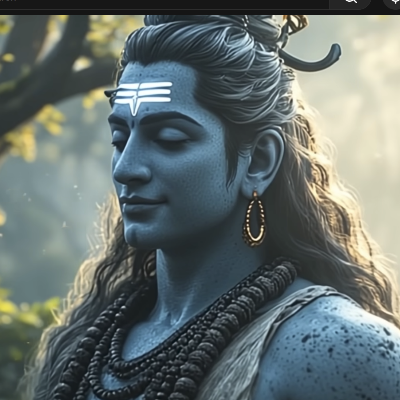
The Atharvaveda commentary by Sayanacharya identifies Bhava's skin colour as nilapitadivarna — a blue and yellowish hue :antCitation[]{citations="2ffe5824-224c-4600-8454-4ced603327a0"} combining the deep blue-black of storm clouds and the golden yellow of ripened grain and sunlight, making his body a visual compendium of the fertile, living world he governs. He is associated with the five elements — earth, water, fire, air, and space — as the Rudra of total existence, and his iconographic form accordingly encompasses the full elemental range rather than being limited to any single elemental correspondence as several of his brothers are. Bhava is depicted with a serene yet powerful countenance — the face of the deity who encompasses all things and is therefore threatened by none. He shares the general iconographic features of all eleven Rudras: matted hair, serpents as ornaments, trident, crescent moon, lion-skin garments, and yellow-hued throat. His specific attributes include the water pot — appropriate for parjanya, the rain-deity — and the mace, representing the sustaining and ordering power of existence itself. Some later iconographic traditions associate Bhava with the green and earth tones of the living, growing natural world, consistent with his governance of rainfall and fertility.
✦ Textual Variants and Inconsistencies
Bhava is one of the most widely distributed names across different Rudra lists. It appears in the Shiva Purana's Shata-Rudra Samhita list as the eleventh, in the Bhagavata Purana's Canto 3.12 list as one of the eleven Rudras born from Brahma's anger, in the Mahabharata's various enumerations, in the Ashtamurti system of the Vishnu Purana and other Puranas, and in the Shatapatha Brahmana's eight Rudra-names. In the Bhagavata Purana's Canto 6.6 list of eleven Rudras born from Sarupa and Bhuta, Bhava does not appear by this name. The Vayu Purana's Kashyapa–Surabhi list does not include Bhava by name. A notable inconsistency concerns the consort assigned to Bhava: the Vishnu Purana's Rudrani list gives Sudha as the consort of the eleventh Rudra, while the popular devotional tradition — drawing on the Shakta literature's pairing of Bhava with Bhavani — assigns the feminine form of Bhava himself as his consort. Both traditions are legitimate within their respective textual frameworks. The Matsya Purana's Kashyapa–Surabhi list does not include Bhava, ending instead with Senani as its eleventh name — a complete divergence from the Shiva Purana at the final position.
✦ Connection to the Wider Genealogy
Bhava belongs to the same dual lineage as all eleven Ekadasha Rudras. Through his father Kashyapa Prajapati, a son of Brahma, he is a paternal grandson of the creator. Through his mother Surabhi, daughter of Daksha Prajapati, he is also a maternal grandson of Daksha. As the eleventh and final incarnation of Shiva in this series, Bhava stands in identity with the supreme Rudra at his most encompassing and immanent — the Shiva who is not only the destroyer, the ascetic, or the warrior, but the ground of existence itself, present in every drop of rain, every blade of grass, every living breath. His consort Sudha, as the eleventh Rudrani, represents the immortal nectar that sustains all life in the cosmos — the feminine power of undying nourishment paired with the masculine principle of undying existence, together forming the complete and self-sustaining ground of the cosmos. The eleven Ekadasha Rudras as a series thus move from Kapali — acceptance of death, the threshold of dissolution — through ten increasingly encompassing manifestations of Shiva's cosmic functions, arriving finally at Bhava — existence itself, the affirmation that beneath all dissolution and all transformation, being is indestructible and the ground of the cosmos is inexhaustibly alive.
✦ References
Primary Sources
- Shiva Purana, Shata-Rudra Samhita, Chapter 3, Section 17: Names Bhava as the eleventh and last of the Rudras born from Kashyapa and Surabhi; specifically identifies him as the son of Surabhi who is the abode of happiness, born from the form of Shiva.
- Atharvaveda (single hymn depicting Rudra as Bhava and Sarva): The earliest textual source naming Bhava as a form of Rudra; identifies Bhava as king of all beings and describes his blue-and-yellow skin colour through Sayanacharya's commentary.
- Shatapatha Brahmana of the Shukla Yajurveda: Includes Bhava among the eight names of Rudra bestowed by Prajapati, corresponding to the cosmic domain of parjanya — rain, fertility, and the renewal of life.
- Taittiriya Brahmana: Lists Bhava among the eight classical forms of Rudra, each corresponding to a fundamental cosmic element or force.
- Harivamsha, Harivamsa Parva 1.3.49–50 and 3.36.50–51: Primary authority for the Kashyapa–Surabhi parentage of all eleven Rudras.
- Vishnu Purana 1.7: Names Sudha as the eleventh Rudrani, consort of the eleventh Rudra; also describes the Ashtamurti system in which Bhava corresponds to parjanya and the water-rain principle.
- Bhagavata Purana 3.12: Includes Bhava among the eleven Rudras born from Brahma's anger with an entirely different set of eleven names, establishing a major textual variant.
- Mahabharata (various Parvas): Includes Bhava in multiple enumerations of the Rudras and uses it as a name of Shiva.
- Svetasvatara Upanishad: Identifies Rudra-Shiva with Purusha and Brahman, providing the deepest philosophical grounding for Bhava's identity as the ground of existence itself.
- Brihadaranyaka Upanishad 3.9.4: Identifies the eleven Rudras with the ten vital energies and the Atman, within which framework Bhava corresponds most naturally to the Atman — pure being.
- Rupamandana and Vishvakarmashilpa: Describe the shared iconographic features of the eleven Rudras and Bhava's specific attributes including the water pot and mace.
Modern Reference Works
- Wisdomlib, "Rudra as Bhava" (Rudra-Shiva Concept Study): Provides the Atharvaveda hymn reference, Sayanacharya's derivation of bhava as originator of the world, the nilapitadivarna skin-colour description, and the identification of Bhava as king of all beings.
- Wisdomlib, "Origin of Rudra" (Rudra-Shiva Concept Study): Provides the Shatapatha Brahmana account of the eight Rudra names and Bhava's specific correspondence with parjanya in that system.
- Exotic India Art, "11 Rudra Avatars of Lord Shiva": Describes Bhava's role as sustainer of cosmic existence, his five-element association, his green-earth-tone iconographic colour, and his specific invocation for prosperity, fertility, and harmony with natural rhythms.
- Wikipedia, "Rudras": Documents the various Puranic lists in which Bhava appears and the textual inconsistencies around his position and parentage across traditions.
- New World Encyclopedia, "Rudra": Notes the scholarly view that Bhava was absorbed from a regional or non-Aryan deity into the Vedic Rudra complex, bringing connotations of earthly existence and immanent natural power.