
About
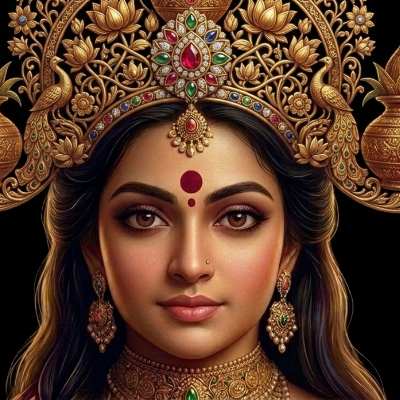
Ila — One of the Eleven Rudranis, Consort of the Rudra Ajapada
Ila · Ila Rudrani · Shakti of Ajapada · Shakti of Ajaikapada · Rudrani of Ugraretas · Ida · Idavida
Ila is a divine feminine figure named in both the Vishnu Purana and the Bhagavata Purana as one of the eleven Rudranis — the female counterparts and consorts assigned to the eleven Rudras, the group of fierce divine beings who are forms or close attendants of the Vedic deity Rudra, identified in later tradition with Shiva. She appears as Ila in both the Vishnu Purana (Book I, Chapter VIII) and the Bhagavata Purana (Canto 3, Chapter 12, Verse 13), occupying the seventh position in both lists, making her one of the most consistently attested of the Rudrani names across the two principal enumerations. In the Vishnu Purana's own Rudra enumeration, the seventh-named Rudra is Ugraretas, and Ila is accordingly his consort within that framework. In the parallel tradition drawn from the Shiva Purana and Matsya Purana — where the eleven Rudras are named Kapali, Pingala, Bhima, Virupaksha, Vilohita, Shastra, Ajapada, Ahirbudhnya, Shambhu, Chanda, and Bhava — the seventh Rudra is Ajapada, and Ila is accordingly identified as his Shakti and consort. The name Ila is, however, one of great complexity in the Hindu scriptural tradition as a whole, for it belongs simultaneously to several distinct and important figures across the Vedic, Puranic, and epic sources, and the relationship between the Rudrani Ila and these other figures of the same name requires careful textual attention.
✦ The Name
The Sanskrit word Ila (written in Devanagari as इला or इल) is among the most semantically rich and multiply applied of all names in the Vedic and Puranic corpus. Its primary meanings in the Vedic context encompass the earth, the flow of nourishment, speech, and the oblation or sacrificial offering — especially the portion of the offering set apart for the gods. In the Rigveda, Ida or Ila is a goddess of the sacrificial offering and of sacred speech, closely associated with the nourishing and vitalising aspects of the ritual. The name is related to the verbal root il or id, meaning to refresh, to animate, to praise, or to invoke, and carries an inherent sense of vitalising flow — the movement of nourishment, speech, or sacred energy from one domain to another.
In its form as Ida, the name designates one of the three principal energy channels of the subtle body in the Tantric and Yogic physiological tradition — the Ida Nadi, the left-side channel associated with the moon, with cooling and receptive energy, and with the feminine principle, running alongside the central Sushumna channel and the right-side Pingala Nadi. This usage, though later than the Vedic, draws on the same root associations of flow, refreshment, and the lunar feminine that the name carries in the Vedic hymns.
As a divine name of the Rudrani, Ila thus personifies the nourishing, vitalising, and speech-bearing flow of sacred energy — the principle of the oblation and of sacred articulation — as a divine feminine power. The name encodes a quality of moving, life-giving essence, whether understood as the ritual offering that moves toward the gods, the sacred speech that moves between the human and divine worlds, or the subtle vital current that flows through the body.
✦ Lineage
- Origin as Rudrani: According to the Vishnu Purana (Book I, Chapter VIII), Ila arose from the female half of Rudra's primordial androgynous form when he divided himself into male and female at Brahma's creative instigation. The Bhagavata Purana (3.12.13) presents the same moment as Brahma formally pronouncing the eleven Rudranis as belonging to Rudra. In either account the Rudranis are not born of a specific parental lineage but are simultaneous individualisations of a single primordial feminine source, each assigned as consort to one of the eleven male Rudras.
- Spouse (Vishnu Purana tradition): Ugraretas — the seventh-named Rudra in the Vishnu Purana's own enumeration of the eleven Rudras. The name Ugraretas is compounded of ugra, meaning fierce, terrible, or powerful, and retas, meaning seed or vital fluid, yielding the sense he of the fierce or powerful seed. Beyond his position in the Vishnu Purana list, Ugraretas receives no extended narrative treatment in the primary sources as an individual Rudra figure, though his name connects him to the broader Shaiva symbolism of the ascetic's stored and potent vital energy.
- Spouse (Shiva Purana / Matsya Purana tradition): Ajapada — the seventh-named Rudra in the Shiva Purana (Shat-Rudra Samhita, Chapter 18) and Matsya Purana enumerations. The name Ajapada is compounded of aja, meaning unborn, or alternatively the goat, and pada, meaning foot or step, yielding either he of the unborn foot — that is, the formless, footless, or transcendent — or he who stands on the goat. Ajapada is closely related to or identified with Ajaikapada, the single-footed unborn one, who appears in several Rudra enumerations including one of the Mahabharata lists, and who is associated with the primal, uncreated aspect of the divine that stands outside the cycle of birth and death. In some texts Ajaikapada is identified with the cosmic pillar or with the primal serpent of the deep, and he is understood as representing the formless, transcendent, or unmanifest aspect of Rudra's power.
- Fellow Rudranis (Vishnu Purana list): Dhi, Vritti, Usana, Urna, Niyuta, Sarpis, Ambika, Iravati, Sudha, and Diksa — the ten other Rudranis named in the same passage of the Vishnu Purana.
- Fellow Rudranis (Bhagavata Purana 3.12.13 list): Dhi, Dhrti, Rasala, Uma, Niyut, Sarpi, Ambika, Iravati, Svadha, and Diksa — the ten other Rudranis named alongside Ila in the Bhagavata Purana passage.
✦ The Cosmogonic Narrative of Origin
The narrative in which Ila appears as a Rudrani is the same cosmogonic account that generates all eleven Rudranis simultaneously. The Vishnu Purana (Book I, Chapter VIII) narrates that at the beginning of the present world-cycle Brahma desired to create a son in his own likeness, and from that creative intention Rudra arose in an androgynous form — half male, half female. Rudra then divided this form: from the male half arose eleven distinct Rudras varying in nature and complexion; from the female half arose eleven Rudranis who were assigned as wives to those eleven Rudras. Brahma then allocated to each Rudra one of eleven specific cosmic and bodily stations — the heart, the five organs of sense, the five organs of action, and the mind. Ila, as the seventh Rudrani in this scheme, is associated with the station and domain corresponding to the seventh-named Rudra of the same enumeration. The Bhagavata Purana (3.12.13) presents the same essential moment as a direct pronouncement by Brahma to Rudra, naming the eleven Rudranis in a list in which Ila appears seventh — consistent with the Vishnu Purana and making Ila one of only a handful of names to appear identically in both lists at the same position.
✦ Ila as Vedic Goddess of Sacrifice and Speech
In the Rigveda, Ida or Ila is invoked as one of three goddesses — the other two being Sarasvati, the goddess of sacred speech and learning, and Bharati, a goddess of the oblation and of inspired utterance — who are called together at the close of the Apri hymns, a specific class of Rigvedic hymns associated with the animal sacrifice. These three goddesses are addressed as the divine presences who descend to the sacrificial ground to accept the offerings and convey them to the gods. Ila in this context is specifically associated with the nourishing substance of the offering, with the refreshment it brings, and with the portion of the sacrifice set aside for the divine. Her name in this usage is closely related to Ida, the oblation-portion, and the two forms are sometimes treated as identical in the Vedic commentarial tradition.
The Shatapatha Brahmana contains a celebrated passage in which Ida is created from the sacrificial offering itself, arising from the ritual as a daughter of Manu — the first man and the progenitor of humanity — who had performed a sacrifice to obtain progeny. In this account, Ida is the daughter born of the sacrifice rather than of a human mother, and she is described as nourishing and sustaining. She is subsequently identified as both the oblation-cow — the embodiment of the nourishing essence of the sacrifice — and as the progenitrix of the human race through her union with Manu. This narrative makes Ila a figure of primordial creative importance in the Vedic tradition, not merely a minor ritual goddess but the mother of human lineages and the living product of the first sacred offering.
✦ Ila as Androgynous Figure in the Puranic Tradition
The Puranic tradition preserves a distinct and extensively narrated account of a figure named Ila who is the son — and subsequently the daughter — of the solar king Vaivasvata Manu, the great progenitor of the current human era. According to the Vishnu Purana, the Bhagavata Purana, and the Mahabharata, when Manu performed a sacrifice to obtain a son, the rite was incorrectly conducted and the result was the birth of a daughter named Ila rather than a son. Through divine grace or through a boon from Shiva and Parvati, Ila was transformed into a male and named Sudyumna. Subsequently, when Sudyumna entered a forest sacred to Shiva and Parvati, he was transformed back into a woman through the curse of that forest. Thereafter Ila-Sudyumna alternated between male and female form month by month. In her female form as Ila she bore a son named Pururavas to the celestial being Budha — the planet Mercury, son of the moon-god Chandra — and Pururavas became the progenitor of the Lunar dynasty, one of the two great royal lineages of the Puranic tradition. In his male form as Sudyumna, he fathered three sons who became founders of other lineages. This narrative of Ila-Sudyumna is one of the most discussed gender-alternating figures in the entire Hindu scriptural tradition.
The relationship between this Puranic Ila and the Rudrani Ila named in the Vishnu Purana and Bhagavata Purana lists is not established in any primary text. They share a name but appear in entirely different narrative and genealogical contexts. The Puranic Ila is a mortal royal figure who is a child of Manu; the Rudrani Ila is a divine being arising from Rudra's primordial female half. No primary source explicitly identifies them as the same figure, and their genealogical and narrative details are incompatible if taken literally. The shared name is best understood as reflecting the broader cultural and semantic resonance of the name Ila across the tradition rather than as indicating identity of person.
✦ Textual Variants and Inconsistencies
The name Ila appears identically in both the Vishnu Purana and the Bhagavata Purana Rudrani lists, in the seventh position in each, making it one of the most stable of all the Rudrani names across the two principal sources. This consistency is notable and distinguishes Ila from several of her fellow Rudranis whose names differ substantially between the two lists.
The principal inconsistency affecting Ila's profile concerns the identity of her specific consort. The seventh-named Rudra in the Vishnu Purana is Ugraretas, while the seventh-named Rudra in the Shiva Purana and Matsya Purana is Ajapada. These are distinct figures. The pairing of Ila with Ajapada arises from aligning the seventh position in the Rudrani list with the seventh position in the Shiva Purana Rudra list, and is not stated explicitly in a single primary text as such. Within the Vishnu Purana's own internal framework, Ila's consort would be Ugraretas.
A further textual consideration concerns the orthographic and phonological relationship between the forms Ila, Ida, and Idavida. In the Vedic tradition, Ida and Ila are used interchangeably in some passages and are treated as distinct names in others. The Vedic Ida of the sacrifice and the Puranic Ila of Manu's lineage are both related to the same root but not uniformly identified with one another in the primary sources. Idavida appears in certain texts as a compound name or epithet. None of these identifications is made explicitly in the primary texts in relation to the Rudrani Ila specifically.
✦ Theological and Philosophical Significance
As a personification of the nourishing sacrificial oblation and of vitalising sacred speech, Ila as a Rudrani embodies the principle of life-giving flow — the movement of sacred nourishment between the human and divine worlds. In the framework of the Rudra theology, where each Rudrani is the Shakti or activating energy of her corresponding Rudra, Ila as the consort of Ajapada carries a specific resonance. Ajapada, the unborn or footless Rudra associated with the transcendent, unmanifest, and formless aspect of divine power, stands outside the cycle of creation and dissolution. The Shakti that accompanies such a principle is fittingly understood as the nourishing, vitalising flow that sustains even the unmanifest — the sacred oblation that feeds the formless divine presence no less than it feeds the embodied gods.
In the Tantric physiological tradition, the Ida Nadi as a subtle energy channel represents the left-side, lunar, receptive, and cooling current of vital force in the body. This physiological symbolism, while later in development than the Vedic usage, continues the same root associations of the name Ila with flowing, refreshing, and sustaining energy. The Rudrani Ila may thus be understood as spanning both the outer sacrificial world — where she is the oblation — and the inner physiological world — where her current flows as the sustaining lunar energy of the body — two expressions of the same fundamental principle of vitalising, nourishing flow.
✦ Connection to the Wider Genealogy
Ila belongs to the collective of eleven Rudranis whose origin is inseparable from the cosmogonic act that simultaneously produced the eleven Rudras. The Rudras themselves are traced to differing ultimate parentages across the major Puranas: the Ramayana and Vamana Purana make them children of the sage Kashyapa and his wife Aditi; the Matsya Purana and Harivamsa name Surabhi the divine cow as their mother; the Vishnu Purana derives them from Rudra's self-division; the Bhagavata Purana (Canto 6, Chapter 6) names them as the sons of Sarupa and Bhuta. Ila's own origin as a Rudrani is tied to whichever of these frameworks governs the account of her consort's generation. The Puranic Ila of Manu's lineage, though bearing the same name, belongs to an entirely separate genealogical stream: she is the child of Vaivasvata Manu, the seventh Manu of the current cosmic era, and through her son Pururavas she becomes the matriarchal ancestor of the entire Lunar dynasty — the lineage that includes the Pandavas and Kauravas of the Mahabharata, the great kings of the Puranic tradition, and a vast range of heroes and sages. That Ila's connection to the Rudrani of the same name is one of shared nomenclature and perhaps shared symbolic resonance rather than of narrative or genealogical identity.
✦ References
- Vishnu Purana, Book I, Chapter VIII — Primary source naming Ila as the seventh of the eleven Rudranis in the cosmogonic account of Rudra's self-division. H. H. Wilson's English translation and footnotes consulted.
- Bhagavata Purana, Canto 3, Chapter 12, Verse 13 — Names Ila as the seventh of the eleven Rudranis in Brahma's pronouncement to Rudra; fully consistent with the Vishnu Purana at this position, making Ila among the most stably attested Rudrani names across the two principal lists.
- Bhagavata Purana, Canto 6, Chapter 6, Verses 17–18 — Names the eleven Rudras as sons of Sarupa and Bhuta; relevant to the genealogical variants of the Rudra group.
- Vishnu Purana, Book IV, relevant chapters on the Solar dynasty — Narrates the story of Ila-Sudyumna, child of Vaivasvata Manu, whose gender alternates between male and female and who becomes the progenitor of the Lunar dynasty through her son Pururavas; relevant for establishing this figure as distinct from the Rudrani Ila despite the shared name.
- Bhagavata Purana, Canto 9, relevant chapters — Further narrates the Ila-Sudyumna account within the Solar dynasty genealogy; confirms the Puranic Ila as a distinct figure from the Rudrani Ila.
- Mahabharata, Adi Parva — Contains accounts of both the Ila-Sudyumna narrative and enumerations of the eleven Rudras; relevant for establishing the textual range of both the name Ila and the Rudra group across the epic tradition.
- Rigveda, Apri hymns and related passages — Primary source for Ida-Ila as the Vedic goddess of the sacrificial oblation and sacred speech, invoked alongside Sarasvati and Bharati; foundational for understanding the theological significance of the Rudrani's name.
- Shatapatha Brahmana, relevant passages — Contains the narrative of Ida's creation from the sacrifice as the daughter of Manu's offering; important for the Vedic background of the name's associations with nourishment, the oblation, and the origin of human lineages.
- Shiva Purana, Shat-Rudra Samhita, Chapter 18 — Names the eleven Rudra incarnations with Ajapada seventh, providing the basis for identifying Ila as the consort of Ajapada through positional alignment with the Rudrani lists.
- Matsya Purana, chapters on the Rudras — Provides further enumeration of the Rudras relevant to the identification of Ajapada and Ajaikapada as the seventh Rudra in the Shiva Purana tradition.
- Monier-Williams Sanskrit–English Dictionary (M. Monier-Williams, 1899) — Entries for Ila, Ida, and related forms record the full semantic range of the name including earth, speech, oblation, refreshment, and the nourishing flow of vital force; essential for the etymological and theological discussion.
- Puranic Encyclopaedia (Vettam Mani, 1975) — Reference work consulted for cross-referencing the Rudrani Ila with the Puranic Ila of Manu's lineage and for entries on Ajapada, Ajaikapada, Ugraretas, and related figures.
- Wikipedia, "Rudras" and "Ila" articles — Secondary sources compiling primary textual material on the Rudranis and on the several figures named Ila in the Hindu tradition; used to verify cross-textual patterns and the distinctness of the various Ila figures.
- Sacred-texts.com, Vishnu Purana Book I Chapter VIII (Wilson translation) — English translation and footnotes consulted directly for the passage naming Ila in the seventh Rudrani position.
- Wisdomlib.org, definitions of Ila, Ida, and Ajapada — Secondary aggregator of Sanskrit lexicographical and Puranic sources; consulted for the semantic range of the name and the attributes of Ajapada as a Rudra figure.