
About
Iravati — One of the Eleven Rudranis, Consort of the Rudra Ahirbudhnya
Iravati · Iravatı · Iravati Rudrani · Shakti of Ahirbudhnya · Rudrani of Bhava · Iravati · Iravata
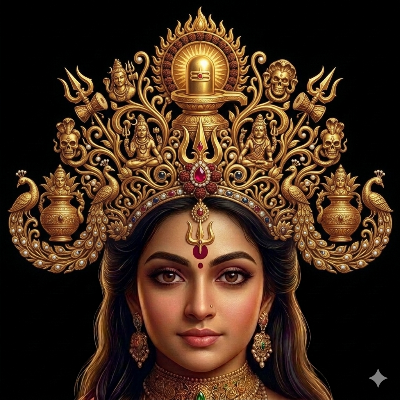
Iravati is a divine feminine figure named in both the Vishnu Purana and the Bhagavata Purana as one of the eleven Rudranis — the female counterparts and consorts assigned to the eleven Rudras, the group of fierce divine beings who are forms or close attendants of the Vedic deity Rudra, identified in later tradition with Shiva. She appears as Iravati in the Vishnu Purana (Book I, Chapter VIII) and as Iravati in the Bhagavata Purana (Canto 3, Chapter 12, Verse 13), occupying the ninth position in both lists and representing one of the most consistently named of all the Rudranis across the two principal enumerations. In the Vishnu Purana's own Rudra enumeration, the ninth-named Rudra is Bhava — here used as an individual name within the group of eleven rather than as the supreme divine title — and Iravati is accordingly his consort within that framework. In the parallel tradition drawn from the Shiva Purana and Matsya Purana — where the eleven Rudras are named Kapali, Pingala, Bhima, Virupaksha, Vilohita, Shastra, Ajapada, Ahirbudhnya, Shambhu, Chanda, and Bhava — the eighth Rudra is Ahirbudhnya, and Iravati is accordingly identified as his Shakti and consort when the positional alignment of the two lists is applied. The name Iravati, like Ila, is shared with other significant figures in the Hindu scriptural tradition, and the relationship between the Rudrani Iravati and those other bearers of the name requires careful textual attention.
✦ The Name
The Sanskrit name Iravati (written in Devanagari as इरावती) is a feminine form derived from the noun ira or iravat, meaning possessed of refreshment, possessed of nourishment, or abounding in food and drink. The root ira is related to the verbal root ir or il, meaning to flow, to refresh, to animate, or to set in motion, and is cognate with the name Ila discussed in the preceding profile. The suffix vati is a possessive feminine suffix meaning she who possesses or she who abounds in, yielding the full sense she who is full of nourishment, she who abounds in refreshing vitality, or the abundantly nourishing one. The name thus belongs to a cluster of Vedic feminine divine names — including Ila, Ida, and Iravati itself — that all draw on the root associations of nourishing flow, refreshment, and the vitalising essence that sustains life.
In the Vedic tradition, ira is used as a word for refreshment, food, and the invigorating drink offered to the gods, and Iravati appears in the Rigveda as an epithet applied to rivers, to Sarasvati, and to other divine or natural phenomena characterised by the quality of abundant nourishing flow. The name is most widely associated in the Puranic tradition with the great river of the northwest — the Ravi or Iravati river, one of the five rivers of the Punjab, whose abundant waters gave the name its most enduring geographical application. The same name is also borne by the mother of the divine elephant Airavata, the vehicle of Indra the king of the gods, and by several other figures across the Puranic corpus. These multiple bearers of the name are addressed individually in the textual variants section below.
✦ Lineage
- Origin as Rudrani: According to the Vishnu Purana (Book I, Chapter VIII), Iravati arose from the female half of Rudra's primordial androgynous form when he divided himself into male and female at Brahma's creative instigation. The Bhagavata Purana (3.12.13) presents the same moment as Brahma formally pronouncing the eleven Rudranis as belonging to Rudra. In either account the Rudranis are not born of a specific parental lineage but are simultaneous individualisations of a single primordial feminine source, each assigned as consort to one of the eleven male Rudras.
- Spouse (Vishnu Purana tradition): Bhava — the ninth-named Rudra in the Vishnu Purana's own enumeration of the eleven Rudras, where Bhava is used as an individual name within the group. The name Bhava means existence, becoming, or arising, and is one of the ancient epithets of Rudra himself in Vedic usage, appearing in the Yajurveda's Satarudriya litany as one of the eight primary names of Rudra alongside Sarva, Rudra, Pasupati, Ugra, Asani, Bhima, and Mahadeva. As an individual Rudra within the group of eleven, this Bhava is one of the lighter, more auspicious forms described in the Vishnu Purana.
- Spouse (Shiva Purana / Matsya Purana tradition): Ahirbudhnya — the eighth-named Rudra in the Shiva Purana (Shat-Rudra Samhita, Chapter 18) and Matsya Purana enumerations. The name Ahirbudhnya is compounded of ahir, meaning serpent, and budhnya, meaning of the deep or of the bottom, yielding the sense the serpent of the deep or the serpent at the base. This Rudra is one of the most ancient figures in the entire Rudra tradition, appearing in the Vedic Satarudriya as well as in the epic and Puranic lists, and representing the primordial, chthonic power of the cosmic waters and the depths of the earth. He is associated with the primal serpent that lies coiled at the base of existence, with the hidden power of the cosmic ocean, and with the forces that sustain the universe from below. In several textual traditions Ahirbudhnya is identified with or closely related to Ahi Budhnya, the Vedic serpent of the deep, and he is also linked with the cosmic serpent Shesha upon whom Vishnu rests in the primordial waters.
- Fellow Rudranis (Vishnu Purana list): Dhi, Vritti, Usana, Urna, Niyuta, Sarpis, Ila, Ambika, Sudha, and Diksa — the ten other Rudranis named in the same passage of the Vishnu Purana.
- Fellow Rudranis (Bhagavata Purana 3.12.13 list): Dhi, Dhrti, Rasala, Uma, Niyut, Sarpi, Ila, Ambika, Svadha, and Diksa — the ten other Rudranis named alongside Iravati in the Bhagavata Purana passage.
✦ The Cosmogonic Narrative of Origin
The narrative in which Iravati appears as a Rudrani is the same cosmogonic account that generates all eleven Rudranis simultaneously. The Vishnu Purana (Book I, Chapter VIII) narrates that at the beginning of the present world-cycle Brahma desired to create a son in his own likeness, and from that creative intention Rudra arose in an androgynous form — half male, half female. Rudra then divided this form: from the male half arose eleven distinct Rudras varying in nature and complexion; from the female half arose eleven Rudranis who were assigned as wives to those eleven Rudras. Brahma then allocated to each Rudra one of eleven specific cosmic and bodily stations — the heart, the five organs of sense, the five organs of action, and the mind. Iravati, as the ninth Rudrani in this scheme, is associated with the station and domain corresponding to the ninth-named Rudra in the same enumeration. The Bhagavata Purana (3.12.13) presents the same essential moment as a direct pronouncement by Brahma to Rudra, naming the eleven Rudranis in a list in which Iravati appears ninth — consistent with the Vishnu Purana and confirming the relative stability of this name across the two lists.
✦ Iravati in Other Puranic and Epic Contexts
The name Iravati is shared by several distinct figures in the Hindu scriptural tradition, none of whom is explicitly identified with the Rudrani Iravati in any primary source. The most prominent of these other Iravati figures are the following.
The Vishnu Purana and the Harivamsa record an Iravati who is the daughter of the sage Kashyapa — one of the seven great primordial sages and the progenitor of a vast range of divine and semi-divine beings — and his wife Kadru, who is the mother of all serpents. This Iravati is thus a daughter of the naga lineage, belonging to the serpent race that is among the most extensive and symbolically significant genealogical groups in the Puranic tradition. Through the serpent lineage, this Iravati is connected to Shesha, Vasuki, Takshaka, and the other great nagas who play prominent roles across the epics and Puranas.
A second Iravati appears in the Puranic accounts of Airavata, the great white elephant who serves as the vehicle of Indra the king of the gods. In some accounts, Iravati is named as the mother of Airavata, and the elephant's name is derived from hers — Airavata meaning born of Iravati. In other accounts, Airavata arises from the churning of the cosmic ocean or from the primordial egg, without maternal attribution. The connection between Iravati as mother of Airavata and Iravati as a naga daughter of Kadru is not consistently established across the primary sources.
The Mahabharata mentions an Iravat or Iravana — also rendered Aravan — who is the son of the Pandava hero Arjuna and the naga princess Ulupi, herself a daughter of the serpent king Kauravya. Iravat participates in the Kurukshetra war on the side of the Pandavas and is slain in battle. This figure is masculine and is distinct from the Rudrani Iravati, though the names share the same root.
The river Iravati — identified with the Ravi, one of the five rivers of the Punjab — appears in Vedic geographical references and Puranic river-lists as one of the sacred rivers of the northern subcontinent. The river's name reflects the same quality of abundant nourishing flow that the name encodes in all its applications.
None of these figures is identified with the Rudrani Iravati in the primary texts. They share the name and its root associations of nourishing abundance and flowing vitality, but their genealogical and narrative contexts are entirely distinct from that of the Rudrani.
✦ Textual Variants and Inconsistencies
The name Iravati appears in both the Vishnu Purana and the Bhagavata Purana Rudrani lists at the ninth position, making it one of the most consistently named Rudranis across the two sources. This consistency parallels that of Ila at the seventh position and Ambika at the eighth, suggesting that the central portion of both lists — from approximately the seventh to the ninth position — shows greater stability of transmission than the earlier positions where more substantial divergences occur.
The principal inconsistency affecting Iravati's profile is the positional question concerning her specific consort. The Vishnu Purana places Iravati ninth in the Rudrani list and names the ninth Rudra in its own enumeration as Bhava. The Shiva Purana and Matsya Purana place Ahirbudhnya eighth in the Rudra list, not ninth — the ninth position in those texts being occupied by Shambhu. The pairing of Iravati with Ahirbudhnya therefore requires careful qualification: it arises not from a straightforward positional alignment but from the way different secondary sources and popular traditions have harmonised the two lists. If the Vishnu Purana Rudrani list is aligned with the Shiva Purana Rudra list strictly by position, the eighth Rudrani — Ambika — would correspond to the eighth Rudra Ahirbudhnya, and Iravati at the ninth position would correspond to Shambhu. The identification of Iravati as consort of Ahirbudhnya specifically, rather than of Shambhu, reflects a particular harmonising convention that is not uniformly supported across all secondary treatments of the material, and the primary sources do not resolve the question definitively.
A secondary orthographic note: the name appears in some transliterations as Iravatı or Iravata rather than Iravati, reflecting differences in the treatment of the final vowel in romanisation, but these are not substantive variants in the underlying Sanskrit.
✦ Theological and Philosophical Significance
As a personification of abundant nourishing vitality — the overflowing refreshment and sustaining essence that the name encodes — Iravati as a Rudrani embodies one of the most fundamental of all divine feminine principles: the inexhaustible flow of life-sustaining power. In the framework of the Rudra theology, where each Rudrani is the Shakti or activating energy of her corresponding Rudra, the pairing of Iravati with Ahirbudhnya carries a particular resonance. Ahirbudhnya, the serpent of the deep, represents the most primordial, chthonic, and hidden layer of cosmic power — the force coiled at the very bottom of existence, in the depths of the cosmic ocean, sustaining everything from below without itself being seen or known. The Shakti of such a principle is fittingly understood as an inexhaustible nourishing abundance — the vital flow that wells up from those hidden depths to sustain the manifested world above.
The symbolic convergence of Iravati's name-meaning with the serpentine associations of Ahirbudhnya is also notable. The naga daughter of Kadru who bears the name Iravati in the Vishnu Purana and Harivamsa belongs to the same serpent lineage that Ahirbudhnya himself represents in his deeper identification with Ahi — the Vedic word for serpent. Whether this convergence reflects an intentional symbolic alignment in the Puranic compositional logic or an independent clustering of associations around shared root meanings cannot be determined from the primary sources, but it is among the most suggestive symbolic patterns in the Rudra-Rudrani pairing system.
In the broader Shakta Puranic framework, the Rudranis collectively manifest the supreme Goddess in her distributed forms. Iravati in this context represents the divine feminine as the principle of abundant, overflowing, inexhaustible nourishment — a quality that in the Vedic tradition belongs particularly to the great rivers and to the cosmic waters from which all life arises, and which in the Puranic tradition is associated with the divine cow Surabhi, the earth goddess, and the primordial ocean of milk from whose churning the most precious of divine gifts were drawn.
✦ Connection to the Wider Genealogy
Iravati belongs to the collective of eleven Rudranis whose origin is inseparable from the cosmogonic act that simultaneously produced the eleven Rudras. The Rudras themselves are traced to differing ultimate parentages across the major Puranas: the Ramayana and Vamana Purana make them children of the sage Kashyapa and his wife Aditi; the Matsya Purana and Harivamsa name Surabhi the divine cow as their mother; the Vishnu Purana derives them from Rudra's self-division; the Bhagavata Purana (Canto 6, Chapter 6) names them as the sons of Sarupa and Bhuta. Iravati's own origin as a Rudrani is tied to whichever of these frameworks governs the account of her consort's generation.
The naga Iravati who is a daughter of Kashyapa and Kadru occupies a distinct genealogical position entirely. Kadru, one of the thirteen daughters of Daksha who are wives of Kashyapa, is the mother of all serpents, and through the vast serpent lineage she is the genealogical ancestor of the nagas who appear throughout the Mahabharata, the Puranas, and the regional traditions. The Iravati of this lineage thus belongs to one of the most extensively elaborated genealogical networks in the entire Puranic system, a network that intersects at numerous points with the lineages of the gods, the sages, and the great royal dynasties. Her connection to the Rudrani Iravati is one of shared name and symbolic resonance rather than of narrative or genealogical identity, and no primary text draws any explicit link between the two.
✦ References
- Vishnu Purana, Book I, Chapter VIII — Primary source naming Iravati as the ninth of the eleven Rudranis in the cosmogonic account of Rudra's self-division; also the source for the distinct figure of Iravati as a daughter of Kashyapa and Kadru in the naga genealogy. H. H. Wilson's English translation and footnotes consulted.
- Bhagavata Purana, Canto 3, Chapter 12, Verse 13 — Names Iravati as the ninth of the eleven Rudranis in Brahma's pronouncement to Rudra; consistent with the Vishnu Purana at this position and confirming the relative stability of the name across the two principal lists.
- Bhagavata Purana, Canto 6, Chapter 6, Verses 17–18 — Names the eleven Rudras as sons of Sarupa and Bhuta with a list differing from both the Vishnu Purana and Shiva Purana; relevant to the genealogical variants of the Rudra group to which Ahirbudhnya belongs.
- Shiva Purana, Shat-Rudra Samhita, Chapter 18 — Names the eleven Rudra incarnations with Ahirbudhnya eighth and Shambhu ninth, directly relevant to the positional inconsistency discussed in the textual variants section concerning whether Iravati corresponds to Ahirbudhnya or Shambhu.
- Matsya Purana, chapters on the Rudras — Provides a further enumeration of the Rudras including Ahirbudhnya; relevant to establishing the range of treatments of this Rudra figure across the Puranic tradition.
- Mahabharata, Adi Parva and Vana Parva — Contains enumerations of the eleven Rudras and the genealogy of the nagas; relevant for the figure of Ahirbudhnya in the Rudra lists and for the figure of Iravat-Aravan as a son of Arjuna and the naga Ulupi, distinct from the Rudrani Iravati.
- Harivamsa, relevant chapters on the naga genealogy — Names Iravati as a daughter of Kashyapa and Kadru within the serpent lineage; relevant for establishing this figure as distinct from the Rudrani Iravati despite the shared name.
- Rigveda, relevant hymns — Primary source for the Vedic usage of ira and iravat as words for nourishment and refreshing abundance, and for the application of the name Iravati to rivers and to Sarasvati; foundational for understanding the name's semantic background.
- Yajurveda, Satarudriya litany — Names Bhava as one of the eight primary epithets of Rudra; relevant to understanding the Rudra named Bhava in the Vishnu Purana's ninth position as one of the most ancient individual names in the Rudra tradition.
- Monier-Williams Sanskrit–English Dictionary (M. Monier-Williams, 1899) — Entries for Iravati, Ira, and Iravat record the full semantic range of the name and establish the possessive suffix construction; essential for the etymological discussion.
- Puranic Encyclopaedia (Vettam Mani, 1975) — Reference work consulted for cross-referencing the multiple figures named Iravati across the Puranic tradition, for entries on Ahirbudhnya, Bhava, and Airavata, and for the genealogy of Kadru's serpent children.
- Wikipedia, "Rudras" and "Ahirbudhnya" articles — Secondary sources compiling primary textual material on the Rudra group and on Ahirbudhnya specifically; used to verify cross-textual patterns and the ancient Vedic attestation of Ahirbudhnya.
- Sacred-texts.com, Vishnu Purana Book I Chapter VIII (Wilson translation) — English translation and footnotes consulted directly for the passage naming Iravati in the ninth Rudrani position.
- Wisdomlib.org, definitions of Iravati, Ahirbudhnya, and related terms — Secondary aggregator of Sanskrit lexicographical and Puranic sources; consulted for confirming the semantic range of the name and the descriptive attributes of Ahirbudhnya across multiple textual traditions.