
About
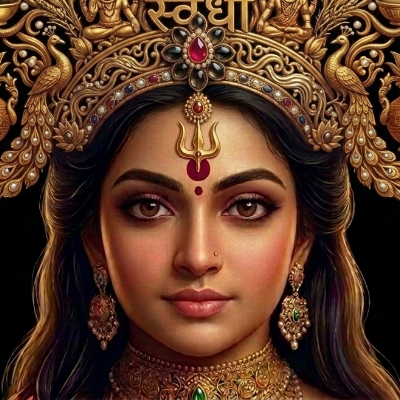
Svadha — One of the Eleven Rudranis, Consort of the Rudra Shambhu
Svadha · Sudha · Svadhā · Svadha Rudrani · Shakti of Shambhu · Rudrani of Kama · Svadha Devi
Svadha is a divine feminine figure named in both the Vishnu Purana and the Bhagavata Purana as one of the eleven Rudranis — the female counterparts and consorts assigned to the eleven Rudras, the group of fierce divine beings who are forms or close attendants of the Vedic deity Rudra, identified in later tradition with Shiva. She appears as Sudha in the Vishnu Purana (Book I, Chapter VIII) and as Svadha in the Bhagavata Purana (Canto 3, Chapter 12, Verse 13), occupying the tenth position in both lists. The difference between these two forms — Sudha and Svadha — is orthographically and semantically significant and is addressed in detail in the section on the name and on textual variants below. In the Vishnu Purana's own Rudra enumeration, the tenth-named Rudra is Vamadeva, and the consort assigned to him in that framework is the figure appearing as Sudha in that text. In the parallel tradition drawn from the Shiva Purana and Matsya Purana — where the eleven Rudras are named Kapali, Pingala, Bhima, Virupaksha, Vilohita, Shastra, Ajapada, Ahirbudhnya, Shambhu, Chanda, and Bhava — the ninth Rudra is Shambhu, and the Rudrani at the corresponding ninth or tenth position is identified as his Shakti and consort depending on how the two lists are aligned. The name Svadha is, beyond its role as a Rudrani name, one of the most theologically and ritually significant words in the entire Vedic and Puranic tradition, designating the sacred oblation offered to the ancestral spirits, and the figure who bears this name as a Rudrani carries with her all the weight of that ancient ritual significance.
✦ The Name
The Sanskrit word Svadha (written in Devanagari as स्वधा) is a compound of the prefix sva, meaning own or self, and the root dha, meaning to place, to hold, or to establish, yielding the primary sense self-established, self-sustaining, or one's own nature or law. In its most ancient and specifically ritual application, svadha is the sacred exclamation pronounced when offering food and water to the departed ancestors — the pitrs — in the sraddha rites that form one of the fundamental obligations of every twice-born householder in the Brahmanical tradition. Just as svaha is the exclamation that accompanies offerings into the sacrificial fire directed toward the gods, svadha is its counterpart directed toward the ancestors. The two exclamations together span the full range of the oblation — from the living divine world to the world of the dead — and both are personified as divine feminine beings in the Puranic tradition. As a personified deity, Svadha is thus the goddess of the ancestral offering, the divine power that receives, conveys, and nourishes the departed through the medium of the sraddha rites.
The Vishnu Purana's variant form Sudha (written in Devanagari as सुधा) is a distinct Sanskrit word meaning nectar, ambrosia, the drink of immortality, or the nourishing whitewash of lime. Sudha is most commonly used as a synonym for amrita — the nectar of immortality churned from the cosmic ocean — and carries associations of sweetness, nourishment, and immortal sustenance diametrically different in register from the mortuary and ancestral associations of Svadha. Whether the Vishnu Purana's Sudha and the Bhagavata Purana's Svadha refer to the same divine figure under two different names, or to genuinely distinct figures who happen to occupy the same structural position in two separate enumerations, cannot be determined from the primary sources with certainty. The H. H. Wilson commentary on the Vishnu Purana records the Bhagavata Purana's variant list but does not explicitly harmonise Sudha with Svadha. Given the theological significance of Svadha as a divine personification in her own right — attested widely across the Puranic corpus independently of the Rudrani list — and the parallel significance of Sudha as a name for the ambrosia of immortality, both readings carry independent theological coherence.
In the Puranic tradition beyond the Rudrani lists, Svadha is explicitly personified as the daughter of Daksha the progenitor and the wife of the ancestral spirits collectively — the pitrs — whose oblation she embodies and conveys. This genealogy and this spousal role are recorded in multiple Puranas independently of the Rudrani enumeration, and they establish Svadha as a divine figure of considerable independent standing whose identity as a Rudrani represents one specific contextualisation of a much broader figure.
✦ Lineage
- Origin as Rudrani: According to the Vishnu Purana (Book I, Chapter VIII), the figure appearing as Sudha — identified with the Bhagavata Purana's Svadha at the tenth position — arose from the female half of Rudra's primordial androgynous form when he divided himself into male and female at Brahma's creative instigation. The Bhagavata Purana (3.12.13) presents the same moment as Brahma formally pronouncing the eleven Rudranis as belonging to Rudra. In either account the Rudranis are not born of a specific parental lineage in the conventional sense but are simultaneous individualisations of a single primordial feminine source.
- Origin as independent Puranic deity: In the Vishnu Purana (Book I, Chapter XV) and in the Bhagavata Purana and other Mahapuranas, Svadha is recorded as a daughter of Daksha — the great progenitor, son of Brahma and lord of created beings — and as the wife of the pitrs, the ancestral spirits who form one of the major categories of divine being in the Puranic hierarchy. This genealogy is entirely independent of the Rudrani origin account and places Svadha within the lineage of Daksha's daughters, who collectively become the wives of sages, gods, and cosmic powers throughout the Puranic genealogical tradition.
- Father (as Daksha's daughter): Daksha — one of the Prajapatis or lords of created beings, a son of Brahma in most Puranic accounts, and one of the central figures in the Puranic genealogical system through whose daughters the divine, semi-divine, and mortal lineages are largely constituted.
- Spouse (Vishnu Purana tradition, Rudrani context): Vamadeva — the tenth-named Rudra in the Vishnu Purana's own enumeration of the eleven Rudras. The name Vamadeva means the gracious or beautiful god, from vama meaning beautiful, pleasing, or left-handed, and deva meaning god. Vamadeva is also one of the five faces of Shiva in the Shaiva Agamic tradition and one of the principal Vedic names for Rudra-Shiva, making him among the most theologically significant of all the individual Rudra names in the group of eleven. He is the gentle, gracious, northwestern face of Shiva in the Pancha Brahma formulation of Shaiva theology.
- Spouse (Shiva Purana / Matsya Purana tradition, Rudrani context): Shambhu — the ninth-named Rudra in the Shiva Purana (Shat-Rudra Samhita, Chapter 18) and Matsya Purana enumerations. The name Shambhu means he who causes happiness or he who is the source of welfare and prosperity, from sham meaning auspiciousness, welfare, or peace, and the causative suffix bhu or a related form. Shambhu is one of the most ancient and widely used epithets of Rudra-Shiva, appearing in the Rigveda and recurring throughout the Vedic, epic, and Puranic literature as a name that foregrounds the benevolent and auspicious aspect of the fierce god. As one of the eleven individual Rudras in the Shiva Purana list, Shambhu embodies the creative and peaceful dimension of the Rudra group.
- Spouse (as independent Puranic deity): The Pitrs — the ancestral spirits, the collective body of departed souls who have completed their earthly lives and reside in the realm of the ancestors. In the Puranic tradition the pitrs are a major category of divine being with their own realm, their own ritual — the sraddha — and their own presiding deity in Yama the lord of death. Svadha as their wife or consort is the divine power that sustains them through the offerings of their living descendants.
- Children (in some Puranic accounts): Several Puranas name daughters of Svadha and the pitrs, though these accounts vary. The Vishnu Purana and related texts do not consistently record children for Svadha in this context.
- Fellow Rudranis (Vishnu Purana list): Dhi, Vritti, Usana, Urna, Niyuta, Sarpis, Ila, Ambika, Iravati, and Diksa — the ten other Rudranis named in the same passage of the Vishnu Purana, with Sudha occupying the tenth position.
- Fellow Rudranis (Bhagavata Purana 3.12.13 list): Dhi, Dhrti, Rasala, Uma, Niyut, Sarpi, Ila, Ambika, Iravati, and Diksa — the ten other Rudranis named alongside Svadha in the Bhagavata Purana passage.
✦ The Cosmogonic Narrative of Origin
The narrative in which Svadha appears as a Rudrani is the same cosmogonic account that generates all eleven Rudranis simultaneously. The Vishnu Purana (Book I, Chapter VIII) narrates that at the beginning of the present world-cycle Brahma desired to create a son in his own likeness, and from that creative intention Rudra arose in an androgynous form — half male, half female. Rudra then divided this form: from the male half arose eleven distinct Rudras varying in nature and complexion; from the female half arose eleven Rudranis who were assigned as wives to those eleven Rudras. Brahma then allocated to each Rudra one of eleven specific cosmic and bodily stations — the heart, the five organs of sense, the five organs of action, and the mind. The figure appearing as Sudha in the Vishnu Purana and as Svadha in the Bhagavata Purana, as the tenth Rudrani in this scheme, is associated with the station and domain corresponding to the tenth-named Rudra of the same enumeration. The Bhagavata Purana (3.12.13) presents the same essential moment as a direct pronouncement by Brahma to Rudra, naming the eleven Rudranis in a list in which Svadha appears tenth.
✦ Svadha as Goddess of the Ancestral Offering
Outside the Rudrani context, Svadha is extensively attested as an independent divine personification of one of the most fundamental categories of Vedic and Brahmanical ritual. The sraddha rites — the periodic offerings of food, water, and sesame seeds made by living descendants to their departed ancestors — are among the most ancient and continuously practised of all Hindu domestic rituals, and the exclamation svadha that accompanies these offerings is their defining sacred utterance. The Vishnu Purana, Agni Purana, Matsya Purana, and Vayu Purana all record the personification of this exclamation as a goddess, Svadha Devi, who is both the medium through which the offerings reach the pitrs and the divine feminine power that nourishes the ancestral realm.
The Vayu Purana contains one of the most developed treatments of Svadha as an independent deity, describing her as residing in the ancestral realm and as the consort of the pitrs collectively. Some Puranic passages describe Svadha as having daughters — the Mena and Dhara of some accounts are named as her children in certain recensions — though these genealogical details are inconsistently recorded. The Devi Bhagavata Purana, in its enumeration of the daughters of Daksha, includes Svadha among them alongside Svaha — the goddess of the fire oblation — and other divine feminine figures who personify the principal categories of sacred utterance and ritual offering.
The pairing of Svadha and Svaha as sister goddesses — one presiding over offerings to the gods through the fire, the other over offerings to the ancestors through the ritual utterance — is one of the most theologically coherent of all the divine sibling pairings in the Puranic tradition. Together they span the full range of the Vedic oblation, from the celestial to the ancestral, from the world of the living gods to the world of the departed. Their joint presence in the Puranic genealogy of Daksha's daughters, alongside Aditi the mother of the gods, Diti the mother of the Daityas, and many others, places them within one of the most richly elaborated genealogical matrices in the entire tradition.
✦ Textual Variants and Inconsistencies
The most significant textual variant in this profile concerns the divergence between the Vishnu Purana's Sudha and the Bhagavata Purana's Svadha at the tenth position in the Rudrani list. As noted in the section on the name, these are two distinct Sanskrit words with different meanings — Sudha denoting nectar or ambrosia, Svadha denoting the ancestral oblation. They are not orthographic variants of one another and do not share a common etymology. The divergence at this position is therefore of the same order as the divergences between Usana and Rasala at the third position, and between Uma and Urna at the fourth — wholly distinct names in two different traditions occupying the same structural slot.
The identification of the tenth Rudrani as the consort of Shambhu requires the same caveat that applies throughout this series of profiles. The Shiva Purana places Shambhu ninth in the Rudra list, not tenth — the tenth position in the Shiva Purana being Chanda. The pairing of the tenth Rudrani with Shambhu rather than with Chanda reflects a particular convention of alignment that varies across secondary treatments of the material. Within the Vishnu Purana's own internal logic, the tenth Rudrani — named Sudha in that text — is paired with the tenth-named Rudra Vamadeva. The alignment of the Bhagavata Purana's Svadha with Shambhu of the Shiva Purana list is a cross-textual harmonisation that is not explicitly made in any single primary source.
A further complexity arises from the multiple genealogical contexts in which Svadha appears as a named deity. Her identity as a daughter of Daksha and wife of the pitrs — well attested in independent Puranic passages — is formally incompatible with her identity as a Rudrani arising from Rudra's primordial self-division. As with the Rudrani Uma and her identity as Parvati-daughter of Himavat, the Puranic tradition does not resolve this incompatibility explicitly but appears to treat the two identities as operating in different registers — the cosmogonic and the genealogical-ritual — without requiring their harmonisation.
✦ Theological and Philosophical Significance
Svadha occupies a position of considerable theological significance in the Hindu ritual and cosmological tradition that extends far beyond her role as one Rudrani among eleven. As the personified power of the ancestral oblation, she stands at one of the most fundamental boundaries in the Vedic worldview — the boundary between the world of the living and the world of the dead. The sraddha rites that she embodies and enables are not peripheral observances but among the most binding of all the obligations that the tradition places upon the living householder. The regular performance of sraddha for one's ancestors — father, grandfather, and great-grandfather on the paternal line, and correspondingly on the maternal — is presented in the Dharmasastras and the Puranas as an obligation whose neglect endangers both the performer and the ancestors themselves.
In the framework of the Rudra theology, where each Rudrani is the Shakti or activating energy of her corresponding Rudra, Svadha as the consort of Shambhu carries a specific theological resonance. Shambhu, whose name means the source of welfare and happiness, is the most explicitly benevolent and auspicious of the Rudra names, representing the face of Rudra-Shiva that brings peace and prosperity rather than destruction and terror. The pairing of this supremely auspicious Rudra with Svadha — the power that sustains the ancestral realm and maintains the bond between the living and the dead — is theologically coherent: the welfare of the living depends in the Vedic worldview not only on the favour of the gods but on the goodwill of the ancestors, and it is Svadha who maintains that ancestral goodwill through the medium of the sraddha offering.
In the broader Shakta Puranic framework the Rudranis collectively manifest the supreme Goddess in her distributed forms. Svadha in this context represents the divine feminine as the power that bridges the worlds of the living and the dead — the cosmic nourishing principle that does not cease with death but continues to flow between the two realms through the medium of the ritual oblation, sustaining the cosmic order across the boundary of mortality itself.
✦ Connection to the Wider Genealogy
Svadha belongs to the collective of eleven Rudranis whose origin is inseparable from the cosmogonic act that simultaneously produced the eleven Rudras. The Rudras themselves are traced to differing ultimate parentages across the major Puranas: the Ramayana and Vamana Purana make them children of Kashyapa and Aditi; the Matsya Purana and Harivamsa name Surabhi the divine cow as their mother; the Vishnu Purana derives them from Rudra's self-division; the Bhagavata Purana (Canto 6, Chapter 6) names them as sons of Sarupa and Bhuta. Svadha's origin as a Rudrani is tied to whichever of these frameworks governs the account of her consort's generation.
In her independent genealogical identity as a daughter of Daksha, Svadha is a sister of an extraordinary range of divine feminine figures. Among Daksha's daughters recorded in various Puranic lists are Aditi the mother of the gods, Diti the mother of the Daityas, Kadru the mother of the serpents, Vinata the mother of the birds and of Garuda, Sati the first wife of Shiva, and Svaha the goddess of the fire oblation. Through this Daksha lineage, Svadha is genealogically linked to virtually every major category of being in the Puranic cosmological order. Her sister Svaha — the oblation utterance of the fire sacrifice — is her closest counterpart, together with her constituting the complete range of the Vedic sacrificial and ancestral ritual as personified divine powers. Through her identity as wife of the pitrs, Svadha stands at the apex of the ancestral lineage system that underlies the entire Puranic genealogical framework, for the pitrs are the collective ancestors from whom all human and divine lineages descend and to whom all living beings owe their continued existence through the obligation of the sraddha rite.
✦ References
- Vishnu Purana, Book I, Chapter VIII — Primary source naming Sudha as the tenth of the eleven Rudranis in the cosmogonic account of Rudra's self-division. H. H. Wilson's English translation and footnotes consulted, including his notation of the Bhagavata Purana's variant form Svadha at the same position.
- Vishnu Purana, Book I, Chapter XV and related genealogical chapters — Records Svadha as a daughter of Daksha and the wife of the ancestral pitrs, establishing her independent genealogical and ritual identity outside the Rudrani context.
- Bhagavata Purana, Canto 3, Chapter 12, Verse 13 — Names Svadha as the tenth of the eleven Rudranis in Brahma's pronouncement to Rudra; the source of the name Svadha as opposed to the Vishnu Purana's Sudha at the same position, making the divergence between these two forms one of the significant textual variants in the Rudrani lists.
- Bhagavata Purana, Canto 6, Chapter 6, Verses 17–18 — Names the eleven Rudras as sons of Sarupa and Bhuta; relevant to the genealogical variants of the Rudra group to which Shambhu belongs.
- Bhagavata Purana, relevant chapters on Daksha's lineage — Records Svadha among the daughters of Daksha alongside Svaha and other divine feminine personifications of the sacred utterances; relevant to the independent genealogical identity of Svadha outside the Rudrani context.
- Shiva Purana, Shat-Rudra Samhita, Chapter 18 — Names the eleven Rudra incarnations with Shambhu ninth and Chanda tenth, directly relevant to the positional ambiguity concerning whether the tenth Rudrani corresponds to Shambhu or to Chanda in the cross-textual alignment of the lists.
- Vayu Purana, relevant chapters on Svadha and the ancestral realm — One of the most developed independent treatments of Svadha as a divine personification of the ancestral oblation and as a consort of the pitrs; contributes substantially to understanding Svadha's significance beyond the Rudrani lists.
- Agni Purana and Matsya Purana, relevant chapters on the sraddha rites — Record Svadha as the presiding deity of the ancestral offering and elaborate on her role in the sraddha ritual tradition; relevant to the theological significance of her name.
- Rigveda and Atharvaveda, relevant hymns — Primary sources for the Vedic usage of svadha as the sacred exclamation of the ancestral offering, establishing the antiquity and centrality of the term in the sacrificial tradition from which Svadha's personification derives.
- Yajurveda, Satarudriya litany — Names Vamadeva and Shambhu among the principal epithets and names of Rudra; relevant to understanding these figures as the most deeply attested Rudra names at the positions corresponding to Svadha in the two principal Puranic enumerations.
- Dharmasastras, relevant passages on sraddha — Establish the obligatory nature of the ancestral offerings and the central role of the svadha utterance in those rites; relevant to the theological weight carried by the name Svadha as a Rudrani.
- Monier-Williams Sanskrit–English Dictionary (M. Monier-Williams, 1899) — Entries for Svadha and Sudha record the distinct etymologies, meanings, and applications of the two names; essential for establishing that they are genuinely distinct words rather than orthographic variants.
- Puranic Encyclopaedia (Vettam Mani, 1975) — Reference work consulted for cross-referencing the Rudrani identity of Svadha with her independent Puranic identity as daughter of Daksha and wife of the pitrs, and for entries on Shambhu, Vamadeva, and related figures.
- Wikipedia, "Rudras" and "Svadha" articles — Secondary sources compiling primary textual material; used to verify cross-textual patterns and the multiple contexts in which Svadha appears as a named divine figure.
- Sacred-texts.com, Vishnu Purana Book I Chapter VIII (Wilson translation) — English translation and footnotes consulted directly for the passage naming Sudha in the tenth Rudrani position and for Wilson's record of the Bhagavata Purana's variant.
- Wisdomlib.org, definitions of Svadha, Sudha, Shambhu, and Vamadeva — Secondary aggregator of Sanskrit lexicographical and Puranic sources; consulted for the semantic range of both variant names and the descriptive attributes of the corresponding Rudra figures.