
About
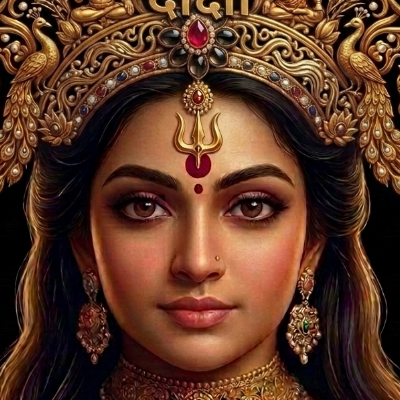
Diksha — One of the Eleven Rudranis, Consort of the Rudra Chanda
Diksha · Diksa · Diksā · Diksha Rudrani · Shakti of Chanda · Rudrani of Dhrtavrata · Diksha Devi
Diksha is a divine feminine figure named in both the Vishnu Purana and the Bhagavata Purana as the eleventh and final of the eleven Rudranis — the female counterparts and consorts assigned to the eleven Rudras, the group of fierce divine beings who are forms or close attendants of the Vedic deity Rudra, identified in later tradition with Shiva. She appears as Diksa in the Vishnu Purana (Book I, Chapter VIII) and as Diksa in the Bhagavata Purana (Canto 3, Chapter 12, Verse 13), occupying the eleventh and last position in both lists and being among the most consistently named of all the Rudranis across the two principal enumerations — the name being identical in both sources. In the Vishnu Purana's own Rudra enumeration, the eleventh-named Rudra is Dhrtavrata, and Diksha is accordingly his consort within that framework. In the parallel tradition drawn from the Shiva Purana and Matsya Purana — where the eleven Rudras are named Kapali, Pingala, Bhima, Virupaksha, Vilohita, Shastra, Ajapada, Ahirbudhnya, Shambhu, Chanda, and Bhava — the tenth Rudra is Chanda, and Diksha is identified as his Shakti and consort through the conventional positional alignment of the two lists. The name Diksha is, beyond its role as a Rudrani name, one of the most theologically and spiritually significant words in the entire Hindu tradition, designating the sacred initiation through which a spiritual aspirant is formally admitted into a lineage of practice and empowered to undertake the path of liberation.
✦ The Name
The Sanskrit word Diksha (written in Devanagari as दीक्षा) is derived from the verbal root diksh, which itself may be related to the root diks meaning to point toward, to direct, to initiate, or to consecrate, or alternatively to a root carrying the sense of preparation, purification, or the rendering fit for a sacred purpose. Its primary and universal meaning in the religious context is initiation — the formal rite of admission into a spiritual tradition, a Vedic sacrificial procedure, or a Tantric or Shaiva lineage, in which the initiating preceptor or guru transmits to the disciple the seed-mantra, the authority, and the inner empowerment to undertake the specific path. The Agamic and Tantric traditions in particular assign extraordinary importance to diksha as the indispensable prerequisite for all higher spiritual practice: without proper initiation from a qualified teacher within an authentic lineage, the practices themselves are held to be without fruit.
In the Vedic sacrificial tradition, diksha refers specifically to the preparatory consecration undergone by the yajamana — the patron of the sacrifice — before the commencement of the soma sacrifice or other major rites. This Vedic diksha involves a period of ascetic preparation, ritual bathing, the assumption of a special garment, dietary restrictions, and a formal consecration that marks the transition from the ordinary to the sacred state. The Shatapatha Brahmana and the Taittiriya Brahmana contain extensive discussions of this preparatory diksha and its significance in the sacrificial context. The Nirukta of Yaska, the ancient Vedic etymologist, discusses the derivation of the word diksha in connection with its sacrificial usage.
As a divine name, Diksha therefore personifies the sacred act and principle of initiation itself — the power by which a human being is transformed, empowered, and directed toward a divine purpose. She is the goddess of consecration, the divine feminine power that makes possible the crossing of the threshold between the ordinary and the sacred, between ignorance and knowledge, between the unregenerate state and the state of spiritual qualification. As the last of the eleven Rudranis, her position at the close of the sequence is itself theologically suggestive: the sequence begins with Dhi — the intellect that perceives — and ends with Diksha — the initiation that completes and seals the spiritual qualification. The entire series may thus be read as a progression from the first stirring of discernment to the formal empowerment that fulfils it.
✦ Lineage
- Origin as Rudrani: According to the Vishnu Purana (Book I, Chapter VIII), Diksha arose from the female half of Rudra's primordial androgynous form when he divided himself into male and female at Brahma's creative instigation. The Bhagavata Purana (3.12.13) presents the same moment as Brahma formally pronouncing the eleven Rudranis as belonging to Rudra. In either account the Rudranis are not born of a specific parental lineage in the conventional sense but are simultaneous individualisations of a single primordial feminine source, each assigned as consort to one of the eleven male Rudras.
- Origin as independent Puranic deity: In the Vishnu Purana (Book I, Chapter XV) and in several other Mahapuranas, Diksha is recorded as a daughter of Daksha — the great progenitor, son of Brahma and lord of created beings — alongside other divine feminine personifications of sacred principles including Svadha and Svaha. This genealogical identity as a Daksha-daughter is independent of the Rudrani origin account and places Diksha within the lineage through which the principal categories of sacred practice and cosmic order are given divine feminine form.
- Father (as Daksha's daughter): Daksha — one of the Prajapatis or lords of created beings, a son of Brahma in most Puranic accounts, and the central genealogical figure through whose daughters the divine, semi-divine, and mortal lineages are largely constituted across the Puranic tradition.
- Spouse (Vishnu Purana tradition, Rudrani context): Dhrtavrata — the eleventh and final Rudra in the Vishnu Purana's own enumeration of the eleven Rudras. The name Dhrtavrata is compounded of dhrta, meaning held, maintained, or firmly upheld, and vrata, meaning vow, sacred observance, or rule of conduct, yielding the sense he who firmly upholds the sacred vow or he of the steadfast observance. Beyond his position as the last in the Vishnu Purana list, Dhrtavrata receives no extended independent narrative treatment in the primary sources.
- Spouse (Shiva Purana / Matsya Purana tradition, Rudrani context): Chanda — the tenth-named Rudra in the Shiva Purana (Shat-Rudra Samhita, Chapter 18) and Matsya Purana enumerations. The name Chanda means fierce, passionate, violent, or impetuous, from the root chand or chad carrying the sense of glowing heat or passionate intensity. As a Rudra, Chanda embodies the most ferocious and wrathful dimension of the Rudra group — the aspect of Rudra-Shiva that burns with consuming intensity and destroys all that stands in the way of cosmic order. The name is also applied to the moon in some contexts, where it carries the sense of luminous radiance, representing a different dimension of the same root. As a guardian deity, Chanda is revered as a fierce protector of the righteous and a destroyer of demonic forces.
- Fellow Rudranis (both Vishnu Purana and Bhagavata Purana lists): Dhi, Vritti or Dhrti, Usana or Rasala, Urna or Uma, Niyuta or Niyut, Sarpis or Sarpi, Ila, Ambika, Iravati, and Sudha or Svadha — the ten Rudranis who precede Diksha in the respective lists, with Diksha occupying the final eleventh position in both enumerations.
✦ The Cosmogonic Narrative of Origin
The narrative in which Diksha appears as a Rudrani is the same cosmogonic account that generates all eleven Rudranis simultaneously. The Vishnu Purana (Book I, Chapter VIII) narrates that at the beginning of the present world-cycle Brahma desired to create a son in his own likeness, and from that creative intention Rudra arose in an androgynous form — half male, half female. Rudra then divided this form: from the male half arose eleven distinct Rudras varying in nature and complexion; from the female half arose eleven Rudranis who were assigned as wives to those eleven Rudras. Brahma then allocated to each Rudra one of eleven specific cosmic and bodily stations — the heart, the five organs of sense, the five organs of action, and the mind. Diksha, as the eleventh and final Rudrani in this scheme, is associated with the station and domain corresponding to the eleventh-named Rudra of the same enumeration. The Bhagavata Purana (3.12.13) presents the same essential moment as a direct pronouncement by Brahma to Rudra, naming the eleven Rudranis in a list in which Diksha again appears eleventh and last — consistent with the Vishnu Purana at this final position.
✦ Diksha as Goddess of Initiation
The significance of Diksha as a divine name cannot be separated from the central importance of the initiatory rite in Hindu spiritual life. Across the Vedic, Puranic, Agamic, and Tantric traditions, diksha is the gateway through which the aspirant passes from one spiritual state to another. In the Vedic context it is the preparatory consecration of the sacrificer; in the Shaiva Agamic tradition it is the formal transmission of grace from the deity through the guru to the disciple, understood as the burning away of the three malas — the impurities of anava, karma, and maya — that bind the soul to the cycle of rebirth; in the Vaishnava tradition it is the formal reception of the mantra from the guru; in the Tantric traditions it encompasses a range of increasingly subtle initiations from the outer ritual to the most secret inner empowerment.
The Kularnava Tantra, one of the most important texts of the Kaula Tantric tradition, devotes extensive treatment to the nature and types of diksha, distinguishing among others the kriya diksha conducted through elaborate ritual, the vak diksha transmitted through the guru's speech, the sparsha diksha transmitted through touch, and the shambhavi diksha transmitted through the guru's glance alone. The Shiva Purana similarly discusses diksha as the essential prerequisite for Shaiva worship and for the attainment of liberation. In the Pancharatra Vaishnava tradition, the samskara of diksha from a qualified acharya is held to be the indispensable foundation of all subsequent practice.
As the personification of this principle, Diksha as a Rudrani embodies the divine feminine power that makes sacred qualification possible — the grace that descends through the initiatory act to transform the aspirant. Her pairing with Chanda — the fierce, intensely burning Rudra — is theologically resonant: the most ferocious of divine energies can only be safely approached and worked with by one who has been properly initiated, properly prepared, and properly empowered. Diksha as Shakti of Chanda is thus the protective and qualifying power without which the fierce energy of her consort would be inaccessible or dangerous.
✦ Textual Variants and Inconsistencies
As noted above, Diksha is one of the most consistently named of the Rudranis across the two principal Puranic lists, appearing as Diksa in both the Vishnu Purana and the Bhagavata Purana at the eleventh and final position. This consistency at the last position mirrors the consistency at the first position — where Dhi appears identically in both lists — and suggests that the terminal and initial names of the sequence were among the most stably transmitted elements of the enumeration.
The principal inconsistency affecting Diksha's profile concerns the identity of her specific consort, as with all the Rudranis. The Vishnu Purana's eleventh Rudra is Dhrtavrata; the Shiva Purana's tenth Rudra is Chanda, its eleventh being Bhava. The pairing of Diksha with Chanda arises from a particular convention of positional alignment and is not stated in a single primary text. Within the Vishnu Purana's own internal logic, Diksha's consort is Dhrtavrata. Some secondary sources and popular treatments assign her to Chanda through the alignment with the Shiva Purana list; others assign her to Bhava, the Shiva Purana's eleventh Rudra, through strict positional correspondence. This ambiguity is not resolvable from the primary sources and should be noted honestly.
The formal incompatibility between Diksha's identity as a Rudrani — arising from Rudra's primordial self-division — and her identity as a daughter of Daksha is the same structural tension that affects Svadha and, more prominently, Uma among the Rudranis. The Puranic tradition does not resolve this tension explicitly but presents both genealogical identities without harmonisation across the different passages in which they appear.
✦ Theological and Philosophical Significance
Diksha's position as the final Rudrani in the traditional sequence invites a reading of the entire eleven-name series as a structured progression of divine feminine principles that together span the full range of the inner life from its first stirring to its consummation. Beginning with Dhi — the discerning intellect that perceives and understands — the sequence moves through Vritti the active functioning of the mind, Usana the burning ardour that drives toward its object, Uma or Urna the luminous or woven being, Niyuta the binding and yoking of forces, Sarpis the purified nourishing essence that sustains the sacred, Ila the vitalising flow of oblation and speech, Ambika the divine mother, Iravati the abundant overflowing vitality, Svadha or Sudha the nourishment that bridges the living and the dead, and finally Diksha — the initiation that seals and fulfils the entire journey. Whether the Puranic compilers of the Rudrani lists intended this progression as a structured philosophical sequence or whether the names accumulated through the aggregation of independent traditions is a question that the primary sources do not answer definitively. What the names reveal collectively, however, is a remarkably coherent range of divine feminine principles spanning the cognitive, the vital, the sacrificial, the maternal, and the initiatory dimensions of sacred life.
✦ Connection to the Wider Genealogy
Diksha belongs to the collective of eleven Rudranis whose origin is inseparable from the cosmogonic act that simultaneously produced the eleven Rudras. The Rudras themselves are traced to differing ultimate parentages across the major Puranas: the Ramayana and Vamana Purana make them children of Kashyapa and Aditi; the Matsya Purana and Harivamsa name Surabhi the divine cow as their mother; the Vishnu Purana derives them from Rudra's self-division; the Bhagavata Purana (Canto 6, Chapter 6) names them as sons of Sarupa and Bhuta. Diksha's origin as a Rudrani is tied to whichever of these frameworks governs her consort's generation. In her independent genealogical identity as a daughter of Daksha, she belongs to the same matrix of Daksha's daughters that includes Aditi, Diti, Kadru, Vinata, Sati, Svaha, Svadha, and many others — the great foundational mothers and divine feminine powers of the entire Puranic cosmological order. Through this lineage, Diksha as the personification of initiation stands alongside Svadha the personification of the ancestral oblation and Svaha the personification of the fire oblation as one of the three great personifications of the foundational sacred acts — the oblation to the gods, the oblation to the ancestors, and the initiatory empowerment — that together constitute the core of the Vedic and Brahmanical sacred order.
✦ References
- Vishnu Purana, Book I, Chapter VIII — Primary source naming Diksa as the eleventh and final Rudrani in the cosmogonic account of Rudra's self-division. H. H. Wilson's English translation and footnotes consulted.
- Vishnu Purana, Book I, Chapter XV and related genealogical chapters — Records Diksha as a daughter of Daksha, establishing her independent genealogical identity outside the Rudrani context.
- Bhagavata Purana, Canto 3, Chapter 12, Verse 13 — Names Diksa as the eleventh and final Rudrani in Brahma's pronouncement to Rudra; consistent with the Vishnu Purana at this position, making Diksha one of the most stably attested names across both lists.
- Bhagavata Purana, Canto 6, Chapter 6, Verses 17–18 — Names the eleven Rudras as sons of Sarupa and Bhuta; relevant to the genealogical variants of the Rudra group to which Chanda and Dhrtavrata belong.
- Bhagavata Purana, relevant chapters on Daksha's daughters — Records Diksha among the daughters of Daksha alongside Svadha, Svaha, and other divine personifications of sacred principles.
- Shiva Purana, Shat-Rudra Samhita, Chapter 18 — Names the eleven Rudra incarnations with Chanda tenth and Bhava eleventh; directly relevant to the positional ambiguity concerning Diksha's consort when the two Rudra lists are aligned with the Rudrani lists.
- Shiva Purana, relevant sections on diksha — Discusses diksha as the essential prerequisite for Shaiva worship and the path to liberation; relevant to the theological significance of the name Diksha as a Rudrani.
- Kularnava Tantra, relevant chapters on diksha — One of the most extensive Tantric treatments of the nature, types, and significance of initiation; relevant to the broader theological importance of the principle Diksha personifies.
- Shatapatha Brahmana, relevant passages on Vedic diksha — Discusses the preparatory consecration of the yajamana before the soma sacrifice; establishes the antiquity and centrality of the diksha concept in the Vedic sacrificial tradition from which the divine personification derives.
- Nirukta of Yaska, relevant passages — Discusses the etymology of diksha in the Vedic sacrificial context; relevant to the name's derivation and primary semantic content.
- Matsya Purana, chapters on the Rudras — Provides further enumeration of the Rudras including Chanda; relevant to the identification of Chanda as the Rudra corresponding to Diksha in the Shiva Purana tradition.
- Mahabharata, Adi Parva — Provides enumerations of the eleven Rudras; relevant for the broader context of Rudra nomenclature across the epic tradition.
- Monier-Williams Sanskrit–English Dictionary (M. Monier-Williams, 1899) — Entry for Diksha records the full semantic range of the word from Vedic sacrificial consecration to Tantric initiation; essential for the etymological and theological discussion.
- Puranic Encyclopaedia (Vettam Mani, 1975) — Reference work consulted for cross-referencing Diksha's Rudrani identity with her independent Puranic identity as a daughter of Daksha, and for entries on Chanda, Dhrtavrata, and related figures.
- Wikipedia, "Rudras" article — Secondary source compiling variant Rudra and Rudrani lists; used to verify the consistency of Diksha's name across both principal enumerations.
- Sacred-texts.com, Vishnu Purana Book I Chapter VIII (Wilson translation) — English translation and footnotes consulted directly for the passage naming Diksa in the eleventh and final Rudrani position.
- Wisdomlib.org, definitions of Diksha, Chanda, and Dhrtavrata — Secondary aggregator of Sanskrit lexicographical and Puranic sources; consulted for semantic range of the name and the descriptive attributes of the corresponding Rudra figures.