
About
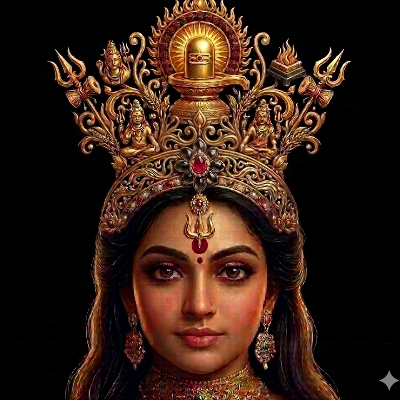
Sudha — One of the Eleven Rudranis, Consort of the Rudra Bhava
Sudha · Sudhā · Sudha Rudrani · Shakti of Bhava · Rudrani of Vamadeva · Amrita · Amrta
Sudha is a divine feminine figure who appears as the tenth of the eleven Rudranis in the list preserved in the Vishnu Purana (Book I, Chapter VIII), where she occupies the tenth position in that text's enumeration of the female counterparts assigned to the eleven Rudras — the group of fierce divine beings who are forms or close attendants of the Vedic deity Rudra, identified in later tradition with Shiva. The Bhagavata Purana (Canto 3, Chapter 12, Verse 13) gives the name Svadha at the corresponding tenth position in its own Rudrani list, and the relationship between these two names — Sudha as the nectar of immortality and Svadha as the exclamation of the ancestral offering — is among the most textually complex of all the variant readings between the two principal Puranic enumerations of the Rudranis, as each name carries a distinct and well-established independent significance in the tradition. The figure of Svadha as a Rudrani has been treated in the preceding profile; the present profile addresses Sudha specifically as she appears in the Vishnu Purana, and examines the question of her identity and theological significance in that specific textual context. In the Vishnu Purana's own Rudra enumeration, the tenth-named Rudra is Vamadeva, making him Sudha's consort within that text's internal framework. In the parallel tradition drawn from the Shiva Purana and Matsya Purana, the eleventh and final Rudra is Bhava, and through the conventional positional alignment of the two lists Sudha is sometimes identified as the consort of Bhava in that tradition.
✦ The Name
The Sanskrit word Sudha (written in Devanagari as सुधा) is a compound of the prefix su, meaning good, well, or auspicious, and the root dha, meaning to place, to hold, or to nourish, yielding the primary sense that which nourishes well, that which sustains excellently, or the supremely nourishing substance. In classical Sanskrit usage Sudha is one of the standard words for amrita — the nectar of immortality, the divine drink that confers immortal life upon those who consume it — and it is used extensively in both the Puranic and the poetic literature as a synonym for this divine substance. The word also carries the secondary meaning of lime or whitewash in certain technical contexts, but this usage is entirely distinct from its theological and cosmological applications.
As a divine name, Sudha personifies the immortalising, supremely nourishing essence of the cosmos — the nectar of immortal life — as a divine feminine power. The associations of the name are with luminosity, sweetness, the white radiance of the moon, and the inexhaustible sustaining power that underlies immortal existence. In the Puranic tradition the amrita produced by the churning of the cosmic ocean — the Samudra Manthan — is among the most celebrated of all divine substances, and the goddess who personifies that substance as Sudha carries with her all the mythological and theological weight of that event and its significance.
It is important to note clearly that Sudha and Svadha are etymologically and semantically distinct. Sudha derives from su and dha — nourishing well, the nectar of immortality. Svadha derives from sva and dha — self-established, one's own nature, and the ritual exclamation of the ancestral offering. The two words are not homophones, are not orthographic variants of one another, and carry fundamentally different theological registers. Their appearance at the same position in the two principal Rudrani lists represents a genuine divergence between two separate textual traditions rather than a scribal error or a variation in spelling convention.
✦ Lineage
- Origin as Rudrani: According to the Vishnu Purana (Book I, Chapter VIII), Sudha arose from the female half of Rudra's primordial androgynous form when he divided himself into male and female at Brahma's creative instigation. In this account the Rudranis are not born of a specific parental lineage in the conventional sense but are simultaneous individualisations of a single primordial feminine source, each assigned as consort to one of the eleven male Rudras.
- Spouse (Vishnu Purana tradition): Vamadeva — the tenth-named Rudra in the Vishnu Purana's own enumeration of the eleven Rudras. The name Vamadeva means the gracious or beautiful god and is one of the most ancient and widely attested epithets of Rudra-Shiva in the entire tradition, appearing in the Vedic literature and in the five-faced Pancha Brahma formulation of Shaiva theology as the northwestern and gentle face of Shiva. Vamadeva as an individual Rudra within the group of eleven represents the auspicious, beautiful, and gracious dimension of Rudra's nature rather than its fierce or destructive aspect.
- Spouse (Shiva Purana / Matsya Purana tradition): Bhava — the eleventh and final Rudra in the Shiva Purana (Shat-Rudra Samhita, Chapter 18) enumeration. The name Bhava means existence, becoming, or arising, and is one of the eight primary names of Rudra in the Vedic Satarudriya litany of the Yajurveda, where it appears alongside Sarva, Rudra, Pasupati, Ugra, Asani, Bhima, and Mahadeva as one of the eight fundamental modalities of the deity. In the Atharvaveda, Bhava is described as the king of all beings. As the eleventh and final of the individual Rudras in the Shiva Purana list, Bhava represents the culminating principle of existence and manifestation within the group — the Rudra whose name expresses the very fact and quality of being.
- Fellow Rudranis (Vishnu Purana list): Dhi, Vritti, Usana, Urna, Niyuta, Sarpis, Ila, Ambika, Iravati, and Diksa — the ten other Rudranis named in the same passage of the Vishnu Purana, with Sudha occupying the tenth position immediately before the final Diksa.
✦ The Cosmogonic Narrative of Origin
The narrative in which Sudha appears as a Rudrani is the same cosmogonic account that generates all eleven Rudranis simultaneously. The Vishnu Purana (Book I, Chapter VIII) narrates that at the beginning of the present world-cycle Brahma desired to create a son in his own likeness, and from that creative intention Rudra arose in an androgynous form — half male, half female. Rudra then divided this form: from the male half arose eleven distinct Rudras varying in nature and complexion; from the female half arose eleven Rudranis who were assigned as wives to those eleven Rudras. Brahma then allocated to each Rudra one of eleven specific cosmic and bodily stations — the heart, the five organs of sense, the five organs of action, and the mind. Sudha, as the tenth Rudrani in the Vishnu Purana scheme, is associated with the station and domain corresponding to the tenth-named Rudra Vamadeva.
✦ Sudha and the Mythology of the Cosmic Nectar
The name Sudha as a synonym for amrita — the nectar of immortality — connects this Rudrani to one of the most celebrated mythological events in the entire Puranic tradition: the churning of the cosmic ocean, the Samudra Manthan, narrated at length in the Vishnu Purana, the Bhagavata Purana, the Mahabharata, and many other texts. In this account, the gods and the anti-gods together churn the primordial ocean of milk using Mount Mandara as the churning rod and the cosmic serpent Vasuki as the rope, and from this churning arise a succession of divine beings and substances including the goddess Sri-Lakshmi, the divine physician Dhanvantari, the wish-granting tree Kalpavriksha, the divine cow Surabhi, the apsaras, the moon, the poison Halahala which Shiva swallows, and finally the amrita itself — the nectar of immortality that is the ultimate prize of the churning and the source of the gods' immortal status.
As the personification of this nectar, Sudha as a Rudrani embodies the principle of immortal sustenance — the divine feminine power that nourishes existence at its most fundamental level, maintaining the immortal being of the gods against the forces of dissolution and death. Her pairing with Vamadeva — the gracious and beautiful Rudra — is consonant with this identity: the gentle, auspicious, life-affirming aspect of Rudra is naturally complemented by the Shakti of immortal nourishment and divine sustenance. Similarly, her pairing with Bhava — the Rudra whose name means existence itself — carries a profound symbolic coherence: the power that sustains immortal existence is fittingly the Shakti of the god whose name is existence.
✦ Textual Variants and Inconsistencies
The central textual issue in this profile — the divergence between the Vishnu Purana's Sudha and the Bhagavata Purana's Svadha at the tenth position — has been addressed in the preceding profile of Svadha and is recapitulated here for completeness. The two names are genuinely distinct Sanskrit words with different meanings and different ritual and theological associations. Sudha means nectar or ambrosia; Svadha means the ancestral oblation utterance. Their appearance at the same position in two different Puranic lists represents a real textual divergence that cannot be harmonised by treating one name as a variant spelling or corruption of the other. The Wilson commentary on the Vishnu Purana records the Bhagavata Purana's variant without attempting to reconcile the two.
The identification of Sudha as the consort of Bhava — the eleventh Rudra in the Shiva Purana list — rather than of Vamadeva — the tenth Rudra in the Vishnu Purana list — follows from the conventional practice of aligning the Vishnu Purana Rudrani list with the Shiva Purana Rudra list by position. Since the Shiva Purana's tenth Rudra is Chanda and its eleventh is Bhava, and since Diksha at the eleventh position has been conventionally associated with Chanda, the Vishnu Purana's Sudha at the tenth position comes to be associated with Bhava through a process of elimination that results from the cross-textual alignment. This alignment is not made explicitly in any single primary text and involves the same methodological caveats that apply throughout this series of profiles.
✦ Theological and Philosophical Significance
As the personification of amrita — the nectar of immortal life — Sudha as a Rudrani embodies the most exalted form of the nourishing divine feminine principle: not merely the sustaining of mortal life but the sustaining of immortal existence itself. In the sequence of the eleven Rudranis, Sudha appears penultimate — preceded by the abundant vitality of Iravati and followed by the initiatory empowerment of Diksha. Read within the progression of the sequence, she represents the culminating gift of the nourishing feminine principle — the nectar that makes the initiated aspirant, now empowered by Diksha, capable of immortal existence. The juxtaposition of Sudha and Diksha at the close of the sequence thus condenses the entire soteriological arc of the tradition: the immortal nectar and the initiatory empowerment together constitute the completion of the spiritual path.
In the broader Shakta framework the Rudranis collectively manifest the supreme Goddess in her distributed forms across the Rudra group. Sudha in this context represents the Goddess as the inexhaustible immortalising principle — the power that overcomes death and sustains being beyond the limits of mortal existence, a quality that in the Shakta tradition is most fully expressed in the figure of the Goddess as Amrita or as the Kula nectar of the Kaula traditions, which identify liberation itself with the tasting of this divine sweetness.
✦ Connection to the Wider Genealogy
Sudha belongs to the collective of eleven Rudranis whose origin is inseparable from the cosmogonic act that simultaneously produced the eleven Rudras. The Rudras themselves are traced to differing ultimate parentages across the major Puranas: the Ramayana and Vamana Purana make them children of Kashyapa and Aditi; the Matsya Purana and Harivamsa name Surabhi the divine cow as their mother; the Vishnu Purana derives them from Rudra's self-division; the Bhagavata Purana (Canto 6, Chapter 6) names them as sons of Sarupa and Bhuta. Sudha's origin as a Rudrani is tied to whichever of these frameworks governs the account of her consort's generation. As the personification of the cosmic nectar of immortality, Sudha in her broader mythological significance is intimately connected with the churning of the cosmic ocean — an event that involves virtually all the major divine lineages of the Puranic tradition, from the gods descended from Aditi and Kashyapa to the anti-gods descended from Diti and Kashyapa, and from the cosmic serpent Vasuki of the naga lineage to the divine physician Dhanvantari, the lord of Ayurvedic medicine, who emerges from the ocean bearing the vessel of amrita itself. The nectar that Sudha personifies is thus at the confluence of all these lineages, being at once the prize of the divine-demonic conflict and the substance that defines and maintains the immortal status of the gods.
✦ References
- Vishnu Purana, Book I, Chapter VIII — Primary and sole major source naming Sudha as the tenth of the eleven Rudranis in the cosmogonic account of Rudra's self-division; the critical text for this profile. H. H. Wilson's English translation and footnotes consulted, including his notation of the Bhagavata Purana's variant Svadha at the same position.
- Bhagavata Purana, Canto 3, Chapter 12, Verse 13 — Names Svadha rather than Sudha at the tenth position in the Rudrani list; the divergence between Sudha and Svadha at this position is the central textual variant addressed in both this profile and the preceding Svadha profile.
- Vishnu Purana, Book I, Chapter IX — The Churning of the Ocean — Narrates the Samudra Manthan and the production of amrita; relevant to understanding the mythological and cosmological significance of the name Sudha as the personification of the immortal nectar.
- Bhagavata Purana, Canto 8, Chapters 6–12 — The most extensive Puranic treatment of the churning of the cosmic ocean and the emergence of amrita; relevant to the broader mythological background of the name Sudha.
- Mahabharata, Adi Parva, Astika sub-parva — Contains an extended account of the churning of the ocean and the production of amrita in the context of the rivalry between the gods and the serpents; relevant to the mythological background of Sudha.
- Bhagavata Purana, Canto 6, Chapter 6, Verses 17–18 — Names the eleven Rudras as sons of Sarupa and Bhuta; relevant to the genealogical variants of the Rudra group to which Bhava and Vamadeva belong.
- Shiva Purana, Shat-Rudra Samhita, Chapter 18 — Names the eleven Rudra incarnations with Bhava eleventh; relevant to the identification of Bhava as the Rudra corresponding to Sudha in the cross-textual alignment of the lists.
- Yajurveda, Satarudriya litany — Names Bhava as one of the eight primary names of Rudra; establishes the deep Vedic antiquity of the name and its significance as one of the most fundamental modalities of Rudra's divine identity.
- Atharvaveda, relevant passages — Describes Bhava as the king of all beings; relevant to understanding the cosmic significance of this Rudra name as the consort of Sudha in the Shiva Purana alignment.
- Monier-Williams Sanskrit–English Dictionary (M. Monier-Williams, 1899) — Entry for Sudha records the full semantic range of the name as nectar, ambrosia, and the nourishing divine substance; essential for the etymological discussion and for establishing the distinction between Sudha and Svadha.
- Puranic Encyclopaedia (Vettam Mani, 1975) — Reference work consulted for entries on Sudha, Bhava, Vamadeva, and the amrita mythology; used to cross-reference the Rudrani identity of Sudha with her broader significance as the personified nectar of immortality.
- Wikipedia, "Rudras" article — Secondary source compiling variant Rudra and Rudrani lists; used to verify the position of Sudha in the Vishnu Purana list and the corresponding variant in the Bhagavata Purana.
- Sacred-texts.com, Vishnu Purana Book I Chapter VIII (Wilson translation) — English translation and footnotes consulted directly for the passage naming Sudha in the tenth Rudrani position and for Wilson's record of the Bhagavata Purana's variant Svadha.
- Wisdomlib.org, definitions of Sudha, Bhava, and Vamadeva — Secondary aggregator of Sanskrit lexicographical and Puranic sources; consulted for the semantic range of the name Sudha and the descriptive attributes of the corresponding Rudra figures.