
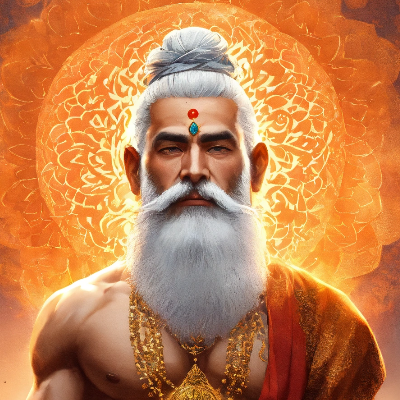
About
Dattoli — Son of Pulastya and Priti, Saptarishi of the Svarocisha Manvantara
Dattoli · Dambholi · Datta · Former Agastya of the Svayambhuva Manvantara
Dattoli is named in the Vishnu Purana as the son born to the sage Pulastya by his wife Priti, daughter of the Prajapati Daksha and his wife Prasuti. Pulastya is one of the seven mind-born sons of Brahma and one of the seven great sages of the first Manvantara, the Svayambhuva Manvantara; he is also the progenitor of the lineage from which the sage Vishrava and, through him, both Kubera and Ravana descended. Priti is the personification of affection and love, one of the twenty-four daughters of Daksha who were distributed in marriage among the great sages at the beginning of the present cosmic cycle. The Vishnu Purana identifies Dattoli explicitly as the rebirth of the sage Agastya who had lived in the preceding Svayambhuva Manvantara — the first of the fourteen cosmic ages into which a Kalpa or day of Brahma is divided. In this present birth as Dattoli, the soul previously known as Agastya is counted among the seven great sages of the second Manvantara, the Svarocisha Manvantara, presided over by Svarocisha Manu, son of the fire-god Agni. The Vishnu Purana, the Saurapurana, the Puranic Encyclopaedia, and multiple Manvantara enumeration lists across the Puranic tradition attest to Dattoli in these connected roles. The figure should not be confused with the more widely known Agastya of the present seventh Manvantara, the Vaivasvata Manvantara, who is a separate sage of immense Vedic and Puranic importance, though the Puranic doctrine of rebirth across Manvantaras implies a continuity of soul between the earlier Agastya, Dattoli, and the later Agastya.
✦ The Name
The name Dattoli is of Sanskrit formation, though its precise compound analysis is not elaborated in the surviving primary sources. The element datta, meaning "given" or "bestowed," is a common Sanskrit prefix in personal names of sages and divine figures, and it may carry the sense of one who is divinely granted or sent forth. The Puranic Encyclopaedia records an alternate name, Dambholi, for the same figure, though the derivation of this alternate name is not explained in the sources consulted. The Saurapurana records the son of Pulastya and Priti simply as Datta, the shorter form of the same root element, identified in that text as well-known as Agastya. The name Agastya itself, which the Vishnu Purana identifies as Dattoli's name in his previous birth during the Svayambhuva Manvantara, is a name of ancient Vedic currency whose etymology is traditionally connected to the idea of one who causes the mountains to tremble or to the figure who came down from the heights, though multiple folk etymologies exist for it and no single derivation is universally accepted across primary sources.
✦ Lineage
- Father: Pulastya — one of the seven mind-born sons of Brahma, one of the Prajapatis, and one of the seven great sages of the first Manvantara; the sage through whom Brahma transmitted the Vishnu Purana, which Pulastya in turn communicated to Parashara; progenitor through his second wife Havirbhu of Vishrava, and through Vishrava of both Kubera and Ravana
- Mother: Priti — one of the twenty-four daughters of the Prajapati Daksha by his wife Prasuti, herself a daughter of Svayambhuva Manu; her name signifies affection or love; she is the sister of Sati, first wife of Shiva, and of Svaha, wife of Agni
- Paternal grandfather: Brahma — the creator god, from whom all Prajapatis and mind-born sages descend
- Maternal grandfather: Daksha — a Prajapati and divine progenitor, father of many daughters whose marriages to the great sages established the foundational genealogies of the Puranic cosmos
- Maternal grandmother: Prasuti — daughter of Svayambhuva Manu, the first Manu, and Shatarupa
- Paternal half-brother: Vishrava — son of Pulastya by his wife Manini; father of the god Kubera and of the demon king Ravana, Kumbhakarna, Vibhishana, and Surpanakha
✦ Identity Across Manvantaras
The Vishnu Purana presents Dattoli through the doctrine of the rebirth of sages across successive Manvantaras. According to this doctrine, the same exalted souls are reborn in each new cosmic age to take up the positions of Saptarishis — the seven great sages who sustain dharma, preserve the Vedas, and guide the world during each age. The Vishnu Purana states that the soul who had been the sage Agastya in the Svayambhuva Manvantara — the first of the fourteen cosmic ages that constitute a Kalpa — took birth as Dattoli, son of Pulastya and Priti, in the subsequent age. As Dattoli, this soul is counted among the seven Saptarishis of the second Manvantara, the Svarocisha Manvantara, which was presided over by Svarocisha Manu, son of the fire-god Agni. The Vishnu Purana names the seven sages of this second age as Urja, Stambha, Prana, Dattoli, Rishabha, Nischara, and Arvarivat. The presiding Indra of the Svarocisha Manvantara was Vipaschit, and the principal divine classes of that age were the Paravatas and the Tushitas.
The Puranic tradition further implies, through its consistent treatment of the rebirth of great sages, that the same soul continued beyond the Svarocisha Manvantara and was reborn again as the celebrated Agastya of the present seventh Manvantara, the Vaivasvata Manvantara. The Agastya of the present age is one of the most prominent figures in the Vedic and Puranic traditions — celebrated in the Rigveda for his hymns, in the Ramayana for his gift of the Aditya Hridaya to Rama, for his drinking of the ocean, for the subduing of the Vindhya mountains, and for carrying the Vedic fire and learning into the southern regions of the subcontinent. That figure, however, belongs to the present age and is a separate Puranic personality in his own right; the Vishnu Purana's statement concerning Dattoli is confined to the transition between the Svayambhuva and Svarocisha Manvantaras, and no further narrative in the primary sources treats Dattoli as a figure independent of this cosmological role.
✦ Textual Variants and Inconsistencies
The principal textual difficulty surrounding Dattoli is the variant attribution of Pulastya's sons to different wives across different Puranas. The Vishnu Purana, Book I, Chapter X, names Dattoli as the son of Pulastya by Priti. The Bhagavata Purana, by contrast, names Pulastya's wife as Havirbhu and states that she bore him both Agastya and Vishrava, making no mention of Priti or Dattoli. The Puranic Encyclopaedia of Vettam Mani, drawing on both sources and on the Mahabharata's reference to two further wives named Sandhya and Pratichi, concludes that Pulastya had four wives in total and that the sons are distributed across them, with Dattoli being the son of Priti and Vishrava the son of Havirbhu.
The Vayu Purana offers a further variant by naming three sons of Pulastya — Dattoli, Vedabahu, and Vinita — without assigning each to a specific mother, and additionally noting a daughter named Sadvati who was married to Agni. The Brahmanda Purana, in its account of Priti's offspring, names three sons — Danagni, Devabahu, and Atri — which may represent either a distinct variant tradition for Priti's children or a partially overlapping list in which some names correspond to those given by the Vayu Purana under different forms. These divergences are characteristic of the Puranic genealogical literature more broadly, where the same lineage is described differently across texts and where later compilers attempt to reconcile variants by positing multiple wives or by treating alternate name-forms as referring to different individuals.
A further variant exists in the list of the Saptarishis of the Svarocisha Manvantara itself. While the Vishnu Purana names Dattoli as the fourth of the seven sages of that age, other Puranic and post-Puranic sources offer different lists for the same Manvantara. The Advaita-Vedanta tradition's compilation of Manvantara sage-lists includes a version of the second Manvantara that names Brihaspati and Dattatreya rather than Dattoli, reflecting the lack of uniform agreement across the tradition on this specific enumeration. The Vishnu Purana's list — Urja, Stambha, Prana, Dattoli, Rishabha, Nischara, and Arvarivat — is consistent across the primary Vaishnava Puranic sources and is considered the standard enumeration for this Manvantara within that tradition.
✦ Theological Significance
Dattoli's significance in the Puranic tradition is primarily cosmological. His identity as both a son of Pulastya by Priti and as a Saptarishi of the Svarocisha Manvantara illustrates the Puranic understanding that the great sages do not merely live and die within a single age but cycle through successive cosmic periods, taking new births and serving new cosmic functions in each age. This doctrine of the continuity of exalted souls across Manvantaras is one of the distinctive features of the Puranic temporal framework, in which the fourteen Manvantaras of each Kalpa are populated by a rotating cast of sages, Manus, Indras, and divine classes — each one a new incarnation of souls whose spiritual attainments qualify them for these cosmic roles. Dattoli, as the form taken by the Agastya-soul between the first and the present ages, represents a link in this chain of cosmic continuity, occupying the position of Saptarishi in the age presided over by Svarocisha Manu and thereby sustaining the transmission of dharma and Vedic knowledge into the second great cycle of the present Kalpa.
✦ Connection to the Wider Genealogy
Through his father Pulastya, Dattoli belongs to the lineage of the mind-born sons of Brahma, placing him within the innermost genealogical circle of the Puranic cosmos. Through his mother Priti, he is a grandson of the Prajapati Daksha and of Prasuti, who was herself a daughter of Svayambhuva Manu — the first Manu and the primordial human sovereign — and Shatarupa. This maternal line connects Dattoli to the earliest stratum of Puranic human genealogy, through figures such as Devahuti — Prasuti's sister — and her son Kapila, an avatar of Vishnu. Through his paternal half-brother Vishrava, the son of Pulastya by Havirbhu, Dattoli is genealogically connected to one of the most ramified lineages in the Puranic tradition: Vishrava's sons include Kubera, the god of wealth and lord of the Yakshas, and Ravana, the demon king of Lanka and principal antagonist of the Ramayana, as well as Kumbhakarna, Vibhishana, and Surpanakha. Dattoli is thus the paternal half-uncle of Kubera and Ravana — a striking genealogical position for a sage who in the preceding age had been identified with the great Agastya, himself a figure whose presence in the Ramayana tradition stands in a complementary relationship to the narrative of Rama's conflict with Ravana.
✦ References
Primary Sources
- Vishnu Purana, Book I, Chapter X: The principal primary source, naming Dattoli explicitly as the son born to Pulastya by Priti and identifying him as the rebirth of Agastya from the Svayambhuva Manvantara; translated by H.H. Wilson.
- Vishnu Purana, Book III, Chapter I: Names Dattoli as the fourth of the seven Saptarishis of the Svarocisha Manvantara — the second of the fourteen cosmic ages — alongside Urja, Stambha, Prana, Rishabha, Nischara, and Arvarivat; the Manvantara is governed by Svarocisha Manu, son of Agni, with Vipaschit as Indra.
- Saurapurana (Upapurana), Vamsha section: Records the son of Pulastya and Priti as Datta, identified with Agastya; cited in Wisdomlib's Shodhganga study of the Saurapurana.
- Vayu Purana: Names three sons of Pulastya as Dattoli, Vedabahu, and Vinita, without assigning each to a specific mother; relevant to the variant offspring accounts.
- Brahmanda Purana, Book II, Chapters 9 and 11: Names three sons of Priti by Pulastya as Danagni, Devabahu, and Atri; relevant as a variant account of Priti's offspring that partially overlaps with and partially diverges from the Vishnu Purana account.
- Bhagavata Purana, Fourth Skandha: Names Pulastya's wife as Havirbhu, attributing both Agastya and Vishrava to her; provides the principal variant account in which Dattoli's name and his mother Priti do not appear.
Modern Reference Works
- Vettam Mani, Puranic Encyclopaedia (via Wisdomlib): The entry on Pulastya synthesises multiple primary sources and records Dattoli as the son of Priti with the Vishnu Purana citation; also records the alternate name Dambholi; essential for navigating the multiple-wife variant accounts.
- Wisdomlib, "Dattoli — 2 definitions": Provides the Puranic Encyclopaedia entry on Dattoli with its Vishnu Purana citation; the most concise primary-source-grounded reference for the figure.
- Wisdomlib, "Pulastya — 23 definitions": Aggregates references to Pulastya across multiple primary texts, including both the Vishnu Purana account naming Priti and the Saurapurana and Bhagavata Purana variant accounts; essential for the textual variant discussion.
- Sacred-texts.com, Vishnu Purana translation (H.H. Wilson), Book I Chapter X and Book III Chapter I: Provides the English translation of the two key Vishnu Purana passages in which Dattoli appears; used for direct verse-level verification.
- Wisdomlib, "Svayambhuva Manvantara: Significance and symbolism": Confirms that the Vishnu Purana and Markandeya Purana both reference the Svayambhuva Manvantara as the period in which Dattoli was previously known as Agastya.
- Wikipedia, "Manu (Hinduism)": Provides the standard Puranic enumeration of the Saptarishis of the Svarocisha Manvantara including Dattoli; used for cross-referencing the Manvantara sage list.