
About
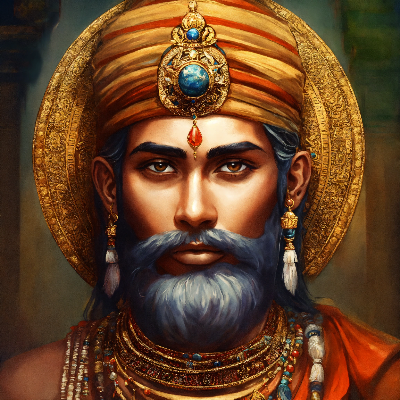
Brahmadatta — Royal Sage of Kampilya, Son of Anuha and Kritvi
Brahmadatta · Pitridatta · Pitrivarti (prior-birth name) · Swatantra (prior-birth name)
Brahmadatta was a king of Kampilya, the capital of the southern Panchala territory, who is celebrated in the Harivamsha, the Bhagavata Purana, the Vishnu Purana, the Matsya Purana, and the Devi Bhagavata Purana as a figure of profound yogic attainment, mastery of the Vedas, and singular ability to understand the speech of all living creatures. He was the son of King Anuha of the Puru-Ajamidha lineage of Panchala and of Kritvi — also named Kirti and Kirtimati — the daughter of the sage Shuka, who was himself the son of Vyasa. The Harivamsha narrates at length the doctrine of Brahmadatta's seven successive transmigrations: his soul, originally one of seven sons of the sage Kaushika, passed through births as tribals, as animals, as Chakravaka birds, as royal swans at Lake Manasa, and finally as a scholarly Brahmin before being born as Brahmadatta in the royal line of Kampilya. This narrative of successive births and the spiritual knowledge preserved across them forms the centrepiece of the Harivamsha's treatment of Brahmadatta and is presented as an illustration of the efficacy of ancestral rites and yogic discipline in shaping the soul's journey across existences. Brahmadatta was also a contemporary of the Kuru king Pratipa, the grandfather of Bhishma, which situates him firmly within the pre-Mahabharata era of the tradition.
✦ The Name
The name Brahmadatta means given by Brahma or granted by the Absolute, combining the root brahma — referring either to Brahma the creator god or to the impersonal Absolute — with datta, meaning given or bestowed. The secondary name Pitridatta, by which he is also identified in the Harivamsha, means given by the forefathers or granted by the ancestral spirits. The Harivamsha explicitly explains this epithet: his name, character, and deeds all accorded with the quality of devotion to his forebears, so both names were equally apt designations for him. In his prior birth as one of the seven swan-souls at Lake Manasa, his name was Swatantra, meaning independent or self-sovereign, and in the birth before that as one of the Chakravaka birds his name was Pitrivarti, meaning one devoted to the forefathers — a continuity of the ancestral-devotion theme across multiple lifetimes. The name Brahmadatta is extremely common across the Sanskrit textual corpus and designates a large number of distinct figures in different texts and traditions; the profile below pertains exclusively to the Kampilya king who was the son of Anuha and Kritvi.
✦ Lineage
- Father: Anuha — king of Kampilya, descended through the Puru-Ajamidha-Nipa lineage of the Panchala royal house, specifically through Samara, Para, Prithu, Sukrita, and Vibhraja. A pious and accomplished king who, according to the Matsya Purana, prayed to Vishnu for a son capable of understanding the speech of all living beings, a boon that was granted in the person of Brahmadatta.
- Mother: Kritvi — also named Kirti and Kirtimati, daughter of the sage Shuka and his wife Peevari. Shuka was the son of the sage Vyasa, compiler of the Vedas and author of the Mahabharata. Peevari was identified in the Vayu Purana, Brahmanda Purana, and Harivamsha as the mind-born daughter of the Barhishada class of divine Pitrs.
- Wives: The Matsya Purana names his wife as Sannati, described as the daughter of Sudeva (also called Devala), who was in her own prior birth the cow that had been killed by the seven sons of Kaushika in their first birth — establishing a karmic connection between Brahmadatta's past sins and his present wife. The Devi Bhagavata Purana names his wife as Kalyani in its shorter treatment of the story. It is not possible from the sources consulted to determine whether these are two names for the same wife or two distinct accounts.
- Sons: Visvaksena and Sarvasena are named in the Harivamsha as sons of Brahmadatta. The Harivamsha identifies Visvaksena as a mighty conqueror and the continuation of the Kampilya royal line. Visvaksena's son was Dandasena, whose son was Bhallata — who was slain by Karna according to the Harivamsha — and Bhallata's son became the last of the Nipa line, overthrown by Ugrayudha. The Vishnu Purana names Visvaksena and then Udaksena and Bhallata as the subsequent kings.
✦ The Seven Transmigrations
The Harivamsha devotes several chapters — narrated by the sage Markandeya to Bhishma, who retells it to Yudhishthira — to the story of the seven successive births that culminated in Brahmadatta's existence as king of Kampilya. The seven souls began as the seven sons of the sage Kaushika — also known as Vishvamitra — and were disciples of a preceptor named Gargya. On a day when they were hungry and foolish, they killed their guru's milk-cow to eat it, which was an act of grievous sin. On account of this transgression, they were cursed to pass through multiple degraded rebirths before returning to a state of purity.
In their second birth they were reborn as tribal hunters in the region of Dasharni. In their third birth they were reborn as deer on the mountain Kalanjara. In their fourth birth they were reborn as Chakravaka birds on a river island. In their fifth birth they were reborn as royal swans at the great Lake Manasa in the Himalayas. It was during this swan-birth that one of the souls — the one who would become Brahmadatta — looked upon the pomp of King Vibhraja of Kampilya as he entered the forest with his retinue, and formed the desire to be born as a king of comparable glory. Two others among the swans, seeing the prosperity of Vibhraja's ministers, formed the desire to be born as ministers. These three desires constituted fresh attachments and led those three souls to take rebirth within the royal house of Kampilya rather than attaining liberation alongside the remaining four souls.
In the sixth birth, the four souls who had retained their dispassion were born as Brahmin scholars in Kampilya. The one who had desired kingship — named Swatantra as a swan — was reborn as Brahmadatta, the son of Anuha, while the two who had desired ministerial position were reborn as the sons of Anuha's two ministers, named Panchika and Kandarika respectively. The Harivamsha states that across all seven births, the souls retained their accumulated knowledge of the Vedas, their yogic discipline, and their memory of the Absolute, because these had been grounded through proper learning in their first birth. Four of the seven — those who had maintained dispassion — were in their sixth birth born as Brahmin scholars with full recollection of their prior existences, and it was one of these Brahmin boys who approached Brahmadatta and triggered the king's own recollection of his past lives by reciting a verse that enumerated all seven births in compressed form.
✦ The Recollection and the Vision of Narayana
The Harivamsha narrates that while Brahmadatta was returning to his palace in a golden chariot after a dawn bathing ritual, accompanied by his minister Kandarika and his friend Panchika — who were themselves fellow-reincarnates from the group of seven — an aged Brahmin stepped forward and recited a verse cataloguing the group's seven successive births: as Brahmins at Kurukshetra, as tribals in Dasharni, as beasts at Kalanjara, as Chakravaka birds on an island, and as swans at Lake Manasa. Upon hearing this verse, Brahmadatta, Kandarika, and Panchika were simultaneously struck with the memory of all their former existences and fell into a swoon of recollection. Brahmadatta subsequently prayed intensely to Vishnu for six days and nights, and received a vision of the god Narayana, who assured him that all would be well. The Harivamsha records that Brahmadatta, Kandarika, and Panchika thereafter, having recovered full memory of their spiritual heritage, attained liberation together. The verse recited by the old Brahmin is notable enough to have attracted independent attention: the American writer Henry David Thoreau translated a version of the seven-births episode from the Harivamsha, published in 1843, under the title The Transmigration of the Seven Brahmans.
✦ The Companion Bird Pujanya
The Harivamsha also narrates a separate and curious episode concerning a female bird named Pujanya — meaning worthy of worship — who made her nest in Brahmadatta's palace and was his close companion. She was a bird of distinctive colouring: white wings, a red head, and a black back and abdomen. Each day she flew out to roam over rivers, lakes, forests, and ocean shores, and each night she returned to the palace and described to Brahmadatta the remarkable things she had seen. In due course Pujanya laid an egg in the palace, and from that egg emerged a strange creature — at first eyeless, gradually acquiring sight and feathers. Brahmadatta's eldest son later damaged or destroyed the young bird, and the Harivamsha attributes the loss of this son's eyes to Pujanya's resulting action against him as retribution. The narrative purpose of this episode within the Harivamsha's framing is to illustrate the bonds of karma and loyalty that connect beings across different species, and to demonstrate the extraordinary qualities of Brahmadatta's court and his attunement to the non-human world.
✦ The Yoga Treatise
The Bhagavata Purana, in its brief treatment of the Kampilya lineage at canto 9, chapter 21, records that Brahmadatta composed a treatise on yoga — referred to as a yoga tantra. The Devi Bhagavata Purana adds the account, absent from the Harivamsha, that Brahmadatta eventually abdicated his throne on the advice of the divine sage Narada, handed the kingdom to his son, and proceeded to Badaryashrama in the Himalayas to perform penance, where he attained liberation. Whether the Harivamsha's account of Brahmadatta receiving a vision of Narayana and attaining liberation within the royal life, and the Devi Bhagavata Purana's account of abdication and penance at Badaryashrama, represent two versions of the same concluding event or two distinct accounts cannot be determined from the sources consulted.
✦ Textual Variants and Inconsistencies
Multiple distinct figures named Brahmadatta appear in the Sanskrit textual tradition, and they must not be conflated with the Kampilya king who is the subject of this profile. The Ramayana's Bala Kanda mentions a king of Kampilya named Brahmadatta who was the son of the Apsara Somada and the sage Chuli — this is a wholly separate person from the Anuha-Kritvi son and belongs to an earlier legendary era when the city was under different rule. Buddhist Jataka literature uses the name Brahmadatta as a stock designation for the king of Benares across dozens of stories; these are literary conventions with no connection to the Panchala lineage. Jain literature names Brahmadatta as a Chakravartin, a universal sovereign, in a cosmological context entirely unrelated to the Puranic genealogy. The Monier-Williams Sanskrit dictionary lists over a dozen bearers of the name from different texts and regions, including kings of the Salvas, of Varanasi, of Shravasti, and of Champa, as well as various Brahmins. The figure treated in this profile is specifically the son of Anuha and Kritvi, king of Kampilya, and descendant of Shuka.
The number of transmigrations described also shows a minor discrepancy between sources. The Harivamsha gives seven births: as Brahmin scholars, as tribals, as deer, as Chakravaka birds, as swans, as Brahmin scholars again, and finally as Brahmadatta the king and his companions. The Matsya Purana's account, as summarised in the Puranic Encyclopaedia, gives a slightly different sequencing of the births and assigns different names to the souls in each birth; the overall structure is consonant with the Harivamsha but the details of the individual birth-names diverge in places. The Padma Purana is also cited in the Puranic Encyclopaedia as containing a version of the seven-sons-of-Kaushika story in its third section, chapter 10, with its own variations.
✦ Connection to the Wider Genealogy
Through his mother Kritvi, Brahmadatta was the grandson of the sage Shuka and the great-grandson of Vyasa, connecting him directly to the lineage of Vedic compilation and Puranic tradition. Through his father Anuha, he stood within the Puru-Ajamidha-Nipa royal line of the Panchalas, making him a kinsman of the Kuru dynasty from which Bhishma descended. He was a contemporary of Pratipa, grandfather of Bhishma. Through his son Visvaksena the line of Kampilya descended through Dandasena, Bhallata, and the later Nipa kings, until the dynasty was extinguished by Ugrayudha. After Bhishma slew Ugrayudha, Prishata — an ally of Bhishma — recovered Kampilya; Prishata was the father of Drupada, and Drupada was the father of Draupadi and Dhrishtadyumna, both major figures in the Mahabharata war. The Harivamsha explicitly identifies Brahmadatta as the ancestor of Drupada's family and traces the dynastic line from Brahmadatta to Drupada's grandfather Prishata, making Brahmadatta a figure whose legacy directly shaped the political and genealogical landscape of the Mahabharata era.
✦ References
Primary Sources
- Harivamsha, Harivamsha Parva, Chapters 20–24 — The primary and most extensive source for Brahmadatta; narrates his parentage, the seven-births story, his qualities as king and yogi, the companion bird Pujanya, the verse of recollection, the vision of Narayana, and his attainment of liberation, as well as the dynastic line descending from him to Drupada's ancestors.
- Bhagavata Purana, Canto 9, Chapter 21, Verse 25 — Names Brahmadatta as the son of Anuha by Kritvi and records that he composed a yoga tantra.
- Vishnu Purana, Book 4, Chapter 19 — Provides the genealogical list placing Brahmadatta as Anuha's son and traces the subsequent Kampilya line through Visvaksena, Udaksena, and Bhallata.
- Matsya Purana, Chapters 15 and 49 — Corroborates the parentage and contains its own version of the seven-births story, with variations in the names assigned to the souls in each birth; also records Anuha's prayer to Vishnu as the cause of Brahmadatta's power of animal speech.
- Padma Purana, Part 3, Chapter 10 — Contains a version of the seven-sons-of-Kaushika story per the Puranic Encyclopaedia; specific details not fully examined in secondary sources consulted.
- Devi Bhagavata Purana, First Skandha — Names Brahmadatta as the son of Anu and Kritvi; records his career as a scholar and ascetic, his abdication on Narada's advice, and his attainment of liberation at Badaryashrama.
- Ramayana, Bala Kanda — Mentions a distinct Brahmadatta of Kampilya, son of the Apsara Somada and the sage Chuli; included only to establish that this is a different figure from the Anuha-Kritvi son.
Secondary and Reference Works
- Puranic Encyclopaedia (Vettam Mani) — Entry on Brahmadatta; summarises the seven-births narrative from the Matsya Purana and Harivamsha, records the marriage to Sannati daughter of Sudeva, and mentions the liberation of Brahmadatta and his companions.
- Wisdomlib.org, definition of Brahmadatta — Collates references from Monier-Williams, Harivamsha, Bhagavata Purana, Vishnu Purana, and Jain cosmological texts; lists the many distinct figures of this name and their textual sources.
- Wisdomlib.org, Story of Brahmadatta — Extended summary of the seven-births narrative drawn primarily from the Matsya Purana and Padma Purana, with the episode of the ants, the verse of recollection, and the companions' attainment of liberation.
- Wilson, H. H., The Vishnu Purana (translation and notes) — Notes on Book 4, Chapter 19, identify Brahmadatta in the Panchala lineage, cross-reference the Harivamsha's transmigration account, and note the Bhagavata Purana's attribution of the yoga tantra to him.
- Thoreau, Henry David, The Transmigration of the Seven Brahmans (1843) — A translation of the seven-births episode from the Harivamsha; noted here as a modern secondary witness to the Harivamsha text's content and to the broader cultural reach of the Brahmadatta narrative.
- Kampilya: History and Archaeology (Scribd document) — Identifies Brahmadatta as a Yogaraja of Kampilya alongside his father Anuha; discusses the city of Kampilya's historical location in Farrukhabad district, Uttar Pradesh, and its identification with the capital of southern Panchala.