
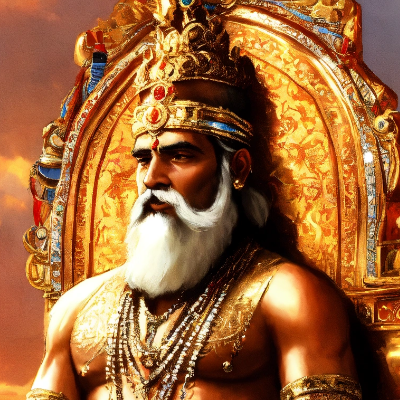
About
Vibhraja — King of Kampilya, Father of Anuha, Unwitting Catalyst of Brahmadatta's Birth
Vibhraja · Vibhrara (Vishnu Purana variant) · Anagha (Purana Index name)
Vibhraja was a king of Kampilya, the capital of southern Panchala, who holds a distinctive position in the Harivamsha's extended narrative of the Brahmadatta lineage. He is the son of Sukrita and the father of Anuha, placing him in the Puru-Ajamidha-Nipa royal succession of Kampilya. Beyond his genealogical position, the Harivamsha assigns Vibhraja two roles of unusual significance: he was the king whose royal magnificence, glimpsed by a group of souls then living as Chakravaka birds near Lake Manasa, triggered the desire for royal rebirth in one of those souls — the soul that would subsequently be born as Brahmadatta, Vibhraja's own grandson — and he was himself a king who, upon beholding the undistracted yoga of the swans at Lake Manasa, was struck with spiritual despondency at his own inability to concentrate as they did, abdicated his throne, and went to the lake to perform austerities. The Harivamsha further records that Vibhraja was subsequently reborn as Visvaksena, the son of Brahmadatta, through the force of his own accumulated karma. He thus appears in the Harivamsha simultaneously as a genealogical ancestor, an inadvertent spiritual catalyst, an ascetic practitioner, and a soul whose own rebirth completes a remarkable karmic loop within the Kampilya lineage. He is attested in the Harivamsha, the Vishnu Purana, and the Bhagavata Purana.
✦ The Name
The name Vibhraja derives from the Sanskrit root meaning to shine brightly or to be resplendent, with the prefix vi- intensifying the sense of brilliance or radiance. The Kannada lexical tradition, drawing on the same Sanskrit root, glosses vibhraja as brilliant or gorgeous appearance and magnificent look. The name is thus an epithet of brightness and royal splendour, fitting for a king whose magnificent appearance in a forest, attended by his retinue, became the occasion for the transmigration narrative at the heart of the Harivamsha's Brahmadatta cycle. The forest where he performed his royal promenade and where the swan-souls gave up their lives was subsequently named Vaibhraja — meaning that which belongs to Vibhraja or that which was made brilliant by Vibhraja — a toponym derived from his name and recorded in the Harivamsha as the lasting memorial of his presence there. The Purana Index, drawing on a source distinct from the Harivamsha, assigns him the additional personal name Anagha, meaning the sinless one or one without fault, though this name does not appear in the Harivamsha text itself.
✦ Lineage
- Ancestry: Vibhraja descended through the Puru-Ajamidha-Nipa royal line of Kampilya. The Harivamsha traces the specific line as: Puru, through Ajamidha, Brihadishu, Brihadhanu, Brihadharma, Satyajit, Visvajit, Senajit, Ruchira, Prithusena, Para, Nipa — whose hundred sons were collectively called the Nipas — then Samara the foremost of those Nipas, then his son Para, then Prithu, then Sukrita, and then Vibhraja. The Bhagavata Purana at canto 9 identifies Vibhraja as the son of Kriti, a name that corresponds to Sukrita in other sources and most likely represents a shortened form of the same name.
- Father: Sukrita — a king of Kampilya in the Nipa lineage, whose name means one of good deeds or one distinguished by meritorious actions. The Harivamsha notes that Sukrita acquired all accomplishments by virtue of good conduct.
- Son: Anuha — the king of Kampilya who married Kritvi, daughter of the sage Shuka, and fathered Brahmadatta. The Harivamsha records that Vibhraja installed Anuha on the throne of Kampilya before departing for his austerities at Lake Manasa.
- Rebirth as grandson's son: The Harivamsha records the tradition that Vibhraja, by the force of his own karma, was reborn as Visvaksena, the son of Brahmadatta — making him, in his next life, the great-grandson of his own son Anuha, and the grandson of Brahmadatta whose birth he had indirectly occasioned in his previous life as the king whose magnificence inspired the Chakravaka bird-soul's desire for royal existence.
✦ The Encounter at Lake Manasa and the Naming of the Vaibhraja Forest
The Harivamsha, in the chapters narrated by Markandeya to Bhishma and retold by Bhishma to Yudhishthira, records that Vibhraja on one occasion came to a forest near Lake Manasa — the great Himalayan lake revered in the tradition — accompanied by the women of his household, and moved through those woods as Indra moves through the garden of Nandana attended by his celestial companions. At this time, seven souls who had been born as royal swans — named in the Harivamsha as Padmagarbha, Aravindaksha, Kshiragarbha, Sulochana, Urubindu, Subindu, and Haimagarbha — were dwelling at the lake, subsisting on water and air and wholly absorbed in yogic practice.
Vibhraja himself, upon noticing the swans engaged in their undistracted yoga, was struck with a kind of spiritual despondency. The Harivamsha states that beholding those sky-flying swans absorbed in yogic exercises, the king became discontented, recognising that he himself was unable to practise yoga with such complete concentration and dispassion. He returned to the city with this thought weighing upon him. The seventh soul among the swans, named Swatantra and identified as the prior-life form of the soul that would become Brahmadatta, looked upon Vibhraja and his retinue in their royal splendour — the king attended by his soldiers, his ministers, and the women of his court — and was seized by the desire to be born as such a king in the next existence. Two other swans, seeing the prosperity of Vibhraja's two ministers, wished to be born as ministers. These three formed fresh attachments through desire, while the remaining four maintained their dispassion.
When all seven souls left their swan-bodies at that forest, the Harivamsha records that the place where they died — rendered brilliant by Vibhraja's presence — took the name Vaibhraja, meaning the forest of Vibhraja or the forest made radiant by Vibhraja. This toponym, derived from his name, is the one lasting mark that the tradition assigns to Vibhraja as a permanent geographic memorial of his role in the transmigration narrative.
✦ Abdication and Austerities
The Harivamsha records that after his encounter with the swans at the forest near Lake Manasa, Vibhraja summoned his ministers and priests, formally installed his son Anuha upon the throne of Kampilya with appropriate ceremonial rites and the recitation of blessing hymns, and then departed for Lake Manasa itself. His intention, as the Harivamsha states it, was to perform austerities at the fringe of the lake where the swans had lived, forgoing cravings, food, and water. His aspiration was to become, in his next birth, the son of one of those swans — or of someone engaged in the same quality of yoga — so that he might through such parentage acquire the capacity for undistracted yogic practice that had so struck him. The Harivamsha observes that the irony of this aspiration mirrors that of the swans: the swans had desired to be born as humans to enjoy royal pleasures, and the human king now desired to be born among beings absorbed in yoga in order to escape the distractions of human royal life. The text preserves this structural parallel as a comment on the circularity of desire and the complexity of karmic motivation.
✦ Rebirth as Visvaksena
The Harivamsha includes the explicit statement that Vibhraja — the father of Anuha — was reborn, through the working of his own prior actions, as Visvaksena, the son of Brahmadatta. The text notes this in the genealogical enumeration of Brahmadatta's successors, remarking that the Vibhraja who was previously known as Anuha's father reacquired mortal life through his karma and was born again as this Visvaksena. The significance of this is considerable within the Harivamsha's thematic framework: the king whose magnificence had inspired Swatantra-the-swan to desire royal birth — ultimately resulting in the birth of Brahmadatta — was himself reborn as Brahmadatta's own son and royal successor. The karma of the encounter at the Vaibhraja forest thus bound Vibhraja's soul to the Kampilya royal line across two successive generations, first as Brahmadatta's grandfather through Anuha, and then as Brahmadatta's son through Visvaksena.
✦ Textual Variants and Inconsistencies
The Vishnu Purana's account of the Panchala lineage names the father of Anuha as Vibhratra rather than Vibhraja. The majority of scholars and commentators treat this as a scribal variant of the same name, since the surrounding genealogy is otherwise fully concordant with the Harivamsha account. The Bhagavata Purana compresses the lineage and names the father of Anuha by the form Kriti, which corresponds to the name Sukrita — Vibhraja's father in the Harivamsha — suggesting that the Bhagavata Purana may have collapsed two generations into one in its condensed list, omitting Vibhraja as an intermediate generation.
A significant inconsistency exists between the Harivamsha and the source underlying the Purana Index entry on Vibhraja. The Purana Index attributes to Vibhraja — identified there under his alternate name Anagha — the act of performing austerities and praying to Narayana for a son, receiving Brahmadatta as the boon granted by the god. In the Harivamsha itself, this prayer to Vishnu for a son gifted with understanding of animal speech is attributed to Anuha, Vibhraja's son, not to Vibhraja directly. The Matsya Purana's version, as summarised by secondary sources, also assigns the prayer to the father of Brahmadatta. Whether this represents a variant in an independent Puranic source that identified the grandfather as the one who prayed, or a confusion between Vibhraja and Anuha in the Purana Index's source, cannot be determined from the materials available.
✦ Connection to the Wider Genealogy
Vibhraja stood in the middle of the Kampilya royal succession, descended from Puru and Ajamidha on one side and the father of Anuha who married into the sage Shuka's family on the other. Through Anuha's marriage to Kritvi — daughter of Shuka, son of Vyasa — Vibhraja became the paternal grandfather of Brahmadatta, and thus a genealogical link between the royal Panchala line and the lineage of Vedic compilation. Through his own rebirth as Visvaksena, he became Brahmadatta's son and the next king of Kampilya, continuing the dynasty through Dandasena, Bhallata, and the later Nipa kings who eventually gave way to the line leading to Prishata and Drupada. Vibhraja's name was also permanently attached to the landscape through the toponym Vaibhraja, the forest near Lake Manasa where the swan-souls gave up their bodies and which served as the site of his own spiritual turning point.
✦ References
Primary Sources
- Harivamsha, Harivamsha Parva, Chapters 20 and 23 — The principal source for Vibhraja; gives his place in the Kampilya genealogy as son of Sukrita and father of Anuha; narrates his promenade at the forest near Lake Manasa; records the swans' reaction to his arrival, the naming of the Vaibhraja forest, his own despondency and abdication, his installation of Anuha, his departure for austerities at the lake, and the tradition of his rebirth as Visvaksena.
- Vishnu Purana, Book 4, Chapter 19 — Names the father of Anuha as Vibhratra in the Panchala genealogical list, which most commentators treat as a scribal variant of Vibhraja.
- Bhagavata Purana, Canto 9, Chapter 21 — In its compressed lineage gives the father of Anuha as Kriti, a name corresponding to Sukrita in other sources; Vibhraja is not named as a distinct generation in this account.
Secondary and Reference Works
- Wisdomlib.org, definition of Vibhraja — Collates the Puranic Encyclopaedia entry and the Purana Index entry; records the alternate name Anagha and the tradition that Vibhraja performed austerities and was blessed by Narayana with Brahmadatta; notes the Monier-Williams attestation of the name from the Harivamsha.
- Wilson, H. H., The Vishnu Purana (translation and notes) — Notes on the Dynasty of Puru identify the name variant Vibhratra and cross-reference the Harivamsha's transmigration account in which Vibhraja features as the unwitting catalyst of Brahmadatta's royal birth.
- Open The Magazine, The Road to Renunciation — Secondary narrative summary of the Harivamsha's Brahmadatta cycle, including the scene of Vibhraja in the forest, the swans' reaction, and the subsequent births; useful for confirming the narrative sequence of the Harivamsha chapters.