
About
Hayagriva — The Horse-Headed Avatara of Vishnu, Lord of Knowledge
Hayagriva · Hayagreeva · Hayashirsha · Ashvashira · Jnanandamaya · Vedanatha · Vagishvara
Hayagriva is a direct manifestation — an avatara — of Vishnu, the preserver deity of the Hindu tradition, appearing in the form of a being with a human body and the head of a white horse. He is celebrated across Vaishnava theological and devotional literature as the supreme deity of knowledge, wisdom, speech, and learning. Unlike the class of avataras that are born through human or divine parents — such as Rama, who was born of King Dasharatha and Queen Kaushalya, or Krishna, who was born of Vasudeva and Devaki — Hayagriva is a direct transcendent form assumed by Vishnu himself, without a birth narrative involving parentage. The primary narrative purpose of this manifestation, as recorded across several Puranic texts, is the recovery of the four Vedas — the Rigveda, Samaveda, Yajurveda, and Atharvaveda — which had been stolen by demonic forces and hidden, depriving the cosmos of sacred knowledge and disrupting the order of creation. Hayagriva as a deity of wisdom and learning holds a position of considerable importance in the Pancharatra Agamic tradition of Vaishnavism and is venerated particularly in South India, where numerous temples maintain dedicated shrines to this form. The principal textual sources for the Hayagriva avatara include the Devi Bhagavata Purana, the Bhagavata Purana, the Matsya Purana, the Agni Purana, the Vishnu Purana, and the Mahabharata, as well as the Pancharatra Agamic texts and the devotional works of the Vaishnava acharya Vedanta Desika.
✦ The Name
The name Hayagriva is a Sanskrit compound of haya, meaning horse, and griva, meaning neck or throat, yielding the sense of one who possesses the neck — or by natural extension the head — of a horse. The variant Hayagreeva reflects a slightly different phonetic rendering of the same compound in South Indian pronunciation and textual traditions. Hayashirsha replaces griva with shirsha, meaning head, and conveys the same identity directly: the horse-headed one. Ashvashira similarly combines ashva, another Sanskrit word for horse, with shira, also meaning head. These names all describe the defining physical characteristic of this avatara form.
Among his theological epithets, Jnanandamaya denotes one who is constituted entirely of the bliss of knowledge — jnana meaning knowledge, ananda meaning bliss, and maya meaning made of or filled with. This epithet is significant because it positions the Hayagriva form not merely as a deity who possesses or grants knowledge but as one whose very being is identified with knowledge itself. Vedanatha means lord or master of the Vedas, directly referencing his role as the deity who restores and presides over sacred scripture. Vagishvara means lord of speech — vak or vag meaning speech and ishvara meaning lord — connecting Hayagriva to the domain of sacred utterance and linguistic knowledge. In some devotional texts he is also called Jnanamurthi, the embodiment or form of knowledge.
✦ Nature and Textual Classification
The Hayagriva avatara belongs to the category of direct or transcendent manifestations of Vishnu, as distinct from those avataras who take birth through earthly or divine parents. The Bhagavata Purana, in its first Canto, enumerates a large number of avatara forms of Vishnu and identifies Hayagriva among them. The same text, in its tenth Canto, includes the name of Hayagriva in the prayer of Akrura, a devotee of Krishna who was himself an avatara of Vishnu, uttered during a vision experienced while bathing in the Yamuna river. This prayerful reference confirms Hayagriva's standing as a recognised and venerated avatara form within the Bhagavata Purana's framework.
The Mahabharata also contains references to Hayagriva as a form of Vishnu connected with the recovery of the Vedas and the defeat of demonic adversaries, though the epic's treatment is briefer than the Puranic accounts. The Pancharatra Agamic tradition, which governs the ritual and theological framework of many Vaishnava temples particularly in South India, treats Hayagriva as a significant and independently worshipped deity in his own right, not merely a narrative episode but a living form deserving of direct devotional engagement.
✦ The Recovery of the Vedas — Devi Bhagavata Purana Account
The most detailed narrative of the Hayagriva avatara is found in the Devi Bhagavata Purana. According to this account, a Danava — a member of the demonic race descended from the sage Kashyapa and his wife Danu, herself a daughter of the progenitor Daksha — also bore the name Hayagriva. This demonic Hayagriva, possessing a horse's head upon a broadly demonic body, had through severe austerities obtained a boon that he could only be slain by another being who similarly bore a horse's head. Confident in this protection, he seized the four Vedas from Brahma — the four-faced creator deity — while Brahma lay in inattentive slumber, and concealed them in the depths of the cosmic ocean. Deprived of the Vedas, the performance of yajna — the sacred fire sacrifice upon which the gods depend for sustenance — became impossible, and the order of creation was imperilled.
The gods approached Vishnu, who was himself at that time engaged in deep yogic meditation, resting with his chin upon the tip of his upright bow. Vishnu had entered so profound a state of absorption that ordinary means could not rouse him. The gods, uncertain how to wake him without causing harm, approached Brahma for counsel. Through the instruction or ordinance of the supreme goddess Devi — whose power the Devi Bhagavata Purana consistently presents as the enabling force behind all divine action — a group of small creatures, described as termites or wood-boring insects, were directed to gnaw through the bowstring of Vishnu's bow. When the string snapped under the accumulated gnawing, the released tension caused the bow to recoil violently, and its tip struck Vishnu's neck with such force that his head was severed. The gods were alarmed at this outcome. At the instruction of Devi, Brahma obtained the head of a white horse and joined it to Vishnu's body. The revived Vishnu, now bearing the horse's head, constituted the Hayagriva form. In this manifestation, Vishnu descended into the cosmic ocean, confronted the Danava Hayagriva, slew him — the boon being satisfied because slayer and slain were both horse-headed — and recovered the four Vedas, restoring them to Brahma and thereby re-establishing the conditions for cosmic order and the continuation of dharmic life.
✦ The Recovery of the Vedas — Bhagavata Purana and Mahabharata Accounts
The Bhagavata Purana and the Mahabharata present a version of the Vedas-recovery narrative that differs in certain respects from the Devi Bhagavata Purana account. In these texts, the adversaries from whom the Vedas are recovered are identified as the two Danavas Madhu and Kaitabha rather than the horse-headed Danava Hayagriva. The Mahabharata passage describes Narayana — one of the names of Vishnu — assuming a horse-headed form and slaying these two Danavas to restore the Vedas to Brahma. The passage further states that following this act, Brahma, aided by Hari — another name for Vishnu — and by the recovered Vedas, proceeded to create all the worlds and their inhabitants.
In this version the narrative of how Vishnu came to bear the horse's head is not developed in the same detail as in the Devi Bhagavata Purana, and the adversaries are different figures. The structural role of the episode is nonetheless the same across both textual traditions: Vishnu in horse-headed form defeats demonic forces that had disrupted cosmic order by stealing or obstructing access to the Vedas, and restores those scriptures to their rightful place as the foundation of creation.
✦ Hayagriva in the Vishnu Purana and Other Contexts
The Vishnu Purana mentions a demonic figure named Hayagriva among the adversaries of Vishnu in battle narratives, listing him alongside other Danavas such as Muru and Pancajana. The Matsya Purana similarly references both the demonic Hayagriva and the broader theme of Vedic theft and recovery, though its account of the horse-headed avatara is less fully developed than the Devi Bhagavata Purana's version. The Agni Purana includes the Hayagriva avatara within its cataloguing of Vishnu's descent forms, contributing to the picture of how the tradition systematically recognised and listed this manifestation.
The Mahabharata additionally contains references to Vishnu appearing in a form called Hayagriva during the great battle against the Taraka-led forces of the Danavas, where Vishnu as Hayagriva comes to the aid of the gods in combat. This martial dimension of the Hayagriva form — distinct from the Veda-recovery narrative — indicates that the horse-headed form of Vishnu carried associations with both cosmic warfare and the protection of sacred knowledge across different strata of the epic tradition.
✦ Textual Variants and Inconsistencies
The primary textual inconsistencies surrounding the Hayagriva avatara fall into three areas that a genealogical or reference system should record clearly.
First, the identity of the demonic adversary varies by text. The Devi Bhagavata Purana names the adversary as the Danava Hayagriva — a horse-headed demon who stole the Vedas and whose boon required a horse-headed slayer. The Bhagavata Purana and the Mahabharata name the adversaries as Madhu and Kaitabha — two entirely different Danavas who are not described as horse-headed and whose theft of the Vedas is the precipitating event. These are two distinct narrative traditions that the texts do not harmonise with each other.
Second, the account of how Vishnu came to bear the horse's head is specific to the Devi Bhagavata Purana. The severing of Vishnu's head through the snapping bowstring and its replacement with a horse's head is a narrative found in that text and is integral to the Devi Bhagavata Purana's theological agenda of presenting Devi as the supreme enabling power. Other texts that reference the Hayagriva avatara do not provide this explanation for how the horse-headed form was assumed, and some simply present it as a direct assumption of form without narrative elaboration.
Third, the lists of avataras in which Hayagriva appears vary between texts. The Bhagavata Purana's first Canto lists a large number of avataras and includes Hayagriva. The Dashavatara lists — the commonly cited lists of ten principal avataras — do not consistently include Hayagriva, who is more typically found in the extended avatara lists of twenty-two or more forms. Different Puranas present different canonical lists, and Hayagriva's inclusion or omission varies accordingly.
✦ Theological and Philosophical Significance
The Hayagriva avatara carries a distinct theological significance within the Vaishnava tradition that sets it apart from avataras primarily associated with the defeat of a specific demonic adversary. While the narrative occasion of the manifestation is indeed the slaying of demonic forces and the recovery of the Vedas, the form itself came to be understood as the embodiment of pure, unconditioned knowledge. The epithet Jnanandamaya — one whose substance is the bliss of knowledge — points to this identification. In Vaishnava theological discourse, particularly as developed by the acharya Vedanta Desika, who composed a celebrated stotra in honour of Hayagriva, this form of Vishnu is understood as the source and sustainer of all genuine knowledge, both sacred and secular.
The deliberate irony of the same name being borne by both the demon who steals knowledge and the deity who recovers and embodies it is theologically significant within the Puranic framework. The demonic Hayagriva represents knowledge corrupted and hoarded as a weapon of power; the divine Hayagriva represents knowledge as its own highest expression, freely restored to creation. The narrative thus enacts symbolically the Vaishnava theological principle that genuine knowledge and divine grace are inseparable, and that the forces of ignorance — represented by the Asura — are ultimately defeated not by superior force alone but by the intervention of the divine form that is knowledge itself.
✦ Iconography and Worship
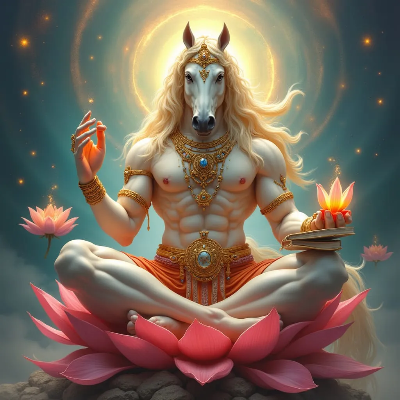
The iconographic conventions for the Hayagriva avatara are well established in the Vaishnava tradition, particularly as codified in the Pancharatra Agamic texts that govern temple worship. Hayagriva is depicted with a human body that is brilliant white in colour, seated upon a white lotus. He bears four arms. One hand is raised in the gesture of bestowing knowledge or in the teaching gesture known as Vyakhyana mudra. Another hand holds a book, representing the Vedas or sacred scripture. The remaining two hands hold the Shankha — the conch shell, an attribute of Vishnu — and the Chakra, the discus weapon, also a standard attribute of Vishnu. His face is consistently depicted as serene, peaceful, and beneficent, without the fierce or wrathful qualities associated with some other forms of Vishnu.
Hayagriva is venerated particularly in South India, where the majority of major Vishnu temples maintain a dedicated shrine for this form. Significant centres of Hayagriva worship include temples in Tamil Nadu and Andhra Pradesh. The full moon day of the month of Shravana — which corresponds approximately to August — is observed as the avatara day of Hayagriva, the occasion on which his manifestation is commemorated with special worship. The ninth day of the Navaratri festival, known as Mahanavami, is also associated with Hayagriva worship in many Vaishnava centres. His blessings are specifically sought at the commencement of study, learning, and scholarly undertakings, in both sacred and secular domains.
✦ Connection to the Wider Genealogy
As a direct transcendent manifestation of Vishnu, the Hayagriva avatara does not occupy a position within the conventional genealogical lineages that organise most of the Itihasa-Puranic family tree. He has no recorded parents, no recorded siblings in the avatara context, no recorded consort in the narrative accounts of this form, and no recorded offspring. His connection to the wider genealogical system is of a different kind: he stands in a narrative and theological relationship to the Danava Hayagriva, who is a son of the sage Kashyapa — one of the seven great Prajapati sages, a son of the sage Marichi who was himself a mind-born son of Brahma the creator — and of Danu, a daughter of the progenitor Daksha. The divine Hayagriva and the demonic Hayagriva share a name and a horse-headed form and are connected by the central narrative in which the former slays the latter, but they share no lineage. The divine form is Vishnu himself in manifestation; the demonic form is a member of the Danava clan descended through the Kashyapa-Danu lineage.
In a genealogical reference system, the Hayagriva avatara is therefore appropriately represented not within any parent-child lineage chain but as a manifestation node connected to Vishnu by a descent or manifestation link, clearly distinguished from the biological parent-child links that organise the Prajapati, sage, royal, and demonic lineages of the broader tree.
✦ References
- Primary Sources:
- Devi Bhagavata Purana, Book 1 — the principal source for the detailed narrative of how Vishnu assumed the horse-headed form, the account of the severed head and its replacement, the identity of the Danava Hayagriva as adversary, and the recovery of the Vedas; the account is framed within a Shakta theological framework that presents Devi as the enabling power.
- Bhagavata Purana, Canto 1 (avatara enumeration) and Canto 10, Chapter 40 (Akrura's prayer) — lists Hayagriva among Vishnu's avatara forms and includes the name in a devotional prayer context; the Vedas-recovery narrative in this text involves Madhu and Kaitabha rather than the horse-headed Danava.
- Mahabharata, Shanti Parva and related passages — references Narayana assuming a horse-headed form to slay Madhu and Kaitabha and restore the Vedas to Brahma; also contains references to a Hayagriva form of Vishnu active in cosmic battle against Danava armies.
- Matsya Purana — references the demonic Hayagriva and the broader theme of Vedic theft and recovery; its account of the horse-headed avatara is less developed than the Devi Bhagavata Purana version.
- Agni Purana — includes Hayagriva within its cataloguing of Vishnu's descent forms, contributing to the systematic listing of this avatara across Puranic literature.
- Vishnu Purana — mentions Hayagriva among demonic adversaries of Vishnu in battle contexts; contributes to the picture of the figure across different narrative registers.
- Pancharatra Agamic texts — codify the iconographic conventions, ritual procedures, and theological significance of Hayagriva as an independently worshipped deity in the Vaishnava temple tradition.
- Vedanta Desika, Hayagriva Stotra — a celebrated devotional composition by the thirteenth-to-fourteenth century Vaishnava acharya Vedanta Desika, which is the principal devotional text associated with Hayagriva worship and which articulates the theological identification of this form with the bliss of knowledge.
- Secondary Sources:
- Vettam Mani, Puranic Encyclopaedia (Motilal Banarsidass, 1975) — provides consolidated entries on both the divine Hayagriva and the demonic Hayagriva with cross-references to relevant Puranic passages.
- Wisdomlib (wisdomlib.org), Lord Hayagriva in Sanskrit Literature — provides a scholarly survey of Hayagriva's mythological aspect across different Puranas with Sanskrit verse references, useful for locating chapter-level citations across multiple texts.
- Wendy Doniger O'Flaherty, Hindu Myths (Penguin, 1975) — provides comparative context for the Vedic theft and recovery narrative pattern within which the Hayagriva episode sits.