
About
Matsya — The Fish Avatara of Vishnu, Preserver of the Vedas and Saviour of Manu
Matsya · Matsyaraja · Shaphara · Minakara · Vedamatsya
Matsya is the fish-formed avatara of Vishnu, the preserver deity of the Hindu tradition, and is counted among the earliest and most ancient of Vishnu's manifestations in Puranic and epic literature. Unlike avataras such as Rama or Krishna, who take birth through human parents and are embedded in genealogical lineages, Matsya is a direct transcendent manifestation — Vishnu assuming the form of a great fish without a birth narrative involving parentage. The central narrative purpose of this avatara is twofold: the preservation of the progenitor Manu and a selected company of sages and living beings from a catastrophic universal deluge, and the recovery of the Vedas — the four sacred scriptures upon which the order of creation depends — from demonic forces that had stolen them during or immediately preceding the deluge. Matsya is one of the most widely attested of all Vishnu's avatara forms, appearing in the Shatapatha Brahmana, the Mahabharata, the Matsya Purana, the Bhagavata Purana, the Agni Purana, the Vishnu Purana, and several other texts, making it among the earliest recorded avatara narratives in the entire Hindu canonical tradition. The Matsya Purana, one of the eighteen Mahapuranas, takes its name directly from this avatara and opens with a version of the deluge narrative as its founding episode.
✦ The Name
Matsya is the standard Sanskrit word for fish, and as the name of this avatara it denotes the form assumed rather than a personal name in the conventional sense. The compound Matsyaraja means king of fish — raja meaning king — and emphasises the sovereignty and supreme scale of the divine fish form as it appears in the deluge narrative, where it grows to an immense cosmic size. Shaphara is an alternate Sanskrit term for a type of fish, used in some early textual contexts to describe the initial form in which the fish-being first appears to Manu as a small creature in a vessel of water. Minakara combines mina, another word for fish, with kara, meaning maker or one characterised by, and is used as an epithet in some devotional contexts. Vedamatsya — the fish of the Vedas — appears in some theological descriptions that emphasise this avatara's role in preserving or recovering sacred scripture.
✦ Nature and Textual Classification
Matsya belongs to the category of direct or transcendent manifestations of Vishnu — avataras who are not born through human or divine parents but who assume a form directly for a specific cosmic purpose. No mother, father, or birth narrative is associated with this avatara in any primary text. The Bhagavata Purana's first Canto, which enumerates a large number of Vishnu's avatara forms, includes Matsya in its list. The Agni Purana similarly catalogues Matsya among Vishnu's principal descents. The Shatapatha Brahmana, one of the prose Vedic texts associated with the Yajurveda, contains an early version of the fish-and-flood narrative that does not explicitly identify the fish as Vishnu but presents it as a divine being of cosmic significance — a detail of considerable importance for understanding the deep antiquity of this narrative in the Sanskrit literary tradition.
The Matsya Purana holds a unique position among the texts dealing with this avatara because the entire Purana is framed as a discourse delivered by Matsya himself to Manu during the period of the deluge, making the fish-deity not merely the subject of a narrative episode but the primary speaker and teacher of the Purana's contents. This framing gives Matsya a role analogous to that of a guru or revealer of cosmic knowledge, consistent with the broader Vaishnava theological identification of Vishnu's avatara forms with the preservation and transmission of dharmic knowledge.
✦ The Shatapatha Brahmana Account
The oldest extant version of the Matsya narrative appears in the Shatapatha Brahmana, a prose Vedic text associated with the Shukla Yajurveda. In this account, the progenitor figure is Manu — identified as the son of Vivasvat, who is the solar deity, making Manu a member of the solar lineage that gives rise to numerous royal dynasties in subsequent Puranic genealogy. A small fish comes to Manu and appeals for his protection, warning him of an imminent great flood that will destroy all living beings. Manu shelters the fish in a vessel of water, and the fish grows rapidly, requiring progressively larger containers — first a jar, then a tank, then a river, and finally the ocean itself — until it has grown to an enormous size. The fish then instructs Manu to build a great boat. When the flood arrives, Manu moors his boat to the fish's horn — the fish is described as a horned fish in this account — and is towed safely through the flood waters until the waters recede. The fish then identifies itself as Prajapati, the lord of all creatures. In this Vedic account the fish is not identified as Vishnu; the explicit identification of the fish with Vishnu as avatara is a development that occurs in the later Puranic literature.
✦ The Mahabharata Account
The Mahabharata, in the Vana Parva — the Book of the Forest — contains a version of the Matsya narrative told to the Pandava prince Yudhishthira by the sage Markandeya. In this account the progenitor is again Manu Vaivasvata, son of the solar deity Vivasvat. A small fish appeals to Manu for protection and grows through successive containers to an immense size. The fish warns Manu of the coming deluge and instructs him to build a ship, gather the seeds of all living things and the seven great sages — the Saptarishis — and await the flood. The seven sages mentioned in this context are a group of supreme sages regarded in the tradition as the progenitors of the brahminical and sage lineages of humanity. When the deluge comes, the fish — now identified in this telling as Brahma or Prajapati, the lord of creatures — tows Manu's ship through the cosmic waters. The Mahabharata account does not consistently identify the fish as Vishnu, reflecting the transitional state of the tradition between the early Vedic identification of the fish with Prajapati or Brahma and the later Puranic identification with Vishnu.
✦ The Bhagavata Purana Account
The Bhagavata Purana presents a version of the Matsya narrative in its eighth Canto that is fully integrated into the Vaishnava theological framework, with the fish explicitly identified as Vishnu throughout. In this account, the progenitor is Satyavrata, a king who is identified in the text as the same figure who later becomes Manu Vaivasvata — the progenitor of the current human age — thereby connecting the deluge narrative to the genealogical framework of the Manu lineages. Satyavrata, while performing ritual ablutions in a river, finds a small fish in his cupped hands. The fish asks for his protection, and he places it in a vessel. The fish grows rapidly through successively larger enclosures until it reaches the ocean and reveals its cosmic proportions, at which point it reveals itself as Vishnu and instructs Satyavrata to prepare a great ship for the coming dissolution of the world.
In the Bhagavata Purana's version, the Vedas-recovery dimension of the narrative is also present. The text indicates that at the end of the previous cosmic cycle, when Brahma had completed his day of creative activity and was entering his night of dissolution, the Vedas slipped from his mouth or became inaccessible as he fell into the sleep of cosmic dissolution. A demon named Shankhasura — a conch-shaped demon — seized the Vedas and concealed them in the cosmic ocean. Vishnu, in the Matsya form, slew Shankhasura and recovered the Vedas, restoring them to Brahma at the commencement of the new cycle of creation. This Vedas-recovery function connects the Matsya avatara thematically to the Hayagriva avatara, which performs the same cosmic function of recovering stolen sacred scripture, though through an entirely distinct narrative and form.
✦ The Matsya Purana Account
The Matsya Purana opens with a version of the Matsya narrative that serves as the framing device for the entire Purana. In this account, the progenitor figure is Manu, and the great fish that appears to him is explicitly identified from the outset as Vishnu himself. The Matsya Purana's version emphasises the teaching function of the fish-deity: during the period of the deluge, when Manu's ship is moored to the fish's horn and towed through the cosmic waters, Matsya delivers to Manu an extensive discourse encompassing cosmology, genealogy, dharma, ritual, and the histories of kings and sages. The entire Purana is presented as the content of this divine instruction. The fish's horn, to which the ship is attached, is described in some versions as identical with the single horn of the great fish, an iconographic detail preserved across multiple accounts.
✦ Textual Variants and Inconsistencies
The Matsya narrative presents several significant variants across its major tellings that a reference system should record clearly.
The identity of the divine fish varies by text and period. The Shatapatha Brahmana identifies the fish with Prajapati, the lord of creatures. The Mahabharata gives an account that identifies the fish with Prajapati or Brahma rather than consistently with Vishnu. The Puranic texts — the Bhagavata Purana, the Matsya Purana, the Agni Purana — uniformly identify the fish as Vishnu. This progression reflects the historical development of Vaishnava theology and the absorption of older cosmogonic narratives into the Vishnu-centred framework of the Puranas.
The identity of the human recipient of the fish's protection also varies. The Shatapatha Brahmana and the Mahabharata use the name Manu without consistently specifying which Manu among the fourteen cosmic Manus is intended, though the context identifies Manu Vaivasvata — the progenitor of the present human age — as the figure in question. The Bhagavata Purana names the figure Satyavrata and identifies him as the king who becomes Manu Vaivasvata, providing an explicit genealogical connection to the Manu lineage. The Matsya Purana uses the name Manu directly.
The identity of the demonic adversary from whom the Vedas are recovered also varies. The Bhagavata Purana names the demon Shankhasura. The Matsya Purana in some passages presents Matsya himself as recompiling and restoring the Vedas and Vedangas — the subsidiary scriptural texts — rather than recovering them from a named demon. Some versions connect the Vedas-theft to the transition between cosmic cycles rather than to a specific demonic act. These variants do not contradict each other in their core theological function but differ in narrative detail.
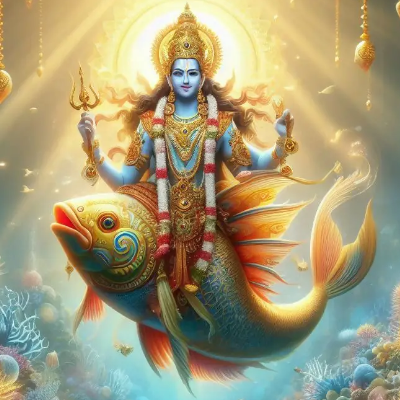
The presence or absence of a horn on the fish also varies. The Shatapatha Brahmana describes a horned fish to which the ship is moored. The Puranic accounts similarly describe a horn, but the iconographic conventions for depicting Matsya show variation between a purely fish form and a composite form with a human upper body emerging from a fish lower body, the latter being a later iconographic development not consistently supported by the earliest textual descriptions.
✦ Theological and Philosophical Significance
Within the Vaishnava theological framework, the Matsya avatara carries several layers of significance. At the most immediate narrative level it represents Vishnu's function as preserver — the role that defines his position within the Trimurthi framework of Brahma as creator, Vishnu as preserver, and Shiva as dissolver. The deluge is an event of cosmic dissolution, and Vishnu's intervention to protect Manu, the Saptarishis, and the seeds of living beings is a direct act of preservation that ensures the continuity of creation across the threshold of dissolution into the next cycle.
The recovery of the Vedas carries the same theological weight identified in the Hayagriva avatara narrative: without the Vedas, the new cycle of creation cannot be properly constituted, because the Vedas are understood as the eternal template upon which dharmic existence is modelled. Vishnu's recovery of the Vedas is therefore not merely a rescue of texts but a preservation of the cosmic order itself.
The Matsya avatara also occupies an important position in the evolutionary or hierarchical reading of the Dashavatara sequence that has been proposed by various commentators, particularly in the modern period. In this reading, the progression from fish to tortoise to boar to man-lion to dwarf and so forth is understood as a symbolic recapitulation of biological or cosmic evolution. This interpretation, while influential in modern discourse, is not a framework explicitly articulated in the primary Puranic texts themselves, which present the avatara sequence in terms of cosmic necessity and dharmic purpose rather than biological development.
✦ Iconography and Worship
The iconography of Matsya presents two principal forms across the textual and artistic tradition. The first and earlier form depicts a large fish, sometimes of golden or luminous colour, with a single horn upon its head to which a ship or rope is attached — an image directly derived from the narrative of Manu's ship being towed through the floodwaters. The second form, which becomes prominent in sculptural and painted traditions, depicts a composite being with the upper torso and arms of Vishnu — four-armed, holding the standard Vaishnava attributes of the conch, discus, mace, and lotus — emerging from the body of a great fish. This composite form emphasises the identity of the fish with Vishnu himself rather than presenting a purely animal form.
Matsya is venerated as the first of the Dashavatara in most Vaishnava temple traditions that maintain Dashavatara shrines or panels, and sculptural depictions of the ten avataras typically place Matsya at the head of the sequence. Dedicated temples to Matsya as a primary deity are less common than those for forms such as Hayagriva or Narasimha, but the form appears consistently in the Dashavatara panels found in major Vaishnava temple complexes across South India and in the sculptural programmes of medieval North Indian temples.
✦ Connection to the Wider Genealogy
As a direct transcendent manifestation of Vishnu, Matsya has no recorded parents, siblings, consort, or offspring in the primary texts. His connection to the wider genealogical system of the Itihasa-Puranic tradition is indirect but structurally important: the beneficiary of his intervention, Manu Vaivasvata — identified in the Bhagavata Purana as the king Satyavrata who is elevated to the position of Manu through the events of the deluge — is himself one of the foundational figures of the entire genealogical tree. Manu Vaivasvata is the progenitor of the solar lineage of kings, the Suryavamsha, which gives rise to dynasties including the Ikshvaku line from which Rama — himself an avatara of Vishnu — descends many generations later. The seven sages, the Saptarishis, preserved alongside Manu in Matsya's ship, are the progenitors of the brahminical sage lineages that run through the entire Puranic genealogical system. Matsya's act of preservation is therefore the event that makes possible the continuation of all the subsequent genealogical lineages of the tradition.
In a genealogical reference system, Matsya is appropriately placed as a manifestation node connected to Vishnu by a descent or manifestation link, in the same transcendent avatara cluster as Hayagriva and other directly assumed forms, clearly distinguished from avataras such as Vamana, Parashurama, Rama, and Krishna who are born through named parents and occupy positions within the standard parent-child lineage structure of the tree.
✦ References
- Primary Sources:
- Shatapatha Brahmana, Book 1, Chapter 8 — the oldest extant version of the fish-and-flood narrative; identifies the fish with Prajapati rather than Vishnu; establishes the core narrative elements of the small fish, the growing through successive containers, the warning of the flood, the building of the ship, and the horn by which the ship is towed.
- Mahabharata, Vana Parva — contains a version of the Matsya narrative told by the sage Markandeya to Yudhishthira; identifies the fish with Prajapati or Brahma; names the seven sages as companions of Manu in the ship; represents a transitional stage between the Vedic and fully Vaishnava versions of the narrative.
- Bhagavata Purana, Canto 8, Chapters 24 — presents the fully Vaishnava version of the narrative with the fish explicitly identified as Vishnu; names the human recipient Satyavrata and identifies him as the future Manu Vaivasvata; includes the account of the demon Shankhasura and the recovery of the Vedas.
- Matsya Purana, opening chapters — frames the entire Purana as a discourse delivered by Matsya to Manu during the deluge; identifies the fish as Vishnu from the outset; emphasises the teaching and knowledge-transmission function of the avatara.
- Agni Purana — catalogues Matsya among Vishnu's principal avatara forms; contributes to the systematic Puranic listing of this descent.
- Vishnu Purana — references Matsya within its treatment of Vishnu's avatara forms and cosmic functions.
- Bhagavata Purana, Canto 1 — enumerates Matsya among the large number of Vishnu's avatara forms in the foundational listing of the text.
- Secondary Sources:
- Vettam Mani, Puranic Encyclopaedia (Motilal Banarsidass, 1975) — provides a consolidated entry on Matsya with cross-references to the relevant Puranic and epic passages and a summary of the principal narrative variants.
- Wendy Doniger O'Flaherty, Hindu Myths (Penguin, 1975) — discusses the Matsya narrative in comparative context and traces the relationship between the Vedic Prajapati-fish and the Puranic Vishnu-fish accounts.
- Wisdomlib (wisdomlib.org) — provides indexed references to Matsya across multiple Puranic and Vedic texts with verse-level citations useful for cross-referencing variant accounts.
- A. A. Macdonell and A. B. Keith, Vedic Index of Names and Subjects (Motilal Banarsidass, reprint) — useful for tracing the Vedic antecedents of the Matsya narrative and the figure of Manu Vaivasvata in the earliest Sanskrit literary tradition.