
About
Kurma — The Tortoise Avatara of Vishnu, Support of the Cosmic Churning
Kurma · Kurmaraja · Akupara · Kacchapa · Kamagaja · Kurmanatha
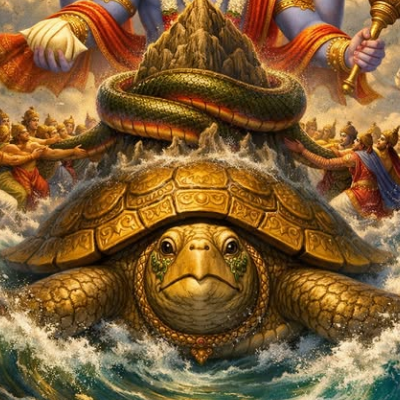
Kurma is the tortoise-formed avatara of Vishnu, the preserver deity of the Hindu tradition, and represents one of the earliest and most widely attested of Vishnu's manifestation forms in both Vedic and Puranic literature. Like Matsya, the fish avatara that precedes it in the conventional Dashavatara sequence, Kurma is a direct transcendent manifestation — Vishnu assuming the form of a great cosmic tortoise without a birth narrative involving parentage. The central narrative purpose of this avatara is to serve as the physical support and pivot for the churning of the cosmic ocean — the Samudra Manthan — in which the gods and the Asuras together churn the primordial waters using the great serpent Vasuki as a churning rope and the mountain Mandara as a churning rod. Without a stable base upon which to rest, the churning rod would sink into the ocean floor and the operation could not proceed. Vishnu in the Kurma form descends to the ocean floor and supports Mandara upon his back, enabling the churning to continue until the great treasures of the cosmic ocean — including the divine physician Dhanvantari bearing the pot of amrita, the nectar of immortality — emerge. The Kurma narrative appears in the Shatapatha Brahmana, the Mahabharata, the Vishnu Purana, the Bhagavata Purana, the Kurma Purana, the Agni Purana, and several other texts, and the Kurma Purana, one of the eighteen Mahapuranas, takes its name from this avatara. Kurma is also significant as the form under which Vishnu is identified with the cosmic tortoise that supports the earth in early Vedic cosmological thinking.
✦ The Name
Kurma is the standard Sanskrit word for tortoise, and as the name of this avatara it denotes the form assumed. Kurmaraja compounds kurma with raja, meaning king, and conveys the sense of the supreme or royal tortoise, emphasising the sovereign and cosmic scale of the divine form as it appears in the churning narrative. Akupara is a name appearing in Vedic cosmological contexts for the great tortoise understood to support the earth or the cosmic structure from below — a being of immeasurable size and endurance, the name itself carrying connotations of boundlessness. Kacchapa is a Sanskrit synonym for tortoise, used in some texts as an alternate designation for this avatara and also as a general term for the tortoise species. Kamagaja is a less common epithet used in some devotional contexts. Kurmanatha compounds kurma with natha, meaning lord or master, yielding the sense of lord of the tortoise form, used in devotional address. In some Shaiva contexts the name Kacchapeshvara — lord in the form of the tortoise — appears in connection with a form of Shiva rather than Vishnu, reflecting the absorption of the cosmic tortoise image across different sectarian traditions.
✦ Nature and Textual Classification
Kurma belongs to the category of direct or transcendent manifestations of Vishnu — avataras who assume a form directly for a specific cosmic purpose without a birth narrative involving parents. No mother, father, or genealogical lineage is associated with this avatara in any primary text. The Bhagavata Purana's first Canto, which enumerates a large number of Vishnu's avatara forms, includes Kurma in its listing. The Agni Purana and the Garuda Purana similarly catalogue Kurma among Vishnu's principal descent forms. The Kurma Purana frames its entire contents as a discourse delivered by Vishnu in the Kurma form to the sages gathered at a sacred site, making the tortoise-deity the primary teacher and revealer of the Purana's knowledge, in a structural parallel to the Matsya Purana's framing of its contents as the teaching of Matsya to Manu.
The Vedic background of the Kurma form is significant. The Shatapatha Brahmana contains passages in which the cosmic tortoise is identified with Prajapati — the lord of creatures — and connected with the act of creation itself, the tortoise's form being understood as a symbol of the self-existent creative principle. The Atharvaveda also contains references to the cosmic tortoise in cosmological contexts. The explicit identification of the tortoise with Vishnu as avatara is, as with Matsya, a development that occurs in the Puranic literature rather than in the earliest Vedic texts.
✦ The Samudra Manthan — The Churning of the Cosmic Ocean
The narrative occasion for the Kurma avatara is the Samudra Manthan — the churning of the ocean of milk — which is one of the most extensively narrated episodes in the entire Puranic tradition, appearing with substantial detail in the Vishnu Purana, the Bhagavata Purana, the Mahabharata, and several other major texts. The episode arises from a crisis in the cosmic order: the gods — the Devas — had been cursed by the sage Durvasa, a son of the sage Atri and the goddess Anasuya, whose curse caused the gods to lose their strength, lustre, and divine energy. Weakened, the Devas were overpowered by the Asuras — the demonic counterparts to the gods — and lost their sovereignty over the three worlds. In their distress the gods approached Vishnu, who advised them that the only means of recovering their strength was to obtain amrita, the nectar of immortality, which lay hidden within the cosmic ocean and could only be extracted through the vast cooperative effort of churning the ocean itself.
Vishnu further counselled the gods to enter into a temporary alliance with the Asuras, concealing from them the ultimate intention of securing the amrita for the gods alone. The Asuras, enticed by the promise of a share in the amrita, agreed to participate. The great mountain Mandara was selected as the churning rod — a mountain of immense size and weight, described as standing many thousands of leagues high. The great serpent Vasuki — the king of the Nagas, the serpent beings who dwell in the subterranean worlds — agreed to serve as the churning rope, coiled around the mountain. The gods held Vasuki's tail end and the Asuras held his head end, and both parties began to pull alternately, rotating Mandara and churning the ocean.
The mountain Mandara, however, lacked a stable base upon which to rest in the depths of the ocean and began to sink into the ocean floor under its own enormous weight, threatening to bring the entire operation to a halt. At this point Vishnu manifested in the Kurma form — descending to the ocean floor and positioning himself beneath the base of Mandara, supporting the mountain upon his vast back and providing the stable pivot that the churning required. In some accounts Vishnu is also described as simultaneously manifesting in a second form seated atop the mountain and in a third form among the churning parties, pervading the entire operation with his divine presence.
The churning, once stabilised by Kurma's support, continued for a vast period of time and produced a series of great treasures and beings from the depths of the cosmic ocean. The Bhagavata Purana and the Vishnu Purana both provide detailed lists of what emerged from the churning, and while the specific order varies between texts, the items generally include the goddess Lakshmi — the consort of Vishnu — who emerged seated on a lotus and was immediately claimed by Vishnu; the divine physician Dhanvantari, who emerged bearing a white pot containing the amrita; the goddess Varuni or Sura, the deity of wine; the divine horse Ucchaishravas; the divine elephant Airavata, who became the mount of the god Indra, the king of the gods; the gem Kaustubha, which became an ornament of Vishnu; the wish-fulfilling tree Parijata; the celestial nymphs the Apsaras; the moon, which Shiva took and placed upon his head; and the deadly poison Halahala or Kalakuta, which arose before the amrita and threatened to destroy all creation with its virulence. Shiva — the third deity of the Trimurthi, the destroyer — consumed the poison to save the worlds, holding it in his throat, which thereby turned blue, giving rise to one of Shiva's most celebrated epithets, Nilakantha, meaning the blue-throated one.
When Dhanvantari finally emerged with the pot of amrita, the Asuras seized it and a conflict broke out. Vishnu then assumed the form of the enchantress Mohini — a supremely beautiful woman — to distract the Asuras and recover the amrita for the gods. The gods drank the amrita and recovered their divine strength and sovereignty. The Kurma's role in all of this was foundational: without the stable support of the tortoise form at the base of Mandara, the churning could not have proceeded and none of the treasures, including the amrita, could have been obtained.
✦ The Shatapatha Brahmana and Vedic Background
The Shatapatha Brahmana contains passages in which Prajapati assumes the form of a tortoise in connection with the act of creation, the tortoise being understood as a self-existent being who creates by spreading his limbs and generating the worlds from his body. In this Vedic cosmological context the tortoise is not associated with the churning of the ocean but with the origination of existence itself. The identification of this cosmic tortoise with Vishnu rather than Prajapati, and the association of the Vishnu-tortoise with the specific episode of the Samudra Manthan, are both developments of the Puranic period. The Shatapatha Brahmana passage is nonetheless significant for understanding the deep Vedic roots of the cosmic tortoise image that the Puranic tradition incorporates into the Kurma avatara narrative.
✦ The Kurma Purana Account
The Kurma Purana presents a version of the Kurma narrative that frames the entire Purana as knowledge revealed by Vishnu in the tortoise form to the sages assembled at the sacred site of Naimisha. The Purana identifies itself as containing the discourse that Vishnu, in the Kurma form, delivered during the period of the Samudra Manthan. In this framing the tortoise form is not merely a physical support for the churning mountain but a teaching presence — a form in which Vishnu reveals cosmological, theological, and dharmic knowledge to a listening audience. The Kurma Purana is notable among the Mahapuranas for containing significant Shaiva elements alongside its Vaishnava framework, reflecting the complex sectarian history of the text.
✦ Textual Variants and Inconsistencies
The Samudra Manthan narrative is one of the most extensively told episodes in all of Puranic literature, and the variants across its major tellings are numerous and in some cases significant.
The identity of the divine being in the tortoise form varies by textual period. The Shatapatha Brahmana identifies the cosmic tortoise with Prajapati rather than Vishnu. The Mahabharata's account of the Samudra Manthan identifies the support beneath Mandara as Vishnu in tortoise form, representing the transitional stage of the tradition. The Puranic texts consistently identify the tortoise as Vishnu throughout. As with the Matsya narratives, this progression reflects the historical absorption of earlier cosmological motifs into the Vishnu-centred theological framework of the Puranas.
The list of treasures produced by the churning varies between texts in both content and sequence. The Vishnu Purana, the Bhagavata Purana, and the Mahabharata all provide lists that overlap substantially but differ in specific items and in the order of their emergence. The Bhagavata Purana's list is the most elaborate of the major accounts. The question of whether Lakshmi emerged before or after the amrita, and precisely which deity received which treasure, is handled differently across these texts.
The role of Vishnu during the churning beyond his support as Kurma is also handled differently across texts. Some accounts describe Vishnu as manifesting simultaneously in multiple forms during the churning — as the tortoise below, as a presence atop the mountain, and among the churning parties — while others confine his role at this stage to the Kurma form alone, with the Mohini form appearing as a separate subsequent manifestation after the amrita has emerged.
The Kurma Purana's identification of itself as a Vaishnava Purana containing extensive Shaiva material has led scholars to note that the text as it survives shows signs of complex editorial history, and the framing of the Purana as a teaching delivered by Vishnu in Kurma form does not sit consistently with all the text's contents.
✦ Theological and Philosophical Significance
The Kurma avatara carries a distinct set of theological resonances within the Vaishnava tradition. The tortoise is an animal that withdraws its limbs entirely within its shell, and this quality was observed and developed as a symbol of controlled withdrawal of the senses — a quality praised in the Bhagavad Gita, the philosophical discourse delivered by Krishna, himself an avatara of Vishnu, to the warrior Arjuna. The Bhagavad Gita uses the image of a tortoise withdrawing its limbs as an analogy for the disciplined withdrawal of the senses from their objects, which is understood as a prerequisite for stable wisdom. The Kurma avatara thus carries an implicit connection to this teaching of sense-withdrawal and inner stability.
At the cosmic level the Kurma form represents the function of stable support — the divine ground upon which the productive activity of the churning depends. In Vaishnava theological discourse this has been understood as a symbol of Vishnu's role as the ultimate sustaining ground of all cosmic activity, the stable foundation without which no creative or transformative process in the universe can proceed. The churning of the ocean, which produces the greatest treasures of existence including the nectar of immortality, depends entirely upon the silent, immovable support of the tortoise below. This image of foundational support without visible agency is theologically consistent with the Vaishnava understanding of Vishnu as the immanent ground of all existence.
The Samudra Manthan episode as a whole, with Kurma's support as its enabling condition, is also understood as a narrative of cosmic cooperation and cosmic deception — the gods and Asuras working together, each believing they will benefit, while Vishnu's overarching intention is the preservation of the cosmic order against the threat posed by unchecked Asura power. Kurma's role in this larger narrative is therefore not passive but strategically foundational within Vishnu's cosmic plan.
✦ Iconography and Worship
The iconographic representation of Kurma follows two principal conventions across the artistic tradition, in a structural parallel to the two iconographic forms of Matsya. The first and earlier form depicts a large tortoise — sometimes of golden or luminous colour — with the mountain Mandara resting upon its back and the serpent Vasuki coiled around the mountain, the entire scene evoking the Samudra Manthan episode directly. The second form, which becomes prominent in sculptural traditions, depicts a composite being with the upper torso and four arms of Vishnu — holding the standard Vaishnava attributes of the conch, discus, mace, and lotus — rising from the body of a great tortoise. This composite form emphasises the identity of the tortoise with Vishnu himself.
A significant centre of Kurma worship is the Srikurmam temple located in Andhra Pradesh, which is one of the very few temples in India where Kurma is venerated as the primary deity rather than appearing solely in a Dashavatara panel. The temple at Srikurmam is regarded in the Vaishnava tradition as one of the significant Vishnu kshetras of South India. Kurma appears in the Dashavatara panels of major Vaishnava temple complexes as the second in the sequence following Matsya, and sculptural depictions of the ten avataras consistently place Kurma in this position.
✦ Connection to the Wider Genealogy
As a direct transcendent manifestation of Vishnu, the Kurma avatara has no recorded parents, siblings, consort, or offspring in the primary texts. His connection to the wider genealogical system of the Itihasa-Puranic tradition is through the figures whose fates and lineages are directly affected by the Samudra Manthan episode that Kurma's intervention enables. The goddess Lakshmi — who emerges from the churning and becomes the consort of Vishnu — is the most significant of these figures in genealogical terms, as her union with Vishnu is a foundational relationship of the Vaishnava theological cosmos. Dhanvantari, who emerges from the churning bearing the amrita and is regarded as the father of Ayurveda and the divine physician, enters the genealogical system as a figure with his own lineage and descendants in subsequent Puranic accounts. The divine horse Ucchaishravas and the divine elephant Airavata, who became the mount of Indra, are also products of the churning that Kurma enabled, and both appear in subsequent genealogical and narrative contexts across the Puranas.
In a genealogical reference system, Kurma is appropriately placed as a manifestation node connected to Vishnu by a descent or manifestation link, in the same transcendent avatara cluster as Matsya, Hayagriva, and other directly assumed forms, clearly distinguished from avataras such as Vamana, Parashurama, Rama, and Krishna who are born through named parents and occupy positions within the standard parent-child lineage structure of the tree.
✦ References
- Primary Sources:
- Shatapatha Brahmana, Book 7 — contains passages identifying the cosmic tortoise with Prajapati in a cosmological and ritual context; establishes the deep Vedic antecedents of the cosmic tortoise image subsequently absorbed into the Kurma avatara narrative.
- Mahabharata, Adi Parva — contains a version of the Samudra Manthan episode with Vishnu in tortoise form supporting Mandara; represents a transitional stage between the Vedic Prajapati-tortoise and the fully Vaishnava Kurma avatara of the Puranas.
- Vishnu Purana, Book 1, Chapters 9 — presents a detailed account of the Samudra Manthan with Kurma as the supporting tortoise form of Vishnu; provides an extensive list of the treasures produced by the churning.
- Bhagavata Purana, Canto 8, Chapters 6 to 12 — contains the most elaborate Puranic account of the Samudra Manthan episode; explicitly identifies the tortoise as Vishnu; provides detailed lists of the treasures emerging from the churning and the subsequent events including the appearance of Mohini.
- Kurma Purana — one of the eighteen Mahapuranas; frames its contents as knowledge revealed by Vishnu in the Kurma form to sages at Naimisha; contains Vaishnava and Shaiva material; takes its name and authority from the Kurma avatara.
- Bhagavata Purana, Canto 1 — enumerates Kurma among the large number of Vishnu's avatara forms in the foundational listing of the text.
- Agni Purana — catalogues Kurma among Vishnu's principal avatara forms within its systematic treatment of Vaishnava theology and mythology.
- Bhagavad Gita, Chapter 2, verse 58 — uses the image of a tortoise withdrawing its limbs as an analogy for the disciplined withdrawal of the senses, a passage theologically connected to the symbolic resonances of the Kurma form.
- Secondary Sources:
- Vettam Mani, Puranic Encyclopaedia (Motilal Banarsidass, 1975) — provides a consolidated entry on Kurma and the Samudra Manthan with cross-references to relevant Puranic and epic passages.
- Wendy Doniger O'Flaherty, Hindu Myths (Penguin, 1975) — discusses the Samudra Manthan narrative in comparative context and traces the relationship between the Vedic cosmic tortoise and the Puranic Kurma avatara.
- Cornelia Dimmitt and J. A. B. van Buitenen, Classical Hindu Mythology (Temple University Press, 1978) — provides translated excerpts of the Samudra Manthan from multiple Puranic sources with introductory commentary identifying the principal variants.
- Wisdomlib (wisdomlib.org) — provides indexed references to Kurma across multiple Puranic and Vedic texts with verse-level citations useful for cross-referencing the variant accounts of the Samudra Manthan episode.