
About
Narasimha — The Man-Lion Avatara of Vishnu, Slayer of Hiranyakashipu and Protector of Prahlada
Narasimha · Narahari · Simhavaktra · Ugrasimha · Hiranyakashipuvakshahsila Nakhara · Lakshminrisimha · Jwalanarashimha · Stambhaja · Prahladadeva
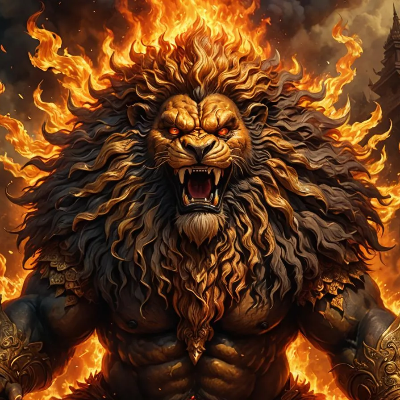
Narasimha is the man-lion avatara of Vishnu, the preserver deity of the Hindu tradition, appearing in the form of a being with a human body and the head and claws of a lion. He is among the most theologically rich and devotionally significant of all Vishnu's avatara forms, and his narrative is one of the most extensively developed in the entire Puranic tradition. Unlike Matsya and Kurma, which are wholly animal forms, and unlike Rama and Krishna, who are wholly human, Narasimha occupies a unique position as a composite being — neither fully human nor fully animal — a form that the primary texts present as cosmically necessary for the fulfilment of a specific boon. The central narrative of this avatara concerns the protection of the boy-devotee Prahlada — son of the Daitya king Hiranyakashipu and a supreme devotee of Vishnu despite his demonic birth — and the destruction of Hiranyakashipu himself, a king who had obtained through severe austerities a boon of conditional invincibility that appeared to place him beyond the reach of any conceivable means of death. Vishnu manifested in the Narasimha form specifically to satisfy every condition of the boon while simultaneously destroying Hiranyakashipu and delivering Prahlada from persecution. The Narasimha narrative appears in the Vishnu Purana, the Bhagavata Purana, the Agni Purana, the Brahma Purana, the Vayu Purana, the Padma Purana, the Harivamsa, and the Mahabharata, and Narasimha is venerated as an independently worshipped deity of great importance in South Indian Vaishnavism, with numerous dedicated temples and an extensive body of devotional literature in Sanskrit and the regional languages.
✦ The Name
Narasimha is a Sanskrit compound of nara, meaning man or human, and simha, meaning lion, yielding the sense of the man-lion or lion-man — a being that combines the essential qualities of both. The variant spelling Narasingha reflects regional phonetic conventions, particularly in North and East Indian usage. Narahari compounds nara with hari — one of the most common names of Vishnu, used across the tradition — and emphasises the identity of the man-lion form with Vishnu himself. Simhavaktra means lion-faced — simha meaning lion and vaktra meaning face — and describes the defining physical characteristic of the form. Ugrasimha means the fierce or terrible lion — ugra meaning fierce, terrible, or wrathful — and reflects the intensely wrathful aspect of this manifestation, which the primary texts describe in vivid detail. The epithet Stambhaja — born from the pillar, from stambha meaning pillar and ja meaning born — refers to the specific narrative circumstance of Narasimha's emergence from a palace pillar, which is the defining dramatic moment of the avatara's appearance. Lakshminrisimha compounds Lakshmi — the goddess of fortune and consort of Vishnu — with Nrisimha, an alternate rendering of Narasimha, and refers to the pacified, benevolent form of the deity in the presence of Lakshmi, as distinct from the terrifying form he assumes at the moment of Hiranyakashipu's destruction. Prahladadeva, meaning the lord or god of Prahlada, is an epithet that identifies the deity specifically through his protective relationship with his supreme devotee.
✦ Nature and Textual Classification
Narasimha belongs to the category of direct or transcendent manifestations of Vishnu — avataras who assume a form directly for a specific cosmic purpose without a birth narrative involving parentage. No mother, father, or genealogical lineage is recorded for this avatara in any primary text. He emerges fully formed from a stone pillar in the palace of Hiranyakashipu, and the manner of his emergence is itself theologically significant: it demonstrates that Vishnu, understood in Vaishnava theology as the omnipresent ground of all existence, is present within all objects and can manifest from any point in creation. The Bhagavata Purana's first Canto enumerates Narasimha among the large number of Vishnu's avatara forms, and he is consistently placed fourth in the standard Dashavatara sequence following Matsya, Kurma, and Varaha. The Bhagavata Purana's seventh Canto contains the most elaborate and theologically developed account of the Narasimha narrative, with the story of Hiranyakashipu, Prahlada, and Narasimha's intervention narrated at considerable length and interspersed with philosophical teachings attributed to Prahlada himself.
✦ The Lineage of Hiranyakashipu
To understand the Narasimha narrative fully, the lineage and background of Hiranyakashipu must be established, as the Puranic texts present his history as the direct cause of Narasimha's manifestation. Hiranyakashipu is a Daitya — a member of the demonic race descended from the sage Kashyapa, one of the seven great Prajapati sages and a son of the sage Marichi who was himself a mind-born son of Brahma the creator, and from Kashyapa's wife Diti, a daughter of the progenitor Daksha. The Daityas are the children of Kashyapa and Diti, distinguished from the Danavas who are children of Kashyapa and Danu, and from the Devas who are children of Kashyapa and Aditi. Hiranyakashipu is the brother of Hiranyaksha — the Daitya who in the Varaha avatara narrative had dragged the earth to the bottom of the cosmic ocean and been slain by Vishnu in the boar form. The slaying of Hiranyaksha by Vishnu is the event that motivates Hiranyakashipu's intense and consuming hatred of Vishnu throughout the Narasimha narrative.
Hiranyakashipu's wife is named Kayadu or Kayadhu in the Bhagavata Purana, identified as a daughter of the Daitya Jambha. Their son is Prahlada — the boy-devotee whose unswerving devotion to Vishnu despite his demonic birth and his father's violent opposition is the central human drama of the Narasimha narrative. Prahlada in turn becomes the grandfather of the Daitya king Mahabali or Bali — the figure central to the Vamana avatara narrative — through Prahlada's son Virochana, making the Narasimha and Vamana narratives genealogically linked through the Daitya lineage.
✦ The Boon of Hiranyakashipu
Enraged by the slaying of his brother Hiranyaksha at the hands of Vishnu, Hiranyakashipu resolved to destroy Vishnu and to establish his own supremacy over the three worlds. To this end he undertook extraordinarily severe austerities — tapas — on the mountain Mandara, standing on his toes with his arms raised, enduring heat and cold and rain without movement for a vast period of time. His austerities were so intense that their heat disturbed the heavens and alarmed Brahma, the four-faced creator deity. Brahma descended and offered Hiranyakashipu a boon of his choosing.
Hiranyakashipu requested what the Bhagavata Purana and other texts present as the most comprehensive protection against death that could be articulated. The specific terms of the boon vary in their precise wording across different texts but consistently cover the same set of conditions. The Bhagavata Purana's account presents Hiranyakashipu requesting that he should not be killed by any being created by Brahma, whether human, animal, or divine; that he should not be killed inside any dwelling or outside it; that he should not be killed during the day or during the night; that he should not be killed on the earth or in the sky; that he should not be killed by any weapon; and that he should not be killed by any animate or inanimate being. Brahma granted this boon. Hiranyakashipu, confident in his conditional invincibility, then conquered the three worlds, subjugated the gods, and demanded universal worship of himself rather than of any deity, declaring himself the supreme being.
✦ Prahlada and His Persecution
The Bhagavata Purana's account explains the origin of Prahlada's devotion to Vishnu through a narrative that precedes his birth. While Hiranyakashipu was engaged in his austerities, the gods — led by Indra, the king of the gods — attacked the Daitya stronghold in his absence and took his pregnant wife Kayadu prisoner. The sage Narada — a divine sage and son of Brahma, celebrated throughout the Puranas as the foremost of Vishnu's devotees and a messenger between the worlds — intervened and persuaded Indra to release her, taking her under his protection. While Kayadu remained in Narada's hermitage awaiting Hiranyakashipu's return, Narada instructed her daily in the knowledge of Vishnu, the nature of the self, and the path of devotion. The unborn Prahlada, present in the womb, absorbed all of this instruction, and was thus a devotee of Vishnu from before his birth — a detail the Bhagavata Purana uses to establish the authenticity and depth of his devotion as entirely independent of personal choice or instruction received after birth.
After his birth Prahlada openly declared his devotion to Vishnu even in his father's presence and in the face of his father's violent disapproval. Hiranyakashipu, who regarded Vishnu as his supreme enemy, attempted repeatedly to bring his son to renounce his devotion and acknowledge Hiranyakashipu himself as the supreme lord. When persuasion failed, he resorted to persecution. The Bhagavata Purana enumerates the various means by which Hiranyakashipu attempted to kill Prahlada: having him trampled by elephants, throwing him from cliff tops, casting him into fire, having him bitten by venomous serpents, submerging him in water, exposing him to extreme cold and wind, striking him with weapons, and having him given poison. In every instance Prahlada survived unharmed, protected by his devotion to Vishnu. The Daitya teachers and ministers who were tasked with reforming the boy also failed, as Prahlada openly taught his fellow students the path of devotion to Vishnu, converting them to his own understanding rather than being converted to his father's position.
✦ The Emergence from the Pillar
The culminating confrontation between Hiranyakashipu and Prahlada, and the occasion of Narasimha's manifestation, is one of the most dramatically rendered episodes in all of Puranic literature. In a final rage at his son's indestructible devotion, Hiranyakashipu directly challenged Prahlada to prove the presence of his Vishnu in the material world. The precise words of the challenge vary across texts but the essential exchange is consistent: Hiranyakashipu demanded to know where Vishnu was, and Prahlada replied that Vishnu was omnipresent — in every being and in every object, including the pillar of the palace hall in which they stood. Hiranyakashipu struck the pillar with his fist or his mace in contempt and derision.
From the broken pillar Narasimha emerged — a being of terrifying appearance, described in the Bhagavata Purana and the Vishnu Purana with vivid detail. His body was vast beyond measure, blazing with a light that rivalled the sun at the end of a cosmic cycle. His face was that of a lion — with a mane of shimmering hair, eyes blazing like molten gold, enormous fangs, and a gaping mouth producing a roar that reverberated through the three worlds. His hands were armed with claws of devastating sharpness. The gods who witnessed his emergence were themselves overwhelmed with terror. Hiranyakashipu alone, confident in his boon, advanced to fight the being that had emerged from the pillar.
The battle between Hiranyakashipu and Narasimha is narrated across multiple texts as brief but total. Narasimha seized Hiranyakashipu, carried him to the threshold of the palace — which is neither inside nor outside — and placed him across his own thighs — which is neither the earth nor the sky. It was the hour of twilight — neither day nor night. Narasimha used his bare claws — not a weapon — to tear open Hiranyakashipu's chest and destroy him. Every condition of the boon was thus satisfied simultaneously: the killer was neither human nor animal but a composite of both, the location was neither inside nor outside, the position was neither on earth nor in the sky, the time was neither day nor night, and the means was neither a weapon nor an inanimate object. The death of Hiranyakashipu fulfilled the boon in every particular while circumventing every protection it appeared to offer.
✦ The Pacification of Narasimha
Following the destruction of Hiranyakashipu, Narasimha remained in an intensely wrathful state that terrified even the gods. The texts describe him as blazing with rage, his energy so overwhelming that none of the great gods — not Brahma, not Shiva, not the divine serpent Shesha upon whom Vishnu rests in his cosmic form — could approach him to pacify him. The goddess Lakshmi — the consort of Vishnu, who had emerged from the churning of the cosmic ocean in the Kurma avatara episode — was also unable to approach the wrathful form. It was only when Prahlada himself came forward and prostrated before Narasimha, offering praise with total devotion, that the divine rage abated. Narasimha, pacified by the approach of his supreme devotee, placed his hand upon Prahlada's head in blessing and offered him any boon he wished. Prahlada's request — that his father's sins be forgiven and that he himself be granted continued devotion to Vishnu without any expectation of personal benefit — is presented in the Bhagavata Purana as the epitome of pure devotion, asking nothing for the self.
In some versions of the pacification narrative, particularly those found in Shaiva-influenced texts, the god Shiva assumes the form of the great composite being Sharabha — a being described as part lion, part bird, and of immense power — to subdue the still-wrathful Narasimha after Prahlada's approach alone proves insufficient. This version is specific to Shaiva texts and is not found in the principal Vaishnava accounts such as the Bhagavata Purana and the Vishnu Purana, which present Prahlada's approach as the sole means of pacification.
✦ Textual Variants and Inconsistencies
The Narasimha narrative presents several significant variants across its major tellings that a reference system should record clearly and honestly.
The precise terms of Hiranyakashipu's boon vary between texts. The Bhagavata Purana provides the most elaborate formulation with the full set of paired conditions covering inside and outside, day and night, earth and sky, weapon and non-weapon, animate and inanimate. The Vishnu Purana and other texts provide the same essential structure but with variations in how the conditions are articulated and ordered. All versions agree on the fundamental outcome — a boon of conditional invincibility that Vishnu circumvents through the Narasimha form — but the precise wording and the number of conditions differs.
The account of Prahlada's prenatal instruction by the sage Narada is specific to the Bhagavata Purana's version of the narrative. Other texts — including the Vishnu Purana — present Prahlada's devotion as arising spontaneously from birth without the prenatal instruction narrative, or attribute his instruction to different sources. The Vishnu Purana presents his devotion as self-generated from birth, requiring no external explanation.
The pacification episode presents the most significant sectarian variant. Vaishnava texts uniformly present Prahlada alone as the agent of Narasimha's pacification, often with Lakshmi also playing a role in some versions. Shaiva texts introduce the Sharabha narrative in which Shiva's composite form subdues Narasimha, and further Shaiva accounts describe Shiva in the Sharabha form eventually disassembling Narasimha's form entirely. These Shaiva accounts are actively contested by Vaishnava commentators and theologians, and neither tradition accepts the other's version of this episode as authoritative. A reference system should record both versions and identify clearly which textual tradition gives which account.
Some texts also present variant accounts of the earlier Jaya-Vijaya narrative that connects the Narasimha story to the broader Vaishnava cosmic framework. In this narrative, Jaya and Vijaya are the two gatekeepers of Vishnu's celestial abode Vaikuntha who were cursed by the four Kumaras — the four eternal boy-sages, mind-born sons of Brahma — to be born as Asuras in three successive lives for having obstructed the sages' entry into Vaikuntha. Hiranyakashipu and Hiranyaksha are identified as the first pair of Asura births of Jaya and Vijaya, their enmity with Vishnu being thus understood as a form of intimate devotion expressed through opposition. This theological framing appears most fully in the Bhagavata Purana and is not consistently developed in all texts that narrate the Narasimha episode.
✦ Theological and Philosophical Significance
The Narasimha avatara carries several distinct layers of theological significance that have made it one of the most extensively commented-upon of all Vishnu's manifestation forms in Vaishnava philosophical literature.
The emergence of Narasimha from the palace pillar in response to Prahlada's assertion that Vishnu is omnipresent is understood in Vaishnava theology as a demonstration of the philosophical doctrine of Vishnu's all-pervading presence in creation. The pillar — an inanimate, ordinary architectural feature of a demonic palace — becomes the point of divine manifestation, demonstrating that no location, no object, and no substance in the universe is devoid of Vishnu's presence. This doctrine, known in Vaishnava philosophical discourse as the omnipresence or sarva-vyapakatva of Vishnu, receives its most dramatic narrative illustration in the pillar episode.
The narrative of Prahlada is simultaneously the tradition's most sustained narrative meditation on the nature and power of bhakti — devoted love directed toward Vishnu — and its independence from external circumstances. Prahlada is born into a demonic lineage, raised in a demonic household, surrounded by opponents of Vishnu, and subjected to every conceivable form of persecution. Yet his devotion does not waver, and it is this devotion alone that calls forth the avatara and determines its outcome. The Bhagavata Purana uses Prahlada extensively as a teacher in his own right, attributing to him discourses on the nature of bhakti and the relationship between the individual self and the supreme, making him one of the tradition's most important exemplars of devotional philosophy.
The composite form of Narasimha — neither man nor animal — also carries the theological implication that Vishnu, when manifesting to fulfil a cosmic necessity, is not constrained by the categories of existing creation. The boon was obtained within the framework of created beings and created conditions; Vishnu's response operates outside that framework by assuming a form that transcends the categories upon which the boon's protection was based. This is understood in Vaishnava theology as a demonstration of Vishnu's sovereignty over the conditions of creation itself.
✦ Iconography and Worship
The iconography of Narasimha is among the most elaborate and varied of all Vishnu's avatara forms, with numerous distinct iconographic types recorded in the Agamic and Pancharatra texts that govern temple worship. The most widely depicted form is Ugra Narasimha — the wrathful man-lion — showing Narasimha with the body of a man and the head of a lion, seated or standing, with Hiranyakashipu laid across his thighs being disembowelled with the divine claws. His eyes are depicted as blazing with tremendous energy, his mane as radiating light, and his overall form as expressing overwhelming power and ferocity. He is typically shown with four or more arms, the additional arms holding the standard Vaishnava attributes of the conch and discus alongside the claws engaged in the act of destruction.
The pacified form, known as Lakshmi Narasimha or Shanta Narasimha, depicts Narasimha in a serene seated posture with the goddess Lakshmi seated on his lap or beside him, his expression calm and benevolent rather than wrathful. This form is the one most commonly installed as the primary deity in temples dedicated to Narasimha, as the wrathful Ugra form is considered too intense for routine worship and is more commonly depicted in sculptural panels than as a primary cult image.
Significant centres of Narasimha worship include the temple at Ahobilam in Andhra Pradesh, which is regarded in the Vaishnava tradition as the site of Narasimha's actual manifestation and maintains nine shrines to different forms of Narasimha across the surrounding hill complex. The temple at Yadagirigutta in Telangana is another major Narasimha pilgrimage centre. Numerous other Narasimha temples exist across South India, and the form appears prominently in the Dashavatara panels of major Vaishnava temple complexes. The day of Narasimha Jayanti — falling on the fourteenth day of the bright fortnight of the month of Vaishakha — is observed as the occasion of Narasimha's manifestation and is marked with fasting and worship in Vaishnava communities.
✦ Connection to the Wider Genealogy
As a direct transcendent manifestation of Vishnu, the Narasimha avatara has no recorded parents, siblings, consort, or offspring in the primary texts. His connection to the wider genealogical system of the Itihasa-Puranic tradition is substantial, however, through the figures whose lineages are directly affected by the events of the narrative.
Hiranyakashipu, the primary adversary of this avatara, is a Daitya and a son of the sage Kashyapa and Diti, placing him in the Kashyapa-Diti Daitya lineage. His brother Hiranyaksha, slain in the Varaha avatara narrative, is the elder of the two. Their lineage descends from Kashyapa, who is a son of Marichi, who is a mind-born son of Brahma the creator.
Prahlada, the son of Hiranyakashipu and Kayadu, occupies a significant position in the Daitya genealogical lineage despite his devotion to Vishnu. Prahlada's son is Virochana, and Virochana's son is Mahabali — also known as Bali — the Daitya king who is the central figure of the Vamana avatara narrative, in which Vishnu manifests as the dwarf brahmin son of the sage Kashyapa and the goddess Aditi. The genealogical chain of Hiranyakashipu, Prahlada, Virochana, and Mahabali thus links the Narasimha and Vamana avatara narratives through a continuous Daitya lineage across three generations.
In a genealogical reference system, Narasimha is appropriately placed as a manifestation node connected to Vishnu by a descent or manifestation link in the transcendent avatara cluster, clearly distinguished from avataras born through named parents. The Daitya lineage of Hiranyakashipu, Prahlada, Virochana, and Mahabali should be represented as a continuous genealogical chain within the Kashyapa-Diti Daitya lineage, with cross-reference nodes indicating the avatara events — Narasimha and Vamana respectively — that intersect with this lineage at specific generational points.
✦ References
- Primary Sources:
- Bhagavata Purana, Canto 7, Chapters 1 to 10 — the most theologically elaborate account of the Narasimha narrative; contains the full story of Hiranyakashipu's austerities and boon, the prenatal instruction of Prahlada by Narada, the persecution episodes, the emergence from the pillar, the destruction of Hiranyakashipu, the pacification by Prahlada, and extensive philosophical teachings attributed to Prahlada; also contains the Jaya-Vijaya narrative in Canto 3 providing the cosmic background.
- Vishnu Purana, Book 1, Chapters 16 to 20 — provides a complete account of the Narasimha narrative; presents Prahlada's devotion as self-generated from birth without the prenatal instruction narrative; one of the earliest Puranic tellings of the story in its fully developed form.
- Brahma Purana — contains an account of the Narasimha narrative contributing variant details to the tradition.
- Agni Purana — catalogues Narasimha among Vishnu's principal avatara forms and provides narrative material on the episode.
- Padma Purana — contains versions of the Narasimha and Prahlada narrative contributing to the textual tradition of the episode.
- Vayu Purana — references Hiranyakashipu and the Daitya lineage in genealogical contexts relevant to the Narasimha narrative.
- Harivamsa — contains material on the Daitya lineage of Hiranyakashipu and Prahlada relevant to the genealogical framing of the Narasimha episode.
- Mahabharata, Shanti Parva and Udyoga Parva — contains references to Narasimha as a form of Vishnu and to the story of Prahlada in philosophical and narrative contexts.
- Bhagavata Purana, Canto 1 — enumerates Narasimha among the large number of Vishnu's avatara forms in the foundational listing of the text.
- Pancharatra Agamic texts — codify the iconographic conventions and ritual procedures for the multiple forms of Narasimha venerated in the Vaishnava temple tradition, including the Ugra and Lakshmi Narasimha forms.
- Secondary Sources:
- Vettam Mani, Puranic Encyclopaedia (Motilal Banarsidass, 1975) — provides consolidated entries on Narasimha, Hiranyakashipu, and Prahlada with cross-references to relevant Puranic and epic passages.
- Wendy Doniger O'Flaherty, Hindu Myths (Penguin, 1975) — discusses the Narasimha narrative in comparative context with analysis of the boon-and-loophole narrative structure.
- Cornelia Dimmitt and J. A. B. van Buitenen, Classical Hindu Mythology (Temple University Press, 1978) — provides translated excerpts from the principal Puranic accounts of Narasimha with introductory commentary identifying the major variants.
- A. K. Ramanujan, ed., The Collected Essays of A. K. Ramanujan — contains relevant discussion of the Prahlada narrative and its place in the devotional literature of South India.
- Wisdomlib (wisdomlib.org) — provides indexed references to Narasimha, Hiranyakashipu, and Prahlada across multiple Puranic texts with verse-level citations useful for cross-referencing the variant accounts.