
About
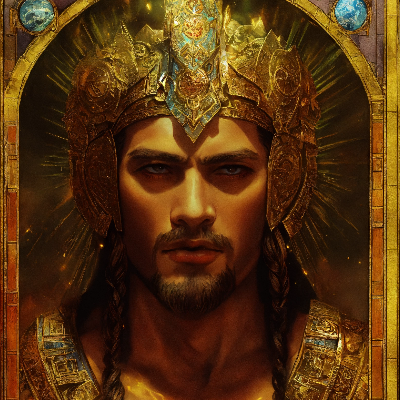
Rishabha — Sage-King, Avatara, and Father of the Bharata Lineage
Rishabha · Rishabhadeva · Vrishaba · Ajanabandhava · Nabhija · Nabheya · Paramahansa · Maharishi · Yogishvara
Rishabha is one of the most celebrated figures in Puranic literature, revered as a great sage-king, a supreme renunciant, and in the Vaishnava tradition as an avatara of Vishnu who descended to demonstrate the path of liberation. He is the son of Nabhi, the eldest among the nine sons of the patriarch Agnidhara and the apsara Purvachitti, and of Merudevi, the daughter of the lord of the cosmic mountain Meru. Rishabha was born after his father Nabhi performed a great sacrifice at which Vishnu himself appeared and granted the boon of a son equal to himself in all qualities — a request Vishnu fulfilled by taking birth as Rishabha. After ruling as a great emperor and fathering one hundred sons, Rishabha renounced his throne, abandoned all social convention, and wandered as a naked ascetic until he attained final liberation. His eldest son Bharata, who succeeded him as emperor, gave the subcontinent its enduring name of Bharatavarsha. Rishabha is also regarded in the Jain tradition as the first of the twenty-four Tirthankaras, making him one of the rare figures in Indian religious history whose significance spans two entirely distinct canonical traditions. His primary appearances are in the Bhagavata Purana, the Vishnu Purana, and the Skanda Purana, and he is extensively celebrated in Jain canonical literature.
✦ The Name
Rishabha derives from the Sanskrit word for bull, the male of the bovine species, and by extension means the best, the foremost, or the most excellent among a group — a common Sanskrit usage in which the bull serves as a metaphor for supremacy within any category. The name thus designates Rishabha as the foremost among men and among sages. The epithet Nabheya or Nabhija means son of Nabhi, marking his filial relationship to his father. Ajanabandhava, meaning the kinsman or protector of those without a master, reflects his role as a universal teacher and liberator. Yogishvara means the lord of yogins, signifying his supreme mastery of ascetic and contemplative discipline. The epithet Paramahansa, meaning the supreme swan, is applied to wandering renunciants of the highest order who have transcended all social and ritual identity; its application to Rishabha marks the culmination of his ascetic life.
✦ Lineage
- Paternal grandfather: Agnidhara, son of Priyavrata and king of Jambudvipa, who divided that continent among his nine sons.
- Paternal great-grandfather: Priyavrata, son of Svayambhuva Manu and an ascetic-king of the earliest cosmic age.
- Father: Nabhi, the eldest son of Agnidhara, sovereign of the Hima region of Jambudvipa, celebrated for the great sacrifice through which he obtained Rishabha as his son.
- Mother: Merudevi, daughter of the lord of the great cosmic mountain Meru, wife of Nabhi.
- Spouse: Jayanti, described in the Bhagavata Purana as a daughter of Indra, the king of the gods, given to Rishabha at Indra's own initiative.
- Sons: One hundred sons are attributed to Rishabha in the Bhagavata Purana. The eldest, Bharata, was a great emperor who renounced his kingdom and devoted himself to spiritual practice; the subcontinent Bharatavarsha takes its name from him. The second through ninth sons — Kushavarta, Ilavarta, Brahmavarta, Aruna, Malaya, Ketu, Bhadrasena, and Indrasprik — were rulers of various territories. Nine of the sons, named Kavi, Havi, Antariksha, Prabuddha, Pippalayana, Avirhotra, Drumila, Chamasa, and Karabhajana, became great sages and wandering devotees of Vishnu, collectively known in the Bhagavata Purana as the Nava Yogendras or nine great yogin-sages. The remaining eighty-one sons are said to have become Brahmin priests and householders charged with the maintenance of Vedic rites.
✦ Birth and Divine Origin
The Bhagavata Purana narrates that Nabhi and Merudevi had long been without a son. Nabhi therefore conducted a great Vedic sacrifice with the assistance of learned priests, offering oblations with the specific desire of obtaining a son of supreme excellence. Vishnu appeared at the sacrifice in a luminous form, having been pleased by the sincerity and precision of the rites. When Nabhi and the officiating priests requested a son equal to Vishnu himself, Vishnu responded that no being could be born who was his equal, and that the only resolution to this request was for him to take birth himself as Nabhi's son. Vishnu accordingly entered the womb of Merudevi and was born as Rishabha. The Bhagavata Purana treats this birth as a full avatara, while some interpretations within the same tradition describe it as a partial manifestation. At his birth, Indra and the gods showered flowers upon the earth and celebrated the event.
✦ The Reign as Emperor
Rishabha grew into a prince of extraordinary capability. Indra, the king of the gods, was so impressed by his qualities that he offered his own daughter Jayanti as Rishabha's wife. Rishabha accepted and ruled his kingdom with justice and wisdom, fathering his hundred sons upon Jayanti. The Bhagavata Purana describes his reign as one of great prosperity and order, during which he instructed his sons and subjects in the principles of righteous living. His teachings to his sons, particularly to the eldest Bharata, form one of the philosophically significant passages of the fifth skanda of the Bhagavata Purana, in which Rishabha expounds the nature of the self, the folly of attachment to material pleasure, and the supreme value of association with holy persons. He taught that the human body, so difficult to attain, ought not to be wasted in the pursuit of the pleasures available to animals, but should be employed in the inquiry into the ultimate reality.
✦ The Renunciation
After instructing his sons and installing Bharata as his successor, Rishabha abandoned all the trappings of kingship and undertook the life of a naked wandering ascetic. The Bhagavata Purana describes in considerable detail his extraordinary mode of renunciation: he wandered without speaking, without washing, without acknowledging any social distinction, eating whatever fell into his mouth without seeking food, lying down wherever night found him, behaving in outwardly unconventional ways that concealed his inner state of complete absorption in the supreme reality. This mode of conduct is described as resembling that of a python — utterly indifferent to external circumstances. He wandered through the kingdoms of Bharata in this state, treated variously with reverence, mockery, and abuse, but remaining entirely unmoved by all of it. The Bhagavata Purana draws explicit attention to this as a demonstration of the state of the Paramahansa, the highest order of renunciant, who has entirely dissolved the sense of individual identity.
✦ The Death of Rishabha
The Bhagavata Purana narrates that Rishabha ultimately entered the Kutajakachala forest in the region of present-day Karnataka. There, a great forest fire broke out, and Rishabha, wholly absorbed in the supreme reality and indifferent to the fate of his body, made no effort to escape. He was consumed by the fire and attained final liberation, his body dissolving in the flames. This account is given as the conclusion of the Rishabha narrative in the fifth skanda of the Bhagavata Purana. The manner of his death — unresisting, absorbed, and indifferent — is presented as the culmination of his lifelong demonstration of complete non-attachment.
✦ The Nava Yogendras
Among Rishabha's hundred sons, nine attained the status of great wandering sages devoted to Vishnu. These nine, named Kavi, Havi, Antariksha, Prabuddha, Pippalayana, Avirhotra, Drumila, Chamasa, and Karabhajana, are collectively celebrated in the Bhagavata Purana as the Nava Yogendras. In the eleventh skanda of the same text, these nine sages appear before the king Nimi and each delivers a discourse on the nature of devotion to Vishnu and the path of liberation. Their teachings constitute one of the important philosophical sections of the Bhagavata Purana. The fact that nine of Rishabha's one hundred sons became wandering Vaishnava sages is treated in the text as a direct fruit of their birth to a father who was himself an avatara of Vishnu.
✦ Textual Variants and Inconsistencies
The Bhagavata Purana presents Rishabha unambiguously as an avatara of Vishnu, born to demonstrate the path of liberation through the example of perfect renunciation. The Vishnu Purana also mentions Rishabha as a great king and the father of Bharata but does not elaborate his story at comparable length or describe his renunciation in the same detail. The Skanda Purana and several Upapuranas mention Rishabha in genealogical contexts. The most significant textual divergence involves the Jain canonical tradition, which regards Rishabha — known in that tradition as Rishabhadeva or Adinatha, the first lord — as the first of the twenty-four Tirthankaras, the ford-makers or liberated beings who teach the path of liberation in each cosmic cycle. In the Jain account, Rishabha is a fully human figure of immense antiquity who attained omniscience through his own austerities and taught the principles of non-violence, truth, and non-attachment. The Jain tradition does not share the Vaishnava account of Rishabha's identity as an avatara of Vishnu; the two traditions preserve parallel accounts of what they both acknowledge to be the same great figure, but interpret his nature and significance in ways that are theologically incompatible. Several Puranas, including the Bhagavata Purana itself, acknowledge that the practices and followers of Rishabha gave rise to a religious movement identified as distinct from Vedic tradition, which some scholars have understood as an early Puranic acknowledgment of the Jain community.
✦ Theological and Philosophical Significance
Within the Vaishnava tradition as expressed in the Bhagavata Purana, Rishabha's significance is primarily as an exemplar of the path of renunciation and knowledge leading to liberation. Unlike many avataras whose principal purpose is the destruction of a particular demon or the restoration of cosmic order, Rishabha's avatara is described as a teaching descent: he took birth in order to demonstrate by personal example how a human being ought to live, renounce, and ultimately attain freedom from the cycle of birth and death. His instructions to his sons in the fifth skanda of the Bhagavata Purana are among the most philosophically concentrated passages in that text, touching on the nature of the self, the bondage created by material desire, and the liberating power of devotion and wisdom. His mode of ascetic wandering after renunciation is presented as a model of the Paramahansa state, the condition of one who has wholly transcended social identity and rests in unmediated awareness of the supreme reality.
✦ Connection to the Wider Genealogy
Rishabha stands at a genealogically pivotal position in the Puranic lineage structure. He is the grandson of Agnidhara and the great-grandson of Priyavrata, placing him in the fifth generation from Brahma through the Svayambhuva line. Through his eldest son Bharata, who succeeded him as emperor and gave his name to the continent, Rishabha is the remote ancestor of the entire subsequent history of Bharatavarsha. The many royal dynasties whose genealogies the Puranas trace — Solar, Lunar, and others — are all said to inhabit and rule the land that takes its name from Rishabha's son. In this sense, Rishabha is the common genealogical ancestor of all the figures whose narratives fill the Puranas and the two great epics, the Mahabharata and the Ramayana, insofar as all of them live in and rule a land named after his son.
✦ References
- Bhagavata Purana, Skanda 5, Chapters 1–6: The principal and most detailed source for Rishabha's birth, parentage, marriage to Jayanti, his hundred sons, his teachings to Bharata and the other sons, his renunciation, his wandering as a Paramahansa, and his death in the forest fire. Also the source for the identification of Rishabha as an avatara of Vishnu.
- Bhagavata Purana, Skanda 11, Chapters 2–5: The source for the discourses of the nine sage-sons of Rishabha, the Nava Yogendras, before the king Nimi.
- Vishnu Purana, Book 2, Chapter 1: Mentions Rishabha as the son of Nabhi and the father of Bharata in the genealogical account of the Priyavrata line.
- Skanda Purana: Contains further references to Rishabha in genealogical and devotional contexts.
- Jain canonical literature (Acaranga Sutra, Kalpa Sutra, and Adipurana of Jinasena): Presents the Jain account of Rishabhadeva as the first Tirthankara, an account parallel to but theologically distinct from the Vaishnava Puranic account.
- Vettam Mani, Puranic Encyclopaedia (1975): Modern reference summarising Rishabha's genealogy, his role as an avatara, and his place in the Puranic lineage system.
- A. D. Pusalker, Studies in the Epics and Puranas (1955): Scholarly discussion of the relationship between the Puranic Rishabha and the Jain Rishabhadeva.