
About
Bharata — Emperor, Renunciant, and Namesake of Bharatavarsha
Bharata · Bharata Chakravartin · Jadabharata · Mahabhagavata · son of Rishabha · Rishabhanuja · Jada
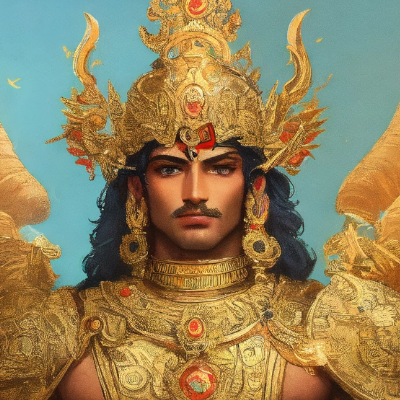
Bharata is the eldest son of Rishabha, the great sage-king and avatara of Vishnu, and of Jayanti, the daughter of Indra, the king of the gods. He is one of the most celebrated figures of the Bhagavata Purana and holds a position of singular importance in the Puranic tradition for two distinct reasons: first, the entire subcontinent known as Bharatavarsha — the land that is the setting for the Mahabharata, the Ramayana, and the vast majority of Puranic narrative — takes its name from him; and second, his own spiritual biography across multiple lifetimes, as narrated at length in the fifth skanda of the Bhagavata Purana, constitutes one of the most psychologically and philosophically detailed accounts of spiritual struggle, failure, and ultimate attainment in all of Puranic literature. Bharata is the great-grandson of Agnidhara, the great-great-grandson of Priyavrata, and stands in the sixth generation from Brahma through the Svayambhuva line. His principal appearances are in the Bhagavata Purana, the Vishnu Purana, the Markandeya Purana, and the Vayu Purana.
✦ The Name
Bharata derives from the Sanskrit root bhr, meaning to bear, to carry, to maintain, or to nourish. The name thus designates one who bears or maintains — a fitting name for a sovereign who bears the burden of righteous governance and for an ancestor who sustains the lineage from which so much of subsequent tradition flows. The epithet Chakravartin means the wheel-turner, designating a universal emperor whose sovereignty extends in all directions without obstruction. The epithet Jadabharata, meaning the inert or dull Bharata, is applied to him specifically in the context of his third lifetime, when he adopted the appearance of a mentally deficient person to conceal his spiritual attainment from the world; Jada means inert, stupid, or apparently senseless. Mahabhagavata means the great devotee of Bhagavan, that is, of Vishnu, and reflects his ultimate spiritual status.
✦ Lineage
- Paternal great-grandfather: Agnidhara, son of Priyavrata and king of Jambudvipa, who divided that continent among his nine sons.
- Paternal grandfather: Nabhi, eldest son of Agnidhara, sovereign of the Hima region of Jambudvipa, at whose great sacrifice Vishnu agreed to be born as Rishabha.
- Father: Rishabha, born as an avatara of Vishnu to Nabhi and Merudevi, a great sage-king who renounced his throne and wandered as a naked ascetic until he attained liberation in a forest fire; regarded in the Vaishnava tradition as a full avatara of Vishnu and in the Jain tradition as the first Tirthankara.
- Mother: Jayanti, daughter of Indra, the king of the gods, given in marriage to Rishabha by her father.
- Brothers: Ninety-nine brothers in total. Among the more individually named are Kushavarta, Ilavarta, Brahmavarta, Aruna, Malaya, Ketu, Bhadrasena, and Indrasprik, who ruled various kingdoms. Nine brothers — Kavi, Havi, Antariksha, Prabuddha, Pippalayana, Avirhotra, Drumila, Chamasa, and Karabhajana — renounced worldly life and became great wandering sages devoted to Vishnu, known collectively as the Nava Yogendras. The remaining eighty-one became Brahmin priests and householders.
- Spouse: The Bhagavata Purana does not name Bharata's wife in its primary narrative of his life. The Markandeya Purana and Vayu Purana mention sons attributed to Bharata in genealogical lists, implying a marriage, but the wife's name and identity are not recorded in these sources.
- Sons: The Vishnu Purana and Vayu Purana name Sumati as a son of Bharata through whom the subsequent lineage of rulers continues. Some Puranic genealogical lists name additional sons, but these vary across texts and are not consistent.
✦ The Reign as Chakravartin
After Rishabha installed Bharata as his successor and departed to live as a wandering ascetic, Bharata ruled the entire earth as a Chakravartin — a universal emperor whose authority was unchallenged across all directions. The Bhagavata Purana describes his reign as one of great righteousness and prosperity. He performed many Vedic sacrifices, including the Ashvamedha, the horse sacrifice that asserted sovereign dominion over all territories, dedicating the merit of these rites to Vishnu. He ruled for a very long period and distributed his kingdom's wealth generously. His reign is presented as the model of righteous universal sovereignty, and it is from this reign that the subcontinent received the name Bharatavarsha — the land or realm of Bharata — a name that displaced the earlier designation of the region as Hima or Himahva, the name it had borne as the portion assigned to Nabhi by Agnidhara.
✦ The Renunciation and the Deer
The most philosophically significant portion of Bharata's narrative in the Bhagavata Purana concerns not his reign but what followed his renunciation. After many years of rule, Bharata appointed his sons as governors of various regions, renounced his throne, and retired to the forest hermitage of Pulaha on the banks of the river Gandaki to practise austerities and devote himself to meditation on Vishnu. He lived there in great simplicity, spending his days in worship, meditation, and the gathering of wild fruits and roots. One day, as he sat by the river after bathing, a pregnant deer came to drink from the water. At that moment a lion roared nearby, and the deer, startled, leapt across the river. In mid-leap she gave birth to a fawn, and the effort of the leap and the shock of the lion's roar caused her death as she landed. The newborn fawn fell into the river. Bharata, observing this, waded in and retrieved the fawn, and from that moment became deeply attached to the young animal. He raised it with great care and affection, constantly watching over it, following it when it strayed, grieving when it was absent, and allowing his meditation and austerities to lapse as his attention shifted entirely to the deer. The Bhagavata Purana presents this episode with great narrative and psychological precision: Bharata, who had renounced an empire without attachment, found himself bound by affection to a single small animal — demonstrating that the subtle tendency toward attachment can reassert itself even in an advanced renunciant if vigilance is relaxed. When Bharata died, his mind was absorbed in concern for the deer, and accordingly his next birth was as a deer.
✦ The Second Life as a Deer
The Bhagavata Purana narrates that by virtue of the spiritual merit accumulated in his previous life as the emperor Bharata, the soul of Bharata retained memory of its prior existence even while inhabiting the body of a deer. This memory produced in the deer a profound grief and a constant awareness of its fallen condition — the consequence of having allowed attachment to overcome spiritual discipline. The deer-Bharata spent his life near the ashrama of Pulaha, the same hermitage where the emperor Bharata had practised austerities, and at the end of that life was reborn as a human being for a third time, having partially exhausted the karmic consequence of his lapse.
✦ The Third Life as Jadabharata
In his third life, Bharata was born as the son of a learned Brahmin named Angira in the land of Ujjayini. From the very beginning of this life he retained the spiritual awareness accumulated across his previous existences. Acutely conscious of the danger that attachment to family and social role posed — the same danger that had undone his first renunciation — he deliberately adopted the outward behaviour of a dull, inert, and apparently unintelligent person. He performed no rituals, observed no social customs, responded to neither praise nor insult, ate whatever was placed before him without preference, and showed no interest in the ordinary concerns of life. His father, who was a learned man, attempted to educate him and perform his sacred thread ceremony and other rites of passage; Bharata submitted to these mechanically but without any apparent comprehension or engagement. When his father died, his stepbrothers and their wives, dismissing him as a worthless fool, assigned him only the most menial agricultural labour and fed him whatever was left over from their own meals. He bore all of this without complaint or reaction.
The Bhagavata Purana narrates two famous episodes from this third life. In the first, Jadabharata was seized by a band of followers of the goddess Kali who intended to sacrifice him to their deity. They brought him to the temple, performed preparatory rites, and were on the point of killing him when the Bhagavata Purana describes the goddess herself emerging in fury and destroying the wicked sacrificers, saving Jadabharata, who throughout the entire episode remained completely unmoved and unafraid.
In the second and more celebrated episode, Jadabharata was engaged as a palanquin-bearer by the retinue of the king Rahugana of the Sindhu-Sauvira region. Jadabharata, while carrying the palanquin, repeatedly slowed and disrupted the pace of the other bearers because he was carefully stepping around insects and small creatures on the road, unwilling to take any life. When the king demanded an explanation for the erratic pace, his officials brought Jadabharata before him. Rahugana rebuked him sharply. Jadabharata then delivered one of the most extended and philosophically significant discourses in the fifth skanda of the Bhagavata Purana: a sustained teaching on the nature of the self, the illusory character of social identity, the false distinction between king and servant, the nature of bondage and liberation, and the supreme reality of Vishnu as the innermost self of all beings. Rahugana, initially contemptuous, was progressively humbled and finally overwhelmed by the depth and clarity of the teaching. He descended from his palanquin, fell at Jadabharata's feet, and asked to become his disciple. Jadabharata then completed his teaching, and Rahugana attained knowledge. Following this episode, Jadabharata is said to have remained in his state of complete inner liberation until the end of that life.
✦ Theological and Philosophical Significance
The narrative of Bharata across his three lives is one of the most carefully constructed didactic accounts in the Bhagavata Purana. It addresses several of the central concerns of that text with unusual depth and narrative vividness. The episode of the deer illustrates the doctrine that the mind's final preoccupation at the moment of death determines the conditions of the next birth, a teaching that appears in various forms across Upanishadic and Puranic literature. The narrative of the deer-life illustrates that accumulated spiritual merit is not entirely lost across births and that memory of one's condition can itself become an instrument of continued spiritual development. The life of Jadabharata illustrates the state of one who has attained inner liberation but conceals it beneath a social disguise — a figure known in Sanskrit literature as an avadhuta, a being who has shed all social identity — and the encounter with Rahugana demonstrates that such a concealed sage may still function as a teacher when circumstances require. The discourse delivered to Rahugana is among the philosophically densest passages in the entire Bhagavata Purana, drawing on Samkhya categories, Vedantic insight into the nature of the self, and Vaishnava devotional theology.
✦ Textual Variants and Inconsistencies
The Bhagavata Purana is the principal and most elaborate source for the three-life narrative of Bharata, including the deer episode, the deer-life, and the life of Jadabharata. The Vishnu Purana mentions Bharata as the son of Rishabha and the sovereign from whom Bharatavarsha received its name, but does not elaborate his personal spiritual biography at comparable length. The Vayu Purana and Markandeya Purana treat Bharata primarily in genealogical terms, naming his sons and descendants, without the three-life narrative. Some genealogical Puranas give variant lists of Bharata's sons, and the name Sumati appears as his principal son and successor in the Vishnu Purana, while other texts give different names. There is no inconsistency among the major Puranas regarding Bharata's identity as the son of Rishabha and the namesake of the subcontinent; the variation concerns primarily the extent to which his personal spiritual narrative is elaborated.
✦ Connection to the Wider Genealogy
Bharata stands in the sixth generation from Brahma, descending through Svayambhuva Manu, Priyavrata, Agnidhara, Nabhi, and Rishabha. He is the figure who transformed a geographic region — the territory allotted to his grandfather Nabhi as the Hima varsha of Jambudvipa — into a named civilisational domain bearing his own name: Bharatavarsha. All the royal lineages, sages, cities, rivers, and events described in the subsequent Puranic and epic tradition are situated within this land. Through his son Sumati and the line that descends from Sumati, Bharata is the genealogical root of the Puranic genealogical traditions that connect to the Solar and Lunar dynasties and to all the kings and heroes of the Mahabharata and Ramayana period. In this sense, while the Puranic genealogies of the Solar and Lunar dynasties trace their divine origins to the sun-god Vivasvat and the moon-god Soma respectively, they are all inhabitants and sovereigns of the land that takes its name from Bharata son of Rishabha.
✦ References
- Bhagavata Purana, Skanda 5, Chapters 7–14: The primary and most detailed source for the complete narrative of Bharata across his three lives — as emperor, as a deer, and as Jadabharata — including the episode of the fawn, the encounter with the Kali worshippers, and the extended philosophical discourse delivered to King Rahugana.
- Vishnu Purana, Book 2, Chapter 1: Identifies Bharata as the son of Rishabha and the sovereign from whom Bharatavarsha derives its name; provides genealogical succession through Sumati.
- Vayu Purana: Treats Bharata in a genealogical context, listing sons and descendants without the three-life spiritual narrative.
- Markandeya Purana: References Bharata in genealogical lists connecting the Rishabha line to subsequent dynastic history.
- Vettam Mani, Puranic Encyclopaedia (1975): Modern reference summarising Bharata's genealogy, his three lives, and his role as the namesake of Bharatavarsha.
- A. D. Pusalker, Studies in the Epics and Puranas (1955): Scholarly discussion of the Bharata narrative and its position in the Puranic genealogical framework.