
About
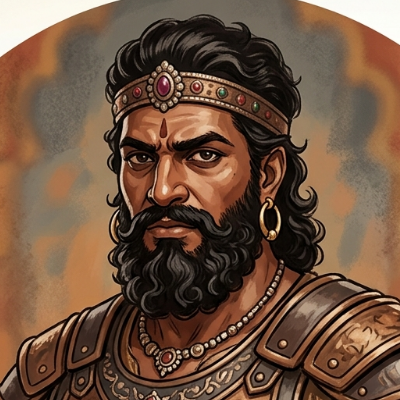
Chitravahana — King of Manipura and Father of Chitrangada
Chitravahana · Chitrabahana · King of Manipura · Father of Chitrangada · Descendant of Prabhanjana
Chitravahana was the king of Manipura, a kingdom situated in the northeastern regions of Bharatavarsha, and the father of Chitrangada, the princess who became one of the wives of Arjuna, the third of the five Pandava brothers and the foremost archer of his age. He was the husband of Vasundhara, named in supplemental Puranic and regional traditions as his consort and the mother of Chitrangada. He appears in the Adi Parva of the Mahabharata in the account of Arjuna's twelve-year pilgrimage to sacred tirthas, during which Arjuna arrived at Manipura, encountered Chitrangada, and sought her hand in marriage. Chitravahana agreed to the marriage on the condition that the son born of the union would remain at Manipura as his heir rather than departing with Arjuna to the Pandava kingdom — a condition rooted both in Chitravahana's lack of male heirs and in a dynastic restriction originating in a boon granted by the god Shiva to his ancestor King Prabhanjana, which ensured that every descendant of the Manipura royal line would have only one child to continue it. The son born of Chitrangada and Arjuna was Babhruvahana, who became king of Manipura and who later, in the Ashvamedha Parva of the Mahabharata, killed his own father Arjuna in single combat during the ashvamedha horse sacrifice before Arjuna was restored to life through the intervention of Ulupi, a Naga princess and another of Arjuna's wives.
✦ The Name
The name Chitravahana is a Sanskrit compound of chitra, meaning variegated, bright, wonderful, or distinguished, and vahana, meaning vehicle, conveyance, or that which carries. The compound thus carries the sense of one whose vehicle or mount is bright or distinguished, a name type common among royal figures in the epic tradition where the nature of a king's chariot, horse, or conveyance could function as an identifying mark of his power and status. An alternate form of the name, Chitrabahana, appears in some recensions of the Mahabharata, where bahana may reflect a regional or scribal variant of vahana rather than a distinct etymological root. The two forms refer to the same figure and the variation is orthographic rather than indicative of a distinct alternate identity.
✦ Lineage
- Kingdom: Manipura — a kingdom in the northeastern regions of Bharatavarsha; its precise identification with any modern geographic location is a matter of scholarly discussion, though the name Manipura persists in the northeastern region of the Indian subcontinent
- Ancestor: Prabhanjana — a king of the Manipura royal line, described in supplemental Puranic and regional traditions as the ancestor to whom the god Shiva granted a boon ensuring that every descendant of his race would produce only one child to continue the lineage; this boon established the structural constraint that governed Chitravahana's dynastic situation and made the putrika arrangement for Chitrangada's marriage a dynastic necessity rather than merely a personal preference
- Wife: Vasundhara — named in supplemental Puranic and regional traditions as the consort of Chitravahana and the mother of Chitrangada; her name derives from the Sanskrit vasundhara, meaning she who holds or bears riches or treasures, a common feminine name of auspicious connotation in the Sanskrit tradition; she is not independently named in the core Mahabharata text itself
- Daughter: Chitrangada — princess of Manipura; became one of the wives of Arjuna, the third of the five Pandava brothers, son of the god Indra and Kunti; mother of Babhruvahana, who inherited the Manipura throne as Chitravahana's heir in accordance with the condition of the marriage
- Grandson: Babhruvahana — son of Chitrangada and Arjuna; raised at Manipura as Chitravahana's heir; became king of Manipura; killed Arjuna in combat during the ashvamedha horse sacrifice performed by Yudhishthira after the Kurukshetra war, after which Arjuna was restored to life through the intervention of Ulupi, a Naga princess and another of Arjuna's wives, who used a divine gem to revive him
✦ The Boon of Prabhanjana and the Dynastic Constraint
Supplemental Puranic and regional traditions record that the dynastic situation of the Manipura royal line — in which each ruler had only a single child to continue the succession — was not a matter of chance or circumstance but the direct consequence of a boon granted by the god Shiva to Chitravahana's ancestor King Prabhanjana. The precise content and occasion of the boon as preserved in these traditions is that every descendant of Prabhanjana's race would have only one child to carry the line forward. The nature of this restriction meant that Chitravahana, having only the one daughter Chitrangada and no son, faced the extinction of his lineage unless the child born of Chitrangada was formally designated as his heir rather than as the heir of her husband's line.
This ancestral boon therefore provides the deeper explanatory context for the condition Chitravahana imposed upon Arjuna at the time of the marriage negotiation. The putrika arrangement — by which the son of Chitrangada would belong to the Manipura line rather than to the Pandava line — was not merely a dynastic preference of Chitravahana's own devising but a necessity arising from the structural constraint placed upon his entire royal house by the Shiva boon generations earlier. The Mahabharata's Adi Parva presents the condition in practical terms without elaborating its theological or ancestral basis in the core text, but the supplemental traditions supply this background and render Chitravahana's position as one of obligation as much as of desire.
✦ The Dynastic Custom and the Condition of the Marriage
When Arjuna arrived at Manipura and sought Chitrangada's hand, Chitravahana presented the condition of the marriage directly and without ambiguity: the son born of the union would remain at Manipura as his heir and would continue the Manipura royal line rather than being taken to Indraprastha as a Pandava prince. This arrangement, known in the dharmashastra literature as the putrika or putrikaputra practice, was a recognised mechanism in ancient Indian law and custom for a man without male heirs to secure the continuation of his own lineage through a daughter's son formally designated as his heir.
The Mahabharata presents Arjuna as accepting this condition without recorded objection, the marriage as taking place on these terms, and Arjuna as remaining at Manipura for three years before resuming his pilgrimage and departing without the child. The text does not record any subsequent visit by Chitravahana to the Pandava court or any further contact between Chitravahana and Arjuna after the pilgrimage episode.
✦ Chitravahana and Babhruvahana
The condition Chitravahana imposed upon the marriage was fulfilled: Babhruvahana was raised at Manipura as the grandson and heir of Chitravahana, growing up in the northeastern kingdom rather than among the Pandavas. Chitravahana's role as the grandfather who raised Babhruvahana is implied by the dynastic arrangement, though the Mahabharata does not narrate the details of Babhruvahana's upbringing or describe Chitravahana's relationship with his grandson in any personal terms. By the time of the ashvamedha horse sacrifice narrated in the Ashvamedha Parva — which takes place after the Kurukshetra war, years after the events of the Adi Parva — Chitravahana is not mentioned as a living figure, and Babhruvahana is described as the reigning king of Manipura, suggesting that Chitravahana had died by that point, though the Mahabharata does not record the circumstances of his death.
✦ Textual Variants and Limitations
The core Mahabharata text in the Adi Parva presents Chitravahana's condition for the marriage in practical dynastic terms without naming his wife or elaborating the ancestral origin of the one-child restriction. The identification of Vasundhara as his consort and the account of the Shiva boon granted to Prabhanjana belong to supplemental Puranic and regional traditions rather than to the Sanskrit epic itself, and should be understood as material that enriches and explains the core narrative without being directly attested in the Adi Parva. The alternate name form Chitrabahana appears in some manuscript traditions but contributes no additional biographical information. Where the supplemental traditions are drawn upon in this profile, they are identified as such, in accordance with the standard of source honesty required of this reference series.
✦ Connection to the Wider Genealogy
Through his daughter Chitrangada and her marriage to Arjuna, Chitravahana established a genealogical connection between the Manipura royal line and the Pandava-Kuru dynasty that became significant in the post-war period of the Mahabharata. His grandson Babhruvahana, the son of Chitrangada and Arjuna, was simultaneously the heir of the Manipura throne through the matrilineal arrangement Chitravahana had insisted upon and the son of one of the five Pandava brothers. Arjuna's other sons included Abhimanyu — born of Subhadra, the sister of Krishna, the Yadava prince revered as an avatar of the god Vishnu — whose son Parikshit inherited the Kuru throne after the Kurukshetra war, and Iravan, born of the Naga princess Ulupi. Babhruvahana was thus the half-brother of Abhimanyu and Iravan, though his identity and inheritance were defined by Manipura rather than by the Kuru lineage. The Shiva boon to Prabhanjana, which constrained the Manipura royal house to a single heir per generation, is the theological and dynastic foundation upon which Chitravahana's entire negotiating position with Arjuna rested, and its presence in the supplemental tradition gives the marriage condition its full genealogical and religious significance.
✦ References
- Mahabharata, Adi Parva (Book 1), chapters 206–208: Primary source for Chitravahana in the core epic; narrates Arjuna's arrival at Manipura, Chitravahana's presentation of the dynastic condition, Arjuna's acceptance, and the establishment of the marriage between Arjuna and Chitrangada; does not name Vasundhara or elaborate the ancestral boon of Prabhanjana.
- Mahabharata, Ashvamedha Parva (Book 14), chapters 79–83: Records the ashvamedha episode at Manipura including Babhruvahana's combat with Arjuna and the aftermath; Chitravahana is not mentioned by name in this section, but the dynastic arrangement he established is the structural basis for Babhruvahana's position as king of Manipura.
- Supplemental Puranic and regional traditions: Source for the identification of Vasundhara as Chitravahana's consort and for the account of the Shiva boon granted to the ancestor Prabhanjana establishing the one-child-per-generation restriction on the Manipura royal line; these traditions supplement rather than contradict the core Mahabharata account and are identified as supplemental throughout this profile.
- Kane, P. V., History of Dharmashastra, Vol. 3 (1946): Discusses the putrika and putrikaputra institutions in ancient Indian law and custom, supplying the legal and social framework within which Chitravahana's condition for the marriage of Chitrangada should be understood; does not discuss Chitravahana directly but provides essential context for the dynastic arrangement he imposed.
- Vettam Mani, Puranic Encyclopaedia (1975): Entry on Chitravahana identifies him as king of Manipura and father of Chitrangada and references the dynastic background including the ancestral boon; synthesises material from both the core epic and supplemental traditions.