
About
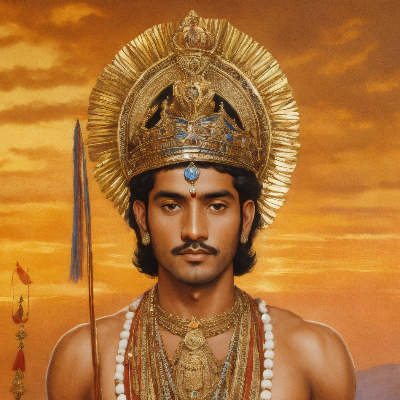
Mandhata — Universal Emperor of the Ikshvaku Dynasty and Son of Yuvanashva
Mandhata · Mandhatri · Yauvanashvin · Son of Yuvanashva · Trasadasyu · Chakravarti
Mandhata, also written Mandhatri, was one of the most celebrated kings of the Ikshvaku solar dynasty of Ayodhya, described across the Mahabharata, the Ramayana, the Vishnu Purana, the Bhagavata Purana, the Matsya Purana, the Harivamsha, and other texts as a universal emperor or chakravarti who conquered the entire earth and extended his dominion into the underworld and portions of the heavens. He was the son of Yuvanashva, king of Ayodhya, and — according to the Harivamsha and Matsya Purana — of his wife Gauri, daughter of Matinara of the Puru lunar dynasty, though the Vishnu Purana and Bhagavata Purana record a miraculous birth from Yuvanashva's own body. He married Bindumati Chaitrarathi, daughter of the Yadava king Shashabindu, and fathered three sons — Purukutsa, Ambarisha, and Muchukunda — as well as fifty daughters who became the wives of the sage Soubhari. Hymn 134 of the tenth Mandala of the Rigveda is attributed to him in the tradition. He is invoked throughout the Mahabharata as an exemplar of the ideal universal king, and his legend is also found in Buddhist Jataka literature where he appears as Mandhatu, a past life of the Bodhisattva.
✦ The Name
The name Mandhata is explained in the Vishnu Purana and Bhagavata Purana through the miraculous birth story: when the child was born from Yuvanashva's body and the question arose of who would nurse him, Indra, the king of the gods, declared mam dhata — meaning I will sustain him or I will be his nurse — and from these words the child received his name. This etymology is understood by H. H. Wilson and other commentators as a likely secondary or folk derivation constructed to explain an existing name rather than as a historically reliable account of how the name originated. The epithet Yauvanashvin means son of Yuvanashva and functions as a patronymic identifier throughout the texts. The epithet Trasadasyu, meaning one who causes terror to the wicked or one whom the wicked fear, appears in some texts as an alternate name or honorific. The designation Chakravarti, meaning wheel-turner or universal emperor, is applied to him as a description of his achievement rather than as a personal name.
✦ Lineage
- Dynasty: Ikshvaku solar dynasty of Ayodhya, one of the two great royal lines of ancient Bharatavarsha, descended from Manu through Ikshvaku
- Father: Yuvanashva — king of Ayodhya of the Ikshvaku line; childless until the miraculous birth episode; his own genealogy traces back through Kakutstha and several generations of solar kings to Ikshvaku and Manu
- Mother (per Harivamsha and Matsya Purana): Gauri — daughter of Matinara, a king of the Puru lunar dynasty descended from Raudrasva and Richeyu; named as Mandhata's natural mother in these sources
- Nurse (per Vishnu Purana and Bhagavata Purana): Indra — the king of the gods; declared himself the sustainer of the newborn Mandhata in the miraculous birth account; nourished the child with divine sustenance from his finger
- Wife: Bindumati Chaitrarathi — daughter of Shashabindu, king of the Yadavas and grandson of Chitraratha; her patronymic Chaitrarathi indicates her descent from Chitraratha; through this marriage Mandhata was connected to the Yadava royal line, the dynasty from which Krishna was later born
- Sons: Purukutsa — the eldest son, who continued the main Ikshvaku line and is associated in the Puranas with an episode involving the Naga people of the Narmada river; Ambarisha — a celebrated king renowned for his devotion to Vishnu, whose story is narrated at length in the Bhagavata Purana; Muchukunda — a warrior king who slept for a vast period after assisting the gods in battle and whose waking destroyed the Yavana king Kalayavana, an episode narrated in connection with the early life of Krishna
- Daughters: Fifty daughters — all married to the sage Soubhari, an episode narrated in the Vishnu Purana and Bhagavata Purana as an illustration of the sage's unexpected turn toward worldly life after a period of ascetic practice
✦ Birth and Early Life
The two irreconcilable traditions about Mandhata's birth are set out fully in the profiles of his parents Yuvanashva and Gauri in this series and are summarised here for completeness. The Vishnu Purana and Bhagavata Purana record that Mandhata was born from Yuvanashva's own body after the king accidentally drank water consecrated by sages for his wives, and that he was nourished by Indra who declared himself the child's nurse. The Harivamsha and Matsya Purana record instead that Gauri, Yuvanashva's wife and the daughter of the Puru king Matinara, was Mandhata's natural mother. The miraculous birth account is the more widely elaborated version in the tradition and has received greater circulation, but the alternative version with Gauri as natural mother is attested in early and significant sources and should not be dismissed.
In the miraculous birth narrative, Mandhata's growth after birth was extraordinarily rapid. Nourished by divine sustenance, he reached the appearance and stature of a much older child within days. The Puranas record that he acquired mastery of the Vedas and of all military sciences by divine grace without formal instruction, and that divine weapons and armour descended from the heavens to him of their own accord — including the Ajagava bow, said to have originally belonged to the god Shiva.
✦ The Universal Conquest
Mandhata is described across multiple texts as a chakravarti — a wheel-turner or universal emperor — whose sovereignty extended over the entire earth. The Mahabharata invokes him repeatedly in its catalogues of great kings as an exemplar of imperial power, generosity, and righteous rule. The Puranas record that by the mere power of his will he was able to cause rain and ensure abundance, and that he abolished taxes because his sovereign power made them unnecessary. He is said to have conquered the earth in a single day by the force of his intention alone.
His conquests included victories over numerous kings, among them Marutta, Asita, Angara — the king of the Druhyus — Nriga, Brihadratha, and Janamejaya. The defeat of the Druhyu king Angara is noted in some sources as having been connected to the alliance between the Ikshvaku line and the Puru line through Mandhata's maternal ancestry from Gauri and Matinara. His son Purukutsa subsequently continued the westward military expansion against the remnants of Druhyu power.
Mandhata also extended his dominion beyond the earth. He is said to have conquered Patala, the underworld, and to have ascended to Svarga, the heaven of Indra, where Indra granted him sovereignty over half the heavenly kingdom. His ambition, however, led him to desire the entire heaven, wishing to displace Indra and take sole rule of the celestial realm. This overreach brought about his downfall: the texts record that at the moment when Mandhata conceived the desire to overthrow Indra, he fell from heaven back to earth and died. The episode is preserved in the Buddhist Jataka tradition as the Mandhatu-jataka, where it serves as a teaching on the dangers of insatiable desire, and the same moral is implicit in the Puranic accounts.
✦ The Daughters and the Sage Soubhari
An episode narrated in the Vishnu Purana and the Bhagavata Purana involves Mandhata's fifty daughters and the sage Soubhari. Soubhari had been a great ascetic who had practiced severe austerities while living submerged in the Yamuna river. Observing the king of the fishes sporting joyfully with his mate, the sage was struck by a desire for domestic life. He approached Mandhata and requested the hand of one of his daughters. Mandhata was placed in a difficult position: declining the sage's request would risk his displeasure, but giving a daughter to an aged ascetic seemed unfitting. He offered Soubhari the choice of whichever daughter would agree to marry him.
Soubhari, by his ascetic power, transformed himself into a beautiful young man and presented himself to each of the fifty daughters in turn. Each was captivated by his appearance and wished to marry him. Faced with this outcome, Mandhata was compelled to give all fifty daughters to the sage. Soubhari established a palace of extraordinary luxury and lived with his fifty wives. He eventually recognised that this attachment to worldly pleasures had drawn him away from the path of liberation, renounced the household life, and returned to ascetic practice. The episode is used in both the Vishnu Purana and the Bhagavata Purana as a teaching on the seductive power of sensory attachment and the dangers it poses even to accomplished ascetics.
✦ The Rigvedic Attribution and the Name Trasadasyu
The tradition attributes Hymn 134 of the tenth Mandala of the Rigveda to Mandhata as its composer or seer. This attribution, if accepted, would place Mandhata among the small group of royal figures in the Vedic tradition who are credited with composing sacred hymns, a distinction that reinforces his status as an ideal king who combined martial, imperial, and spiritual excellence. The name Trasadasyu, which appears in some texts as an alternate name or epithet for Mandhata, is also the name of a Rigvedic king celebrated in other hymns, and some scholarly analysis has explored whether the Puranic Mandhata and the Rigvedic Trasadasyu represent the same historical or semi-historical figure under different names. The two names being applied to the same Puranic figure in the tradition suggests an attempt to identify the celebrated Puranic emperor with the Vedic king of that name.
✦ Mandhata in the Buddhist Tradition
Mandhata appears in the Buddhist Jataka literature as Mandhatu, identified as a past life of the Bodhisattva. The Mandhatu-jataka preserves an account broadly parallel to the Hindu Puranic tradition in its broad outline — a great chakravarti king who conquers the earth and is given half of Indra's heaven, then falls through the desire for more — and uses the story to illustrate the Buddhist teaching on the insatiability of craving and the inevitable end of all worldly achievement. The Buddhist account is independent of the Hindu Puranic tradition in its theological framing but draws on the same underlying legend, testifying to Mandhata's fame as a legendary figure across the religious traditions of ancient India.
✦ Connection to the Wider Genealogy
Mandhata occupies a central position in the Ikshvaku solar dynastic succession as the king whose reign marks the apex of the pre-Ramayana period of the solar line's glory. Through his three sons the succession divides: Purukutsa continues the main royal line toward the later Ikshvaku kings including Harishchandra, Sagara, Bhagiratha, and eventually Dasharatha and Rama; Ambarisha's devotional lineage is celebrated separately in the Bhagavata Purana; and Muchukunda's extraordinary story of long sleep and the destruction of Kalayavana connects the solar line to the early life narrative of Krishna. Through his maternal lineage from Gauri and Matinara of the Puru line, Mandhata carried lunar dynastic ancestry, and through his wife Bindumati Chaitrarathi he was connected to the Yadava royal house from which Krishna descended. His fifty daughters' marriage to the sage Soubhari created a connection to the brahminical ascetic tradition. Mandhata thus stands at a genealogical crossroads where the solar Ikshvaku line, the lunar Puru line through his mother, and the Yadava line through his wife all converge.
✦ References
- Vishnu Purana, Book 4, chapters 2–3: Primary source for the miraculous birth account, Mandhata's rapid growth, his conquests, his ascent to heaven, his desire to overthrow Indra, and his fall and death; also narrates the episode of the fifty daughters and the sage Soubhari.
- Bhagavata Purana, Skandha 9, chapters 6–7: Gives a version of the birth story and Mandhata's career consistent with the Vishnu Purana; the Soubhari episode is elaborated here with particular devotional emphasis; also contains the famous account of Ambarisha, Mandhata's son, in a later chapter.
- Harivamsha (appendix to the Mahabharata): Preserves the alternative birth tradition naming Gauri as natural mother; provides the genealogical context situating Mandhata within both the Ikshvaku and Puru dynastic traditions.
- Matsya Purana, chapters 12 and 49: Names Gauri as the mother of Mandhata; records Mandhata's place in the dynastic succession.
- Mahabharata, Vana Parva (Book 3), Drona Parva (Book 7), and Shanti Parva (Book 12): Invokes Mandhata repeatedly in catalogues of great kings and in discussions of ideal kingship as an exemplar of imperial power and dharmic rule; confirms his parentage through Yuvanashva and his status as a chakravarti.
- Ramayana, Bala Kanda: Includes Mandhata in the genealogy of the Ikshvaku solar line as an ancestor of Rama; confirms his position in the succession between Yuvanashva and the later Ikshvaku kings.
- Rigveda, Mandala 10, Hymn 134: Attributed to Mandhata as its composer in the traditional reckoning; cited in support of his standing as a royal sage alongside his imperial achievements.
- Mandhatu-jataka (Pali Buddhist canon): Preserves the Buddhist version of the Mandhata legend as a Jataka story illustrating the Buddhist teaching on the insatiability of craving; parallel to but theologically distinct from the Hindu Puranic accounts.
- H. H. Wilson, commentary on the Vishnu Purana (1840): Identifies the textual conflict between the miraculous birth account and the Matsya Purana and Harivamsha natural birth tradition; discusses the probable etymology of the name Mandhata and its relationship to the Indra episode.
- Vettam Mani, Puranic Encyclopaedia (1975): Entry on Mandhata synthesises the material from the Mahabharata, the Puranas, and the Harivamsha; records both birth traditions and the principal episodes of his reign.