
About
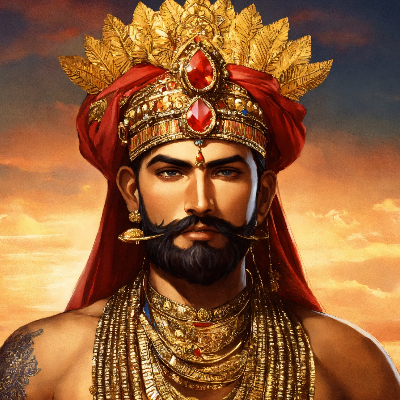
Shashabindu — Universal Sovereign of the Yadu Dynasty
Shashabindu · Sasabindu · Shashbindu
Shashabindu is one of the most celebrated kings of the Yadu dynasty in Puranic literature, described as a chakravartin — a universal sovereign who rules over the entire earth. He is the son of Chitraratha, who was himself the son of Rusadru, placing Shashabindu in a line of descent from Yadu, the eldest son of the lunar-dynasty emperor Yayati and his wife Devayani. Among Shashabindu's many children, his daughter Bindumati became the wife of the great Ikshvaku-dynasty emperor Mandhata. Shashabindu appears in the Bhagavata Purana, the Vishnu Purana, and is referenced in the Mahabharata's lists of great kings. He is remembered both as a sovereign of extraordinary power and wealth and as the father of an immense number of sons.
✦ The Name
The name Shashabindu is a compound formed from shasha, meaning hare or rabbit, and bindu, meaning drop or dot. The precise symbolic intent of the name is not elaborated in the primary texts, but the combination is distinctive and unusual. Some later commentators have associated the name with a mark or auspicious sign, though no authoritative etymology is provided within the canonical sources themselves.
✦ Lineage
- Father: Chitraratha — a king of the Yadu dynasty and son of Rusadru, a descendant of Yadu who was the eldest son of the emperor Yayati
- Sons: The Bhagavata Purana states that Shashabindu had ten thousand wives and from them an immense number of sons, of whom one hundred were especially distinguished; the Vishnu Purana similarly emphasises the vastness of his progeny without naming all of them individually
- Daughter: Bindumati — given in marriage to Mandhata, the celebrated emperor of the solar Ikshvaku dynasty, and mother of Purukutsa, Ambarisha, and Muchukunda
✦ As a Chakravartin
The Puranas describe Shashabindu as one of the great chakravartins — universal sovereigns regarded as having ruled the entire known world. He is listed alongside other legendary emperors such as Mandhata, Bharata, and Sagara in enumerations of world-rulers found in the Mahabharata and in various Puranas. His reign is characterised in these sources by unparalleled prosperity, vast territorial sovereignty, and an enormous royal household. The tradition of his ten thousand wives and his multitude of sons is repeated consistently across the Bhagavata and Vishnu Puranas as an index of his exceptional power and fortune.
✦ Connection to the Wider Genealogy
Through his daughter Bindumati's marriage to Mandhata, Shashabindu occupies a significant position in the intersection of the two great royal dynasties of the Puranic tradition. The Yadu dynasty, to which Shashabindu belongs, descends from the lunar line through Yadu, son of Yayati. The Ikshvaku dynasty, to which Mandhata belongs, descends from the solar line through Ikshvaku, son of Manu Vaivasvata. The children born of Bindumati and Mandhata — Purukutsa, Ambarisha, and Muchukunda — are therefore of dual royal descent, connecting both the solar and lunar streams of the Puranic genealogical tradition.
✦ References
- Bhagavata Purana, Skandha 9, Chapter 23: Records Shashabindu as a chakravartin and son of Chitraratha, describing the vastness of his wives and progeny.
- Vishnu Purana, Book 4, Chapter 12: Places Shashabindu in the Yadu genealogical succession and notes his status as a universal sovereign.
- Mahabharata, Shanti Parva and Adi Parva (genealogical lists): Includes Shashabindu among the great chakravartins of ancient India.
- Vettam Mani, Puranic Encyclopaedia (1975): Provides a consolidated entry on Shashabindu, drawing on the Bhagavata and Vishnu Puranas and noting his daughter Bindumati's connection to Mandhata.