
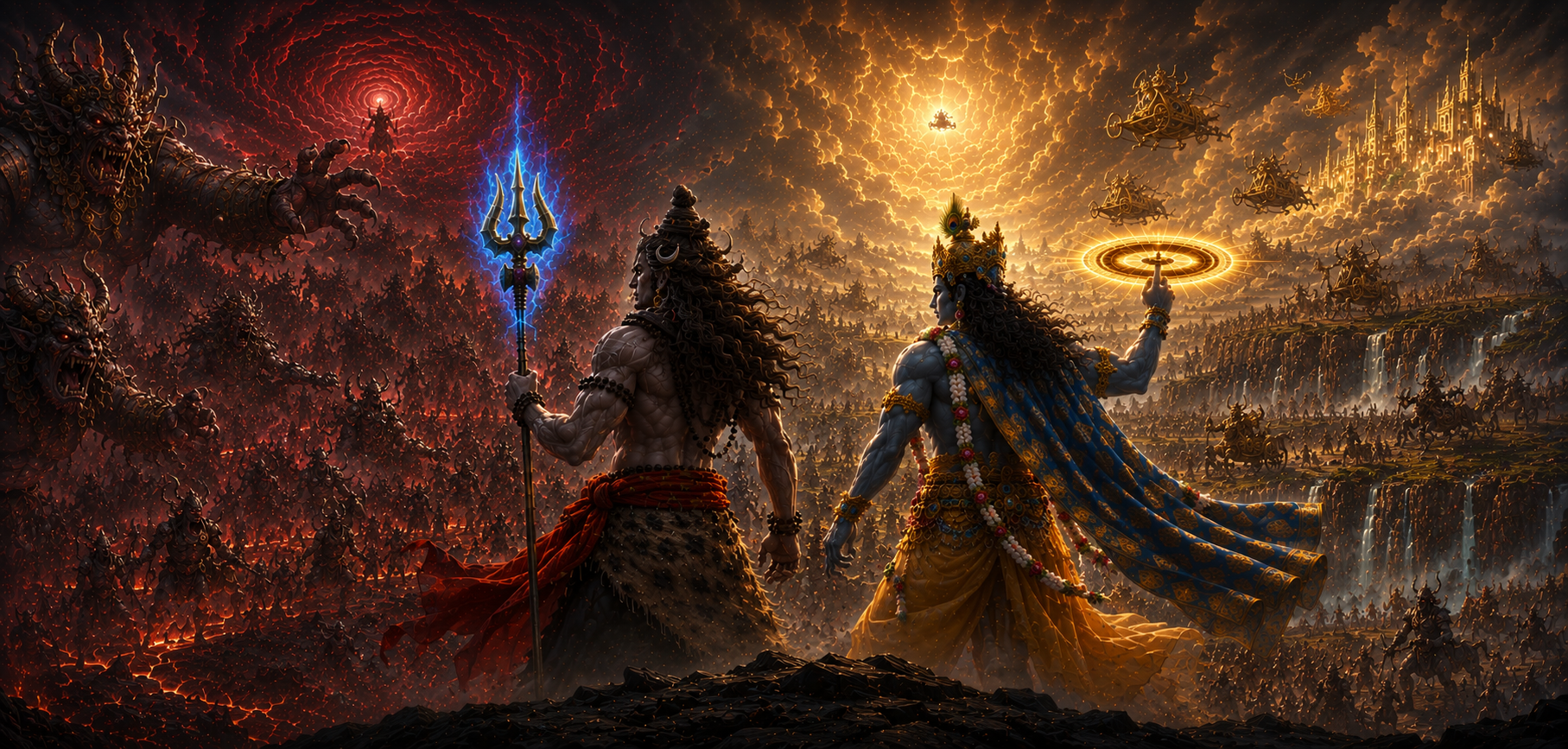
Before avatars, before the great churning of the ocean, before even the famous wars of the Daitya kings Hiranyaksha and Hiranyakashipu — there was the Halahala War. It stands at the very threshold of the Varaha Kalpa, the present cosmic age, and its significance lies not just in who fought it, but in what it revealed: that the power of creation, even when wielded by the gods themselves, can produce forces that turn against their creators.
This is the only war in the twelve in which Vishnu and Shiva fight side by side as equals — not as avatar and deity, not as rivals, but as co-guardians of a universe threatened by its very first inhabitants.
Cosmic & Temporal Context
The Devi Bhagavata Purana opens its account of the Halahala War with an unusual cosmological claim: that at the very beginning of the Varaha Kalpa, the Trimurti — Brahma, Vishnu, and Shiva — each possessed not only their characteristic functions of creation, preservation, and dissolution, but also the combined power of creation. This was a primal age, before the three functions had been cleanly separated and assigned.
It was in this age of undivided divine power that the first beings were created — and the first beings to emerge were the Halahalas, a sect of Asuras. Their creation was not an act of malice or error; it was simply the natural first expression of the Trimurti's creative power. But what followed was the first lesson in the paradox of creation: that which is given the fullest potential will also have the fullest capacity for disruption.
The Varaha Kalpa is the present cosmic day of Brahma — 4.32 billion years long. The Halahala War occurs in its very earliest phase, before most of the universe's current structures and hierarchies had been established. There were no fixed heavens, no established order of Devas over Asuras, no covenant of boons and austerities. The Halahalas arose into a universe that was, in the most literal sense, still being made.
Background & Cause
The Halahalas did not begin as enemies of the gods. Born from the Trimurti's creative power, they were the universe's first inhabitants, possessing enormous natural vitality and intelligence. Like all beings of the early ages of a Kalpa, they were born in a state of great spiritual energy — and they used it. They performed austerities, approached Brahma, and obtained boon after boon from him.
With each boon, the Halahalas grew more powerful. They mastered the three worlds — the terrestrial (Bhurloka), the atmospheric (Bhuvarloka), and the celestial (Svargaloka) — and brought them under their dominion. At this stage, they were not merely powerful; they were effectively sovereign over all of manifest existence.
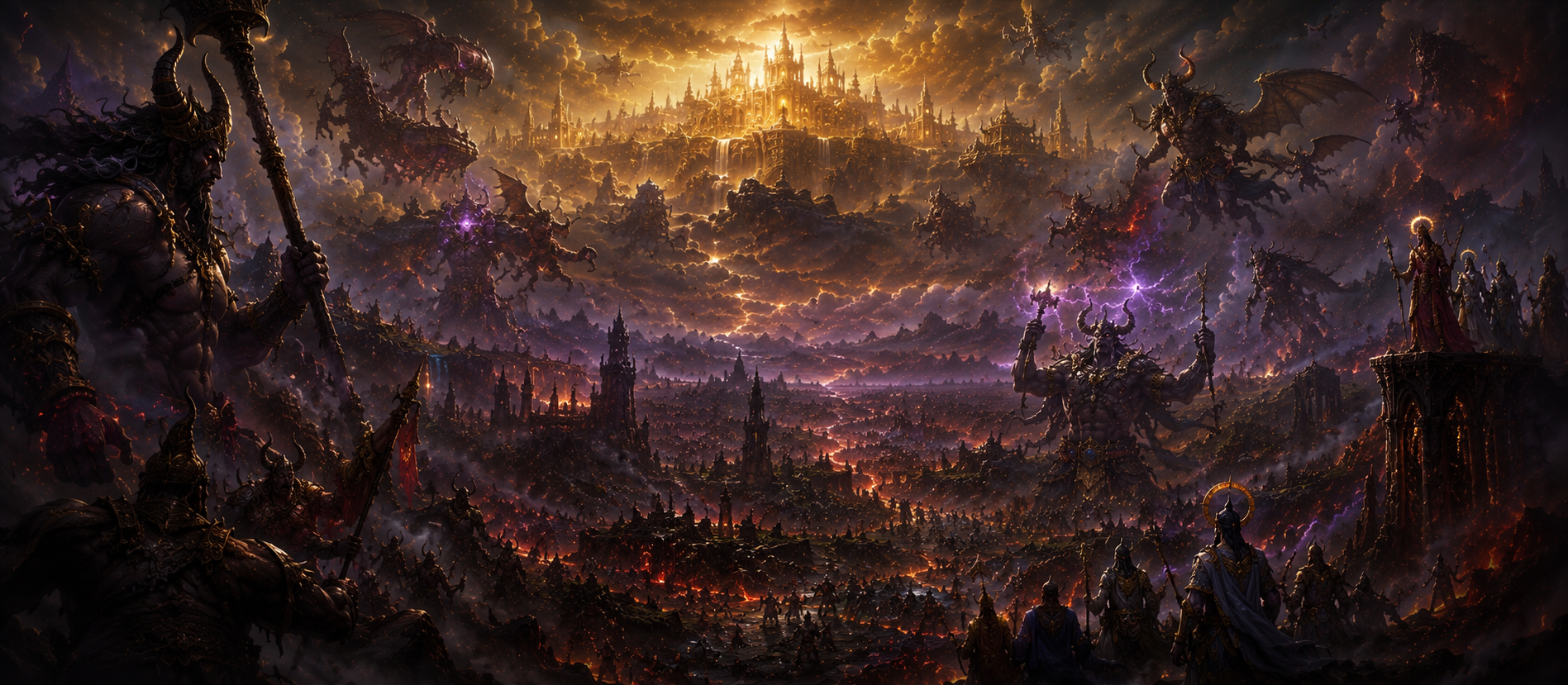
The Halahalas, armed with Brahma's boons, brought all three worlds — Bhurloka, Bhuvarloka, and Svargaloka — under their dominion before turning their ambitions toward the divine abodes themselves.
Then they took the final, irreversible step: they blockaded Kailasa and Vaikuntha — the personal abodes of Shiva and Vishnu respectively. This was no longer a question of cosmic governance; it was a direct assault on the gods' own sanctuaries. No boon from Brahma covered this. No negotiation was possible. The two great gods would have to fight.
Key Combatants
Divine Forces
The Gods
- Vishnu — Preserver of the universe; wielder of the Sudarshana Chakra and Sharnga bow. Fighting in his primal cosmic form, not yet as an avatar.
- Shiva — Destroyer and transformer; wielder of the trishula. Fighting from Kailasa, his own besieged abode.
- Brahma — Does not fight directly; acts as mediator and witness. His role in granting the Halahalas' boons makes him an indirect cause of the war.
Asura Forces
The Halahalas
- The Halahala Asuras — First creation of the Trimurti; powerful sect of Asuras who obtained extraordinary boons from Brahma. No individual leader is named in the primary source — they are described as a collective force.
- Their power base — Dominion over all three worlds; direct blockade of Kailasa and Vaikuntha.
The Battle
The Devi Bhagavata Purana does not describe the Halahala War in blow-by-blow tactical detail the way later conflicts — the Tripura War, or the Vritra War — are described. What it conveys instead is duration and effort: the war lasted a thousand years, and it required both Vishnu and Shiva fighting together to achieve victory. This in itself is a statement of the Halahalas' power. No single deity could overcome them.
The battlefield was, in the most literal sense, cosmic — fought across the planes that the Halahalas had conquered and at the gates of the divine abodes they had besieged. Vishnu's weapons — the Sudarshana Chakra, the mace Kaumodaki, the conch Panchajanya — and Shiva's arsenal — the trishula, the bow Pinaka, and the full force of his cosmic dissolution-energy — were brought to bear together against an enemy that had Brahma's own boons as its armour.
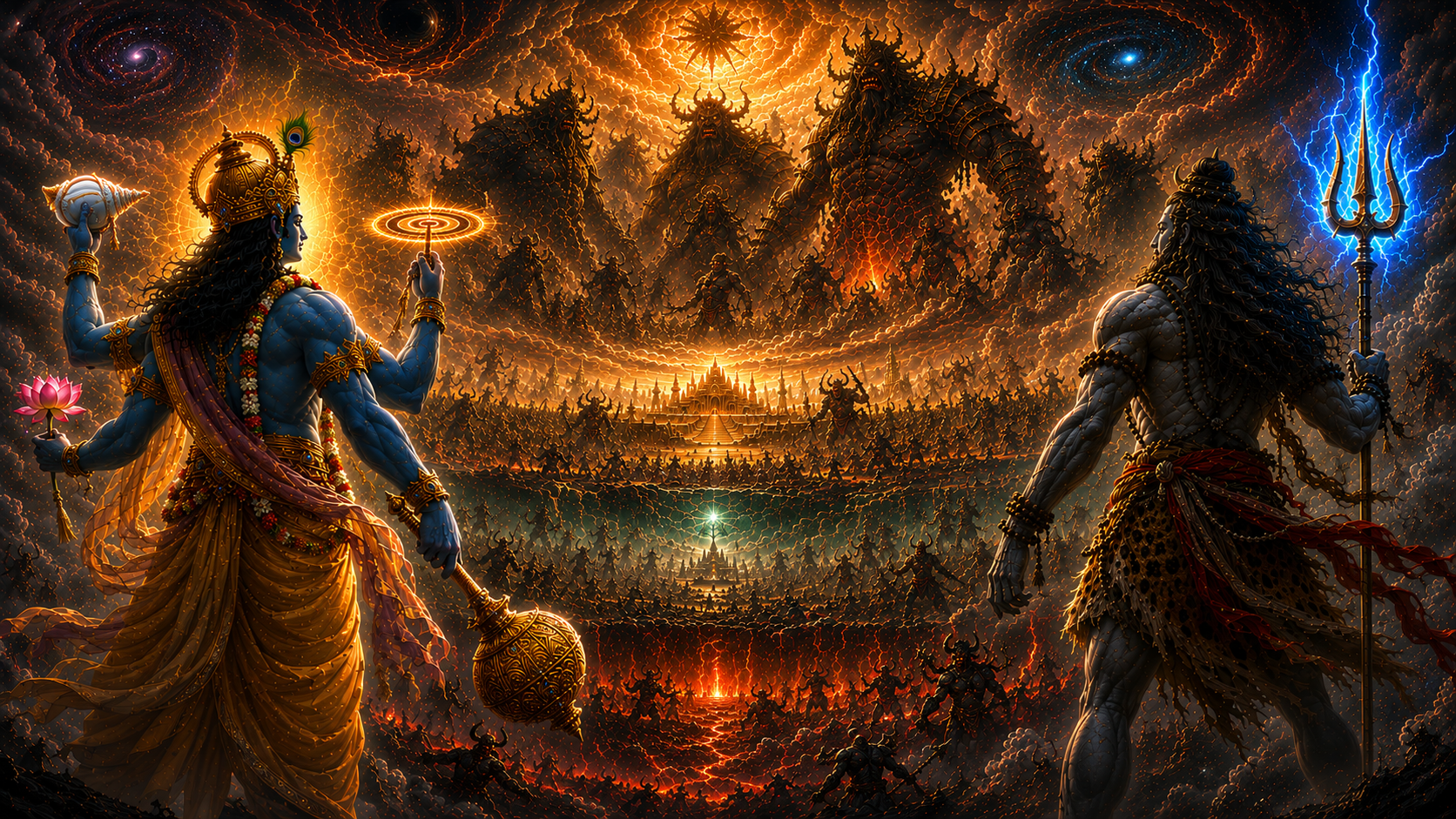
Over a thousand divine years, Vishnu and Shiva fought the Halahala asuras in concert — the only war in the twelve in which the two great gods serve as co-warriors rather than alternating champions.
"The Halahalas, who became very powerful within a short period of time, earned from Brahma all the boons they wanted, conquered the three worlds, and barricaded Kailasa and Vaikuntha — so Vishnu and Shiva defeated them after a fierce fight lasting for a thousand years."
Devi Bhagavata PuranaThe Aftermath — A Victory That Became a Crisis
After the victory, Vishnu and Shiva returned to their respective consorts — Lakshmi and Parvati — and recounted their achievements with evident pride. The goddesses, however, were not impressed. They laughed.
What the gods experienced as a great triumph, their divine consorts regarded as boasting — or perhaps as an insufficient appreciation of their own role in sustaining the gods' power. The text does not spell out precisely what offended Lakshmi and Parvati; what it records is the result: Vishnu grew angry with Lakshmi, and Shiva grew angry with Parvati. Both goddesses left.
The consequences were immediate and severe. Without Lakshmi — who embodies the sustaining energy of prosperity and cosmic preservation — Vishnu began to lose his power. Without Parvati — who embodies Shakti, the primal energy that animates Shiva — Shiva similarly weakened. The two gods who had just defeated the Halahalas were now losing the very power they had fought with.
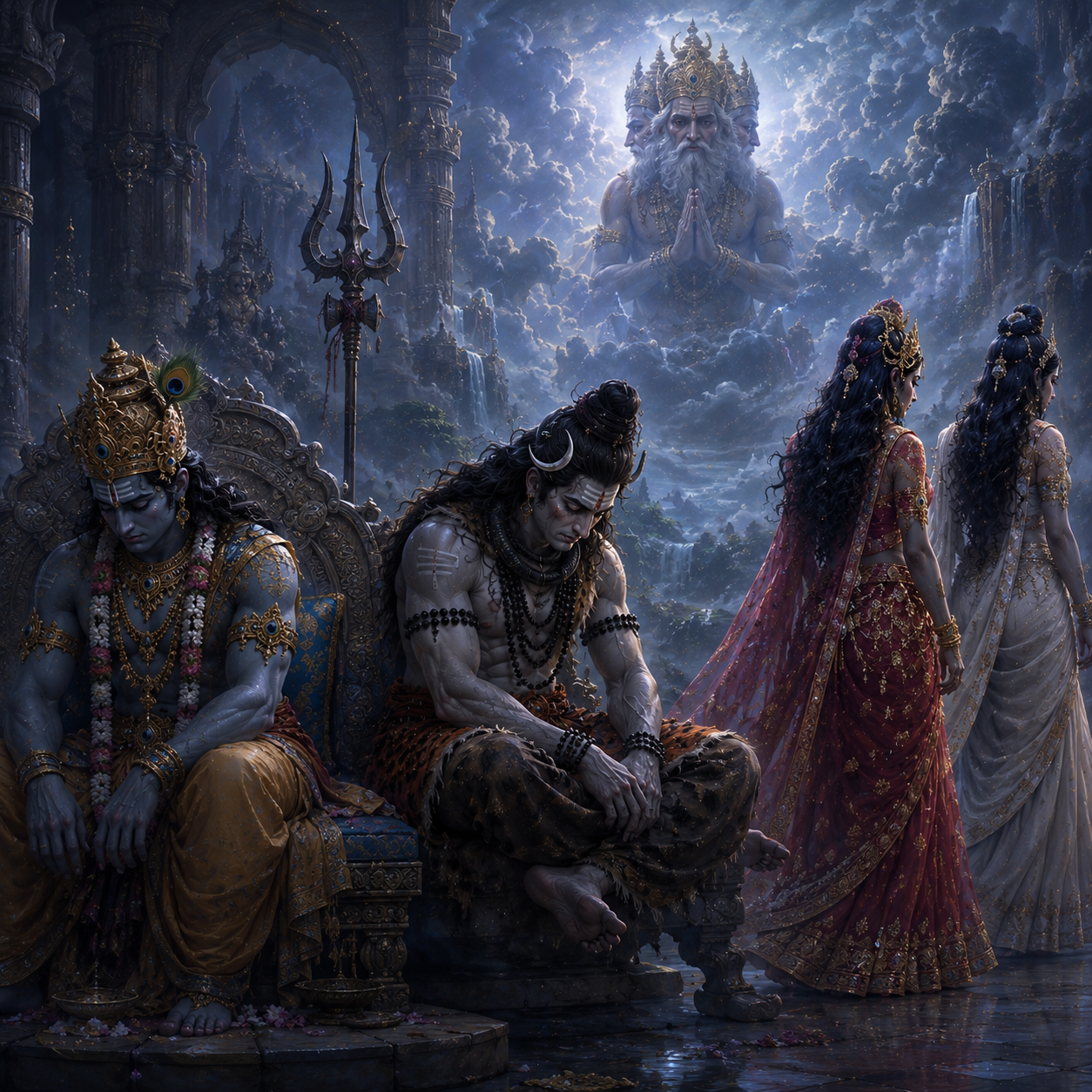
The goddesses' departure — and Brahma's eventual mediation — form the theological heart of the Halahala War's aftermath.
It was Brahma who recognised what was happening and why. He intervened — not as a warrior, but as a mediator — and persuaded Lakshmi and Parvati to return to their husbands. When they did, the gods' power was restored. But the episode had made its point unmistakably: divine power is not solely the property of the gods. The Shakti principle — the feminine energy that animates and sustains — is not secondary to divine might. It is its source.
Outcome Summary
Military result: Decisive Deva victory. The Halahala Asuras were defeated after one thousand years of continuous warfare. Their blockade of Kailasa and Vaikuntha was broken, and dominion over the three worlds was restored to the cosmic order.
Theological consequence: The post-war quarrel between Vishnu and Shiva with their consorts, and the subsequent loss and restoration of divine power, establishes the Shakti doctrine as the Devi Bhagavata Purana's central argument: that the power of the male deities is derivative of the Devi's energy, not independent of it.
Narrative function: As the first of the twelve wars, the Halahala War sets the template — a crisis born of creation's own energy, requiring divine intervention — while also introducing the Devi Bhagavata's distinctive theological emphasis on the primacy of the Goddess.
Cosmic Significance
Among the twelve wars, the Halahala War occupies a singular position because it precedes all the established categories of divine conflict. It is not a war of tyranny (like the Narasimha War) or a war of cosmic theft (like the Varaha War) or a war of broken alliances (like the Samudra Manthana). It is something more primal: the first demonstration that creation contains, from its very inception, the seeds of its own disruption.
The Halahalas did nothing that was not sanctioned. They were created legitimately. They performed austerities legitimately. They received boons legitimately. And yet they became a threat that required a thousand years of combined divine warfare to overcome. The Halahala War is, in this reading, not a story about evil — it is a story about the structural tension between creative power and the order that creative power must ultimately serve.
It also establishes, from the outset of the cycle, that no single divine power is sufficient for the demands of cosmic guardianship. Vishnu alone could not defeat the Halahalas. Shiva alone could not. Only together — and only with the restored support of their consorts — could they prevail. This lesson of interdependence runs as an undercurrent through all twelve wars.
Textual Sources & Variants
The Halahala War is primarily attested in the Devi Bhagavata Purana, which gives the fullest narrative. The Brahmanda Purana names it first in the list of twelve wars of the Varaha Kalpa but does not elaborate on the narrative. Other Mahapuranas do not appear to preserve an independent account of this specific war under this name.
| Source | Detail | Note |
|---|---|---|
| DeviBhagavataPurana | Full narrative: Halahalas as first Trimurti creation, thousand-year war, post-war quarrel, departure and return of consorts | Primary source; strongly Shakta theological framing throughout |
| BrahmandaPurana | Names Halahala as first of twelve wars in the Varaha Kalpa list | Framework source; no independent narrative provided |
| OtherMahapuranas | The word "Halahala" in most other Puranic contexts refers to the poison produced during the Samudra Manthana (War V), not to this sect of Asuras | Important distinction: the Halahala poison and the Halahala War are entirely separate events, connected only by name |
References
Primary Sources
- Devi Bhagavata Purana — Skandha I–II (Halahala War narrative; post-war episode with consorts)
- Brahmanda Purana — Varaha Kalpa section (list of twelve wars; Halahala named first)
Secondary Sources
- Mani, Vettam. Puranic Encyclopaedia. Motilal Banarsidass, 1975. Entry: "Halahala."
- Hazra, R. C. Studies in the Upapuranas. Calcutta, 1963.
- Coburn, Thomas B. Devī-Māhātmya: The Crystallization of the Goddess Tradition. Motilal Banarsidass, 1984.