

The Varaha War marks a turning point in the sequence of twelve cosmic conflicts. Where the first war — the Halahala War — saw the Trimurti fighting collectively in their primal divine forms, the Varaha War introduces an entirely new mode of divine intervention: the avatar. For the first time in the Varaha Kalpa, Vishnu does not fight as himself. He takes a form — a specific, chosen, purposeful form — to address a specific crisis. This is the beginning of the avatar age.
The crisis itself was elemental: the Earth, the ground beneath all life, had been seized and dragged to the bottom of the cosmic ocean. Without her, the universe had no foundation. Life was impossible. And the god who had done this was Hiranyaksha — brother of the slain Halahala-era king Hiranyakashipu — a Daitya of extraordinary power whose arrogance had found its most devastating possible expression.
Cosmic & Temporal Context
The Varaha War occurs in the early phase of the Varaha Kalpa, after the defeat of the Halahalas but before the great cycles of creation had fully stabilised. The Earth — Bhudevi or Prithvi, understood in the Puranas not merely as a physical planet but as a goddess and a living cosmic principle — was among the first stable features of the manifest universe. Without her, no Manu could govern, no creatures could exist, no yajna could be performed. The seizure of the Earth by Hiranyaksha was, in cosmic terms, an act of total annihilation.
The Bhagavata Purana situates this war within Brahma's creative cycle: having just produced the first round of creation, Brahma found that the Earth had sunk into the cosmic waters. It is at this moment that a tiny boar — no larger than a thumb — emerged from Brahma's nostril and immediately began to grow to cosmic proportions. This was Vishnu, taking the Varaha form of his own spontaneous will, without being summoned. The avatar arose because the crisis demanded it.
The Varaha avatar is one of the Dashavatara — the ten principal avatars of Vishnu — and occupies the third position in most canonical lists, following Matsya (fish) and Kurma (tortoise). It belongs to the earliest phase of cosmic time, when life on Earth was still being established and the forces that threatened it were correspondingly elemental in nature.
Background & Cause
Hiranyaksha and his brother Hiranyakashipu were sons of the sage Kashyapa and his wife Diti — making them Daityas, children of the Diti lineage, ancient adversaries of the Devas who were children of Aditi. Their enmity with the divine order was therefore structural, not incidental. But where Hiranyakashipu's story would be one of ideological conflict — the banning of Vishnu-worship and the persecution of his own son Prahlada — Hiranyaksha's was one of raw physical conquest.
Having obtained boons of great strength from Brahma, Hiranyaksha roamed the three worlds seeking a worthy opponent. Finding none among the Devas, who fled before him, he turned his ambitions toward an act of cosmic vandalism: he plunged into the primordial ocean and, at its depths, found the Earth herself. He seized her and carried her down into the dark waters, plunging the universe into formlessness and chaos.
The Devas, helpless, approached Brahma. Brahma directed them to Vishnu. It was at the moment of this appeal — or perhaps anticipating it — that the Varaha avatar emerged.

Hiranyaksha's seizure of Bhudevi — the Earth goddess — was the most elemental act of destruction in the Varaha Kalpa: without Earth, the universe had no foundation for life.
Key Combatants
Divine Champion
Vishnu as Varaha
- Vishnu (Varaha Avatar) — The second avatar of Vishnu in the Varaha Kalpa; takes the form of a colossal cosmic boar. Emerged from Brahma's nostril as a tiny form and grew to fill the cosmos. Armed not with conventional weapons but with his own immense physical form and the power of Vishnu himself.
- Bhudevi (Earth) — Not a warrior but the reason for the war; rescued from the ocean floor and held aloft on Varaha's tusks throughout the combat.
- Brahma — Witnesses the avatar's emergence; does not fight but his creative authority is what Hiranyaksha's boons were extracted from.
Adversary
Hiranyaksha
- Hiranyaksha — Elder brother of Hiranyakashipu; son of Kashyapa and Diti. Name means "golden-eyed." Possessed immense physical strength, boons of near-invincibility from Brahma, and a mace as his primary weapon. Had roamed all three worlds unchallenged before seizing the Earth.
- His power base — Physical dominance, Brahma's boons, mastery of the ocean depths where he held the Earth captive.
The Battle
Varaha dived into the cosmic ocean. The Bhagavata Purana describes the descent in vivid terms — the great boar plunging through the waters, his body filling the ocean, his breath like a storm, his eyes glowing like twin suns in the dark depths. At the ocean floor, he found the Earth and gently lifted her on his tusks. It is at this moment — Varaha rising with Bhudevi balanced on his tusks — that one of Hinduism's most iconic images crystallises.
Hiranyaksha had been waiting. He challenged Varaha as the god rose through the waters, hurling insults and his mace in equal measure. Varaha set Bhudevi safely in a secure cosmic space and turned to face his opponent. The battle that followed lasted, by the Purana's account, thousands of years in divine time — a furious hand-to-hand combat at the bottom of the cosmos between the avatar of preservation and the demon of annihilation.

The climactic confrontation: Varaha rises with the rescued Earth as Hiranyaksha makes his final assault — the defining image of the second cosmic war.
The Bhagavata Purana describes the combat in martial detail: Hiranyaksha fought with his mace, with Maya-craft (illusory weapons and tricks), with storms of arrows and spears conjured through his power. Varaha countered each assault. Brahma and the assembled gods watched from above, anxious that the battle was lasting so long. The sage Narada reassured them: Vishnu was toying with his enemy, prolonging the fight not from weakness but from a kind of cosmic sport.
Finally, as the sun began to set — because even cosmic battles observe the rhythm of time — Brahma urged Varaha to end it before darkness fell and Hiranyaksha's power increased under the cover of night. At that moment, Varaha struck Hiranyaksha behind the ear with his hand. A single blow. The demon fell.
"As a sporting elephant kills a lion, so did Hari slay Hiranyaksha — that enemy of the gods who had long wandered the three worlds unchallenged."
Bhagavata Purana, Skandha IIIThe Rescue of Bhudevi
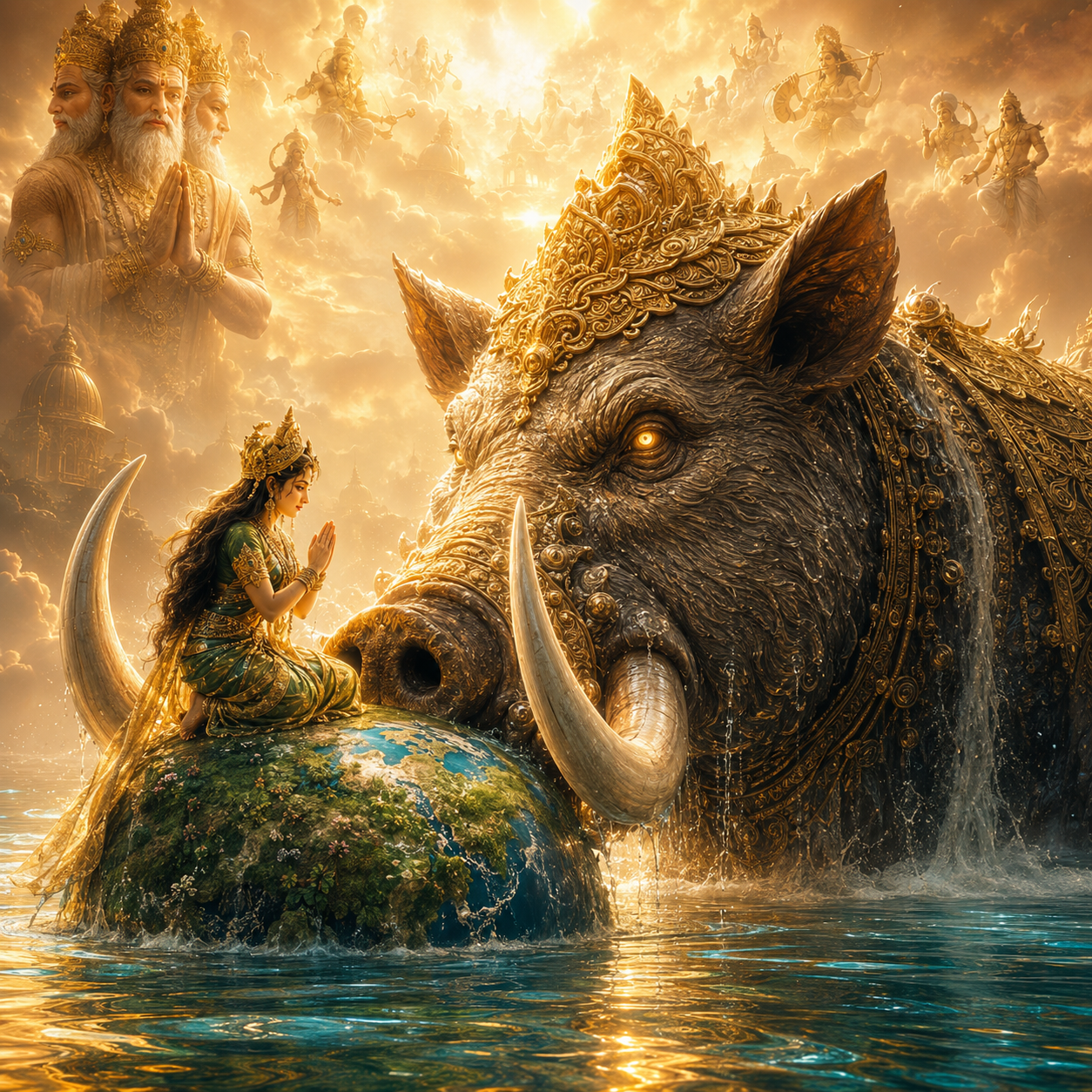
The restoration of Bhudevi to her cosmic position — the purpose for which the Varaha avatar arose — is celebrated across the heavens.
With Hiranyaksha slain, Varaha restored the Earth to her proper position in the cosmos. The Bhagavata Purana describes this act with the tenderness of a lover — Varaha placing Bhudevi gently back upon the surface of the waters, the Earth goddess radiating gratitude, the heavens brightening as life became possible again.
Brahma and the assembled gods celebrated with hymns. The sages praised the avatar. And Bhudevi herself sang a long paean of gratitude to Vishnu — preserved in the Bhagavata as a devotional poem — that acknowledges not just her rescue but the principle it represents: that the universe's foundations will always be upheld, no matter what forces seek to unmake them.
The Varaha War thus ends not in the grimness of battle but in restoration. The Earth is back. Life can begin again. And the pattern of the avatar — a specific divine form for a specific cosmic crisis — has been established for all the conflicts to come.
Outcome Summary
Military result: Decisive Deva victory. Hiranyaksha was slain by a single blow from Varaha after a combat lasting thousands of divine years. The Earth goddess Bhudevi was rescued and restored to her cosmic position.
Theological significance: The Varaha War establishes the avatar doctrine as the Puranic solution to cosmic crisis — Vishnu taking a purposeful form calibrated to the nature of the threat. The boar's strength and its affinity for the earth (boars dig and root in soil) make the Varaha form the fitting response to an Earth-crisis specifically.
Dynastic consequence: Hiranyaksha's death sets in motion the chain that leads directly to the third war — the Narasimha War. His brother Hiranyakashipu, enraged by his death, will perform austerities, obtain his own set of formidable boons, and create the conditions for Vishnu's next avatar.
Cosmic Significance
The Varaha War is the first war in the twelve in which Vishnu acts alone. No co-warrior, no coalition — just a single avatar confronting a single enemy in a single extended combat. This is the avatar model in its purest form: targeted, economical, complete.
It is also the first war in the sequence that involves the Earth directly — not as a backdrop but as the victim, the prize, and ultimately the beneficiary. The Earth's personhood as Bhudevi, her capacity for distress and gratitude, her relationship with Vishnu as both protector and beloved — all of these are established here and will resonate through the entire Puranic cosmological tradition. Later avatars, including the Vamana and Parashurama, will interact with Bhudevi again; and in the Rama and Krishna avatars, Bhudevi's appeal to Vishnu is what precipitates his descent altogether.
Among the Dashavatara sequence, Varaha occupies the cosmological position corresponding to the Boar Age — the earliest stable period of terrestrial life, before the great human civilisations of the Treta and Dvapara Yugas. The Varaha War is therefore not just the second of twelve cosmic conflicts; it is the founding act of the liveable Earth.
Textual Sources & Variants
The Varaha War is among the most widely attested of the twelve, appearing in detailed narrative form across multiple Mahapuranas and in the Mahabharata. The accounts broadly agree on the central facts — Earth seized, Varaha avatar, underwater battle, Hiranyaksha slain — but differ on details of the combat's duration, the precise weapons used, and the theological framing of the rescue.
| Source | Detail | Variant / Note |
|---|---|---|
| Bhagavata Purana Skandha III |
Fullest narrative: Varaha emerges from Brahma's nostril, dives into the ocean, lifts Bhudevi, battles Hiranyaksha, kills him with a blow behind the ear. Brahma's hymn and Bhudevi's paean both preserved. | Primary narrative source; richest theological and devotional content. Brahma's nostril as origin point is specific to this account. |
| Vishnu Purana Book I |
Varaha emerges from Brahma's nose during meditation; battle narrative broadly consistent with Bhagavata. Hiranyaksha slain after prolonged combat. | Slightly abbreviated; less devotional elaboration. No hymn from Bhudevi preserved here. |
| Vayu Purana |
Varaha account present; emphasises the avatar's cosmic scale — his form filling the ocean and the heavens simultaneously. | More cosmological emphasis, less narrative detail of the combat itself. |
| Matsya Purana |
Varaha narrative present with some differences in the weapon descriptions used by Hiranyaksha during combat. | Names additional weapons including divine spears not mentioned in the Bhagavata account. |
| Mahabharata Shanti Parva |
Varaha referenced as an avatar of Vishnu; the Earth-rescue episode mentioned but not narrated in full. | Allusive rather than narrative; treats the Varaha story as established prior knowledge. |
References
Primary Sources
- Bhagavata Purana — Skandha III, Chapters 13–19 (Varaha avatar emergence, battle with Hiranyaksha, rescue of Bhudevi, Bhudevi's hymn)
- Vishnu Purana — Book I, Chapters 4–5 (Varaha narrative; Hiranyaksha combat)
- Vayu Purana — Chapter 6 (Varaha cosmological account)
- Matsya Purana — Chapters 246–248 (Varaha War; variant weapon descriptions)
- Mahabharata, Shanti Parva — Section 340 (Varaha referenced among Vishnu's avatars)
- Brahmanda Purana — Varaha Kalpa section (Varaha War named second in the twelve-war list)
Secondary Sources
- Mani, Vettam. Puranic Encyclopaedia. Motilal Banarsidass, 1975. Entries: "Hiranyaksha," "Varaha," "Bhudevi."
- Wilson, H. H. (trans.). The Vishnu Purana. Trübner & Co., 1865. Book I.
- Tagare, G. V. (trans.). The Bhagavata Purana. Motilal Banarsidass, 1976. Skandha III.
- Matchett, Freda. Kṛṣṇa: Lord or Avatāra? The Relationship between Kṛṣṇa and Viṣṇu. Curzon, 2001. (On the Dashavatara sequence and the Varaha's cosmological position.)