
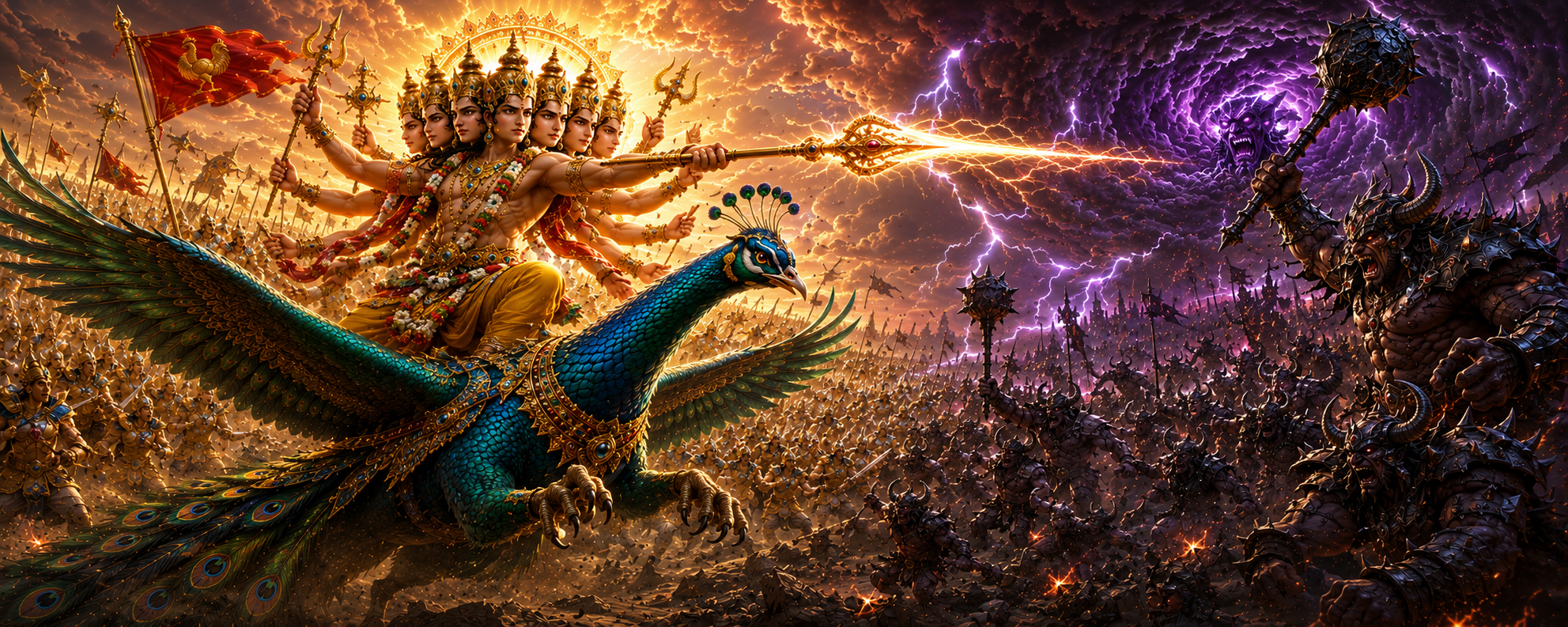
The Kolahala War is the final conflict of the Varaha Kalpa's great twelve-war sequence — the closing chapter of a cosmic cycle that began with the Halahala War, the first battle at the dawn of creation. It is the only war in the twelve in which the principal divine champion is Kartikeya, son of Shiva and Parvati, commander of the divine armies. His appearance here is structurally deliberate: the sequence that opened with the Trimurti fighting together closes with a new divine champion, born specifically for this age and this task.
The Kolahala War is also, among the twelve, the one with the least elaborate textual development — and this matters. The Brahmanda Purana names it; the Skanda Purana provides the fullest narrative context; but neither gives it the narrative depth of the Traipura War or the Vritra War. This relative sparseness is itself a theological statement: the twelfth war does not need to be the most elaborate. It needs to be the last. Its significance is structural as much as narrative — the closing of the cycle, the confirmation that cosmic order has been restored, the handing of guardianship to the next generation.
Kartikeya — The Warrior Born for This Age
Kartikeya — known variously as Subrahmanya, Murugan, Skanda, Kumara, Shanmukha, and many other names across the traditions that revere him — is the second son of Shiva and Parvati, and the commander of the divine army (Senapati of the Devas). His birth, narrated at length in the Shiva Purana and the Skanda Purana, was itself a cosmic event: the gods needed a commander who could lead them against the great demon Tarakasura, whose boon stipulated that only a son of Shiva could defeat him. The gods conspired to bring Shiva and Parvati together after Sati's death and rebirth, and the child born of their union — Kartikeya — was raised by the Krittikas (the Pleiades), which is the origin of his most common name.
Kartikeya defeated Tarakasura in a war that is narrated in the Shiva Purana as his defining battle — the proof of what he was born to do. The Kolahala War, the twelfth of the twelve cosmic conflicts, is his second great appearance in the sequence, confirming him as the inheritor of the role that had previously been filled by Vishnu's avatars, by Shiva, and by Indra. The divine generalship has now passed to a new holder.
| Name / Epithet | Meaning | Tradition / Region |
|---|---|---|
| Kartikeya | "Son of the Krittikas" (the Pleiades who nursed him) | Pan-Puranic; most common name in Sanskrit texts |
| Subrahmanya | "Dear to the Brahmins" or "excellent among the wise" | South India; the primary name in Tamil Nadu and Karnataka |
| Murugan | "The beautiful / the young / the divine" | Tamil tradition; the name by which he is most widely worshipped in Tamil Nadu and Sri Lanka |
| Skanda | "The one who leaps" or "the ejected / emanated one" | Mahabharata and Puranic texts; emphasises his powerful birth from Shiva's fire |
| Kumara | "The eternal youth" or "the prince" | Pan-Puranic; emphasises his perpetual youth and princely bearing |
| Shanmukha | "The six-faced one" | Pan-Puranic; his most celebrated iconographic form, with six faces each facing a different direction |
| Senapati | "Commander of the armies" | His functional title; the role for which he was born |
| Velayudha | "He whose weapon is the Vel (divine spear)" | South Indian tradition; the Vel given by Parvati is his primary weapon |
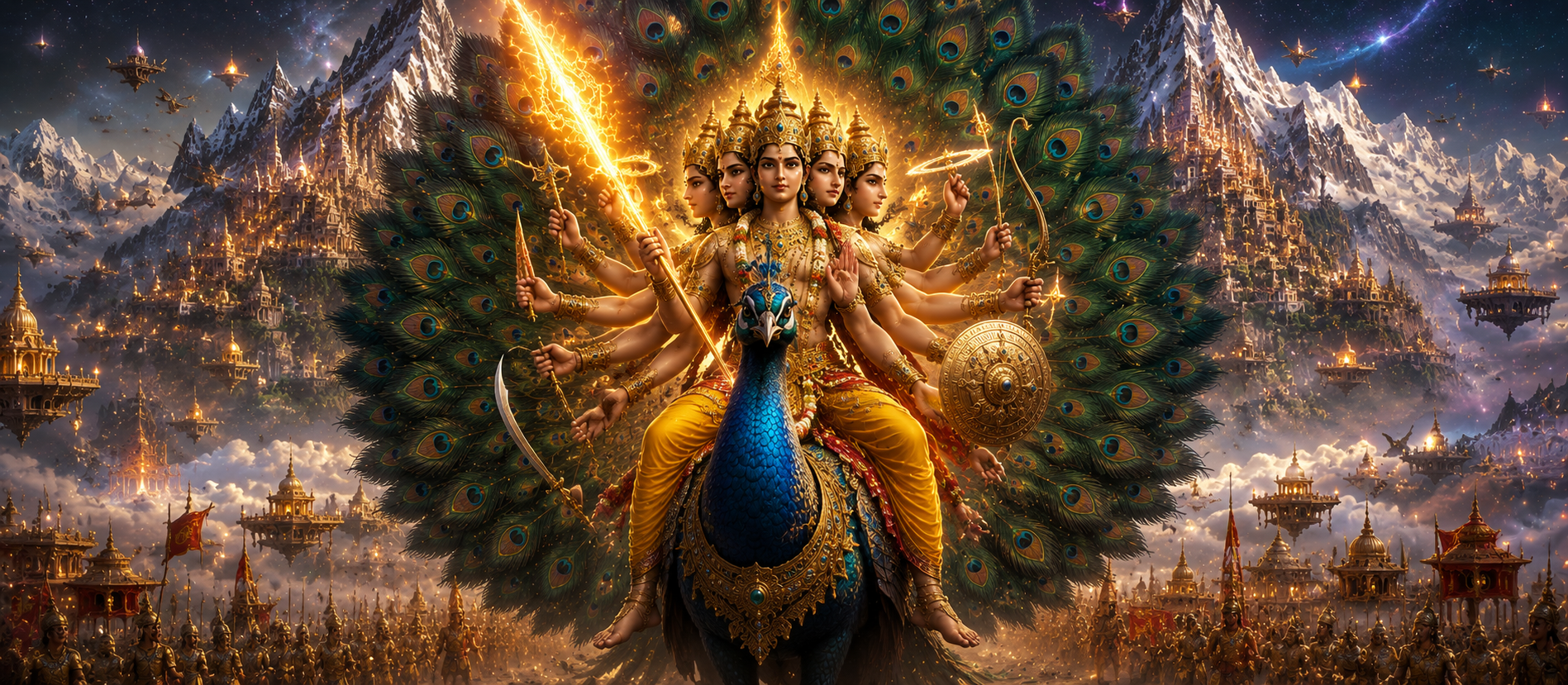
Kartikeya as Shanmukha — the six-faced commander of the divine armies, whose appearance in the twelfth war marks the completion of the generational handover of cosmic guardianship.
Kolahala — The Asura of Tumult and Uproar
Kolahala's name is itself his defining characteristic. In Sanskrit, kolahala means a great noise, tumult, uproar, or commotion — the sound of many voices crying out in confusion and distress, or the sound of a violent conflict. He is not, like Hiranyakashipu, a figure of ideological opposition to the divine order, nor, like Vritra, a cosmic principle of obstruction. He is chaos made manifest: a king of the Asuras whose very presence destabilises, whose armies bring pandemonium rather than strategy, whose power is the power of overwhelming disorder.
The Puranic accounts of Kolahala are sparser than those of the other eleven adversaries in the sequence. He does not have the elaborate boon-origin stories of Hiranyakashipu or the Tripurasuras, the cosmological weight of Vritra, or the philosophical complexity of Andhaka. What he has is scale and noise: a vast Asura army that brings the chaos of the end of a cycle crashing against the divine order. His name suggests that the twelfth war is not about ideology or theology but about the sheer accumulated tumult of a cosmic age drawing to its close.
In some regional Puranic traditions — particularly those connected to south Indian Shaiva and Murugan worship — Kolahala is associated with the armies that threatened the divine order in the period just before the cosmic stability of the present era was established. His defeat by Kartikeya is understood as the act that made the current age possible: not just the restoration of the Devas to Svargaloka, but the settling of the cosmic order into the relative stability it has maintained since.
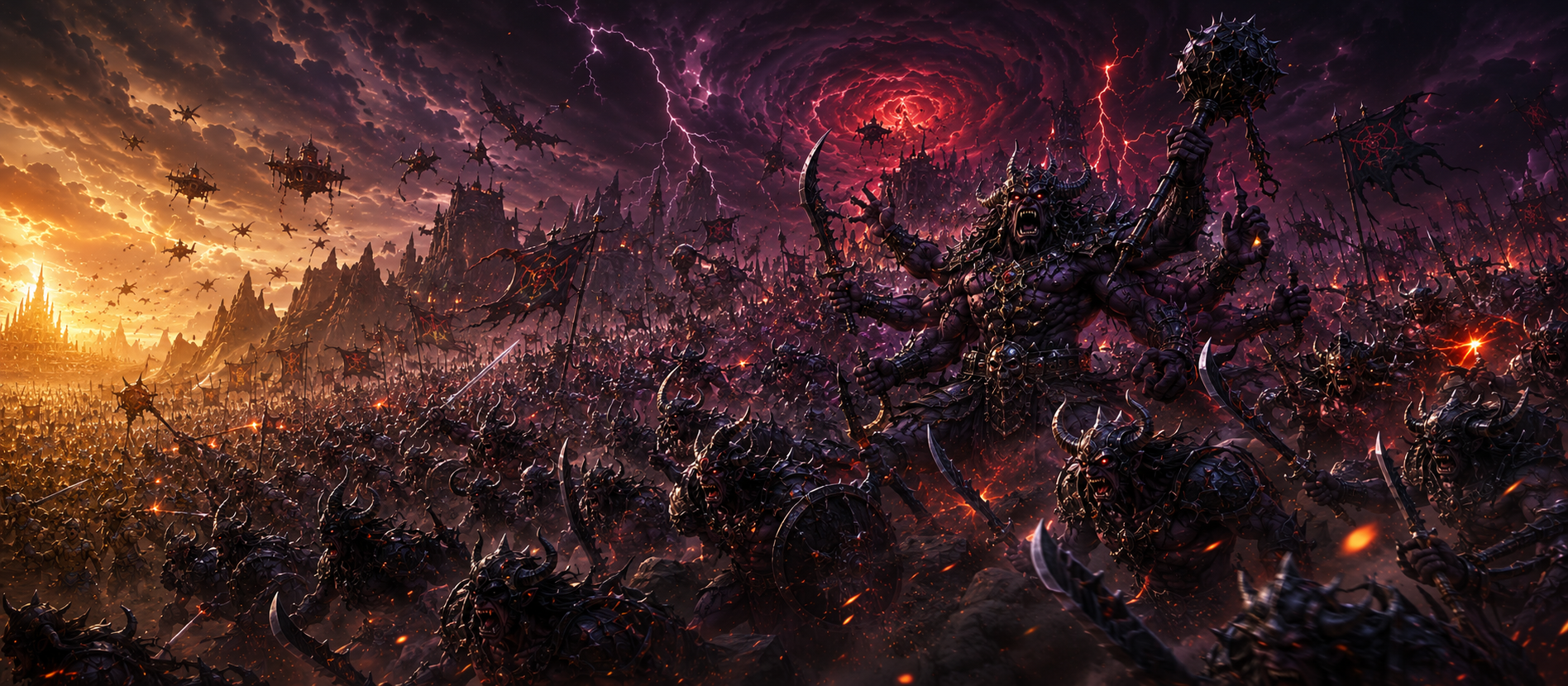
Kolahala — the Asura of tumult — at the head of the last great demonic army of the Varaha Kalpa. His power is not strategy or boon-protection but the overwhelming noise and scale of chaos unleashed.
Key Combatants
Divine Champion
Kartikeya and the Deva Army
- Kartikeya (Subrahmanya / Skanda) — Son of Shiva and Parvati; divine Senapati; rides the peacock Paravani; wields the Vel (divine spear given by Parvati). His six faces allow him to perceive the entire battlefield simultaneously. The twelfth war is the confirmation of his role as the present age's supreme divine commander.
- Shiva and Parvati — Kartikeya's parents; their blessing and the Vel (Parvati's gift) underpin his power throughout the war.
- The divine army (Devasena) — The full celestial army under Kartikeya's command; the word Devasena is also the name of Kartikeya's consort, reflecting the identification of the divine army itself with his divine feminine counterpart.
- Indra and the senior Devas — Now subordinate to Kartikeya as commander; present in the battle but under his leadership rather than their own.
Adversary
Kolahala and the Asura Host
- Kolahala — The Asura king whose name means tumult and uproar; commander of the last great Asura force of the Varaha Kalpa's conflict cycle. His power is the power of cosmic noise and disorder.
- The Asura army — Vast, chaotic, the accumulated demonic forces that have been building through the latter phase of the twelve-war sequence. After the defeats of Vipracitti and Vritra (Wars X and XI), this is the final concentrated effort of the Asura order to prevent the stabilisation of the cosmic balance.
The Vel — Parvati's Gift and the War's Decisive Weapon
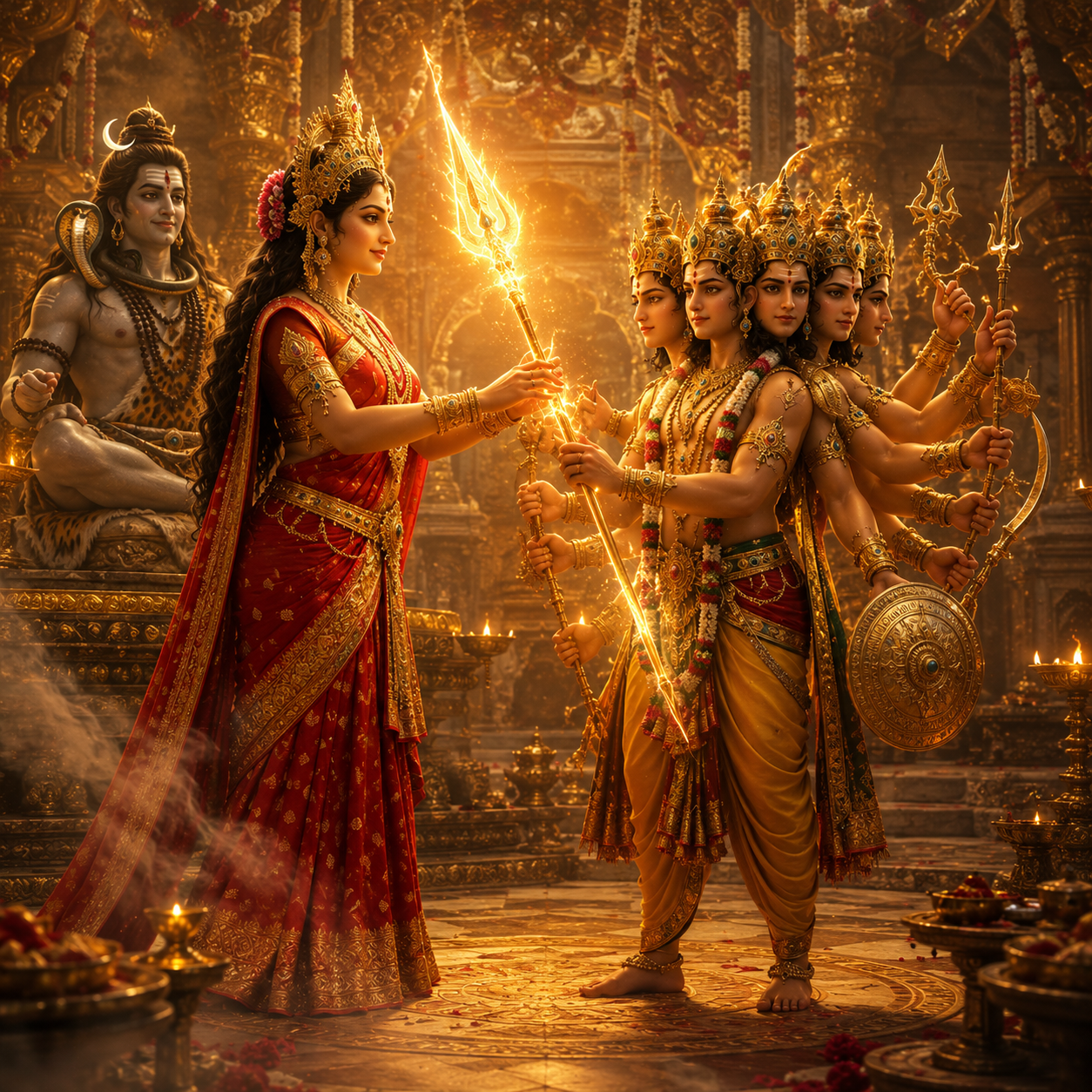
The Vel — Parvati's own Shakti given material form as a divine spear — is both Kartikeya's primary weapon and the theological statement at the heart of the Kolahala War: the masculine divine acts through the power of the feminine.
The Vel — Kartikeya's divine spear — is one of the most celebrated sacred objects in the Murugan tradition of south India. In the Tamil tradition particularly, the Vel is not merely a weapon but a philosophical and theological symbol: it is described as the embodiment of jnana (divine knowledge), the spear that cuts through ignorance as surely as it cuts through demon-flesh.
The Vel was given to Kartikeya by Parvati — and this origin is central to its significance. It is not a weapon forged by the divine craftsman or granted by Brahma; it is the concentrated power of the Divine Mother herself, taking the form most useful to her warrior son. When Kartikeya throws the Vel at Kolahala, he is deploying not just his own power but the full force of Shakti directed through him.
In the Tamil legend of Idumban's myth and the stories associated with the temples of Palani and Tiruchendur, the Vel plays a central role in different narratives of Kartikeya's divine interventions. The Kolahala War's use of the Vel connects the cosmic twelve-war sequence to the living devotional tradition of millions of Murugan devotees in south India, Sri Lanka, and across the Tamil diaspora.
The Battle — The Final War of the Varaha Kalpa
The Kolahala War is described in the Puranic tradition as a war fought on the grandest possible scale — a final gathering of demonic forces before the cosmic cycle's stabilisation. Kolahala's armies were enormous: the Skanda Purana describes the noise of their approach as audible across all three worlds, the ground shaking with the tread of their marching, the sky darkening with the clouds of their numbers. The name of their king was apt.
Kartikeya met them at the head of the Deva army — the divine forces arrayed with the precision and order that their commander's six-faced awareness enabled. Where Kolahala's forces brought chaos, Kartikeya brought clarity. Where the Asuras were noise, the Devas under Skanda were directed force.
The battle narrative emphasises the contrast between Kolahala's overwhelming numbers and Kartikeya's tactical precision. The Vel, hurled by Kartikeya at the critical moment, pierced through the Asura host and struck Kolahala directly. Some accounts describe the Vel as returning to Kartikeya's hand after striking — a detail familiar from the Tamil tradition of Vel-worship. Kolahala fell. His armies, leaderless and deprived of the tumultuous force that had animated them, broke and were routed.
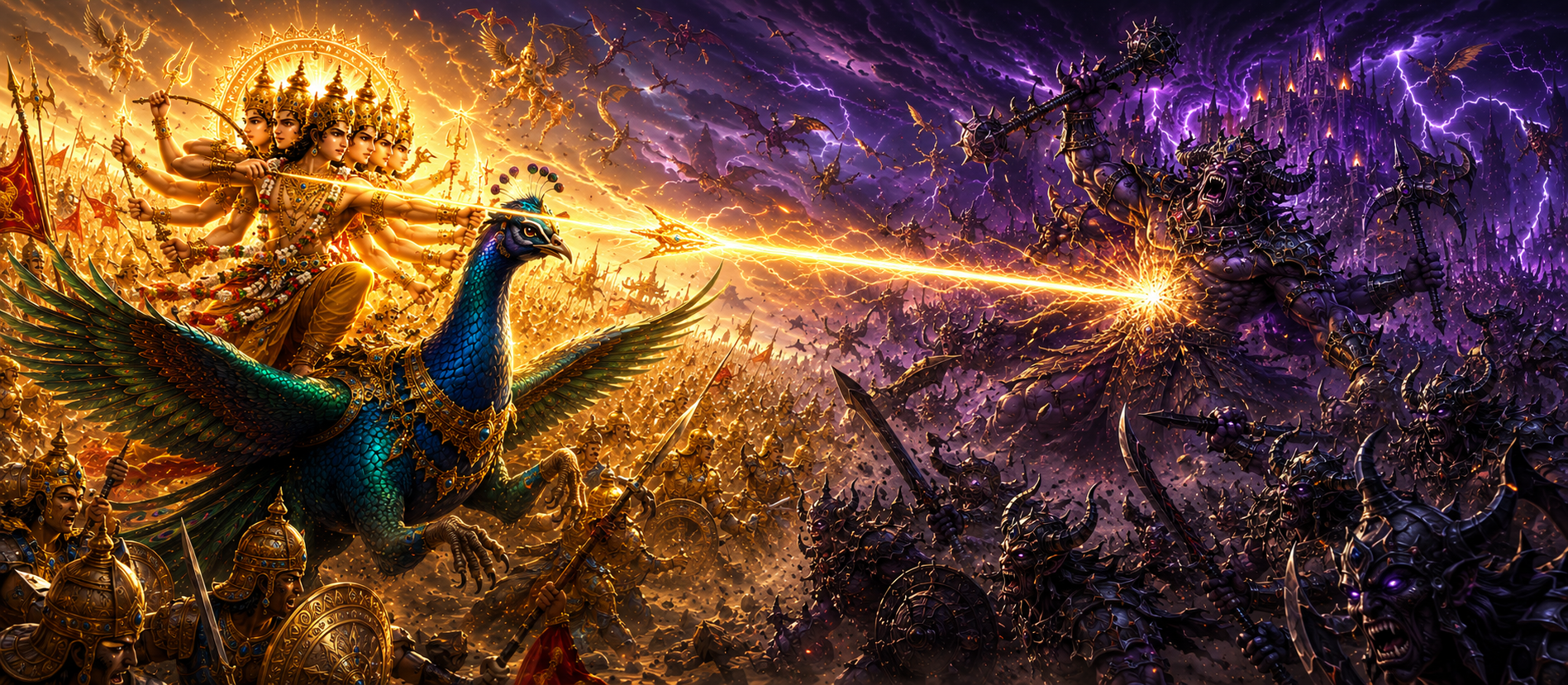
The throw of the Vel — the final decisive act of the twelve-war sequence. One weapon, one target, one war's end and a cosmic age's beginning.
"With the fall of Kolahala, the great tumult that had shaken the three worlds through twelve wars finally stilled. The Devas took their seats in Svargaloka. Kartikeya stood at their head, and the age that followed was — for a time — at peace."
Brahmanda PuranaThe Completion of the Cycle
With Kolahala's defeat, the twelve-war sequence of the Varaha Kalpa reaches its conclusion. The Brahmanda Purana, which is the primary source for the framework of the twelve wars, notes this completion without great fanfare — the end of the cycle is stated rather than celebrated. This restraint is itself appropriate: the completion of a cosmic cycle is not a triumphant ending so much as a settling, a return to the baseline from which the next disruption will eventually arise.
What has changed? The three worlds are again under Deva governance. The Asura forces have been defeated for the twelfth and final time in this cycle. But more importantly, the chain of divine champions through whom that order was maintained has been completed — from the Trimurti fighting together in War I, through Vishnu's avatars in Wars II–IV, through the cooperative churning of War V, through the sage-rivalries of VI and VII, through Shiva's destroyer-wars in VIII and IX, through Indra's two sequential tests in X and XI, to Kartikeya's closure of the sequence in XII. Each link in that chain was necessary. Each war called forth the form of divine power suited to that specific crisis.
Kartikeya's position at the end of the sequence is the tradition's statement about the present age's divine guardianship. The great avatar wars of Vishnu (Varaha, Narasimha, Vamana) belong to the early phase of the Varaha Kalpa. The Shaiva destruction-wars (Traipura, Andhaka) belong to the middle phase. And the final war belongs to Kartikeya — the commander born specifically for this age, whose worship is most alive in the south Indian tradition that has preserved the deepest memory of these twelve conflicts.
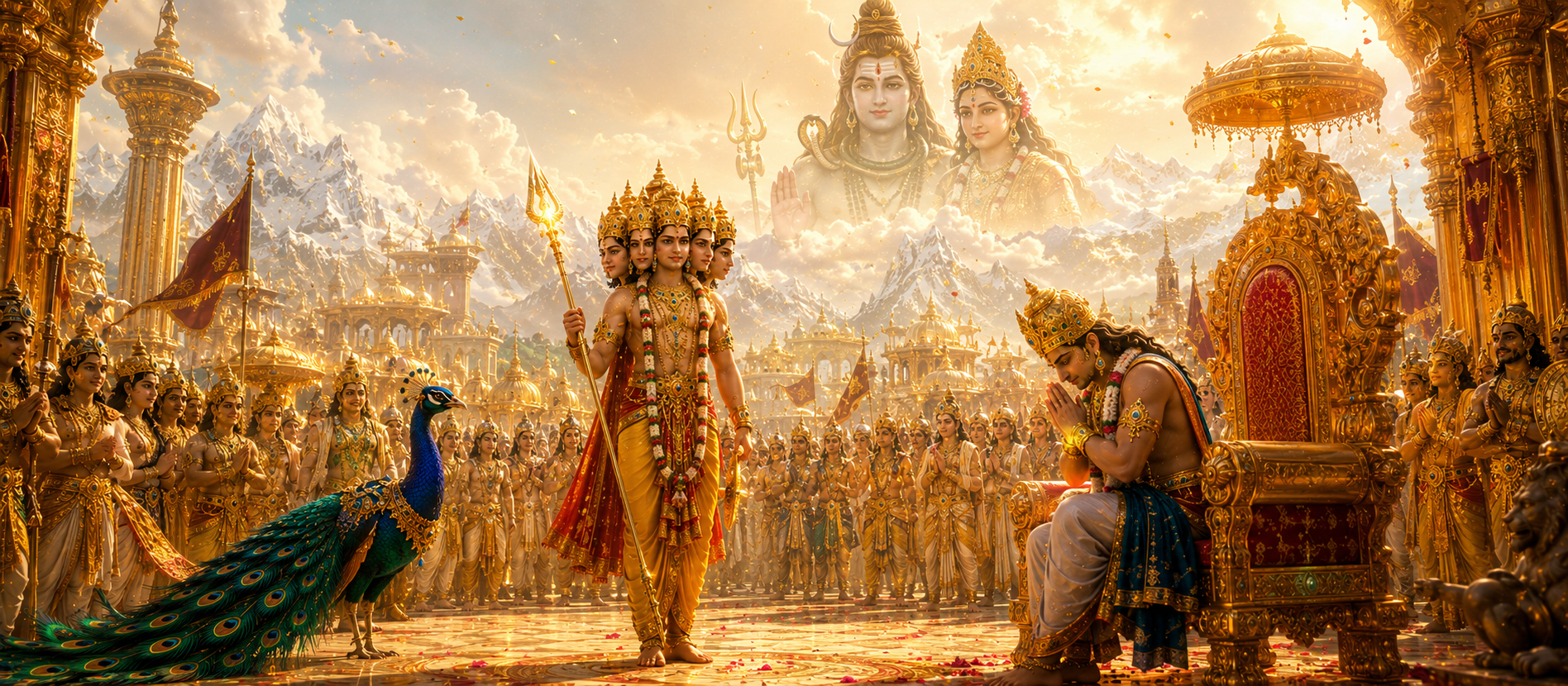
The restored cosmic order — twelve wars, twelve divine champions, one completed cycle. The Varaha Kalpa's great conflict sequence closes with Kartikeya standing at the head of the divine order he has confirmed.
The Twelve Wars — The Complete Cycle
The sequence that opened with the Halahala War — two gods fighting together against the first beings they had created — closes here with a single warrior-god whose Vel pierces through the final tumult of the age. Between these two poles, twelve wars have shaped the cosmos as it is known: the Earth has been rescued, a tyrant's boons circumvented, sovereignty reclaimed by law, the ocean churned for its treasures, the moon's transgression corrected, sages settled their rivalries in bird-form, three cities destroyed in one shot, a demon purified on a trident, illusions seen through, the world's waters released from a cosmic obstruction, and now the final war brought to its close by the new general of the age.
No single theological principle explains all twelve. That is the point. The universe requires different kinds of divine power at different moments — the avatar's precision, the destroyer's patience, the sage's sacrifice, the warrior's clarity. The twelve wars argue, together, that the cosmic order is maintained not by any single deity but by a succession of appropriate responses to successive crises, each response calling forth the form of divinity the moment requires.
The Varaha Kalpa continues. New disruptions will arise. New champions will be called. But for now — after twelve wars, through the long arc of the present cosmic age — the three worlds are in order, Kartikeya stands at the head of the divine armies, and the great cycle that began at the dawn of creation has, for the moment, run its course.
Outcome Summary
Military result: Decisive Deva victory. Kolahala was slain by Kartikeya's Vel. The vast Asura army, deprived of its leader and the tumultuous force that animated it, was routed. The three worlds were restored to Deva governance under Indra, with Kartikeya confirmed as the divine Senapati.
Structural significance: The twelfth war completes the generational succession of divine champions across the twelve-war sequence — from the Trimurti acting collectively, through Vishnu's avatars, through Shiva's destroyer-wars, through Indra's test-wars, to Kartikeya's closure. Each phase handed cosmic guardianship forward; the Kolahala War confirms the handover to the present age's commander.
Theological significance: The Vel's centrality establishes the Shakti principle one final time: Kartikeya fights with Parvati's own power given material form. The warrior who closes the cycle does so through the gift of the Divine Mother. The sequence that opened with the Devi Bhagavata's distinctive emphasis on the primacy of Shakti (War I — Lakshmi and Parvati withdrawing their power from the gods) closes with Shakti in the form of the Vel delivering the final victory. The frame is complete.
Kartikeya in Living Tradition — The Warrior God of South India
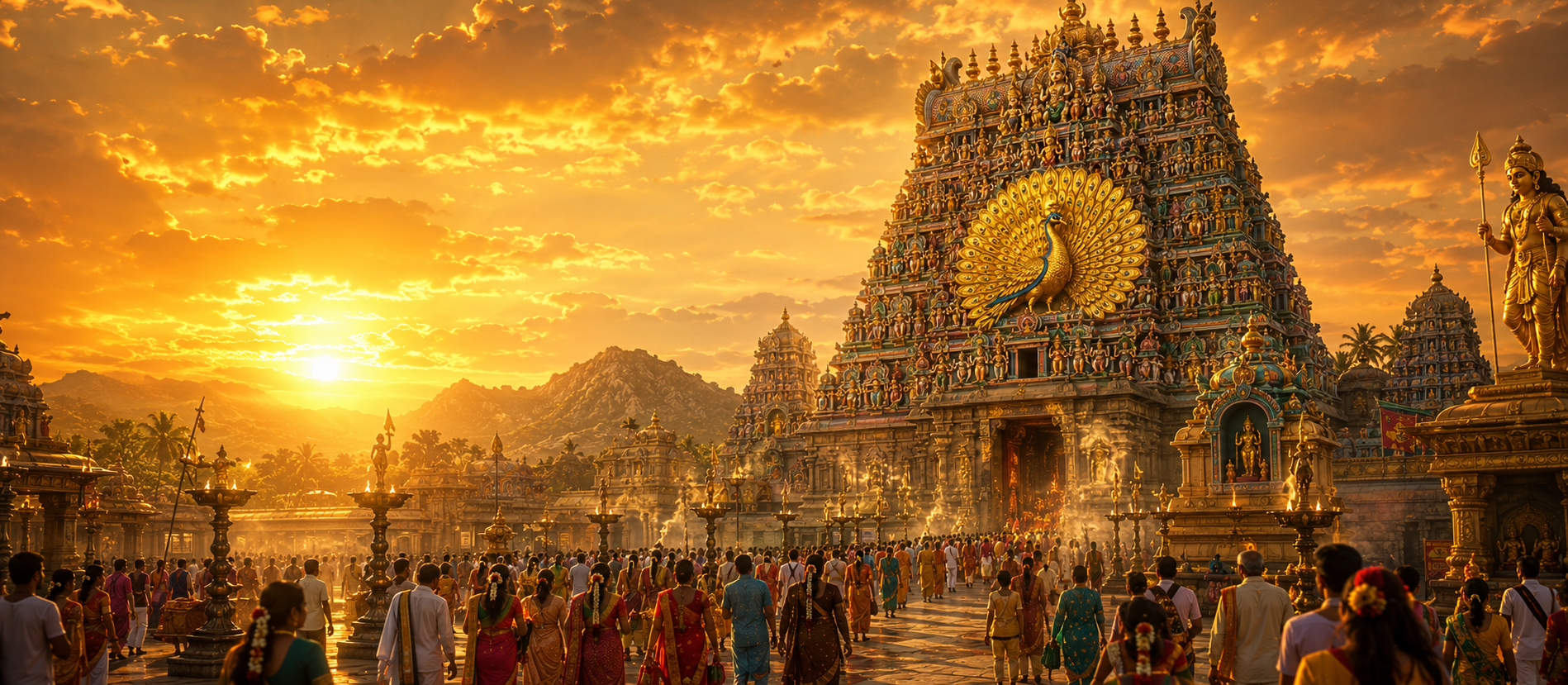
The Murugan temples of south India — where the warrior who closed the Varaha Kalpa's twelve-war cycle is worshipped as present divine power by millions of devotees. The cosmic war ended; the devotion continues.
Of all the divine champions of the twelve wars, Kartikeya has the most intensely alive living worship tradition. The Murugan temples of Tamil Nadu — from Tiruchendur on the coast to Palani in the hills, from Swamimalai to Pazhamudircholai — are among the most visited pilgrimage sites in south Asia. The Thaipusam festival, celebrated across south India, Malaysia, Singapore, and wherever Tamil communities have settled, honours Kartikeya with a devotional intensity that makes the cosmic wars feel immediate rather than mythological.
This living tradition is the final confirmation of what the twelve-war sequence was always ultimately about. The cosmic conflicts recorded in the Brahmanda Purana and the Devi Bhagavata Purana were never merely historical accounts of divine battles. They were theology in narrative form — the tradition's way of explaining who guards the universe and why, who can be called upon when the cosmic order is disrupted, and what forms of divine power are available to the world in its moments of deepest need. Kartikeya's presence at the end of that sequence, and his living presence in millions of devotees' daily worship, is the tradition's answer to its own question: the cycle ends here, and this is who stands at the close of it.
Textual Sources & Variants
The Kolahala War is the least elaborately narrated of the twelve conflicts in the surviving Puranic tradition. The Brahmanda Purana names it and identifies Kartikeya as the champion and Kolahala as the adversary. The Skanda Purana — the text dedicated to Kartikeya himself, one of the longest of the Mahapuranas — provides the fullest account of the war in the context of Kartikeya's divine role as Senapati. Regional traditions in south India, particularly those associated with specific Murugan temple legends, preserve additional narrative detail not always attested in the Sanskrit Mahapurana tradition.
| Source | Detail | Variant / Note |
|---|---|---|
| Brahmanda Purana |
Kolahala War named twelfth and final in the twelve-war list of the Varaha Kalpa. Kartikeya (Subrahmanya) identified as the divine champion. Kolahala as the Asura adversary. The war's outcome — Kolahala's defeat and the completion of the cycle — stated. | Primary framework source. The most explicit naming of this as the twelfth and final conflict in the canonical sequence. Narrative detail limited — the Brahmanda Purana's function here is structural confirmation rather than narrative elaboration. |
| Skanda Purana Kumara Khanda |
Fullest narrative account of the Kolahala War in the context of Kartikeya's role as Senapati. The Vel as the decisive weapon; the battle narrative; Kolahala's defeat; the restoration of the three worlds. The war framed as the confirmation of Kartikeya's role as the present age's divine commander. | Primary narrative source. The Skanda Purana is the text most dedicated to Kartikeya's mythology; its account of the Kolahala War reflects the fullest Kartikeya-centred theological framing. |
| Shiva Purana Kumara Khanda |
Kartikeya's role as Senapati established; his previous major war (against Tarakasura) narrated at length. The Kolahala War referenced as the confirmation of the role established in the Tarakasura War. | The Shiva Purana frames the Kolahala War primarily through the lens of Kartikeya's relationship to his parents Shiva and Parvati — the Vel as Parvati's gift, the war as the fulfilment of the purpose for which the son was born. |
| Tamil Puranic traditions |
The Kanda Puranam (Tamil version of the Skanda Purana) and associated temple sthala-puranas provide additional narrative detail; the Vel's role and Kartikeya's battle with Surapadman (a related but distinct figure from Kolahala) are extensively narrated. | The Tamil tradition sometimes conflates or parallels the Kolahala War with the Surapadman war — a distinct but related cosmic conflict in the Tamil Murugan mythology. The two traditions are connected but not identical. |
References
Primary Sources
- Brahmanda Purana — Varaha Kalpa section (Kolahala War named twelfth and final; Kartikeya as champion; completion of the cycle stated)
- Skanda Purana — Kumara Khanda (fullest narrative of the Kolahala War; Vel as decisive weapon; restoration of the three worlds)
- Shiva Purana — Kumara Khanda (Kartikeya as Senapati; Parvati's gift of the Vel; the war as fulfilment of Kartikeya's purpose)
- Kanda Puranam (Tamil) — (Tamil elaboration of the Skanda Purana tradition; Murugan's wars including the Surapadman episode)
- Mahabharata, Shalya Parva — (Kartikeya's birth and role as Senapati narrated at length in the Skanda episode)
Secondary Sources
- Mani, Vettam. Puranic Encyclopaedia. Motilal Banarsidass, 1975. Entries: "Kartikeya," "Skanda," "Subrahmanya," "Kolahala," "Vel."
- Clothey, Fred W. The Many Faces of Murugan: The History and Meaning of a South Indian God. Mouton, 1978. (The most comprehensive scholarly study of the Murugan/Kartikeya tradition.)
- Zvelebil, Kamil V. Tiru Murugan. International Institute of Tamil Studies, 1981. (On the Tamil Murugan tradition and its relationship to the Sanskrit Kartikeya mythology.)
- Tagare, G. V. (trans.). The Brahmanda Purana. Motilal Banarsidass, 1983. (The twelve-war framework in its primary Puranic source.)
- O'Flaherty, Wendy Doniger. Asceticism and Eroticism in the Mythology of Siva. Oxford University Press, 1973. (On Kartikeya's birth and his relationship to Shiva and Parvati.)