
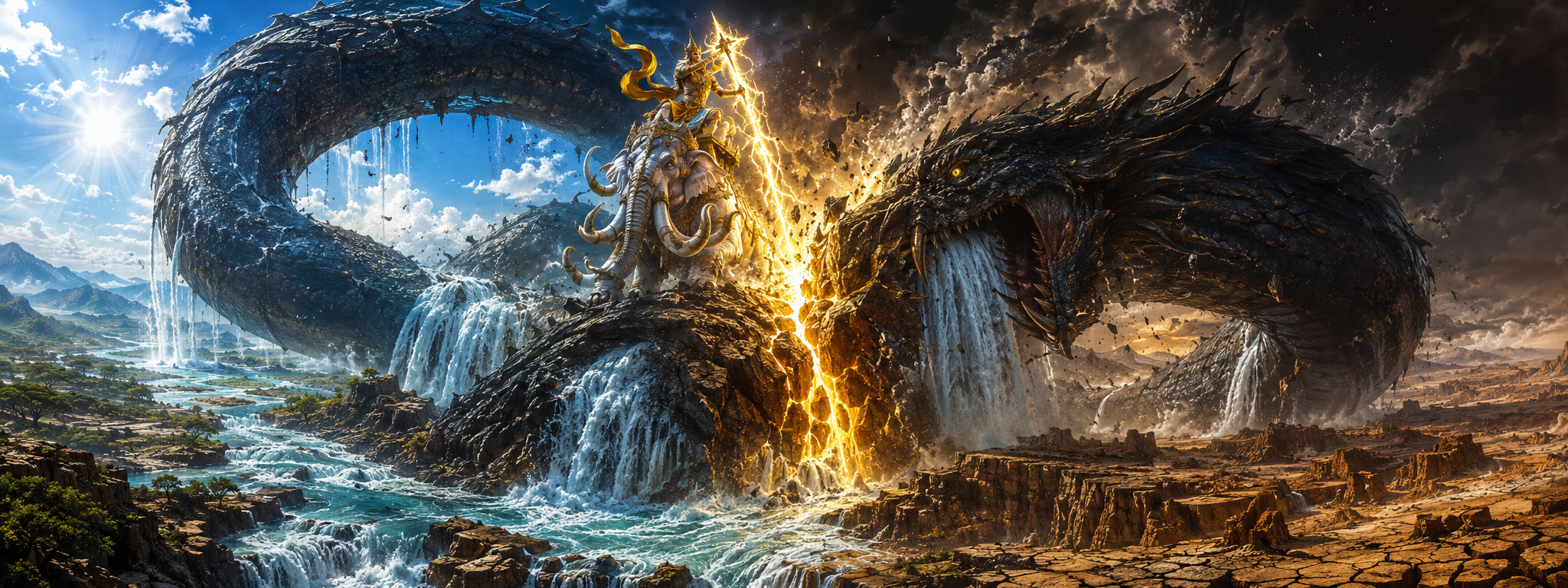
The Vritra War is the oldest conflict in the twelve. While the other wars are primarily Puranic in their full narrative development, the Vritra War reaches back to the very foundations of Sanskrit literature — to the Rigveda itself, where Indra's slaying of Vritra is among the most frequently hymned events in the entire text. More than two hundred Rigvedic hymns reference the Vritra myth in some form. No other event in the twelve wars has this depth of textual history.
It is also, cosmologically, the most consequential war for life on earth. Vritra did not merely conquer territory or displace the gods — he hoarded the world's waters. Every river, every rain cloud, every source of water in the universe was locked within his coiling body or blocked by his vast form. Without water, creation was dying. The Vritra War is therefore not a war for sovereignty or devotion or cosmic law. It is a war for survival — the most elemental possible reason to fight.
Vritra — The Cosmic Obstructer
Vritra's nature has been interpreted across multiple layers of the Sanskrit tradition. At the oldest Rigvedic layer, he is primarily a cosmic phenomenon — the principle of obstruction, drought, and the blocking of life-giving waters. His name derives from the root vr — to obstruct, to cover, to enclose. He is the obstruction made flesh: a vast serpentine or dragon-like being who lies coiled across the mountains, blocking every river and cloud, hoarding the waters that the world needs to live.
In the Puranic elaboration, Vritra is given a more specific origin. The Bhagavata Purana's account — told in Skandha VI across several chapters — provides the most surprising genealogy: Vritra was originally a great devotee of Vishnu named Chitraketu, a king who had lost his son and in his grief offended the sage Durvasa. Durvasa cursed him to be born as a demon. Reborn as Vritra — terrifying in form, an enemy of the gods — he carried within him the devotion he had cultivated in his previous life. The Vritra of the Bhagavata is therefore, paradoxically, a Vaishnava devotee in demon form — one whose death at Indra's hands is itself a form of liberation.
The Rigvedic Vritra and the Bhagavata's Chitraketu-as-Vritra are different layers of the same figure — the older text caring nothing for origin stories, the Purana weaving the ancient myth into its theology of devotion and rebirth. Both accounts agree on the essential facts: Vritra held the waters, Indra killed him, the waters were released.
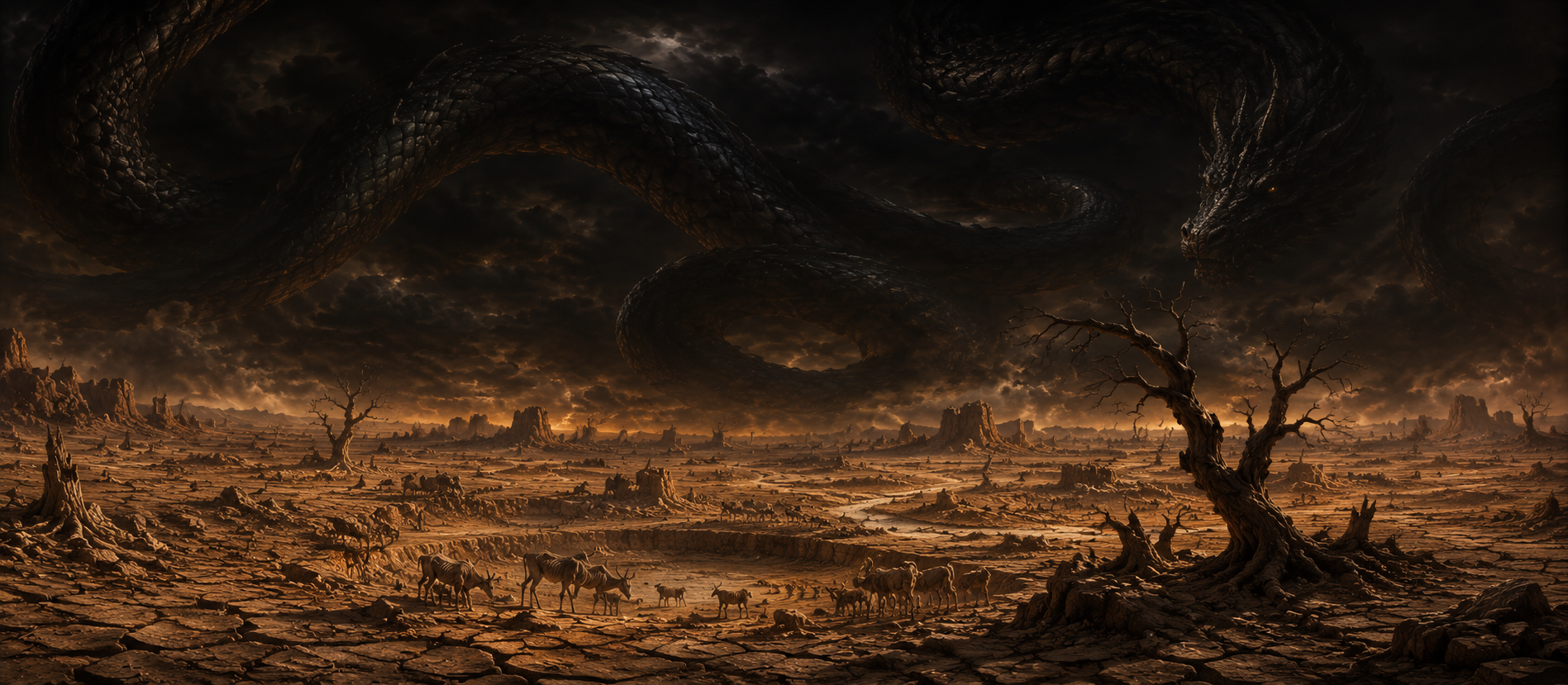
Vritra's hoarding of the world's waters was not merely a cosmic disruption — it was the extinction of life itself, the most existential threat in the entire sequence of twelve wars.
The Problem — Indra's Broken Vajra
The gods knew what needed to be done. Vritra had to be defeated and the waters released. Indra, as king of the gods and lord of thunder and rain, was the obvious champion — his very nature was the antipode of Vritra's obstruction. But Indra faced a fundamental problem: his primary weapon, the Vajra, had been shattered or was insufficient against Vritra's power. No conventional weapon in the divine arsenal could penetrate the cosmic obstructer's defences.
The Puranas and the Mahabharata record that the gods consulted Brahma and Vishnu about how to defeat Vritra. The answer they received was not a new weapon forged in the celestial smithy, not a divine boon, not a strategic alliance. It was a request — a request to a specific sage, for the most intimate possible sacrifice.
The sage was Dadhichi — also known as Dadhyanch, and in some texts as Dadhica. He was one of the great sages of the Angiras tradition, a master of divine knowledge, a figure of such accumulated spiritual merit that his very bones carried cosmic power. The gods came to him and explained the crisis: Vritra could only be slain by a weapon made from Dadhichi's bones. They asked him to give his life for the world.
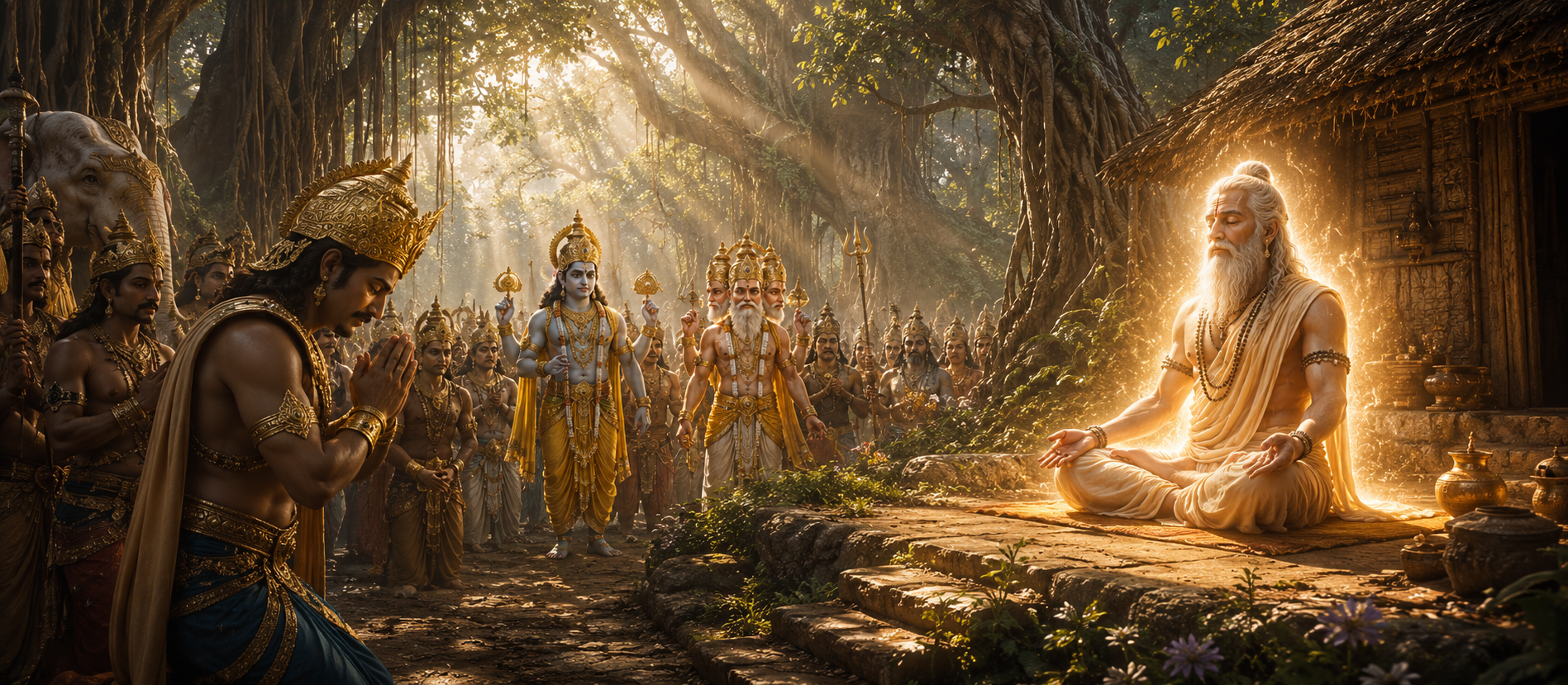
The gods approaching Dadhichi — the most extraordinary supplication in the twelve wars: Indra, king of all the heavens, asking a forest sage for the gift of his life.
Dadhichi's Sacrifice — The Most Sacred Gift in Sanskrit Literature
Dadhichi's response to the gods' request is, in the Puranic tradition, one of the supreme acts of selfless sacrifice in all of Sanskrit literature. He did not hesitate. He asked only that the gods give him a moment to complete his meditation and release his consciousness from his body in the proper way — not through violence but through the yogic dissolution called the mahayoga. The gods agreed and waited.
Dadhichi entered deep meditation, withdrew his prana (life force) from every part of his body, and departed. His body remained — and immediately, the gods understood the sacred nature of what they had been given. They approached Dadhichi's remains with the reverence due to a supreme sacrifice. The divine craftsman Vishvakarma fashioned from Dadhichi's bones — particularly from his spine, which contained the concentrated force of his years of tapas — the new Vajra. Some accounts describe multiple weapons being made from different bones; the primary weapon fashioned from his spine or skull was the thunderbolt with which Indra would slay Vritra.
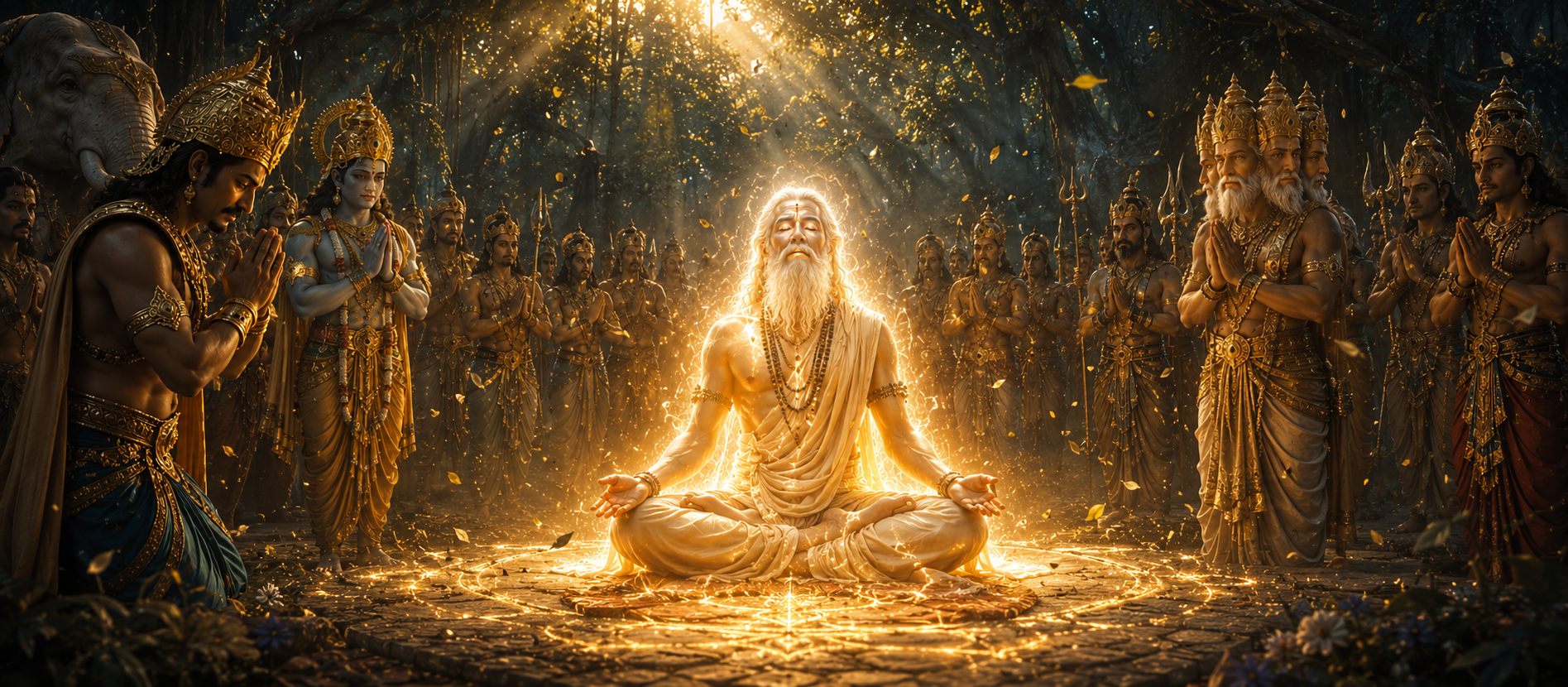
Dadhichi's voluntary release of life through mahayoga — one of the most celebrated acts of selfless sacrifice in all of Sanskrit literature — the foundation on which the Vajra was built and the world's waters rescued.
The forging of the Vajra from Dadhichi's bones is described across multiple sources with consistent emphasis on the spiritual quality of the weapon produced. This was not merely a stronger thunderbolt — it was a weapon infused with the accumulated tapas of one of the greatest sages in the universe. The bones of a man who had spent his life accumulating divine knowledge and offering it freely carried a power that no weapon forged from divine metal could match.
The Bhagavata Purana's version adds a further dimension: when the new Vajra was placed in Indra's hand, he felt not just its physical weight but its moral weight — the consciousness that this weapon existed because a sage had willingly given everything for the world. The awareness of Dadhichi's sacrifice became, in some sense, part of the weapon's power. Indra went to meet Vritra not just with a better weapon but with the weight of a sage's selfless life behind every stroke.
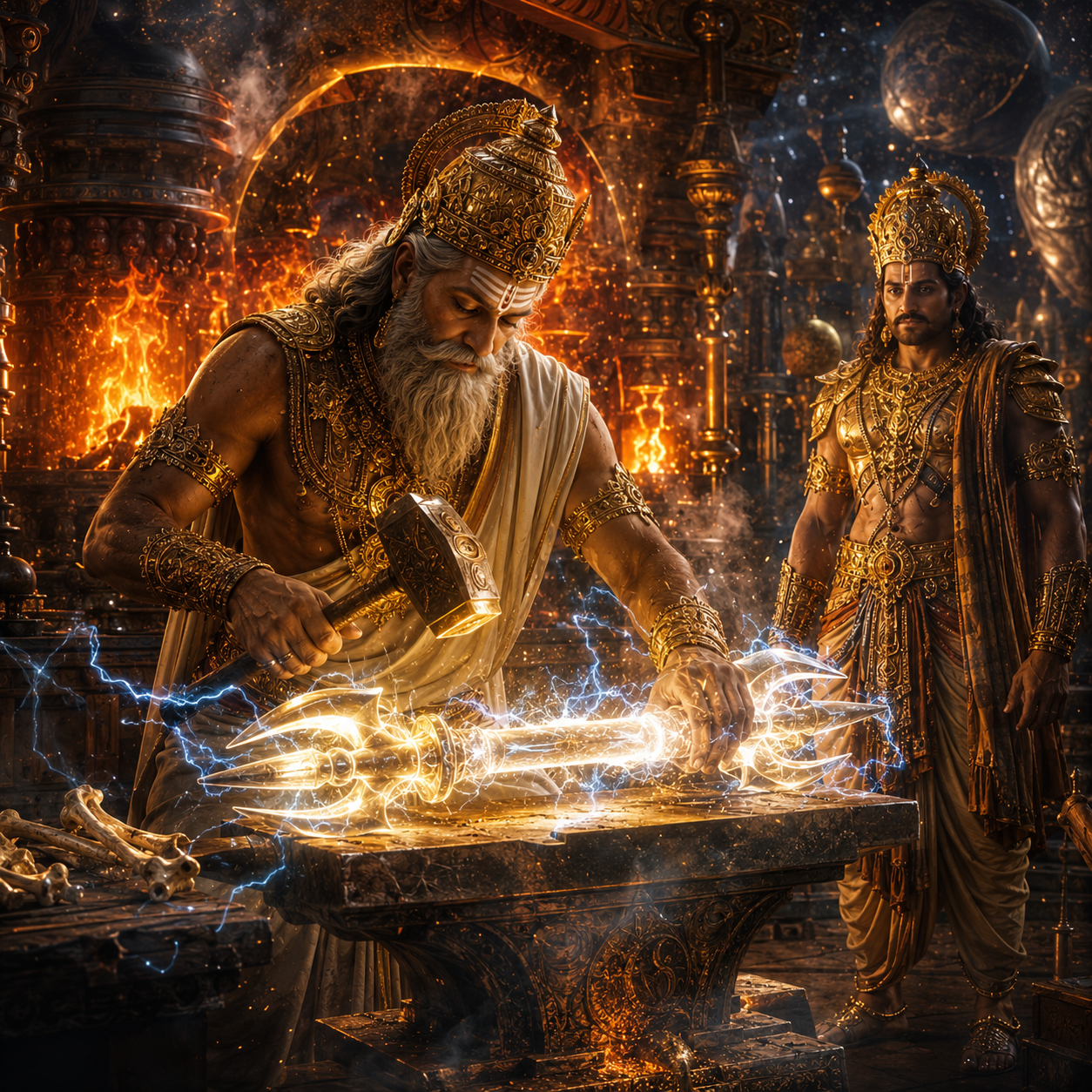
The Vajra forged from Dadhichi's bones — a weapon whose power derives not from divine metal but from a sage's accumulated spiritual merit willingly sacrificed.
Key Combatants
Divine Champion
Indra and the Devas
- Indra — King of the gods; wielder of the new Vajra made from Dadhichi's bones. His victory here is not merely military but cosmologically restorative: he releases the waters that make all life possible.
- Dadhichi (Dadhyanch) — The sage whose voluntary sacrifice made the victory possible. He does not fight — he gives. His contribution to the Vritra War is the most profound act in the entire twelve-war sequence.
- Vishvakarma — The divine craftsman who fashions the Vajra from Dadhichi's bones.
- Vishnu — Supports the Deva forces; in the Bhagavata's version, enters Indra's body at a critical moment, lending his divine power to the fatal blow.
The Adversary
Vritra
- Vritra — The cosmic obstructer; vast serpentine being who hoards the world's waters; son of the sage Tvashtr in some accounts; Chitraketu reborn in the Bhagavata's version. Despite his terrifying form, the Bhagavata's Vritra is a Vishnu-devotee who recognises that his death at Indra's hands is liberation.
- Tvashtr (variant) — Some accounts describe Vritra as the creation of the sage Tvashtr, who fashioned him specifically to avenge his son's death at Indra's hands — adding a layer of Indra's own prior transgression to the war's background.
- The Asura forces — Vritra commands vast demonic armies, but the war's decisive element is the direct confrontation between Indra and Vritra himself.
The Battle — Indra Faces His Fear
The battle between Indra and Vritra is among the most dramatically narrated in the entire Bhagavata Purana. Vritra is not merely physically formidable — he is psychologically overwhelming. The Bhagavata devotes considerable space to Indra's fear before and during the battle. Indra hesitated. He had faced many enemies, but something about Vritra — his sheer scale, his cosmic nature, perhaps the uncanny quality of fighting a being who radiated devotion even in battle — caused the king of the gods to hold back.
Vritra himself, in the Bhagavata's version, addresses Indra across the battlefield with philosophical composure. He tells Indra that he bears him no personal enmity; that the outcome of the battle is already determined by Vishnu's will; that Vritra himself desires only liberation and is grateful that Indra is the instrument of it. He invites Indra to strike without hesitation. The Bhagavata turns what in the Rigveda is a pure battle hymn into a philosophical dialogue — Vritra's speech on the eve of his death is one of the most celebrated passages of Vaishnava theology in the text.
"O Indra, why do you hesitate? Whatever is to happen will happen. I bear you no ill-will. Strike me, and do not fear — for the one whose arrow I truly await is not you, but the Lord who stands behind your weapon."
Vritra to Indra — Bhagavata Purana, Skandha VI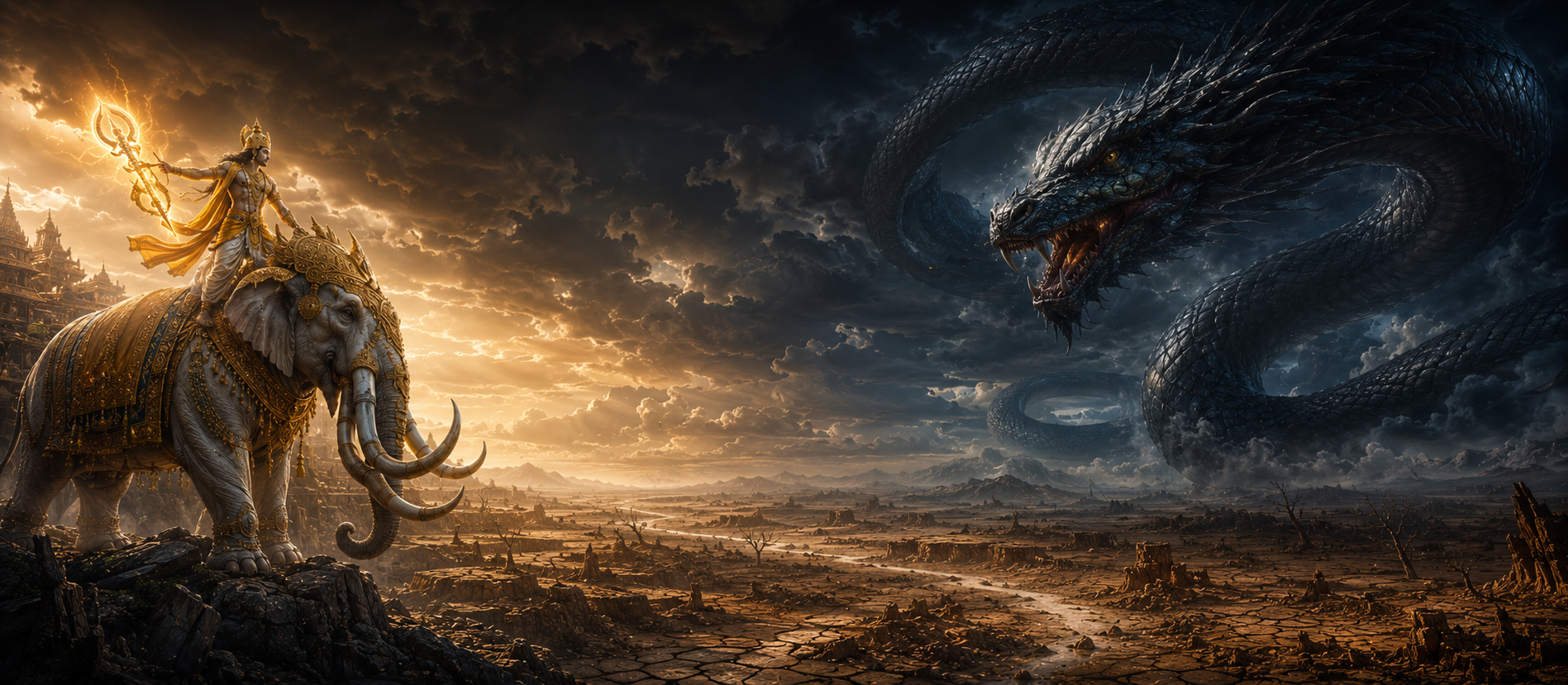
The confrontation across the battlefield — Indra's hesitation and Vritra's philosophical composure are the Bhagavata Purana's most original contribution to the oldest myth in Sanskrit literature.
Indra finally overcame his hesitation. In the Rigvedic account, the battle is described in martial terms — Indra striking Vritra repeatedly with his bolt, Vritra resisting, the final blow splitting him open. The Bhagavata's account describes something more specific: at the decisive moment, Vishnu entered Indra's body and his weapon, lending his divine presence to the strike. The Vajra — already carrying the power of Dadhichi's sacrifice — now also carried the power of Vishnu's direct presence.
Indra struck Vritra. The cosmic obstructer fell. And from his split body — as the Rigveda had hymned for centuries — the waters of the world poured forth: rivers that had been held for ages, rain clouds that had been sealed, every water source in the universe released simultaneously. Creation exhaled. Rain fell on the parched earth. Rivers ran again. The world, brought to the edge of extinction, was restored to life.
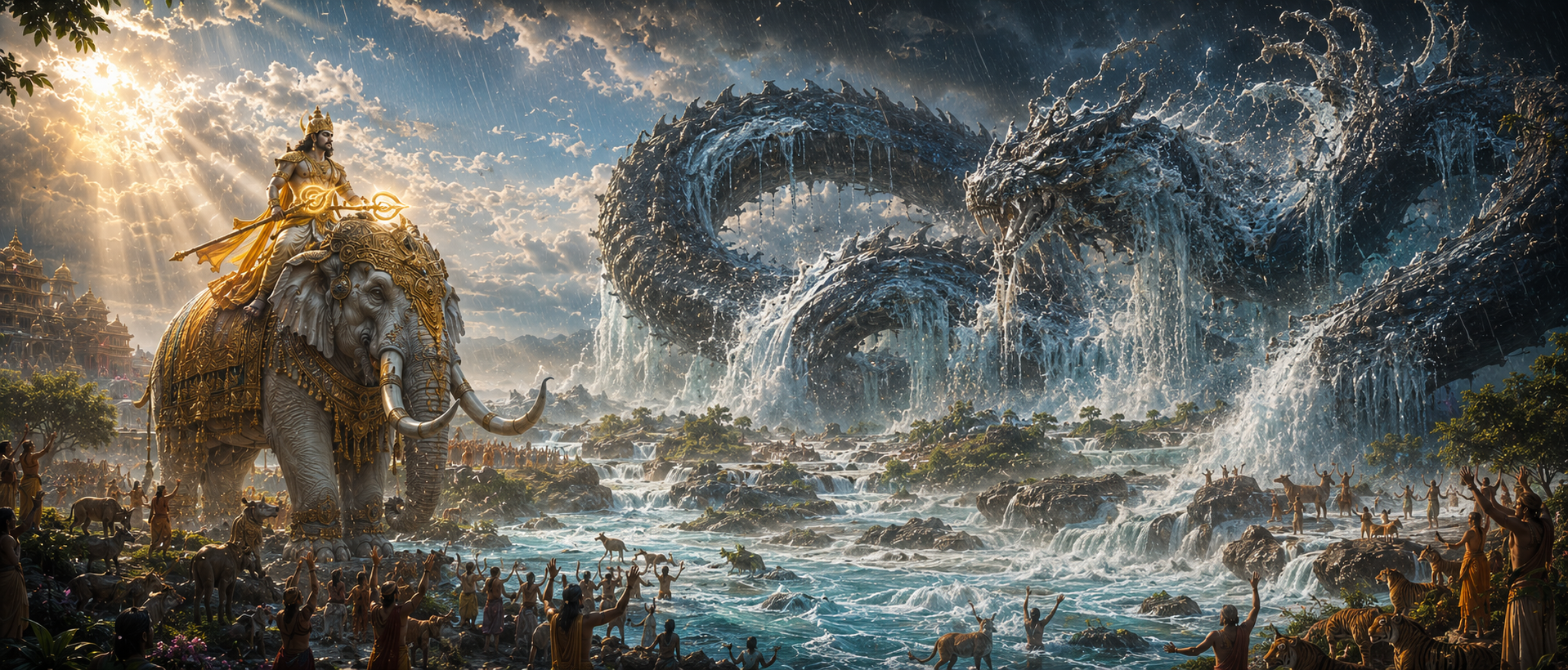
The release of the world's waters — the Vritra War's resolution is not a military triumph but the restoration of life itself to a creation that had been dying of thirst.
The Aftermath — Indra's Brahmahatya and Purification
The Bhagavata Purana's version of the Vritra War does not end with Vritra's death and the release of the waters. It adds a profound theological coda that is unique in the twelve wars: the question of Indra's guilt.
Vritra, in the Bhagavata's account, was born from a Brahmin lineage — either as Chitraketu (a king of Brahmin knowledge) or as the son of Tvashtr (a Brahmin sage). Killing a Brahmin — even in justified battle — carried the terrible sin of Brahmahatya (slaying of a Brahmin), which adhered to Indra like a shadow even in his moment of victory. The Brahmahatya manifested as a form of spiritual pollution that diminished Indra's power and required elaborate purification.
The Bhagavata describes how the Brahmahatya was distributed and purified — divided among trees, rivers, earth, and women, each absorbing a portion of the sin in exchange for a divine boon. This episode connects the Vritra War to the broader Puranic theology of ritual pollution and purification, and establishes that even the most cosmically necessary acts can carry moral consequences that must be addressed.
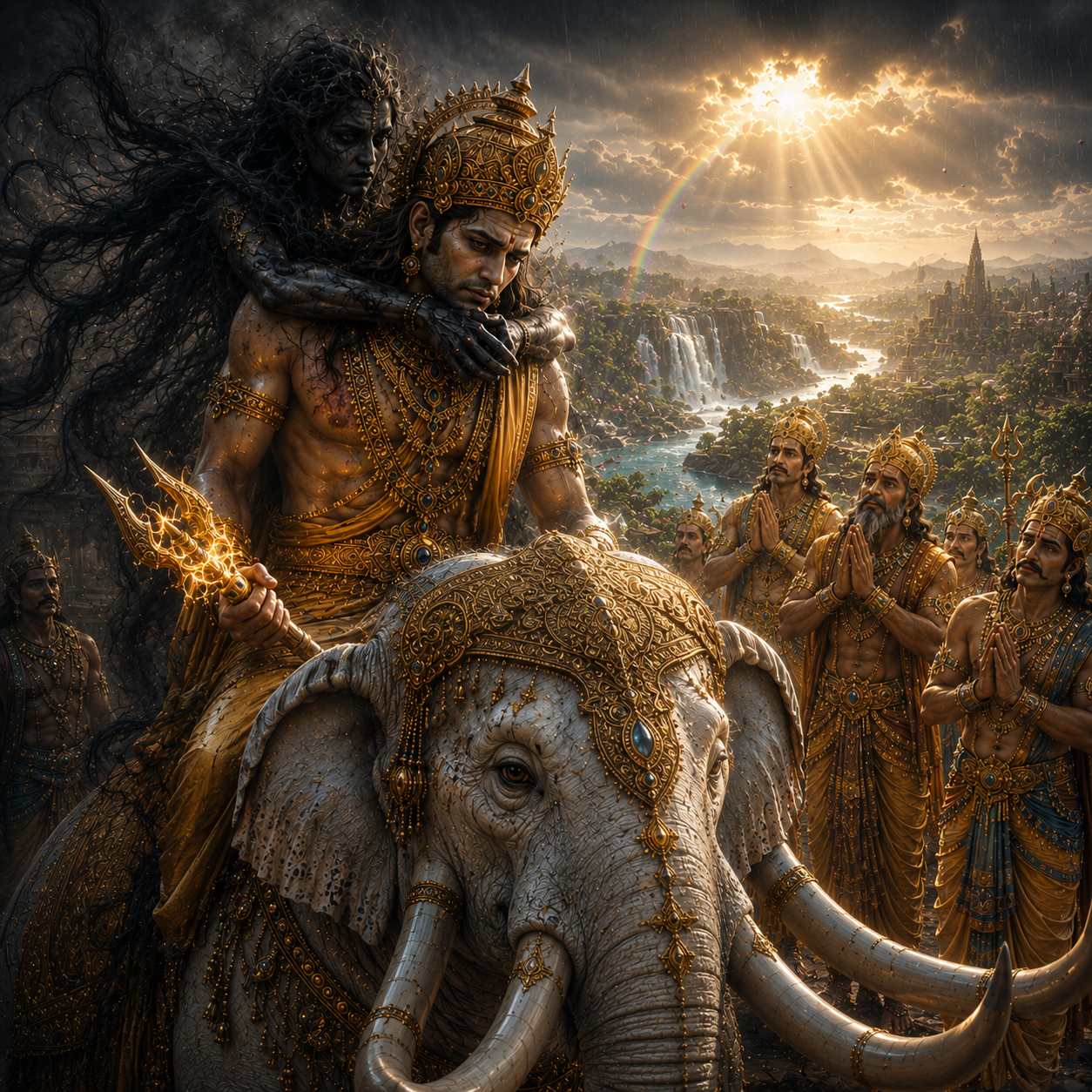
The Brahmahatya — the moral weight of killing a Brahmin-born being, even in cosmic necessity — is the Vritra War's most theologically searching aftermath, unique among the twelve conflicts.
The Brahmahatya episode is the Bhagavata Purana's most sophisticated contribution to the Vritra narrative — and the detail that most clearly distinguishes the Puranic version from the Rigvedic original. The Rigveda celebrates Indra's victory without qualification; the Bhagavata interrogates it.
This interrogation is consistent with the Bhagavata's broader theological project: the text is interested not just in the cosmological results of divine action but in the moral and spiritual consequences for the divine actors themselves. Indra wins the Vritra War — but the winning costs something. The waters are restored — but the restorer carries a stain that requires purification. The war is necessary — and its necessity does not erase its moral complexity.
Placed here, as the penultimate conflict in the twelve wars, this nuance serves a structural purpose. The sequence of twelve conflicts has moved from the relatively uncomplicated wars of force (Hiranyaksha, Hiranyakashipu) through the theologically complex (Vamana, Samudra Manthana, Tarakamaya) to arrive at this: a war that is simultaneously the oldest in the tradition and the most morally searching in its aftermath. After Vritra, only the Kolahala War remains — and a new divine champion is waiting.
Outcome Summary
Military result: Decisive Deva victory. Vritra was slain by Indra's Vajra — the weapon forged from the sage Dadhichi's voluntarily sacrificed bones. The world's waters, hoarded within Vritra's body, were released. Creation was restored from the brink of extinction.
Dadhichi's legacy: The sage's sacrifice is remembered in the tradition as one of the most perfect acts of seva (selfless service) in the entire corpus of Sanskrit literature. Dadhichi had no personal stake in the war; he simply gave what was needed when it was needed. Several temples in India commemorate his sacrifice, and his name is synonymous with the principle of dana (giving) taken to its absolute limit.
Theological consequence: The Brahmahatya episode — Indra's spiritual pollution from killing a Brahmin-born being, and its subsequent purification — establishes the principle that cosmic necessity does not suspend moral law. Even the most justified killing carries consequences that must be addressed through proper ritual and spiritual work. This is the Bhagavata Purana's answer to the question of whether the ends justify the means: they may be necessary, but they do not nullify the means' moral weight.
Textual depth: The Vritra War has the longest textual history of any conflict in the twelve — from the Rigveda (circa 1500–1200 BCE) through the Mahabharata to the Bhagavata Purana (circa 900 CE). The evolution of the myth across this span — from pure battle hymn to philosophical dialogue and moral interrogation — is one of the most complete examples of Puranic narrative development available in Sanskrit literature.
Cosmic Significance
The Vritra War occupies a unique position in the twelve conflicts as the one whose roots predate all of Puranic literature. When the Brahmanda Purana or the Devi Bhagavata Purana lists the twelve wars of the Varaha Kalpa, the Vritra War is the one entry in the list that every educated person in ancient India would have known before reading any Purana — because it was in the Rigveda, the oldest layer of the tradition, already a celebrated victory when the Puranas were being composed.
Its placement as the eleventh of twelve — second to last — is therefore theologically significant. The sequence is building to a conclusion, and it places at the penultimate position the war that is simultaneously the oldest and the most layered. After ten wars of varying complexity, the sequence returns to its oldest roots — to the most elemental conflict (water vs. drought, life vs. extinction) — before moving to the final war and the new divine champion.
Dadhichi's sacrifice also stands as the sequence's supreme statement on the relationship between individual acts and cosmic outcomes. Every other conflict in the twelve is resolved by divine power — an avatar's form, a destroyer's arrow, a king's dharmic obligation. The Vritra War is resolved by a human choice: a sage who had no obligation to give anything decided to give everything. This human-scale act of sacrifice is, in the Bhagavata's telling, what makes the cosmic restoration possible. Without Dadhichi, Indra would have had no weapon. Without the weapon, Vritra could not be slain. Without Vritra's death, the world would have died of thirst.
Textual Sources & Variants
The Vritra War has the widest textual distribution of any of the twelve conflicts, spanning from the Rigveda to the latest Puranic compositions. The core facts are remarkably stable across this enormous span; the major variants concern Vritra's origin, the specific nature of Dadhichi's sacrifice, and the Brahmahatya episode. The Rigvedic version knows nothing of Dadhichi or of Chitraketu — these are Puranic elaborations of an older myth.
| Source | Detail | Variant / Note |
|---|---|---|
| Rigveda Mandala I, Hymn 32 |
The oldest account — a pure battle hymn. Indra strikes Vritra with his bolt; Vritra releases the waters; cosmological victory celebrated. No Dadhichi, no Chitraketu, no Brahmahatya. Pure martial myth of the storm-god defeating the drought-demon. | The foundational text. The Puranic versions are elaborate theological expansions of this hymn's core narrative. Vritra here is primarily a cosmic phenomenon (obstruction, drought) rather than a character with a personal history. |
| Bhagavata Purana Skandha VI |
Fullest theological account: Chitraketu as Vritra's previous life; Dadhichi's voluntary sacrifice; Vajra forged from his bones; Indra's hesitation and Vritra's philosophical address; Vishnu's direct participation; the Brahmahatya and its purification. | Primary Puranic source. The most theologically elaborate version — the Bhagavata turns the ancient battle hymn into a meditation on sacrifice, devotion, and the moral complexity of necessary killing. |
| Mahabharata Shanti Parva and Udyoga |
Vritra narrative present; Dadhichi's sacrifice attested; the war described in summary form. The Mahabharata knows the Puranic elaboration of the myth, including Dadhichi, but does not narrate it as fully as the Bhagavata. | Confirms the Dadhichi element as established tradition by the epic period. The Mahabharata uses the Vritra story primarily as an illustration in philosophical discourses rather than as a narrative in its own right. |
| Matsya Purana and Vishnu Purana |
Vritra account present in both; Dadhichi's sacrifice attested; Brahmahatya episode present in some form. Details vary — particularly on the precise nature of Vritra's origin (Tvashtr's creation vs Chitraketu's rebirth). | The Tvashtr origin (Vritra created by the sage Tvashtr to avenge his son's death at Indra's hands) is attested in Matsya and some other Puranas. This variant gives the war a further moral dimension — Indra as the one who created the conditions for his own crisis. |
| Brahmanda Purana |
Vritra War (Varta War) named eleventh in the twelve-war list of the Varaha Kalpa. | Framework source; the war is called "Varta" (related to Vritra) in this list. Confirms its position as penultimate in the canonical sequence. |
References
Primary Sources
- Rigveda — Mandala I, Hymn 32 (oldest account of Indra-Vritra battle; the foundational text)
- Bhagavata Purana — Skandha VI, Chapters 9–17 (Chitraketu; Dadhichi's sacrifice; philosophical dialogue; Brahmahatya and purification)
- Mahabharata, Shanti Parva — Sections 270–272 (Vritra narrative in philosophical context; Dadhichi attested)
- Matsya Purana — Chapters 246–249 (Vritra account; Tvashtr origin variant)
- Vishnu Purana — Book I (Vritra narrative; Dadhichi's sacrifice)
- Brahmanda Purana — Varaha Kalpa section (Varta/Vritra War named eleventh in the twelve-war list)
Secondary Sources
- Mani, Vettam. Puranic Encyclopaedia. Motilal Banarsidass, 1975. Entries: "Vritra," "Dadhichi," "Vajra," "Brahmahatya."
- Doniger O'Flaherty, Wendy. The Rig Veda: An Anthology. Penguin, 1981. (Translation and commentary on Rigveda I.32 — the Vritra hymn.)
- Tagare, G. V. (trans.). The Bhagavata Purana. Motilal Banarsidass, 1976. Skandha VI.
- Macdonell, A. A. Vedic Mythology. Strassburg, 1897. (On the Rigvedic Vritra and the development of the myth in later tradition.)
- Jamison, Stephanie W. and Joel P. Brereton (trans.). The Rigveda. Oxford University Press, 2014. (Modern scholarly translation with commentary on the Vritra hymns.)