
Matsya stands apart from the other nine avataras in one important respect: it answers no demon. Where Varaha meets Hiranyaksha and Narasimha meets Hiranyakashipu, Matsya's adversary is dissolution itself — the periodic flood that ends one cycle of creation and begins the next. Its purpose is not to punish adharma in a ruler or a tyrant but to preserve the raw material of dharma — the Vedas, the seed of every living species, and the one righteous man, Manu — through a catastrophe that spares nothing else.
This chronicle follows the fish's growth from a creature small enough to cup in two hands to one vast enough to anchor a boat across a drowned world, and traces how the story was told differently across the Brahmana, epic, and Puranic layers of the tradition.
Context of Incarnation
The Bhagavad Gita's doctrine of avatara — "whenever dharma declines... I manifest myself" — is usually read through crises of tyranny: a boon-protected demon, a corrupted king, a usurped throne. Matsya is the doctrine's earliest and most elemental test case, applied not to a moral crisis but to a cosmological one. At the end of a Manvantara — one of the fourteen great ages presided over by a Manu — the three worlds dissolve into a single ocean. Nothing survives that is not deliberately preserved. The avatara's task here is custodial rather than punitive: to ensure that when the waters recede, creation can resume from exactly where it left off, with the same Vedic knowledge, the same seed-forms of life, and a Manu to father the age that follows.
This framing matters for what comes after in the sequence. Kurma, Varaha, and Narasimha — the three avataras that follow Matsya, also placed within Satya Yuga — each escalate toward more active intervention against a named adversary. Matsya is the quiet premise beneath all of them: before dharma can be defended, it first has to survive.
The Narrative
Manu — in the fullest Puranic tellings, Vaivasvata Manu, son of the sun-god Surya and Sanjna, and the progenitor of the current Manvantara — is performing his morning water offerings on a riverbank when a tiny fish leaps into his cupped hands and speaks. It asks for protection from the larger fish that will otherwise eat it. Moved by the request, Manu places it in a water pot. Within a day the fish has outgrown the pot; Manu transfers it to a well, then a lake, and finally, as it continues to swell past any vessel that can hold it, to the ocean itself. Only then does the fish reveal its true identity as Vishnu, and explain why it sought out Manu in particular: in seven days, a deluge will dissolve the three worlds, and Manu — the one being of unwavering rectitude in that age — has been chosen to survive it and refound humanity afterward.
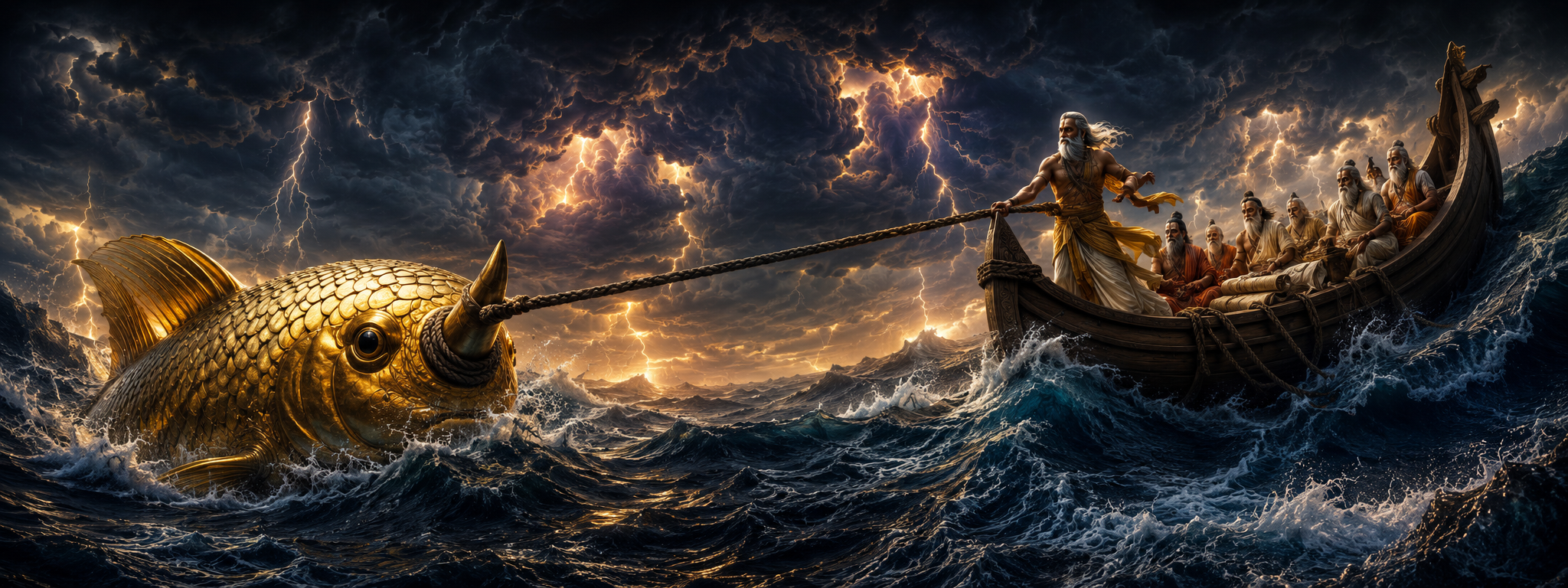
Vishnu instructs Manu to build a great ship, load it with the seeds of every plant and pairs of every living creature, and take aboard the Saptarishi — the seven great sages — as companions. When the flood rises exactly as foretold, drowning the land under a shoreless ocean, Matsya appears in its full monstrous scale, a single horn rising from its head. Manu ties the ship's rope to that horn — in most tellings, using the serpent Vasuki as the cable itself — and the fish tows the vessel through the storm for what some versions give as years, until it comes to rest against the peak of a Himalayan mountain, afterward known in some tellings as Naubandhana, "the place where the boat was bound." There the boat waits out the flood until the waters recede, and Manu descends to repopulate the earth, becoming the ancestor of the entire human lineage that follows him — the branching solar and lunar dynasties this project has already traced from his sons and daughter Ila.
A second episode is folded into the same avatara in the Puranic sources, though it belongs to a different moment in cosmic time. While Brahma slept between cycles of creation, the demon Hayagriva stole the four Vedas from his mouth and fled into the depths of the ocean. Matsya, in this telling the same fish-form of Vishnu, pursues Hayagriva into the waters, kills him, and restores the Vedas to Brahma — ensuring that the sacred knowledge, like the seed-life in the flood story, survives a threat that would otherwise have erased it entirely.
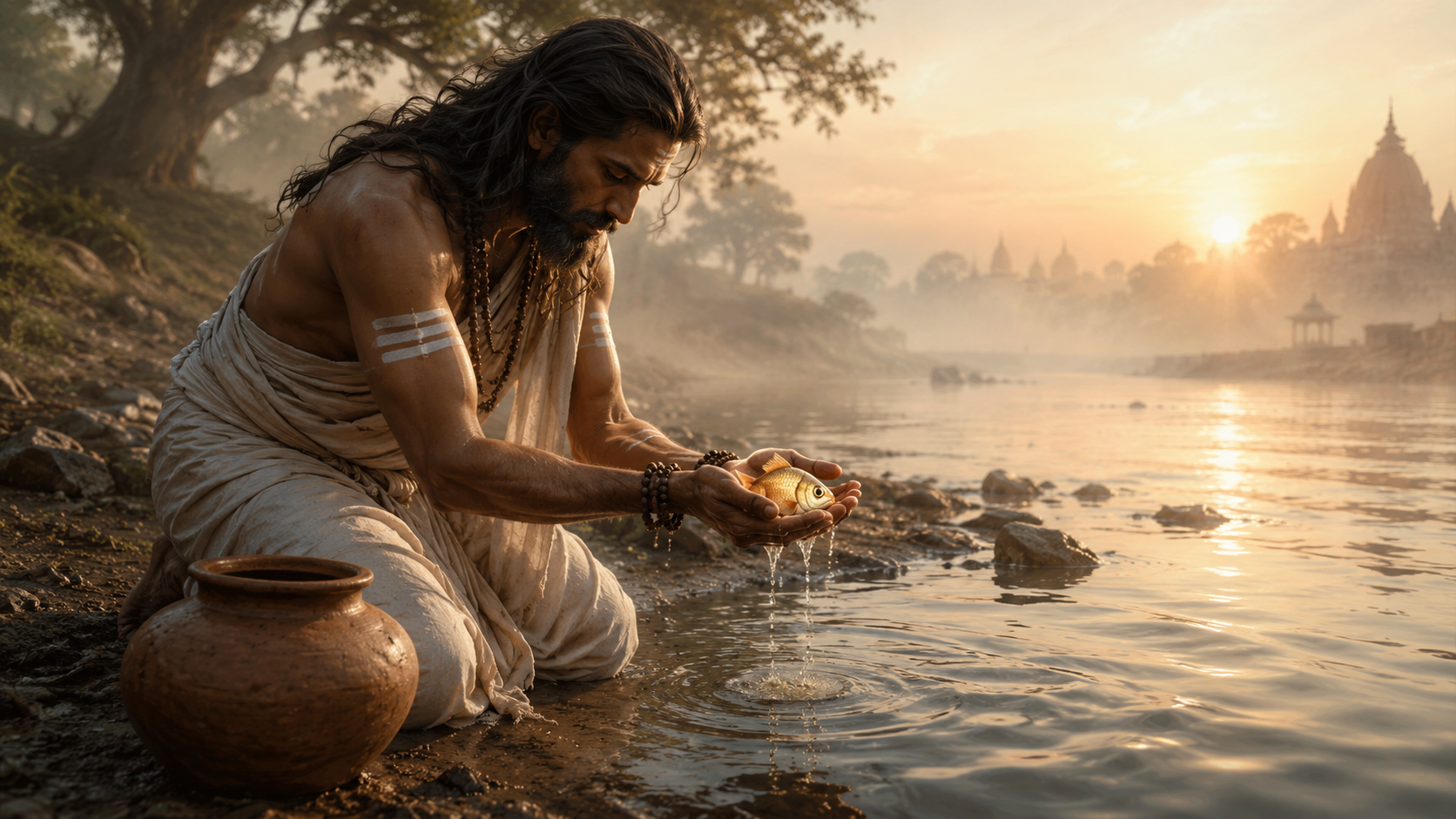
The fish's first request: protection from the larger fish of the river — the seed of everything that follows.
Shatapatha Brahmana (1.8.1, the oldest surviving version): the account is comparatively spare — the fish grows, warns Manu of the flood, and asks to be towed to safety, but is not explicitly identified as Vishnu. The identification of the fish as a Vishnu-avatara is a Puranic-era development layered onto an older flood narrative.
Mahabharata (Vana Parva 12.187): introduces the horn on the fish's head as the point of attachment for the boat's rope, and situates the boat's resting place on a peak referred to as Himavat.
Bhagavata Purana (8.24) and Matsya Purana: supply the fullest elaboration — explicit identification with Vishnu from the outset, the Hayagriva sub-episode, and the placement of the flood at the close of the Chakshusha Manvantara, immediately preceding Manu's own Vaivasvata Manvantara. The Matsya Purana, which takes its name from this avatara, embeds the narrative within a much larger and largely unrelated compendium of royal genealogies, cosmology, and temple-architecture material — a textual curiosity worth noting for anyone approaching the Purana expecting a text primarily about the avatara itself.
Symbolism & Iconography
Matsya's defining theological signature is preservation rather than combat. Every other avatara in the list meets and defeats an adversary; Matsya's task is custodial — carrying forward, intact, the components a new age of the world will need: the Vedas, the seed-forms of life, and a single righteous human lineage. In that sense Matsya sets the terms for the entire Dashavatara before the sequence turns toward conflict with Kurma, Varaha, and Narasimha.
In sculpture and painting, Matsya appears in two established forms: as a complete, colossal fish, usually with a single horn; and in the ardha-matsya or half-fish form common in later temple iconography, where the upper body is a four-armed Vishnu bearing the conch, discus, mace, and lotus, and the lower body tapers into a fish's tail. Both forms appear across Dashavatara temple sets and painted cycles alongside the other nine avataras, typically first in sequence.
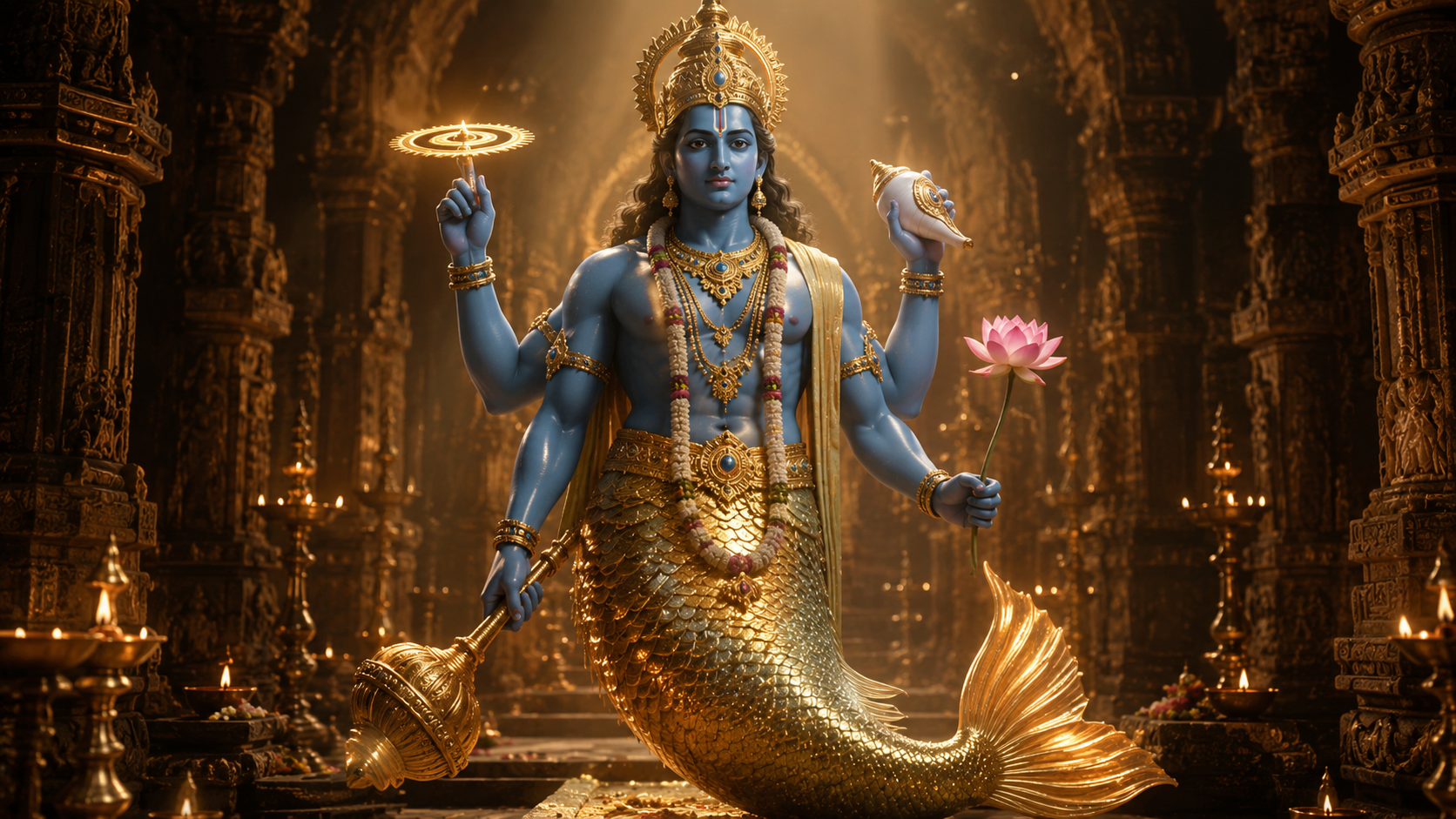
The ardha-matsya form, standard in later temple sculpture: Vishnu's four arms and emblems above, the fish's tail below.
Every subsequent avatara in this series presupposes that the world Matsya saved is still there to be defended. Kurma stabilizes the churning that produces amrita for that world; Varaha lifts its earth from the ocean; Narasimha protects a devotee within it; and every avatara after that governs, teaches, or judges people who exist only because Manu's line survived the flood. Matsya's story is also the genealogical hinge of the entire Puranic lineage tradition this project documents: Vaivasvata Manu, preserved here, is the common ancestor from whom the Solar dynasty (through his son Ikshvaku) and, through his daughter Ila, the Lunar dynasty both descend — meaning nearly every royal and sage lineage profiled elsewhere in this database traces back, eventually, to the boat this fish towed through the flood.
References
Primary Sources
- Shatapatha Brahmana 1.8.1 — the earliest surviving version of the flood narrative.
- Mahabharata, Vana Parva, ch. 187 (the "Matsya Upakhyana") — introduces the horn and the mountain resting-place.
- Matsya Purana, chapters 1–2 — the fullest single-text account, embedded within a much larger compendium.
- Bhagavata Purana 8.24 — the deluge narrative and its placement at the Chakshusha–Vaivasvata Manvantara boundary.
- Bhagavata Purana 1.3.15, 8.24.7–8 and Vishnu Purana — the Hayagriva sub-episode and recovery of the Vedas.
Secondary Sources
- Dimmitt, Cornelia, and van Buitenen, J.A.B. Classical Hindu Mythology: A Reader in the Sanskrit Puranas. Temple University Press, 1978.
- Mani, Vettam. Puranic Encyclopaedia. Motilal Banarsidass, 1975. Entries: "Matsya," "Manu," "Hayagriva."
- O'Flaherty, Wendy Doniger. Hindu Myths: A Sourcebook. Penguin Classics, 1975.
The Shatapatha Brahmana account is treated here as the base narrative layer, with the Vishnu-identification, the Hayagriva episode, and the Manvantara placement flagged as later Puranic elaboration rather than silently merged into a single composite story.