
Puranic Stories & Cosmic Conflicts
FamilyRoots · Sacred Narrative Series
FamilyRoots · Sacred Narrative Series
Itihasa · Purana · Sacred Narrative
Deep-dive narrative series on the wars, sages, avatars, and divine events that shaped the Puranic universe — told with primary source scholarship for a general educated reader
The Puranas and the great epics — the Mahabharata and Ramayana — contain some of the most sophisticated narrative theology in world literature. Each story is simultaneously a cosmological statement, a devotional teaching, and a genealogical record. This section of FamilyRoots presents these narratives as extended, scholarly articles: grounded in primary Sanskrit sources, clear about textual variants, and written for anyone who wants to understand the stories in depth rather than merely encounter them.
Each series covers a specific cluster of connected events or figures. Articles within a series are linked sequentially, with a master overview article for each series. All articles are available in Indian and international languages through Google Translate.
Start Here

Companion Series · 8 Articles · Complete
Who's a Deva versus a Rakshasa, what a Purana actually is, how an ocean can hold an entire earth — the vocabulary and cosmology every other series on this site quietly assumes you already have. Read this first.
Read the Master Article →All Series
 ✓ Complete · 12 of 12
Varaha Kalpa · Deva-Asura Wars
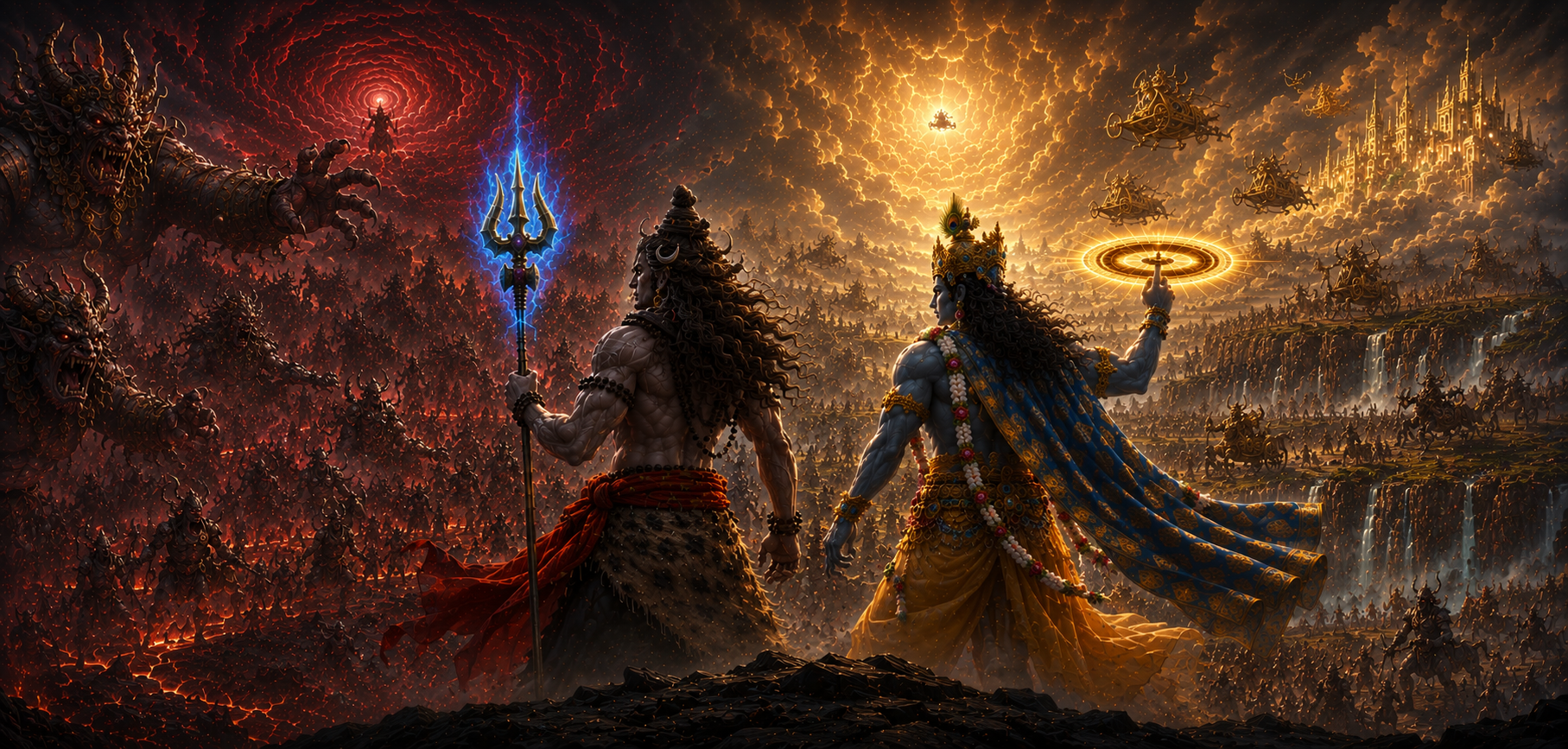
How twelve battles shaped the present age of the universe
From the Halahala War at the dawn of creation to Kartikeya's closing of the cycle — covering every major divine champion, every cosmic crisis, and the full arc of the Varaha Kalpa's defining conflicts.
 ✓ Complete · 3 of 3
Devi Mahatmya · Shakta Tradition
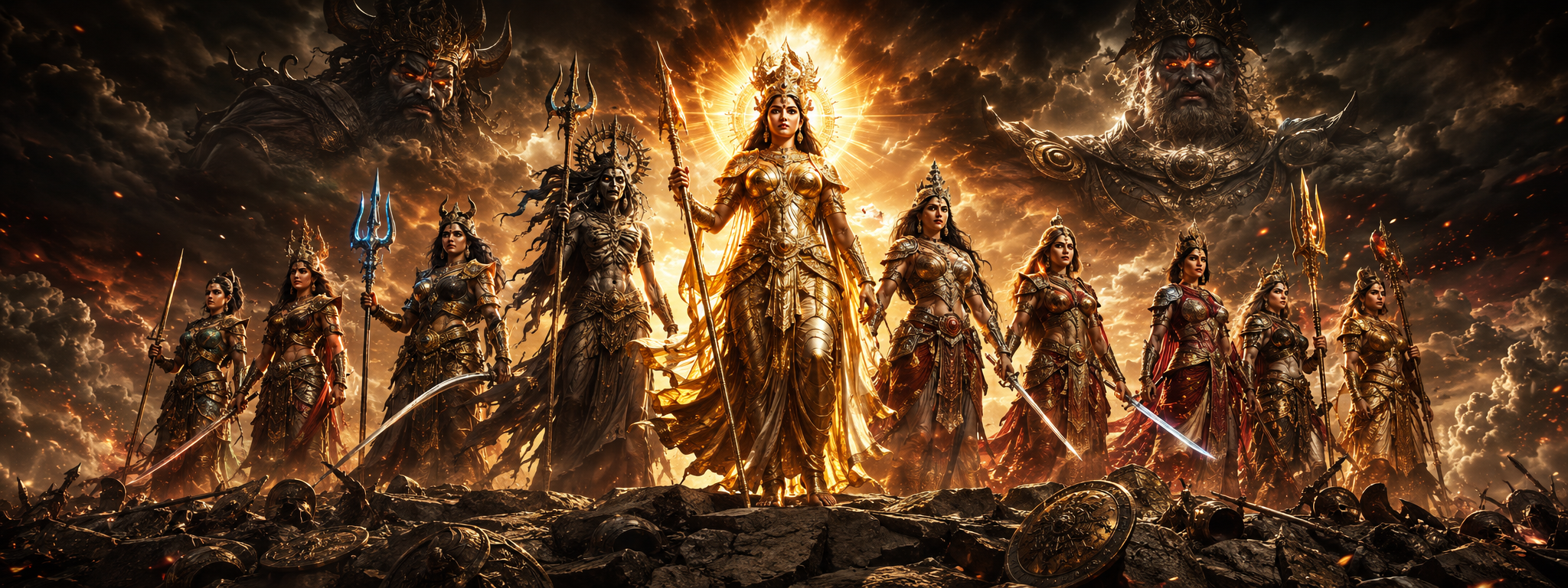
The Devi Mahatmya Wars — three great battles of the Goddess
The Markandeya Purana's Devi Mahatmya narrates three epochal victories of the Goddess over the forces of cosmic disruption — the slaying of Madhu-Kaitabha, the Mahishasura War, and the battle against Shumbha-Nishumbha and Raktabija.
 ✓ Complete · 10 of 10
Vishnu · Avatar Tradition
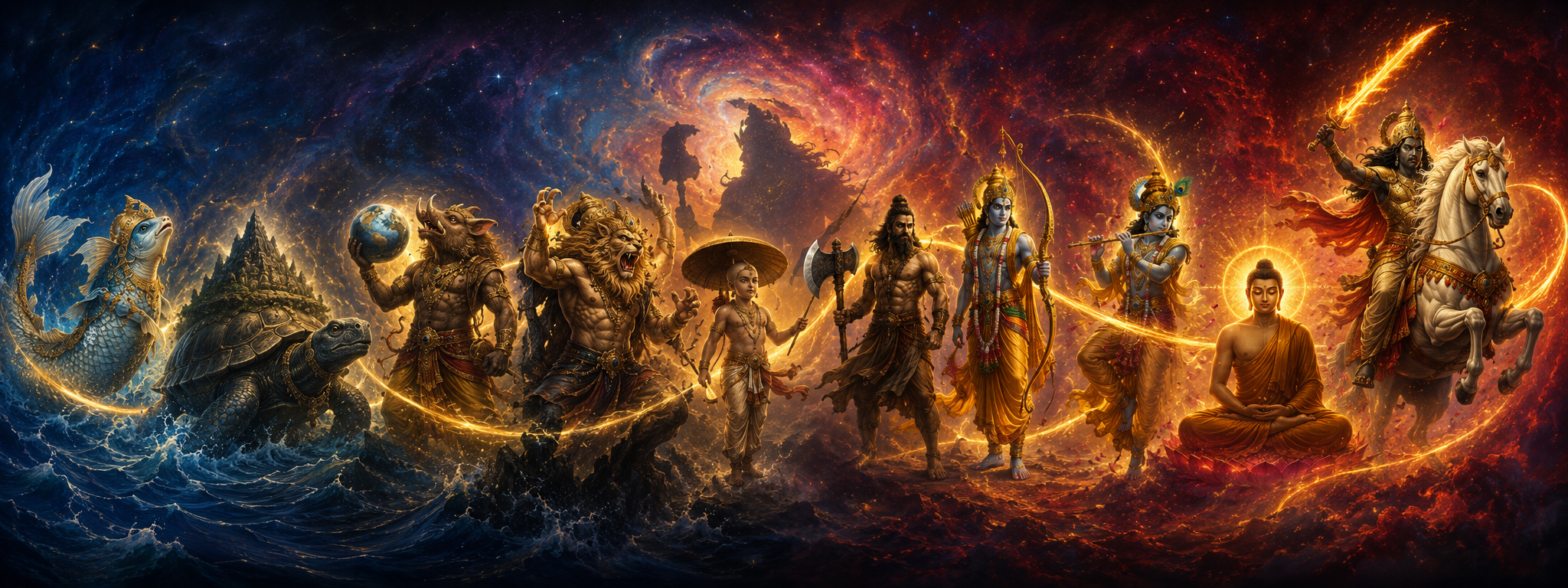
The Ten Avatars of Vishnu — from the Cosmic Ocean to the End of the Age
Deep-dive articles on each of Vishnu's ten principal avatars — Matsya, Kurma, Varaha, Narasimha, Vamana, Parashurama, Rama, Krishna, Balarama (or Buddha), and Kalki — covering their full Puranic narratives, theological significance, and textual variants across the Mahapuranas.
 ✓ Complete · 7 of 7
Rishis · Brahmin Lineages
Seven Great Sages — Their Lives, Rivalries, and Lineages
The seven great sages of the Saptarishi tradition — Vashistha, Vishvamitra, Bharadvaja, Gautama, Jamadagni, Kashyapa, and Atri — each given full biographical treatment: their austerities, their confrontations, their students, and the lineages they founded that run through the Solar and Lunar dynasties.
 ✓ Complete · 6 of 6
Suryavamsha · Chandravamsha · Origin Stories
How the Solar and Lunar Lines Began — From Brahma to the First Kings
The origin stories of the two great royal lineages of the Puranas — the Suryavamsha (Solar dynasty) tracing from Brahma through Manu Vaivasvata and Ikshvaku, and the Chandravamsha (Lunar dynasty) from Soma through Budha and Pururavas — with detailed treatment of the key founding figures and their divine parentages.
 ✓ Complete · 8 of 8
Daityas · Danavas · Rakshasas
The Adversaries — Full Biographies of the Puranas' Greatest Demons
The great Asura kings of the twelve wars and beyond — Hiranyakashipu, Hiranyaksha, Mahabali, Ravana, Mahishasura, Vritra, Tarakasura, and Andhaka — told from their own perspective as full biographical articles rather than simply as opponents of divine heroes. Covering their lineages, austerities, boons, kingdoms, and the full arc of their stories.
 ✓ Complete · 8 of 8
Bhairava · Veerabhadra · Sharabha · Hanuman
Shiva's Story-Rich Forms — From Nandi to Ashwatthama
The story-rich, well-attested avatars of Shiva — Nandi, Veerabhadra, Bhairava, Sharabha, Durvasa, Hanuman, Kirat, and Ashwatthama — each told as a full biographical chronicle rather than a passing mention, with the weakly-sourced remainder of the wider avatar-list deliberately left out.
 ✓ Complete · 10 of 10
Shakta Tradition · The Ten Wisdom Goddesses
The Ten Forms of the Devi
Kali, Tara, Tripura Sundari, Bhuvaneshwari, Bhairavi, Chhinnamasta, Dhumavati, Bagalamukhi, Matangi, and Kamala — ten wisdom-forms of the Goddess, each a different aspect of her power and a different path of realization. A companion to The Three Charitas, structurally parallel to how The Dashavatara treats Vishnu's ten forms.
 ✓ Complete · 12 of 12
Sacred Geography · Somnath to Grishneshwar
Shiva's Self-Manifested Lights Across Sacred India
A companion to the narrative series rather than a chapter within any of them — twelve pilgrimage sites where Shiva is said to have manifested self-arisen, as pure light. Each article covers the manifestation legend and its place in the wider tradition, from Somnath's resolved curse to Grishneshwar's devotion outlasting grief.
 ✓ Complete · 7 of 7
Thematic Companion · Shaap Across the Puranas
Curses of the Puranas
A companion to the narrative series rather than a chapter within any of them — seven articles on how a curse actually works: the mechanism behind Shaap, from the release clause hidden in nearly every sentence to the curses that reshaped the cosmos, turned sage against sage, quietly set two epics in motion, disguised grace as punishment, landed on the gods themselves, and still explain small corners of the world today.
 ✓ Complete · 8 of 8
Thematic Companion · Vara Across the Puranas
Boons of the Puranas
A companion to the narrative series and to The Word That Cannot Be Unsaid — eight articles on how a boon actually works: the mechanism behind Vara, from the blind spot hidden in nearly every grant to the boons that went wrong, the promises mortals kept with no god enforcing them, the boons asked for truth rather than power, the gifts too large to ever take back, the grace disguised as reward, the favors exchanged among the gods themselves, and the small ones still quietly shaping daily practice today.
 ✓ Complete · 9 of 9
Thematic Companion · Austerity in Puranic Tradition
Nine Fires — How Austerity Shaped Gods, Demons, and Men
A companion to the narrative series — nine articles on tapasya: what it is and the Indrasana-kampa pattern behind most austerity narratives, the named forms and postures of practice, the boons it wins for power and invincibility, devotion, progeny and lineage, and transformation, the weapons and wars it produces, how it is broken, and how the practice itself changes across the four yugas.
 ✓ Complete · 10 of 10
Thematic Companion · Divyastras of Puranic Tradition
Astra-Vidya — Knowledge as Power in Puranic Tradition
A companion to the narrative series — ten articles on the divine weapons (divyastras) of Puranic and epic tradition: how astra-vidya was taught and guarded, the great personal weapons of Brahma, Shiva, and Vishnu, the elemental astras tied to the directional gods, the arsenal of the Devi, the signature weapons carried by the epics' own heroes, and how this entire tradition of invoked, sentient weaponry is echoed in India's modern missile-naming conventions.
 ✓ Complete · 7 of 7
Puranas Revisited · Popular Telling vs. Primary Text
Where the Well-Known Detail and the Source Text Part Ways
A companion to the narrative series — each entry starts with one popular, widely-repeated detail from the Puranas and Itihasas and checks it against the primary text, chapter and verse. It only becomes an article when that check turns up a real, citable gap: a detail with no textual home, two Puranas disagreeing outright, or a simplification the source treats as far less settled.
 ✓ Complete · 12 of 12
Abstractions Made Flesh · When an Idea Becomes a God
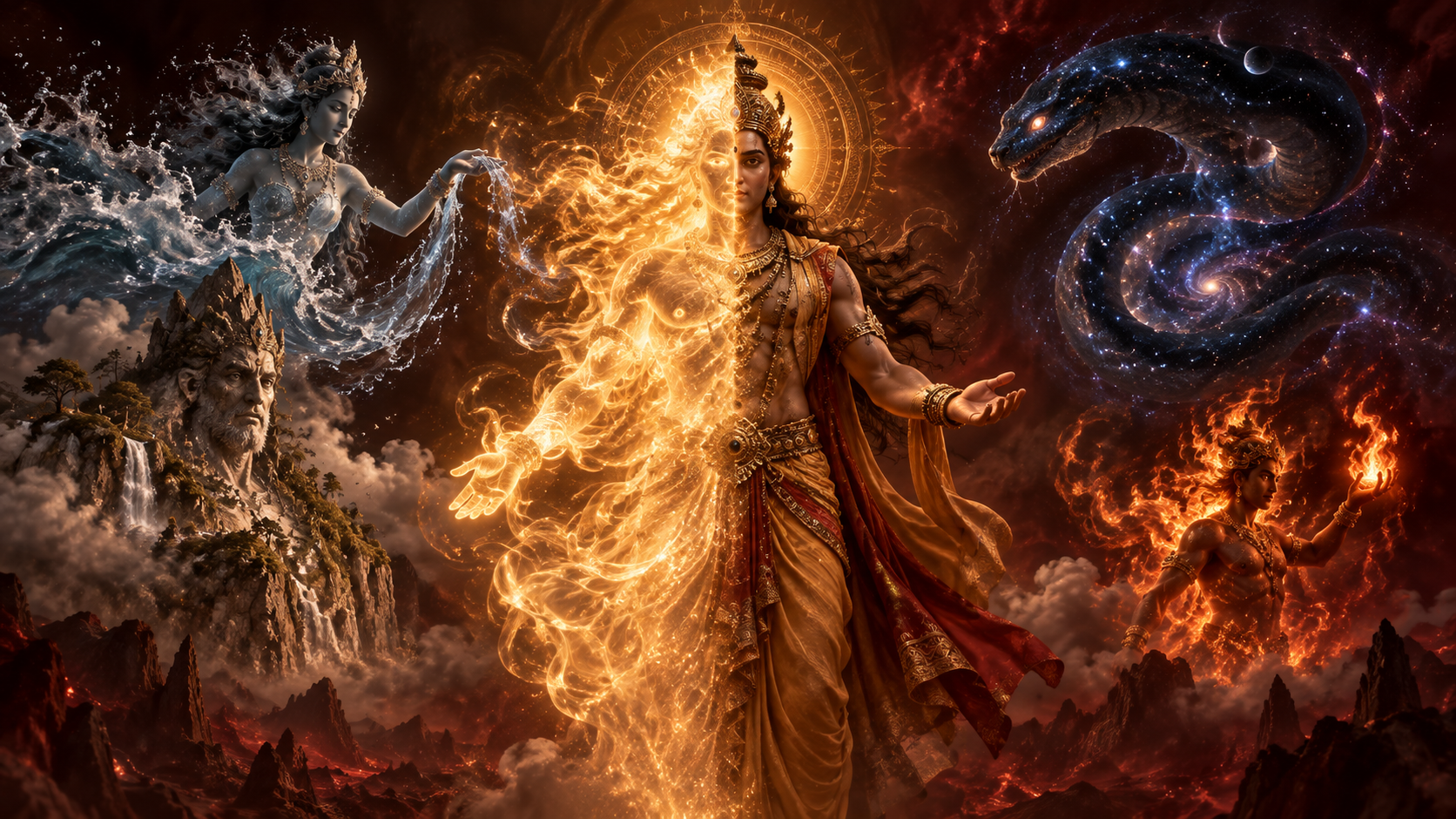
How Virtue, Time, Rivers, and Sleep Itself Became Gods
Across twelve articles, this series traces every mechanism the tradition uses to turn an abstraction into a deity — a virtue given a mirrored genealogy, a river or mountain accumulating a family and a story, an old quality dissolving into an already-developing goddess, an established god handed a new portfolio, and one city that refuses to be unmade even when the universe ends.
 ✓ Complete · 10 of 10
Beyond Ordinary Conception · When Life Takes an Uncommon Path
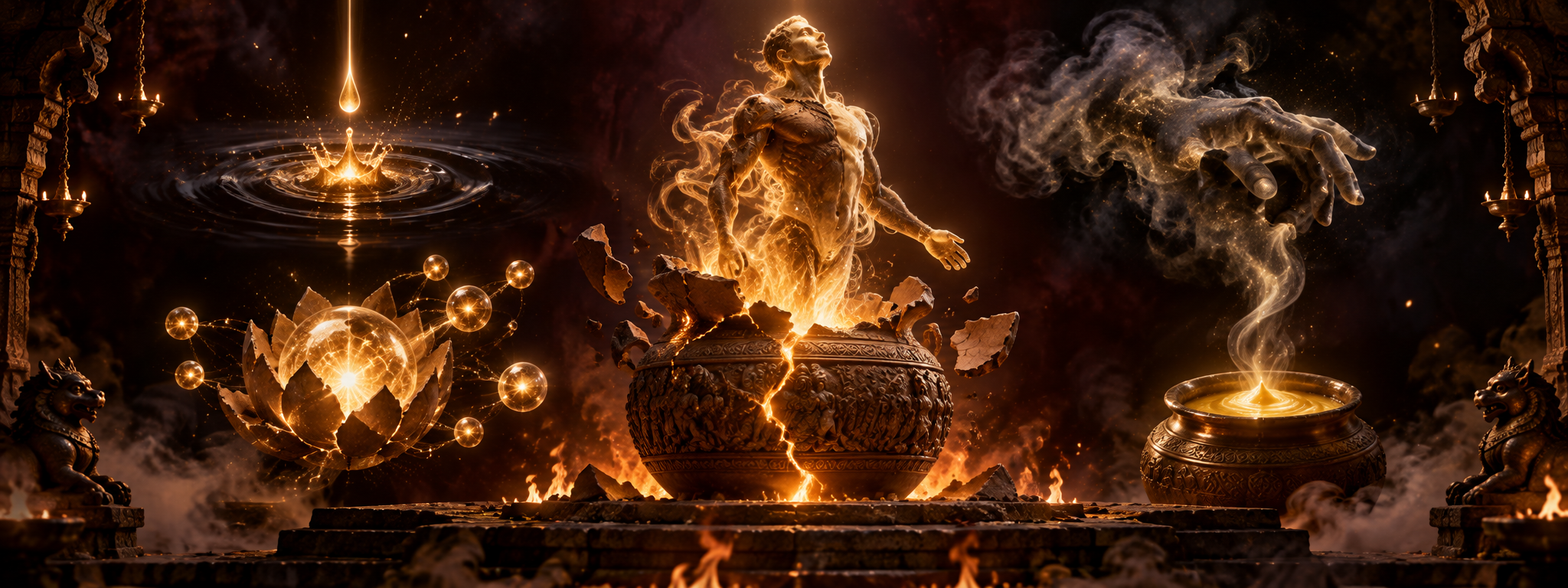
Ten Mechanisms the Tradition Uses Instead of an Ordinary Birth
Across ten articles, this series catalogues every way the Puranas and Itihasas let a figure come into being without conventional conception — mind-born sages, seed diverted into a jar or an animal, beings that simply emerge from a churned ocean, a ritual substance carrying nature or number astray, one origin split into many or two fused into one, a being condensed directly from another deity's own body, a child given by boon rather than conceived, a life shaped or taught inside the womb, and births that hatch from eggs.
Editorial Standard
All articles in this section draw primarily on the Mahapuranas and the great epics as their first sources. Textual variants between different Purana accounts are documented rather than smoothed over. Regional devotional traditions and sthalapurana sources are noted where relevant but clearly distinguished from Mahapurana attestation.
This is a living section — new series and articles will be added as the FamilyRoots genealogical project grows. Each article series connects directly to the lineage profiles in the main genealogical tree.