
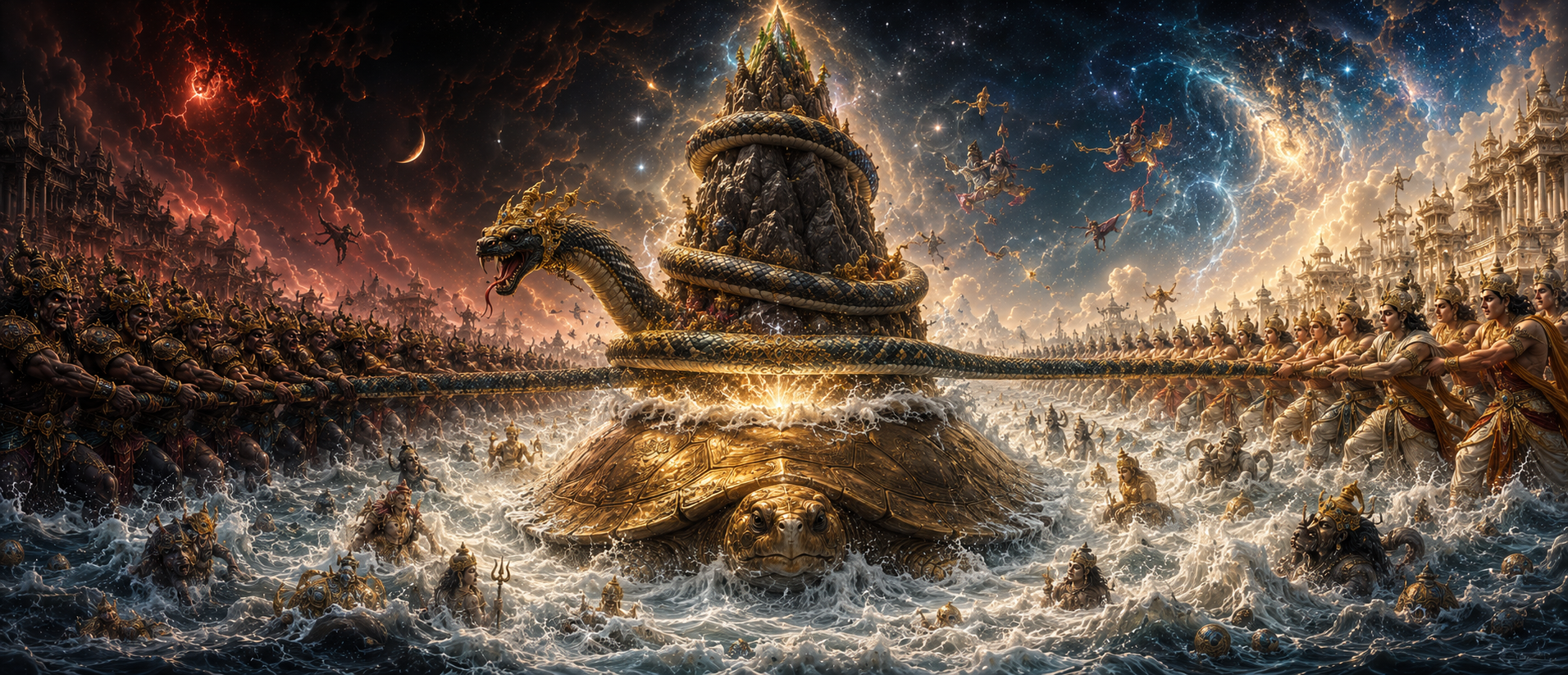
This article covers Kurma as an incarnation in its own right — why Vishnu took this particular form and what it represents theologically and iconographically. The full battle narrative of the churning itself, including the emergence of the fourteen treasures, the contest over the amrita, and Vishnu's later intervention as Mohini, is told in complete detail in The Twelve Cosmic Wars — Samudra Manthan.
Context of Incarnation
Kurma answers a different kind of crisis than most avataras in this list. There is no demon to defeat and no throne to reclaim; the threat is structural failure at the moment of a joint undertaking. Devas and Asuras have agreed, unusually, to cooperate — churning the ocean of milk together using Mount Mandara as the churning-rod and the serpent Vasuki as the rope, in pursuit of amrita and the treasures lost when the sage Durvasa's curse had stripped the gods of their fortune. But Mandara has no base to rest on in the open ocean, and begins to sink under its own weight almost as soon as the churning starts. Vishnu's response is not to fight but to become infrastructure: he takes the form of a colossal tortoise, submerges beneath the mountain, and bears its full weight on his shell for the duration of the churn.
Where Matsya preserves creation from outside a catastrophe, Kurma sustains a difficult, contested cooperative act from directly underneath it. The avatara's contribution is invisible for most of the story it enables — the drama of the churning belongs to the Devas, the Asuras, Vasuki, and the treasures that emerge — but nothing in that drama is possible without the steady, silent weight-bearing happening beneath the surface.
The churning of the ocean, the contest between Devas and Asuras over the amrita, and Vishnu's intervention as Mohini to secure it for the gods alone are told in full — with the complete list of the fourteen treasures, the churning's escalating stages, and the aftermath — in the Twelve Cosmic Wars series.
Read the Samudra Manthan War →Symbolism & Iconography
Kurma's defining quality is stillness under load — endurance rather than action. The tortoise, already associated across much of the ancient world with stability and longevity, becomes here the literal foundation beneath a cosmic undertaking that neither side of the churning could have completed alone. Later commentarial and yogic tradition extends the association: the retraction of a tortoise's limbs into its shell becomes, in some schools, an image for the withdrawal of the senses in meditation — the posture kurmasana takes its name from the same association.
In sculpture and painting, Kurma is depicted differently from Matsya's common half-human form: most surviving Dashavatara sets and temple reliefs show Kurma as a complete tortoise, often with Mount Mandara resting visibly on its back, rather than as a composite half-man, half-tortoise figure. Where the ardha-matsya hybrid form is well established in later temple iconography, Kurma more consistently keeps its full animal form throughout the tradition's visual record.
The core elements of the Kurma episode — the tortoise-support, Mandara, Vasuki, the churning itself — are stable across the Mahabharata (Adi Parva), the Bhagavata Purana, and the Vishnu Purana, with only minor variation in the ordering and number of treasures produced. The Kurma Purana, which takes its name from this avatara, follows the same pattern as the Matsya Purana: it embeds a comparatively brief account of the avatara itself within a much larger compendium of unrelated cosmological and dharma-shastra material.
Kurma follows Matsya's act of preservation with an act of enablement — bearing the weight that makes a difficult, high-stakes cooperative endeavor possible at all. It is the only avatara in the ten whose defining act is neither combat nor teaching but simple, sustained structural endurance, and it sets up the more overtly combative interventions of Varaha and Narasimha that follow it within the same Satya Yuga.
References
Primary Sources
- Mahabharata, Adi Parva, chapters 15–17 — the churning narrative in full, including Kurma's role.
- Bhagavata Purana 8.5–8 — the tortoise-support episode within the larger Samudra Manthan account.
- Vishnu Purana 1.9 — parallel account with variant ordering of the emergent treasures.
- Kurma Purana, chapters 1–2 — brief avatara narrative within a larger dharma-shastra compendium.
Secondary Sources
- Dimmitt, Cornelia, and van Buitenen, J.A.B. Classical Hindu Mythology: A Reader in the Sanskrit Puranas. Temple University Press, 1978.
- Mani, Vettam. Puranic Encyclopaedia. Motilal Banarsidass, 1975. Entry: "Kurma."
This article covers the avatara's theology, symbolism, and sourcing only. For the complete narrative of the churning and its aftermath, see The Twelve Cosmic Wars — Samudra Manthan.