
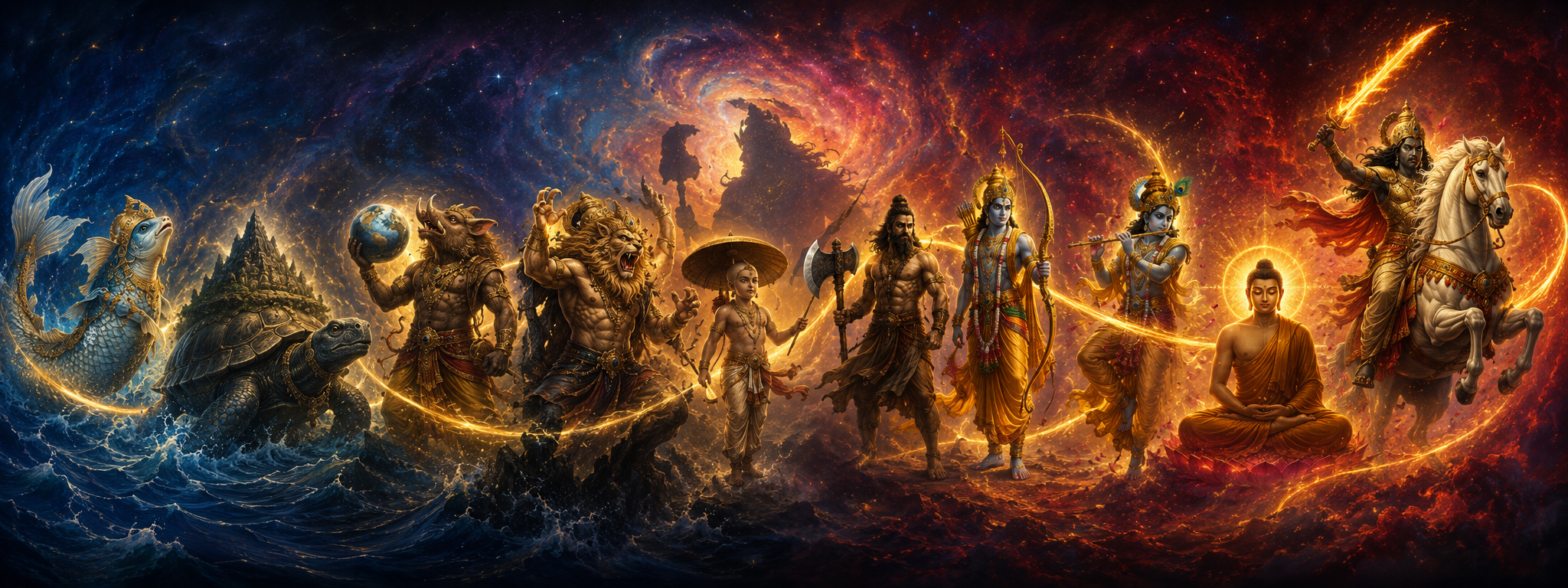
The Dashavatara — "ten descents" — is the most widely recognized framework in Vaishnava tradition for organizing Vishnu's interventions in the world. Where the Devi Mahatmya's three Charitas each answer a single crisis within one continuous text, the ten avataras are drawn from across the Puranic corpus — the Bhagavata Purana, Vishnu Purana, Matsya Purana, Varaha Purana, and the two great epics — and span the full arc of cosmic time, from the earliest age of the world to a battle still to come.
The doctrine's clearest statement is Krishna's own, in the Bhagavad Gita: whenever dharma declines and adharma rises, the divine takes form to restore balance, protect the virtuous, and destroy the wicked — appearing "age after age." Nine of the ten avataras are described as having already occurred; the tenth, Kalki, is prophesied to appear at the close of the current Kali Yuga.
The Frame — Dharma-Samsthapana Across Four Ages
Every avatara in the list responds to a specific, named threat to cosmic or moral order — never a generic evil, but a particular imbalance requiring a particular form. Matsya saves the seed of creation itself from the dissolving flood. Kurma stabilizes the churning of the ocean when the mountain used as a churning-rod threatens to sink. Varaha lifts the earth from the cosmic waters after Hiranyaksha drags her under. Narasimha destroys the boon-protected tyrant Hiranyakashipu through a form that is neither man nor beast, neither of day nor night, neither indoors nor out — a loophole made flesh. Vamana humbles the otherwise righteous king Bali not by force but by the geometry of three measured steps. From there the avataras become progressively more human: Parashurama corrects a corrupted warrior class with the tools of both priest and soldier; Rama models righteous kingship through personal exile and war; Krishna, the purna avatara — the "complete" descent, carrying the fullness of divine attributes rather than a partial expression — teaches through statecraft, love, and the Gita itself; Buddha, in the mainstream Puranic reading, appears to draw the unworthy away from Vedic ritual through compassion and non-violence; and Kalki will end the current age by force, clearing the way for the cycle to begin again.
A popular later reading treats the sequence as tracing a rough ascent — aquatic, to amphibious, to land animal, to hybrid, to diminutive human, to increasingly refined human forms — though this is an interpretive lens applied to the list rather than a claim made explicitly in the source texts themselves, and it is worth holding loosely alongside the theological reading that actually organizes the Puranas: each avatara addressing a specific adversary or crisis, not a biological stage.
"Whenever there is a decline of dharma and a rise of adharma, O Bharata, I manifest myself. To protect the virtuous, to destroy the wicked, and to reestablish dharma, I appear age after age."
Bhagavad Gita, Chapter 4, Verses 7–8| Avatara | Age (Yuga) | Crisis Addressed | Articles |
|---|---|---|---|
| 1 — Matsya | Satya | The primeval flood; rescue of Manu, the Vedas, and the seed of all life | 1 article |
| 2 — Kurma | Satya | Samudra Manthan — the churning of the ocean for amrita | 1 article |
| 3 — Varaha | Satya | Hiranyaksha; the earth dragged beneath the cosmic ocean | 1 article |
| 4 — Narasimha | Satya | Hiranyakashipu; protection of Prahlada | 1 article |
| 5 — Vamana | Treta | Bali's dominion over the three worlds | 1 article |
| 6 — Parashurama | Treta | Kartavirya Arjuna; corruption of the Kshatriya order | 1 article, 2 chapters |
| 7 — Rama | Treta | Ravana; the Ramayana | 1 article, multi-chapter |
| 8 — Krishna | Dvapara | Kamsa, Jarasandha, the Kurukshetra war; includes Balarama | 1 article, multi-chapter |
| 9 — Buddha | Dvapara / Kali cusp | Withdrawal of the unworthy from Vedic ritual | 1 article |
| 10 — Kalki | Kali (future) | Prophesied end of the current age | 1 article |
Note: Buddha's yuga placement varies by source — the Bhagavata Purana situates him near the Dvapara–Kali boundary, while some later texts place him fully within Kali Yuga. Some Vaishnava lists substitute Balarama for Buddha in the ninth position; this series follows the mainstream Puranic list (Buddha as ninth) and covers Balarama within the Krishna avatara articles. See the textual-variants note in the Buddha article for detail.
Four avataras in this list — Kurma, Varaha, Narasimha, and Vamana — are also central figures in The Twelve Cosmic Wars, where their stories are told in full as battle narratives. Rather than duplicate that material, their articles here are shorter and focus on the avatara as incarnation — the theology of the descent, its symbolism, and its iconography — linking out to the corresponding war article for the complete account of the conflict itself.
The Ten Avataras
Matsya — The Fish
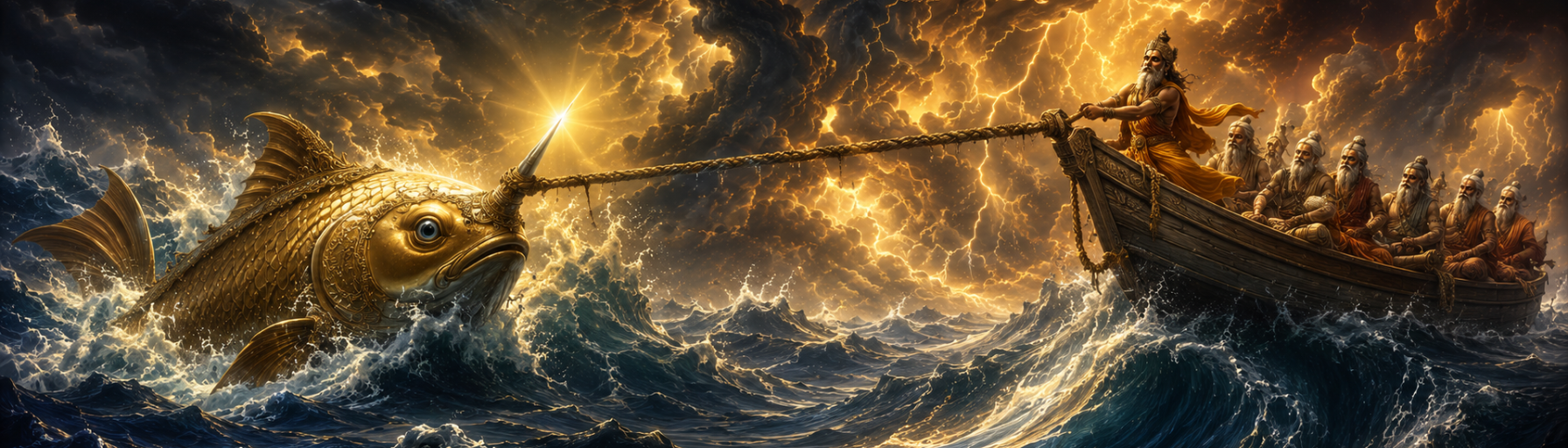
A small fish approaches Vaivasvata Manu asking for protection, growing until its true nature as Vishnu is revealed. It warns Manu of an imminent deluge that will dissolve the world, instructs him to build a great boat carrying the seven sages, the seeds of all life, and the Vedas, and then tows the boat to safety by its horn through the flood waters — in some tellings recovering the Vedas from the demon Hayagriva as well.
Matsya Purana · Shatapatha Brahmana 1.8.1 · Bhagavata Purana 8.241 article · Origin, the flood, and the theology of preserved creation
Read the Matsya Avatara →
Kurma — The Tortoise
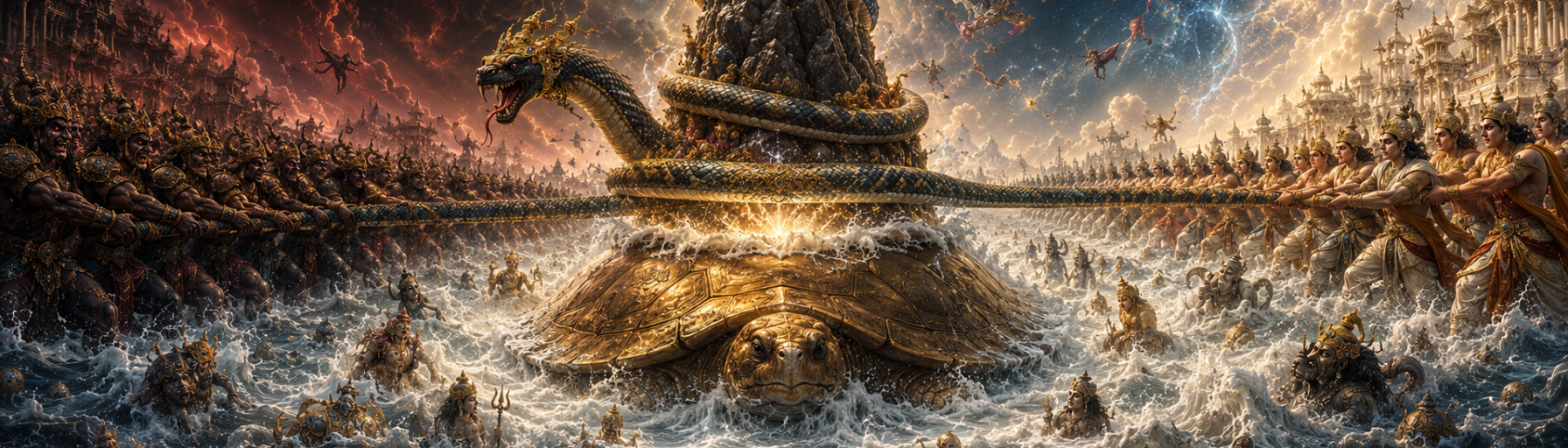
When Devas and Asuras jointly churn the ocean of milk for amrita using Mount Mandara as the churning rod, the mountain begins to sink into the sea. Vishnu takes the form of a great tortoise and bears the mountain's full weight on his back, stabilizing the churn long enough for the fourteen treasures — including the amrita itself — to emerge.
Bhagavata Purana 8.5–8 · Vishnu Purana 1.9 · Mahabharata, Adi Parva1 article · Incarnation theology and symbolism
Full battle narrative: see The Twelve Cosmic Wars — Samudra Manthan
Read the Kurma Avatara →
Varaha — The Boar
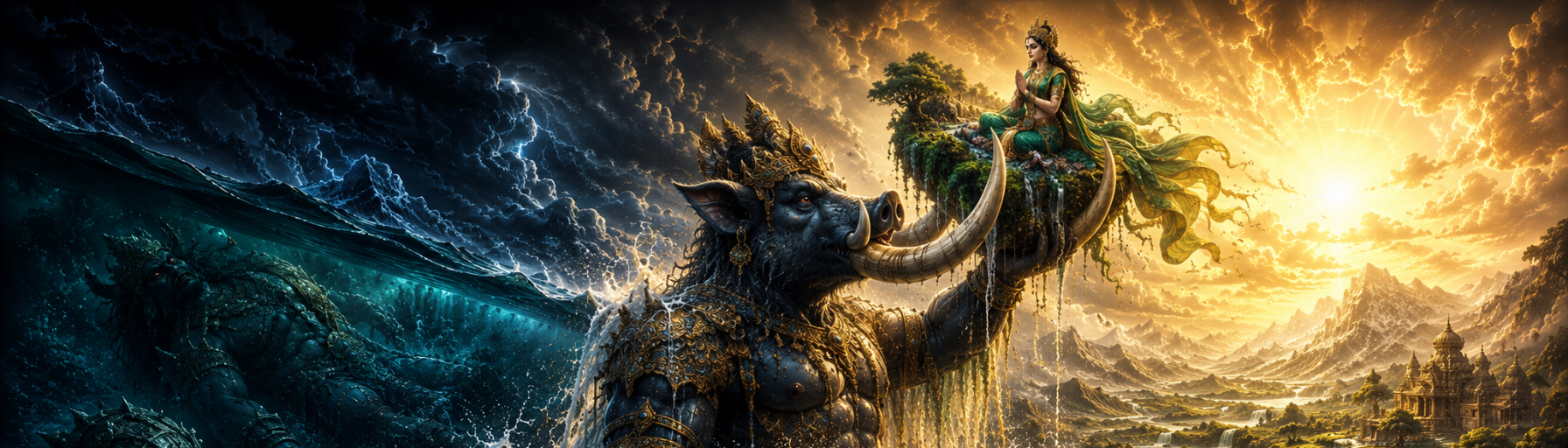
The demon Hiranyaksha drags the earth to the bottom of the cosmic ocean. Vishnu takes the form of a colossal boar, dives into the depths, slays Hiranyaksha in a battle of a thousand years, and raises the earth-goddess Bhudevi on his tusks back to her place in the cosmos.
Bhagavata Purana 3.13, 3.17–19 · Vishnu Purana 1.4 · Varaha Purana1 article · Incarnation theology and symbolism
Full battle narrative: see The Twelve Cosmic Wars — the Hiranyaksha War
Read the Varaha Avatara →
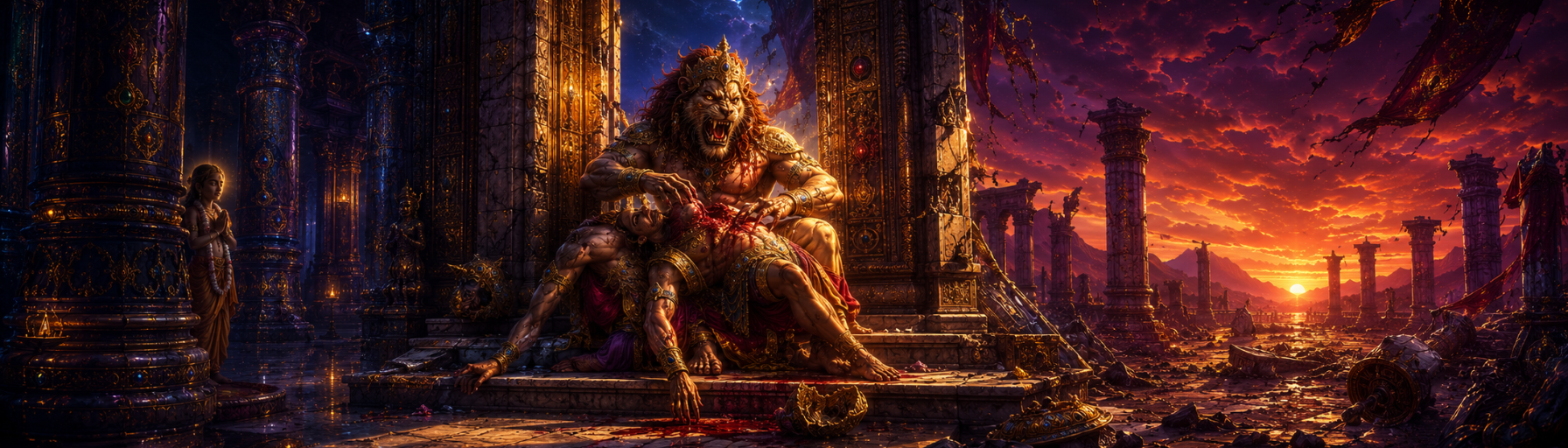
Narasimha — The Man-Lion
Hiranyakashipu, brother of Hiranyaksha, obtains a boon making him nearly unkillable — not by man or beast, not by day or night, not indoors or outdoors, not on earth or in the sky. When he threatens his own devoted son Prahlada, Vishnu erupts from a palace pillar as Narasimha, a form that is neither man nor lion, and kills the demon at the threshold, at twilight, on his own lap.
Bhagavata Purana 7.8 · Vishnu Purana 1.20 · Narasimha Purana1 article · Incarnation theology and symbolism
Full battle narrative: see The Twelve Cosmic Wars — the Hiranyakashipu War
Read the Narasimha Avatara →
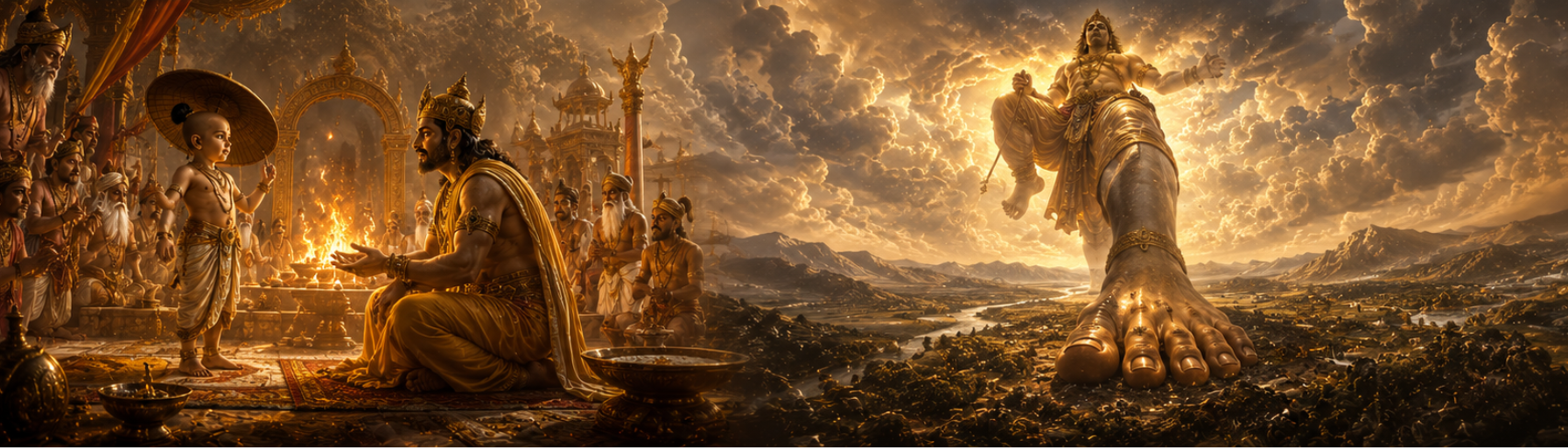
Vamana — The Dwarf
The virtuous but overreaching Asura king Bali holds dominion over all three worlds. Vishnu approaches him as a modest dwarf-brahmin and asks for only as much land as he can cover in three steps. Granted the boon, he expands into the cosmic form Trivikrama, covering earth and sky in two steps, and places his third on Bali's own head — sending him to the netherworld with sovereignty intact, but humbled.
Bhagavata Purana 8.15–23 · Vishnu Purana 1.20 · Vamana Purana1 article · Incarnation theology and symbolism
Full battle narrative: see The Twelve Cosmic Wars — Bali's Sovereignty
Read the Vamana Avatara →
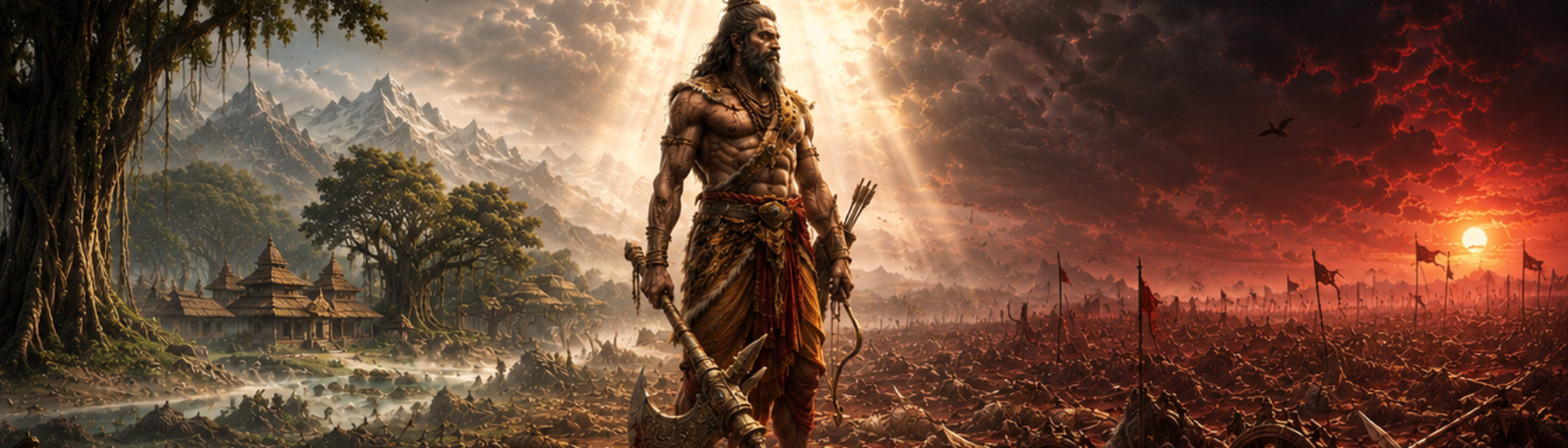
Parashurama — The Warrior Sage
Born to the sage Jamadagni and Renuka, Parashurama is a brahmin who carries a warrior's axe. After the thousand-armed king Kartavirya Arjuna wrongs his family, Parashurama kills him and, in the retaliation that follows, undertakes a long campaign against a Kshatriya order he judges to have become oppressive — a figure who later trains Bhishma, Drona, and Karna, and appears again to test Rama in the Ramayana.
Mahabharata, Vana & Shanti Parvas · Bhagavata Purana 9.15–161 article with 2 chapters · Origin & the Renuka episode; Kartavirya Arjuna & the campaigns
Read the Parashurama Avatara →

Rama — The Ideal King
Prince of Ayodhya, exiled fourteen years by his father's word, husband to Sita, brother to Lakshmana, Bharata, and Shatrughna — Rama's life models dharma through kingship, exile, loss, war, and rule. His war against the Rakshasa king Ravana, waged with an army of vanaras and the devotion of Hanuman, is the central conflict of the epic that bears his name.
Valmiki Ramayana · Bhagavata Purana 9.10–111 article, multiple acts · Structure to be finalized when this avatara is drafted
Read the Rama Avatara →
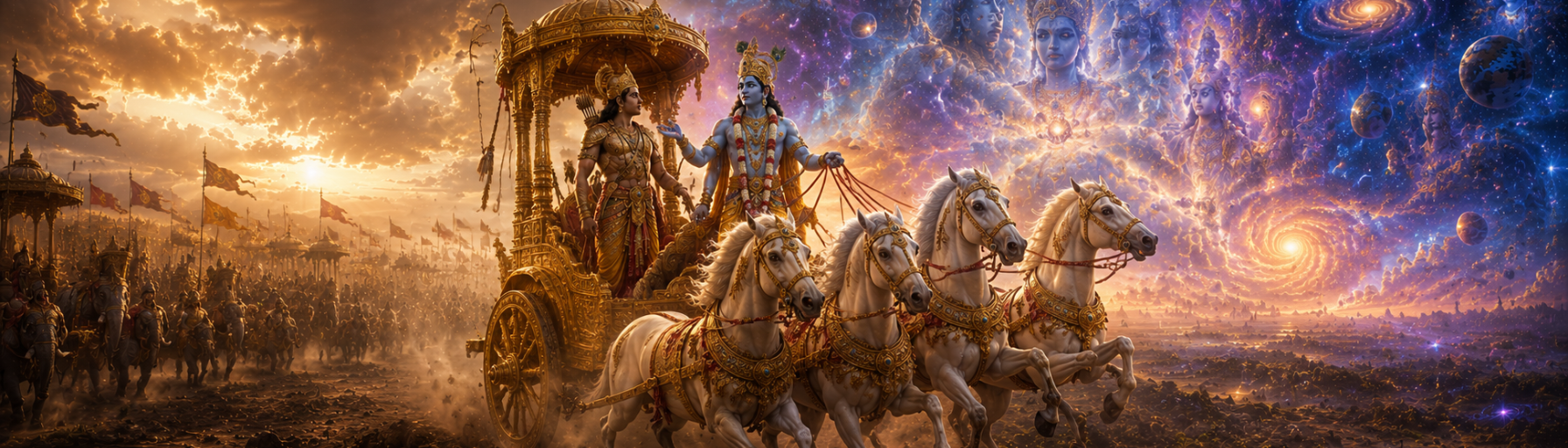
Krishna — The Complete Avatara
Regarded in the Bhagavata tradition as the purna avatara — the full and complete descent, rather than a partial expression of divine attributes — Krishna's life spans cowherd boyhood in Vrindavana, the killing of the tyrant Kamsa, the founding of Dwaraka, and his role as Arjuna's charioteer and counselor at Kurukshetra, where he delivers the Bhagavad Gita. His elder brother Balarama, also an incarnation in several textual traditions, is present throughout this arc.
Bhagavata Purana, Skandhas 10–11 · Mahabharata · Harivamsha1 article, multiple chapters · Childhood & Vrindavana; Mathura & Kamsa; Dwaraka & the wars; Kurukshetra & the Gita; Prabhasa & the end — including Balarama throughout
Read the Krishna Avatara →
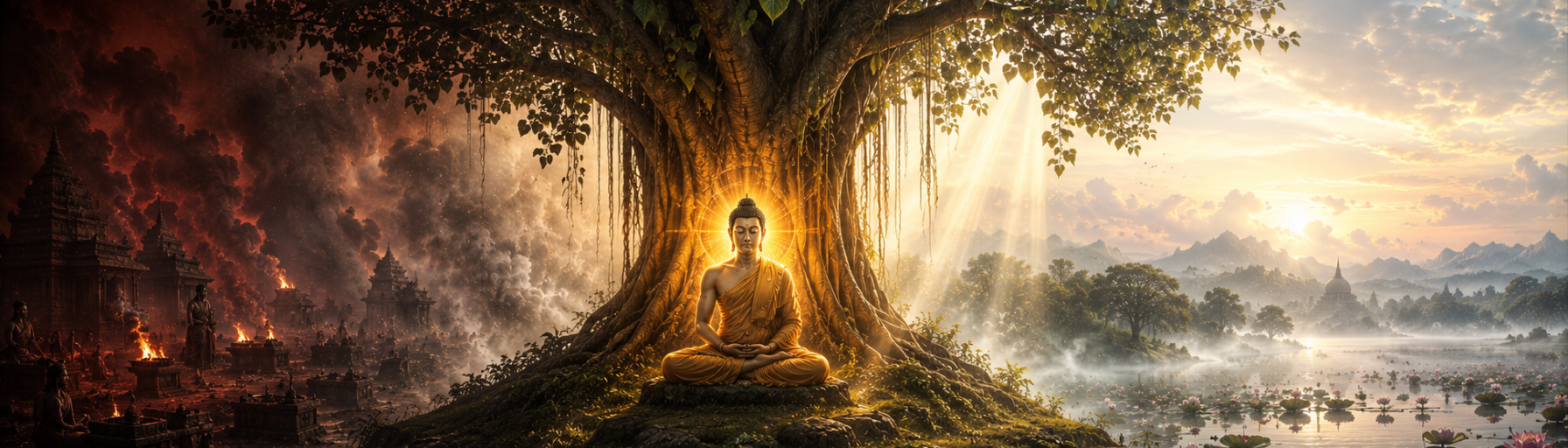
Buddha — The Enlightened One
In the Bhagavata and several other Puranic lists, Vishnu appears as Buddha to draw those unfit for Vedic ritual away from its misuse, teaching through compassion, restraint, and non-violence rather than sacrifice. This article follows that mainstream placement and includes a textual-variants note on the alternative tradition — followed by some Vaishnava lists — that substitutes Balarama for Buddha in this position; Balarama himself is covered in full within the Krishna avatara articles.
Bhagavata Purana 1.3.24 · Vishnu Purana 3.181 article · Includes Buddha/Balarama textual-variants note
Read the Buddha Avatara →
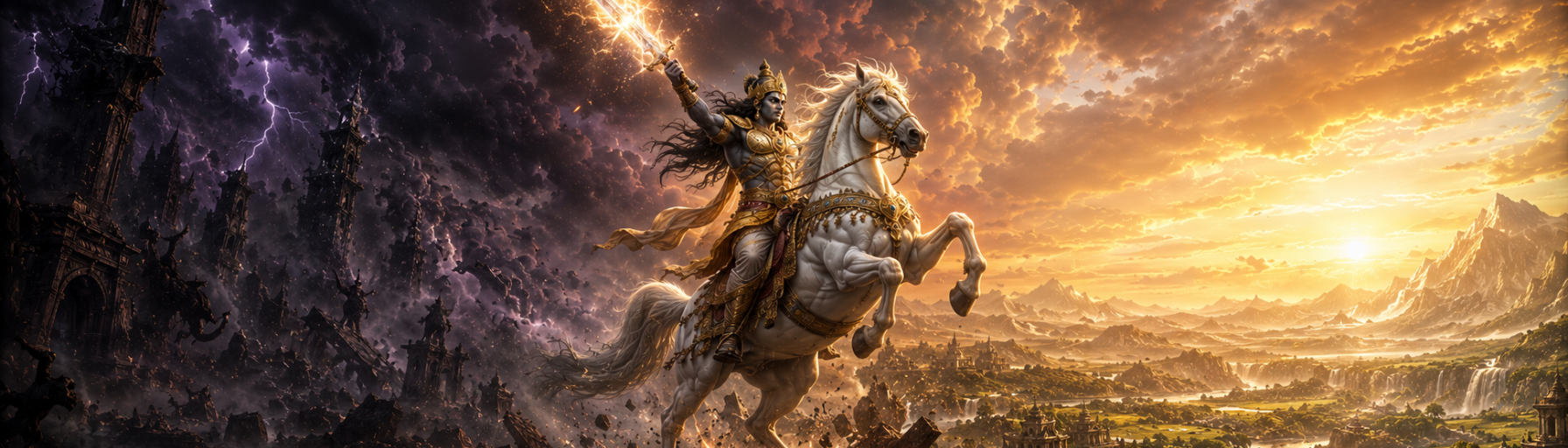
Kalki — The Future Destroyer
Prophesied rather than narrated as past event, Kalki is described as appearing at the close of Kali Yuga — the current, most degraded age — riding a white horse and wielding a blazing sword, to destroy the wicked, dissolve the age's corruption, and restore the conditions for Satya Yuga to begin anew.
Vishnu Purana 4.24 · Bhagavata Purana 12.2 · Kalki Purana1 article · Prophecy, symbolism, and textual sources
Read the Kalki Avatara →
References
Primary Sources
- Bhagavata Purana — Skandhas 1, 3, 7–9, 10–11, 12 (the fullest single-text account of the avataras)
- Vishnu Purana — Book 1 (Varaha, Narasimha, Vamana), Book 3.18 (Buddha), Book 4.24 (Kalki)
- Matsya Purana — the Matsya avatara narrative in full
- Varaha Purana — the Varaha avatara narrative in full
- Bhagavad Gita, Chapter 4 — the doctrinal statement of avatara theology (verses 7–8)
- Valmiki Ramayana — the Rama avatara
- Mahabharata, including the Harivamsha — Krishna, Balarama, and Parashurama
- Kalki Purana — the Kalki avatara prophecy
Secondary Sources
- Bassuk, Daniel E. Incarnation in Hinduism and Christianity: The Myth of the God-Man. Macmillan, 1987.
- Dimmitt, Cornelia, and van Buitenen, J.A.B. Classical Hindu Mythology: A Reader in the Sanskrit Puranas. Temple University Press, 1978.
- Mani, Vettam. Puranic Encyclopaedia. Motilal Banarsidass, 1975. Entries: "Dashavatara," "Matsya," "Kurma," "Varaha," "Narasimha," "Vamana," "Parashurama," "Rama," "Krishna," "Buddhavatara," "Kalki."
- Parrinder, Geoffrey. Avatar and Incarnation. Oxford University Press, 1970.