
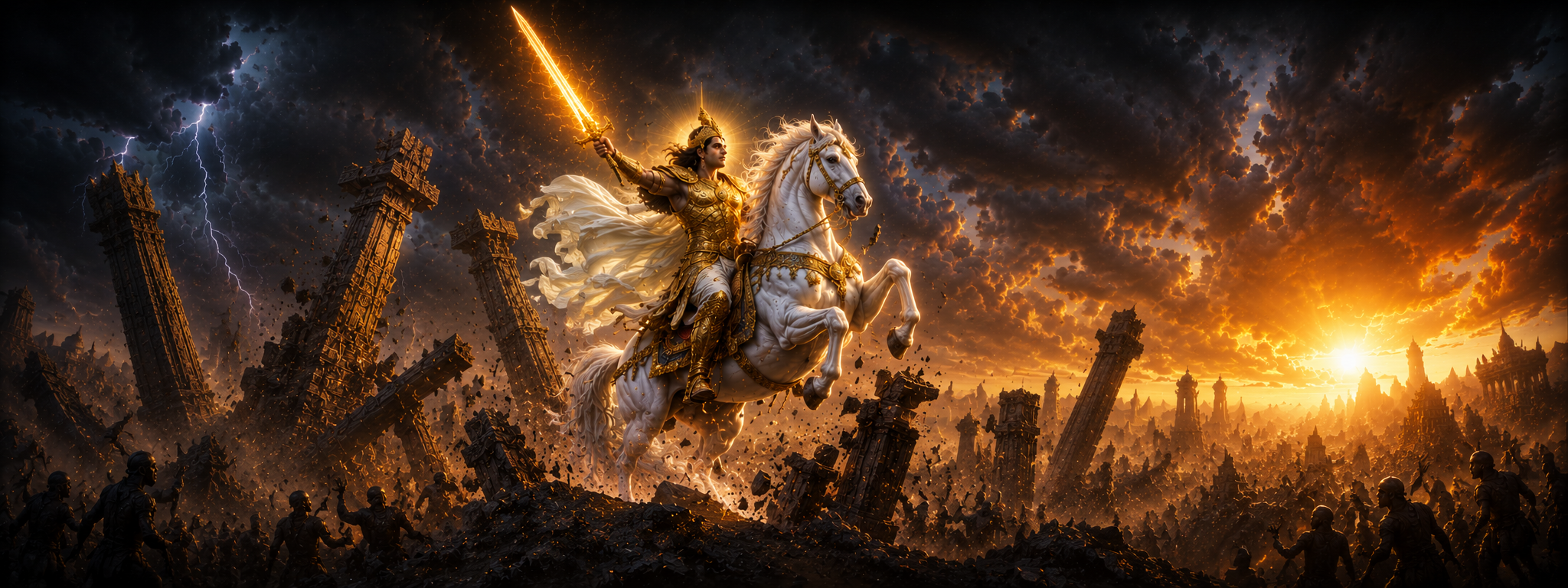
Kalki closes the Dashavatara on a different footing than any avatara before it: every other chapter in this series describes what the tradition holds to have already happened. Kalki describes what the tradition holds is still to come — a prophecy embedded within texts otherwise devoted to past events, describing the end of the very age those texts consider themselves to be written within.
Context of Incarnation
Kali Yuga, the fourth and final age in the cycle, is described across the Puranas as a period of steadily accelerating moral decline — dharma reduced to a fraction of its original strength, rulers governing by greed and force rather than duty, truth and virtue increasingly rare and unrewarded. At the close of this age, when conditions have degraded as far as the cycle permits, Vishnu is prophesied to take his tenth and final form: born to a brahmin named Vishnuyasha in a village called Shambhala, riding a brilliant white horse, wielding a blazing sword, tasked with destroying the corrupt and the tyrannical wherever they hold power and restoring the conditions under which a new Satya Yuga — the first and most virtuous age — can begin.
Some Puranic passages describe Kalki's adversaries using terms for outsiders or those beyond the traditional social order current at the time of composition; this article treats those adversaries at the level the prophecy itself is generally read today — corrupt and tyrannical rule in the abstract, the culmination of Kali Yuga's own decline — rather than mapping the term onto any specific historical or present-day community, a reading this project does not endorse and which the text itself does not require.
The Kalki Purana's Narrative
Unlike most of the Puranas named for earlier avataras — which devote only a fraction of their content to the avatara narrative itself — the Kalki Purana is unusual in giving this single, still-future avatara a complete and detailed biography, narrated in the same concrete terms used for events the tradition treats as already past. It describes Kalki's birth and childhood, his training in the arts of war, his marriage to a princess named Padma (called Rama in some tellings), the raising of an army, and a sustained campaign against Kali — the personification of the degraded age itself, a figure distinct from the goddess Kali despite the similarity in name — and Kali's followers. Kalki defeats them, performs the Ashvamedha to affirm his sovereignty, and re-establishes dharma across the earth before Satya Yuga begins anew.
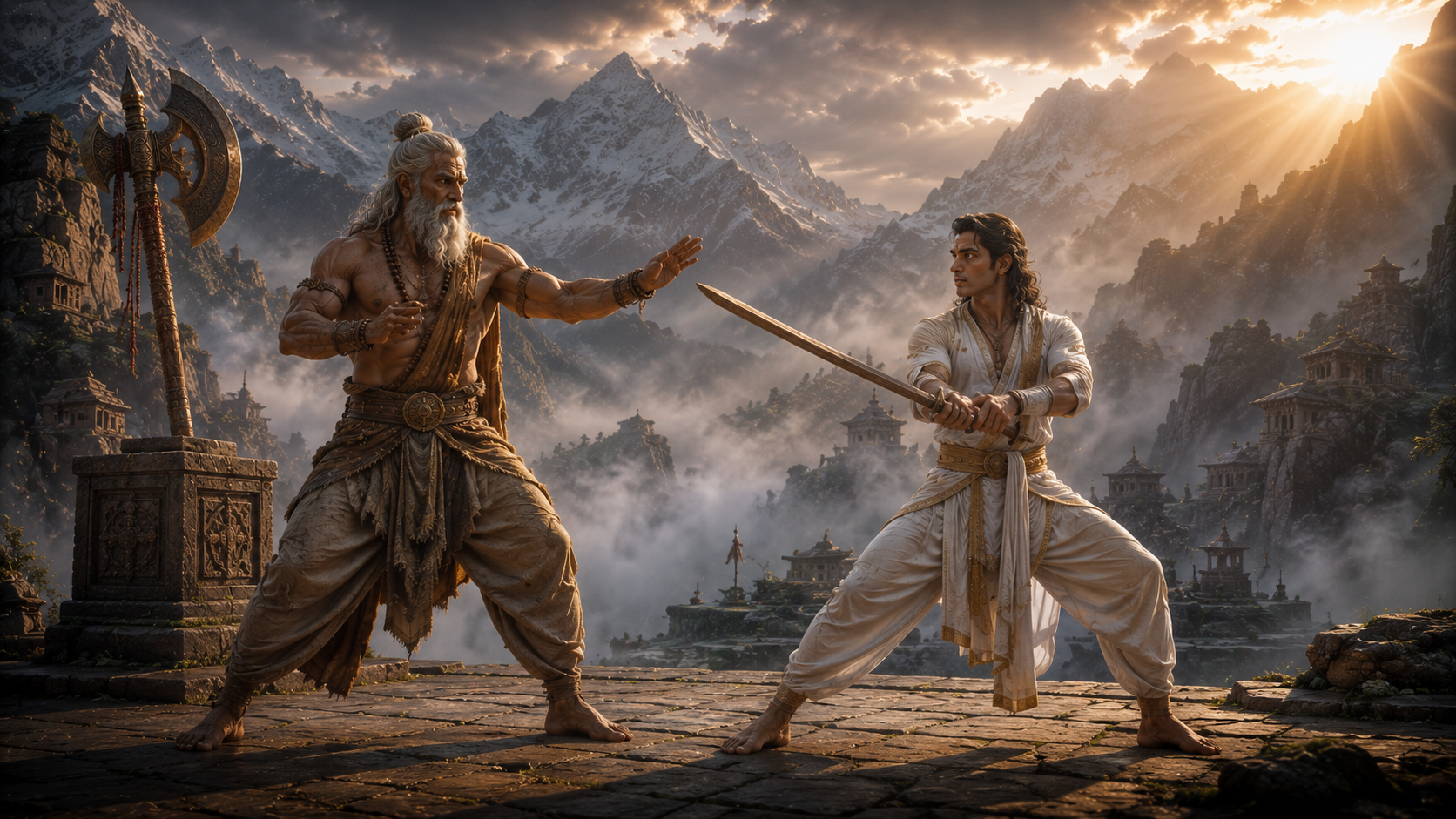
One of the clearest single threads connecting two avataras directly across this entire series.
Several Puranic sources, including the Kalki Purana, describe Kalki as trained in the arts of war by Parashurama — still living, per this project's earlier chapter, as one of the small number of figures regarded as Chiranjivi and continuing his austerities on the mountain Mahendragiri since the close of the Treta Yuga. If the detail is followed through, it means the sixth avatara personally prepares the tenth for the task that closes the entire cycle — one of the very few moments in the Dashavatara where two avataras are connected not just thematically but by a direct, described relationship, joining the earlier Vali–Bali–Prahlada lineage thread and the Vali–Krishna death-parallel this project has traced elsewhere in the series.
Symbolism
Kalki's iconography — the white horse, the blazing sword — favors speed and decisiveness over the more contemplative or protective imagery of most of the avataras before him: a final, swift correction rather than a sustained intervention. As the only avatara defined entirely by prophecy rather than narrated past event, Kalki also occupies a distinct category within the doctrine itself — every other avatara answers a crisis the tradition holds to be resolved; Kalki answers a crisis the tradition holds to still be building, including, implicitly, within whatever present moment a reader of these texts currently occupies.
Kalki closes the sequence this series opened with Matsya, and the frame is worth stating plainly: Matsya preserved the seed of creation at the start of a cycle already ending; Kalki clears the wreckage of a cycle at its close so a new one can begin. Between them lie eight avataras spanning cosmology, single combat, institutional correction, personal constraint, and the fullest possible expression of engaged divine life in Krishna — the complete arc the Bhagavad Gita's own doctrine promises: whenever dharma declines and adharma rises, the divine appears, age after age, and will appear once more when this one finally gives way.
References
Primary Sources
- Vishnu Purana 4.24 — the Kalki prophecy and the restoration of Satya Yuga.
- Bhagavata Purana 12.2 — parallel account within the Purana's closing description of Kali Yuga.
- Kalki Purana — the fullest single-text narrative of the avatara's future life.
Secondary Sources
- Mani, Vettam. Puranic Encyclopaedia. Motilal Banarsidass, 1975. Entry: "Kalki."
- Bassuk, Daniel E. Incarnation in Hinduism and Christianity: The Myth of the God-Man. Macmillan, 1987 — for Kalki's place within the wider avatara doctrine and comparative eschatological traditions.
References to Kalki's adversaries in the source texts are presented here at the level of tyranny and corruption in the abstract, consistent with how the prophecy is generally read today, rather than mapped onto any specific historical or contemporary community.