

Before anything else, a scope note: this article covers the Buddha-avatara as a category within Vaishnava Puranic theology — a specific claim made by certain Hindu texts about Vishnu's incarnations. It is not an account of Buddhism as a religion, and Buddhism's own textual tradition does not recognize or endorse this framing; the historical Buddha's life, teaching, and self-understanding as recorded in Buddhist sources are a separate and complete subject in their own right, outside this project's scope. What follows describes what certain Puranas say, not what Buddhists believe about their own founder.
Context of Incarnation
In the Bhagavata Purana and Vishnu Purana's telling, Vishnu takes the form of Buddha to draw those unworthy of true Vedic knowledge — described in the texts as demons or the spiritually unfit — away from ritual sacrifice through a teaching of compassion, non-violence, and renunciation, so that they lose the spiritual merit sacrifice would otherwise grant them and can be more easily overcome by the gods. It is, by a wide margin, the most unusual stated purpose given to any avatara in the sequence: not protection, correction, or teaching offered in good faith to those who seek it, but a deliberately double-edged intervention whose declared aim is to mislead its recipients for a strategic end.
This framing has drawn sustained and reasonable criticism, both historically and in modern scholarship. Read plainly, it casts a tradition — Buddhism — that developed entirely independently of Vaishnava theology, with its own scriptures, ethical system, and account of its founder's enlightenment, as a deliberate deception engineered from within a rival religious framework. Some scholars have read the doctrine's historical function as a strategy of absorption: incorporating a rival tradition's founder into the Vaishnava fold once Buddhism's political and institutional presence in India had significantly declined, in a way that could acknowledge Buddhism's ethical appeal while subordinating it to a Vedic framework it never claimed to be operating within. This article presents the Puranic text's own stated purpose plainly, alongside this critical reading, rather than smoothing over what the sources actually say.
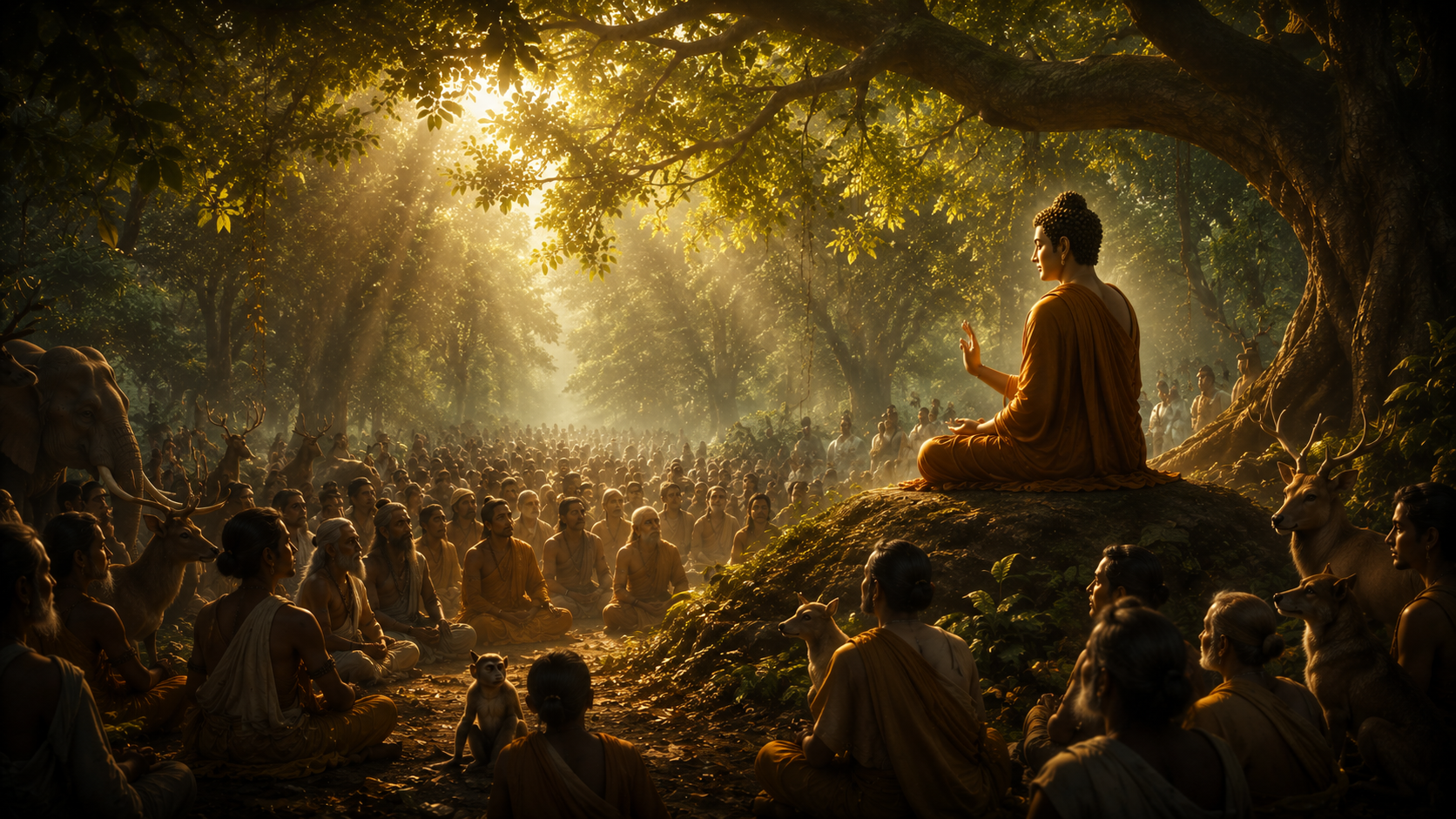
Where every prior avatara intervenes through action, Buddha's role in this tradition is defined by teaching and renunciation alone.
Which Buddha, and Which List
Two separate textual questions are worth distinguishing clearly. The first is whether the Puranic "Buddha avatara" always refers to the historical Gautama Buddha, founder of Buddhism. In the mature and most widely cited Puranic sources — the Bhagavata Purana and Vishnu Purana — the identification with Gautama is essentially unambiguous. Some earlier or more obscure textual layers, however, describe a "Buddha" figure with looser or unclear connection to the historical founder, and some scholars treat these as an earlier, more diffuse tradition later consolidated and fixed onto Gautama specifically as Buddhism's identity became more culturally prominent and fixed in the Indian imagination.
The second, and more consequential, question concerns the ninth avatara's identity within the ten-item list itself. A number of older Puranic king-lists and avatara enumerations name Balarama, not Buddha, as the ninth avatara alongside Krishna, with Buddha entirely absent from the sequence. The now-standard ten-avatara list most people are familiar with today — the one this project follows — owes its fixed, popular form significantly to Jayadeva's twelfth-century Sanskrit poem, the Gita Govinda, whose Dashavatara Stotra names Buddha explicitly and is widely credited with cementing this exact sequence in devotional and artistic tradition far more than any single Purana did on its own.
This project's earlier chapters noted that Balarama is covered within the Krishna avatara rather than given a standalone ninth-avatara article, and promised a full explanation here. That explanation is this: because credible textual traditions place Balarama, not Buddha, in the ninth position, and because Balarama's own story is inseparable from Krishna's across nearly every phase of his life — birth, Vrindavana, Mathura, Dwaraka, the war, and Prabhasa — treating him as a standalone ninth avatara would have required either duplicating large portions of the Krishna narrative or presenting Balarama's life as a thin, disconnected fragment. This project instead follows the Buddha-inclusive list that has become the standard popular sequence since Jayadeva, while ensuring Balarama's full story is told nowhere lost — fully present across the five Krishna chapters rather than reduced to a footnote in either position.
Both variant traditions are well attested and neither is simply "correct" at the other's expense; they reflect a genuine, long-running divergence in how different regions and periods of Vaishnava practice have populated this ninth slot.
Symbolism and a Note on Practice
Theologically, Buddha's inclusion introduces ahimsa (non-violence) and karuna (compassion) as central virtues within the avatara sequence in a way no prior avatara centers so directly — and does so immediately after Krishna, the purna avatara defined by full, active engagement across every register of worldly life. The juxtaposition is stark: where Krishna teaches, loves, rules, strategizes, and fights, the avatara that follows him is defined almost entirely by withdrawal and renunciation of exactly that kind of worldly action.
Unlike Rama or Krishna, the Buddha-avatara has never developed a significant independent devotional cult within Hinduism — there are few if any temples dedicated specifically to Buddha as a Vishnu-avatara, in contrast to the vast devotional infrastructure built around nearly every other name on this list. Buddha is, within Hindu practice, more a fixed theological category completing a numbered list than a figure actively worshipped in that specific role — a genuine point of contrast worth noting plainly, since it distinguishes this avatara's actual devotional footprint from its formal doctrinal position.
Buddha functions as a deliberate contraction after Krishna's expansion — the sequence's one avatara defined by withdrawal rather than action, teaching through renunciation rather than statecraft or combat. It is also, by a clear margin, the avatara whose inclusion carries the most active theological controversy in the entire list, both for its stated Puranic purpose and for what it claims about a tradition that makes no such claim about itself. The tenth and final avatara, Kalki, returns the sequence to its most active register — not renunciation, but a decisive, prophesied act that closes the current age entirely.
References
Primary Sources
- Bhagavata Purana 1.3.24 — the Buddha avatara's stated purpose.
- Vishnu Purana 3.18 — parallel account and its role in the deluding of the asuras.
- Jayadeva, Gita Govinda, Dashavatara Stotra (12th century) — the influential formulation fixing the now-standard ten-avatara sequence.
Secondary Sources
- Bassuk, Daniel E. Incarnation in Hinduism and Christianity: The Myth of the God-Man. Macmillan, 1987 — for the Buddha-avatara's historical development and interpretive controversy.
- Holt, John Clifford. The Buddhist Vishnu: Religious Transformation, Politics, and Culture. Columbia University Press, 2004 — for the historical relationship between Buddhist and Vaishnava traditions across South and Southeast Asia.
- Mani, Vettam. Puranic Encyclopaedia. Motilal Banarsidass, 1975. Entry: "Buddhavatara."
This article describes a Puranic theological claim about Vishnu's incarnations; it does not represent or characterize Buddhism's own account of itself, which is outside this project's scope.