

This chapter tells the formative episode of Parashurama's life — a family crisis at his father's hermitage that establishes, before any battle with a king, the absolute obedience and the terrible cost that define him. It is a difficult episode by any standard, and this account presents it as the sources do, without softening or embellishing what it actually says, and flags the genuine variation between tellings rather than resolving it into a single tidy version.
The Household at the Hermitage
Jamadagni, a sage of the Bhrigu lineage, lives in ascetic simplicity with his wife Renuka and their sons — Parashurama, in most tellings the youngest, is called Rama in his own household before the epithet "with the axe" ever attaches to him. Renuka is described across the sources as a woman of exceptional purity, capable of tasks her purity alone makes possible — most notably carrying water from the river each day in a pot of unfired, sun-dried clay, which holds its shape only because of her spiritual state.
One day, at the riverbank, Renuka's composure breaks. In the fullest version of the story, she sees a Gandharva king — named in some tellings as Chitraratha — enjoying himself in the water with his queens, and is struck, for a moment, with something between admiration and longing. It is not described in most sources as an act of any kind — no words exchanged, no transgression beyond an internal shift — but it is enough. She returns to the hermitage late, and finds she can no longer carry water in the unfired pot; her composure, and the purity that had sustained the household's ritual routine, has visibly slipped.
Jamadagni's Judgment
Jamadagni, whose austerities have given him the perception to know exactly what happened at the river without being told, is consumed by fury at what he judges an unforgivable breach. He calls his sons one at a time and commands each to kill their mother. The elder sons, unable to bring themselves to the act, refuse — and Jamadagni curses each of them in turn, in most versions striking them with a loss of intelligence or awareness, reducing them to a dazed, animal-like state.
Parashurama, called last, obeys without hesitation or question. In the fullest tellings, his axe takes not only Renuka's life but, in the same moment, the life of a kinswoman who tries to intervene or who is present and implicated by association — accounts vary on exactly who else is struck down alongside her. Jamadagni, moved by his youngest son's total obedience rather than by the act itself, offers him any boon he wishes.
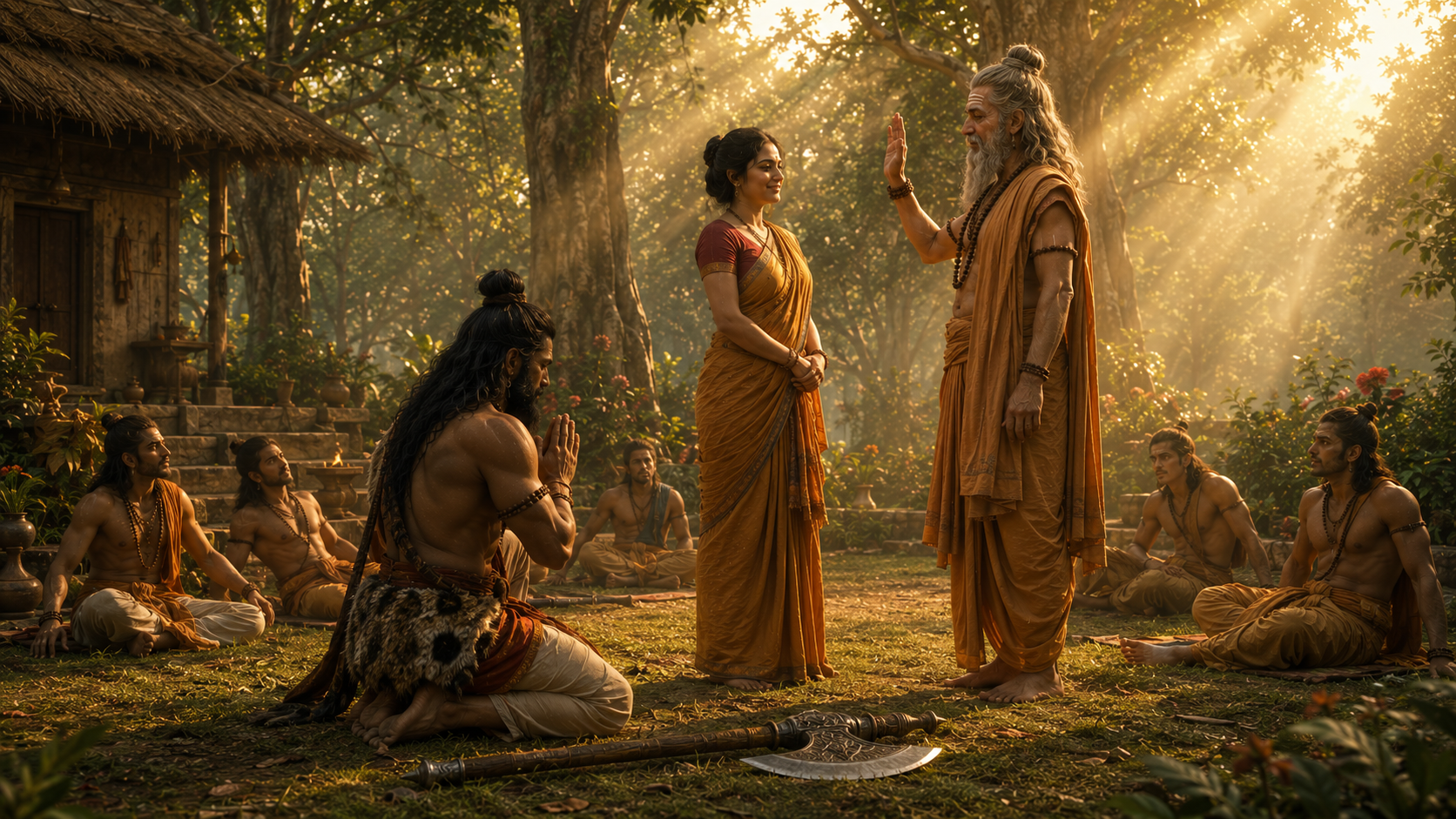
The restoration that follows: the moment Parashurama's boon undoes almost everything the act itself had caused.
The Boon
Parashurama's request reframes the entire episode. He asks that his mother be restored to life exactly as she was, that she retain no memory of her death, that his brothers regain their intelligence and awareness, and, for himself, a long life and invincibility in the battles that lie ahead. Jamadagni grants all of it. The household resumes as if nothing had happened — except that Parashurama's willingness to act on command, without exception or hesitation, has now been established beyond question, and will define how both his father and, later, other figures approach him for the rest of his life.
Sources vary meaningfully on the nature of Renuka's lapse: some describe it explicitly as a fleeting internal desire with no outward act; others are less specific, leaving room for later commentators to read it as anything from a momentary loss of composure to something more deliberate. This project follows the more widely attested reading — an internal, involuntary moment rather than any willful transgression — because it is both the better-sourced version and the one that makes the story's central tension (a father's anger measured against the actual weight of what occurred) legible rather than simply justified.
The story has long been a site of ethical discussion within the tradition itself rather than a straightforward endorsement of either the punishment or the obedience that carried it out — commentators across centuries have read it as an exploration of the danger of unchecked anger in a position of authority as much as a celebration of filial duty, and this article does not resolve that tension on the tradition's behalf.
Renuka herself is also worshipped independently in several regional traditions, particularly across Karnataka, Maharashtra, and Andhra Pradesh, where she is venerated as a goddess in her own right — most prominently at the Renuka Yellamma temple at Saundatti — a devotional tradition that exists somewhat apart from her role in Parashurama's story.
The household returns to its ascetic routine, sustained in part by Kamadhenu, the wish-fulfilling cow gifted to Jamadagni for his austerities — the very possession whose theft, by a visiting king, sets the second chapter of Parashurama's story in motion.
References
Primary Sources
- Mahabharata, Vana Parva, chapter 116 — the fullest account of the Renuka episode.
- Bhagavata Purana 9.15.20–31 — parallel account within the larger Haihaya-Bhrigu narrative.
- Devi Bhagavata Purana, Book 4 — a variant tradition with differing detail on Renuka's lapse.
Secondary Sources
- Mani, Vettam. Puranic Encyclopaedia. Motilal Banarsidass, 1975. Entries: "Renuka," "Jamadagni."
- Dimmitt, Cornelia, and van Buitenen, J.A.B. Classical Hindu Mythology: A Reader in the Sanskrit Puranas. Temple University Press, 1978.
This chapter presents a difficult episode as the primary sources describe it, flagging genuine textual variation rather than harmonizing it into a single account.