
This chapter carries Parashurama's story from a single family grievance into a decades-long public campaign, and forward across two epics — into his role as teacher to the Mahabharata generation, and into a direct meeting with Rama, the avatara who follows him.
The Theft of Kamadhenu
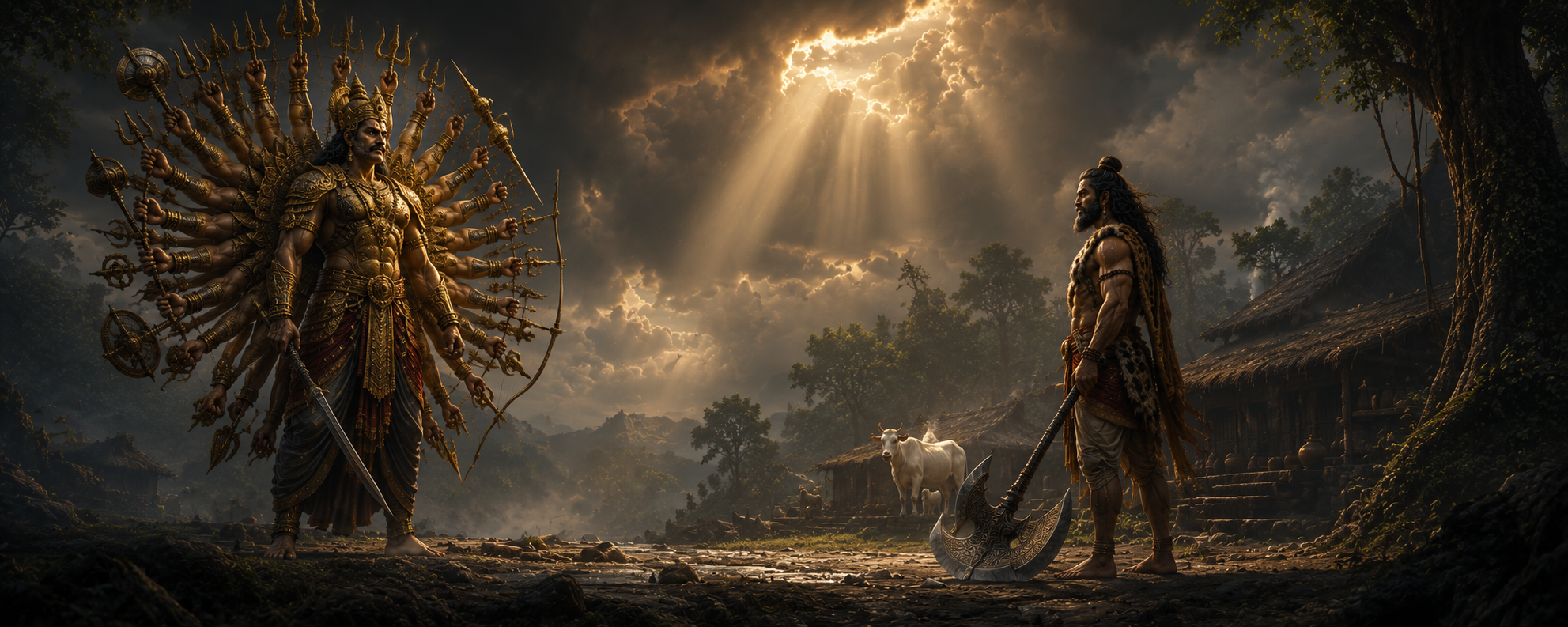
Kartavirya Arjuna — also called Sahasrarjuna, "thousand-armed," a boon he won through austerity, and king of the Haihaya dynasty ruling from Mahishmati — visits Jamadagni's hermitage and is received with lavish hospitality made possible by Kamadhenu, the wish-fulfilling cow granted to Jamadagni for his own austerities. Overcome by desire for a possession capable of granting any wish, Kartavirya orders the cow and her calf seized and carried back to his capital by force, over Jamadagni's protest.
Parashurama returns to find his father humiliated and the household's most valuable possession gone. He pursues Kartavirya's forces, and in the confrontation that follows kills the king and reclaims Kamadhenu — an act which, in the logic of the story that follows, is not the end of the conflict but its true beginning.
Jamadagni's Death and the Vow
Kartavirya's sons, seeking to avenge their father, attack the hermitage while Parashurama is away and kill Jamadagni. Returning to find his father dead, Parashurama performs the funeral rites and then makes the vow that defines the rest of his life: to rid the earth of an oppressive Kshatriya order twenty-one times over. What follows, across the length of his campaigns, is described as a sustained purge of ruling lines judged to have abused their power — accounts describe him filling five lakes at Samanta-panchaka, near present-day Kurukshetra, with the collected blood of his conquests, an offering eventually made to the spirits of his ancestors, who appear and ask him to end the campaigns rather than continue them indefinitely.
At the campaigns' conclusion, Parashurama performs a great sacrifice and gives away the entirety of the conquered land as a ritual gift to the sage Kashyapa — the origin, in some tellings, of why Parashurama himself is afterward landless, retreating instead to austerities on the mountain Mahendragiri.
Decades after the campaigns, Parashurama's long life carries him into the role of teacher rather than warrior.
Teacher to a Later Generation
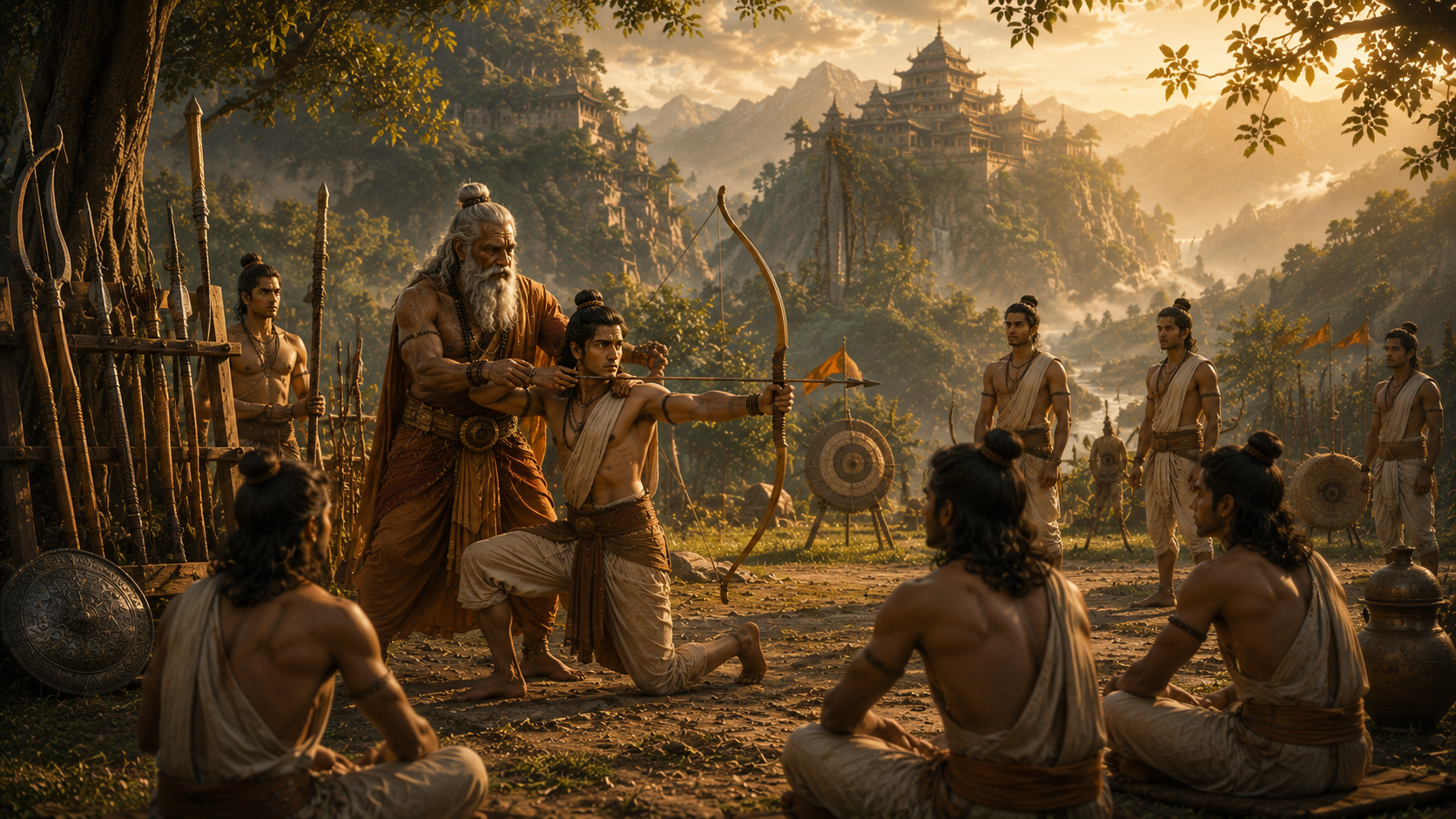
Parashurama's extended life — he is counted among the small number of figures regarded as Chiranjivi, still living rather than having died within his own story — allows him to reappear a generation later as a teacher of arms to Bhishma, Drona, and Karna, each central figures in the Mahabharata's Kurukshetra generation this project's genealogical database already traces in detail. His relationship with Karna in particular ends badly: on learning that Karna concealed his true origin to gain admission as a student, Parashurama curses him — in most tellings, that the knowledge Parashurama has taught him will fail Karna at the moment he needs it most, a curse whose consequences play out decades later at Kurukshetra.
The Meeting With Rama
Parashurama's final major appearance comes at the wedding assembly of Sita, where the young Rama breaks Shiva's great bow to win her hand. Word of the broken bow reaches Parashurama, who arrives in fury, framing the broken bow as an insult to Shiva and, by extension, to himself as Shiva's disciple. He challenges Rama to string Vishnu's own bow instead — and when Rama does so with visible ease, Parashurama's anger dissolves into recognition: the power that moves through him and the power that moves through Rama are the same power, differently distributed. In most tellings he withdraws his own accumulated spiritual force into Rama in that moment and departs for Mahendragiri to resume his austerities — one of the only scenes in the entire textual tradition in which two avataras meet directly, and the elder visibly steps back for the one who follows him.
The number of campaigns — twenty-one — is consistent across nearly all sources, though it functions in most tellings as a formulaic total rather than a literal count of twenty-one individually named wars; only a handful of specific campaigns are detailed by name in the surviving texts. Sources also differ on the precise circumstances of Jamadagni's death — some describe a direct attack by Kartavirya's sons in person, others a raid carried out by soldiers on their order — and on the exact wording and consequence of the curse laid on Karna, which is recounted differently depending on which parva of the Mahabharata is telling it.
The meeting with Rama closes Parashurama's active role in the Dashavatara sequence on a note distinct from everything before it — not a battle won or a tyrant destroyed, but one avatara visibly recognizing and yielding to the next. It is a fitting place to end this two-chapter account, and a natural bridge into the seventh avatara, whose story begins where this one steps aside.
References
Primary Sources
- Mahabharata, Vana Parva, chapters 115–116 — the theft of Kamadhenu and Jamadagni's death.
- Mahabharata, Shanti Parva, chapter 49 — the twenty-one campaigns and their conclusion.
- Bhagavata Purana 9.15–16 — the Haihaya lineage and Parashurama's response in full.
- Mahabharata, Karna's biography (recounted across multiple parvas) — Parashurama as teacher and the curse on Karna.
- Valmiki Ramayana, Bala Kanda, chapters 74–76 — the confrontation with Rama.
Secondary Sources
- Dimmitt, Cornelia, and van Buitenen, J.A.B. Classical Hindu Mythology: A Reader in the Sanskrit Puranas. Temple University Press, 1978.
- Mani, Vettam. Puranic Encyclopaedia. Motilal Banarsidass, 1975. Entries: "Parashurama," "Kartaviryarjuna," "Karna."
The Karna-curse episode is treated here briefly; a fuller account belongs with Karna's own profile in the genealogical database, where his full biography is already documented.