
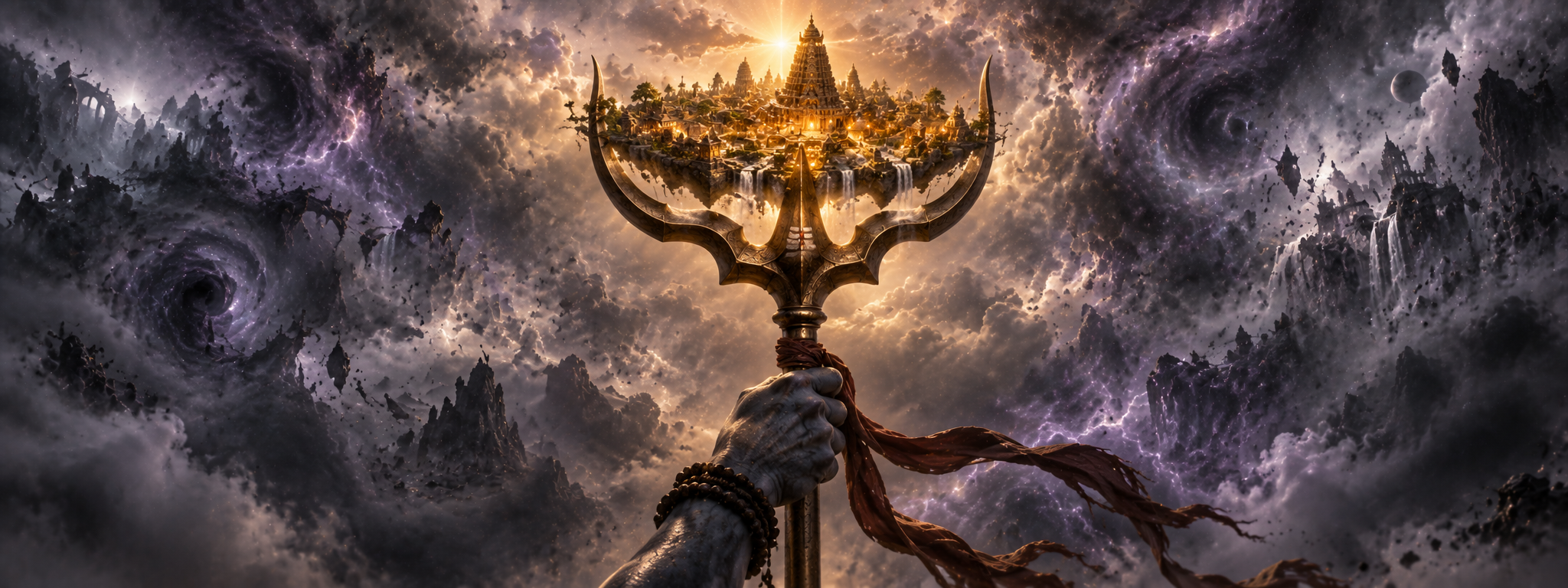
This series closes on a genuine finding rather than another entry in a familiar shape: geography, across the whole of the Puranic tradition, mostly does not get personified the way rivers and mountains do. Almost every famous sacred site earns its holiness through what happened there, not through being a person in its own right. Kashi is the deliberate exception, and it's worth closing on, because it does something no other place in this series does: it survives the end of the universe, awake and unchanged.
Most Places Are Holy Because of What Happened There
Prayaga is sacred because it's the confluence where the rivers meet and where sacrifices are performed. Naimisharanya, one telling holds, marks the exact spot where a wheel set spinning by Brahma's mind finally came to rest, its rim tracing the forest's boundary. Kurukshetra is named directly, in the Bhagavad Gita's own opening verse, as Dharmakshetra — the field of righteousness — a moral designation rather than a personified one. None of these places act. They are acted upon, marked, and consecrated by a deity's presence or a sage's deed, and then venerated ever after for having been the location where something significant occurred. That's consecration by association, and it's the overwhelming pattern for sacred geography across this entire tradition.
Kashi: A City With a Body of Its Own
The Skanda Purana's Kashi Khanda breaks that pattern outright. Kashi — Varanasi — isn't merely favored by Shiva the way other cities are favored by other gods. The text gives the city itself agency across cosmic time: when pralaya arrives, the universal dissolution that ends one cosmic cycle before the next begins, everything else in creation is unmade. Kashi is not. The city is described as lifting away from the earth entirely, rising into a subtle realm beyond the reach of the dissolving world, and coming to rest balanced on the very tip of Shiva's trident — held there, safe, for the duration of a period in which nothing else survives. When creation resumes, Kashi is released back into the world exactly as it was, untouched by an event that erased everything around it.
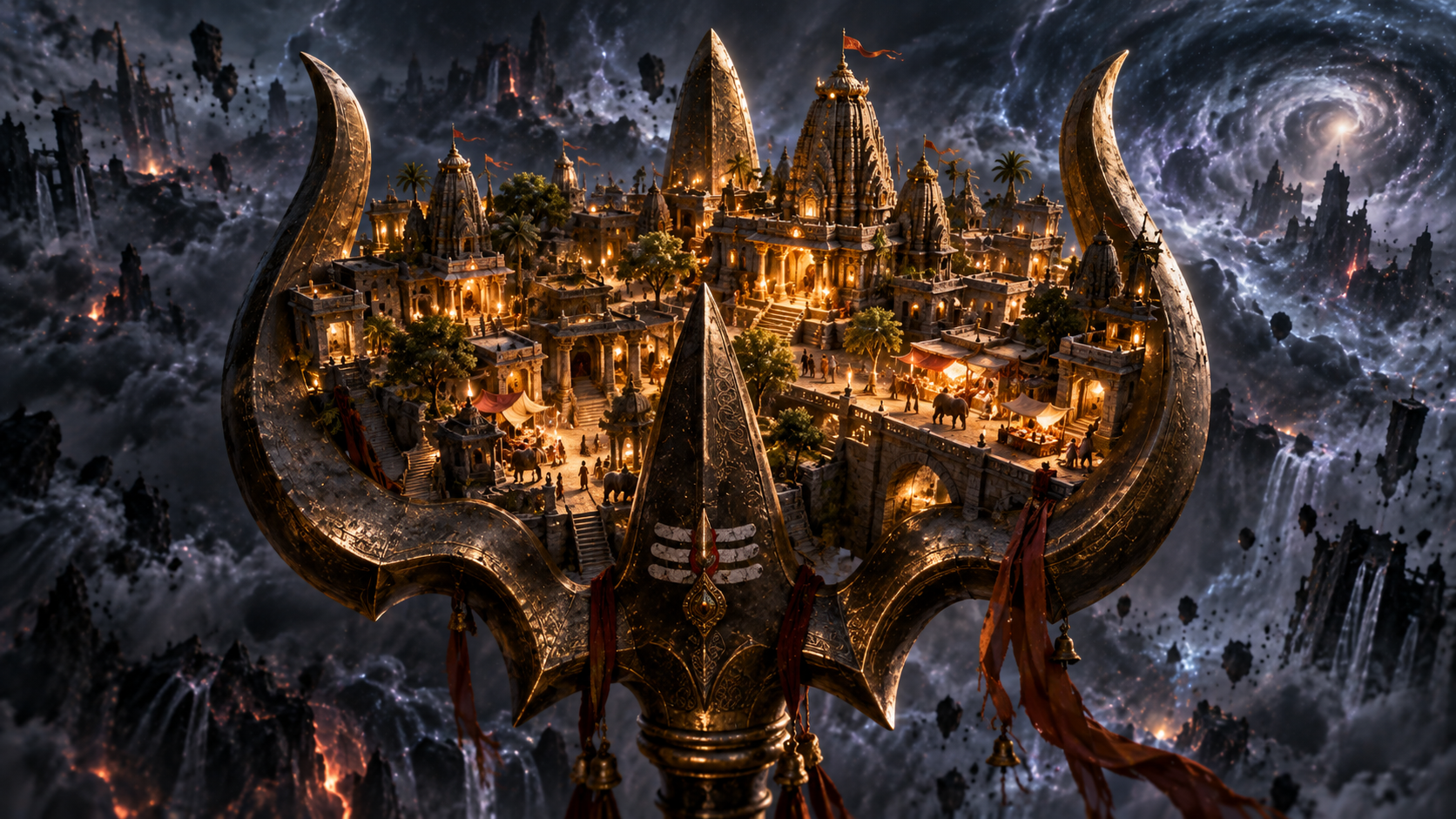
Ordinary life continuing inside Kashi, balanced on Shiva's trident, while the rest of creation is unmade around it.
The city's other name, Avimukta — "the never-forsaken" or "the never-abandoned" — states the same claim more plainly still: Shiva does not leave this place, under any circumstance, including the circumstance of the universe itself ending. That's not a description of a place that was blessed once and has carried the memory of that blessing ever since. It's a description of an ongoing, active relationship that persists through an event nothing else persists through — the same relationship that places the Vishwanath Jyotirlinga here, the seventh of the twelve, covered in full in this project's Twelve Jyotirlingas series.
Everything else in creation ends at pralaya. One city, by name, simply refuses to be forsaken.
A Modern Coda: Bharat Mata, and Why She Doesn't Belong Above
One further land-personification is well known enough that leaving her out entirely would be its own kind of distortion — but she belongs here only as a clearly marked exception, not folded in alongside Kashi. Bharat Mata, Mother India, is a personification of the land as a whole, but she's a creation of the nineteenth and twentieth centuries, tied to the nationalist movement and to specific literary and artistic works of that era rather than to the classical Puranic corpus this series otherwise draws on. She's real, she's significant, and she's outside this series' scope for the same reason the export-control notice or any other modern development would be: this project is a study of a much older tradition, and Bharat Mata's roots lie somewhere else entirely.
Geography, across this entire tradition, mostly doesn't behave the way rivers, mountains, and abstractions do elsewhere in this series — it gets consecrated, not personified. Kashi is the one place that breaks fully from that pattern, described with the same kind of agency, survival, and ongoing relationship that this series has spent its whole length tracing in other figures. It's a fitting note to end on: even in the one domain where personification is the exception rather than the rule, the tradition still found exactly one place it wasn't willing to let the end of the universe touch.
Across twelve articles, this series has traced several distinct answers to one question: how does an abstraction become a deity? Sometimes a new figure is born specifically to carry it, as with Dharma and Adharma's mirrored trees. Sometimes an observable phenomenon simply accumulates a family and a story, as with the rivers, the mountains, and the sky. Sometimes an old quality dissolves into an already-developing person, as with Shri and Lakshmi. Sometimes the abstraction turns out to be the actual mechanism holding the cosmology together, as with Yoganidra. And sometimes, as the Dikpalas showed, the tradition doesn't invent anything new at all — it simply hands the job to a god who already had one. Kashi adds a final, quieter answer: most of the time, geography doesn't get this treatment at all, which makes the one place that does all the more worth noticing.
References
Primary and Secondary Sources
- Skanda Purana, Kashi Khanda — for Kashi's survival of pralaya balanced on Shiva's trident, and the city's epithet Avimukta.
- Puranic material on Prayaga, Naimisharanya, and Kurukshetra as tirthas sanctified by association with a deity's act or a significant event, used here as the comparison pattern against Kashi.
- Bhagavad Gita, opening verse — for Kurukshetra's designation as Dharmakshetra.
- 19th- and 20th-century Indian nationalist literary and artistic tradition — for Bharat Mata as a modern personification of the land, noted here as outside this series' classical Puranic scope.
Bharat Mata is included only as an explicitly flagged modern coda, consistent with this series' general practice of naming adjacent material rather than silently omitting it or blurring it into the classical corpus it doesn't belong to.