
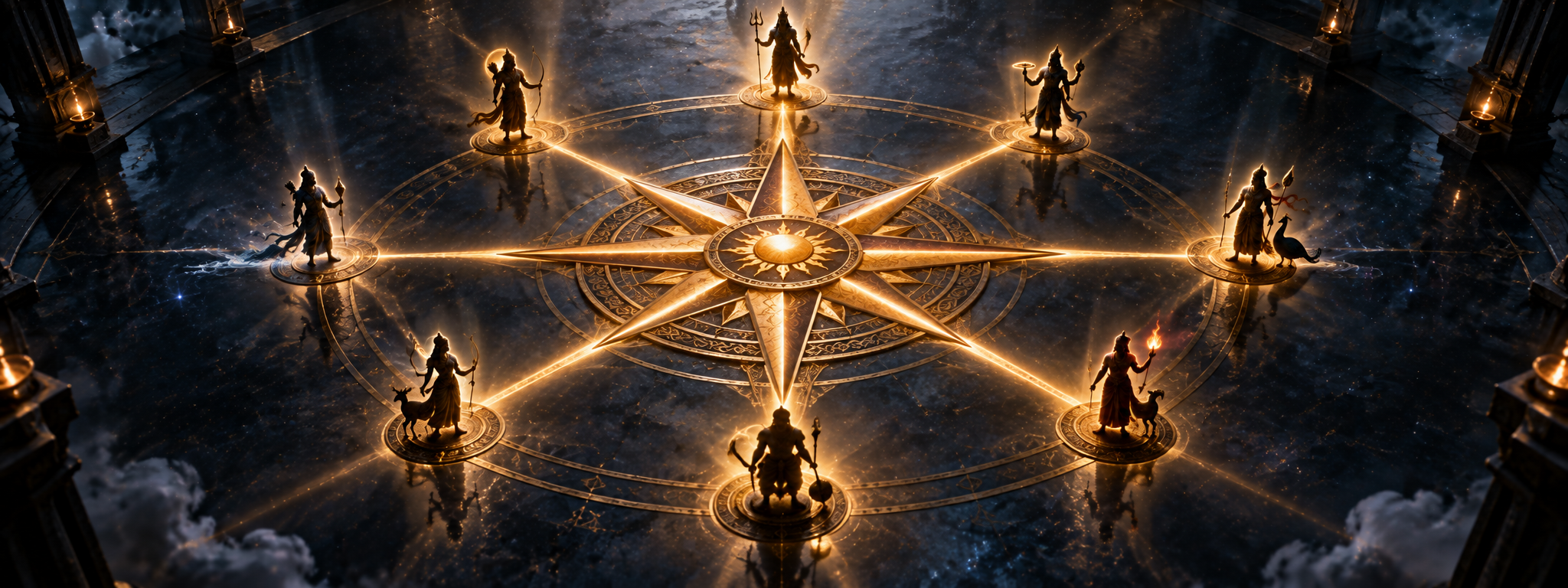
This article works differently from the rest of the series, on purpose. Every prior entry has been a story about how a new deity comes to exist to embody something — a virtue, a river, a mountain's pride, sleep itself. This one is a story about the opposite move: the abstraction here is space, divided into directions, and rather than growing a new figure to represent each direction, the tradition simply hands the job to gods who were already major, already established, and already busy doing something else entirely.
The Eight, and Who Already Held the Job Before This One
The classical set of guardians, the Ashta-Dikpalas, assigns one deity to each of the eight compass points:
| Direction | Guardian | Elsewhere in this series |
|---|---|---|
| East | Indra | King of the gods — not otherwise profiled in this series. |
| Southeast | Agni | Already covered as a primary Vedic god predating the Panchabhuta system in Five Elements, Two Kinds of God — a third role layered onto the same figure. |
| South | Yama | Covered at length in The Judge Who Was Once the First to Die — judge of the dead there, spatial guardian here. |
| Southwest | Nirriti | Introduced as a sidebar in Two Trees, One Root — destruction and misfortune personified there, a place assigned here. |
| West | Varuna | Already covered as sovereign of cosmic order and the waters in Five Elements, Two Kinds of God. |
| Northwest | Vayu | Already covered twice — as Mainaka and Meru's friend in Mountains That Once Had Wings, and as a primary elemental god in Article 7. |
| North | Kubera | God of wealth and treasurer of the gods — not otherwise profiled in this series. |
| Northeast | Ishana (an aspect of Shiva) | Not otherwise profiled in this series in this specific aspect. |
A fuller, ten-direction version of the same scheme, the Dasha-Dikpala, adds two more points that aren't on the horizontal compass at all: Brahma is assigned the zenith, directly overhead, and Ananta (or, in some versions, Vishnu directly) is assigned the nadir, directly below. Even at its largest, the pattern holds — every added guardian is a major figure with an already-established identity, never a new invention created specifically to hold a direction.
Five of the eight names on this list already have a chapter of their own elsewhere in this series. None of those chapters are about directions.
One Figure, Two Jobs — Sometimes Three
Nirriti is the cleanest case of what makes this mechanism distinct. In Part I, she's introduced as an unstable, independently significant figure — destruction and misfortune personified, with a genealogy that shifts depending on which text is consulted. Here, none of that instability matters; she simply holds the southwest. A quality-personification and a place-assignment, sitting on the same name without any friction between them, because they were never trying to answer the same question in the first place.
Agni and Vayu go a step further, carrying three roles apiece across this series: major independent Vedic deities in their own right, elements absorbed into the later Panchabhuta classification, and now directional guardians on top of both. Nothing about any one of those three roles depends on or explains the others — they simply accumulate onto the same name over the long life of the tradition, the way titles accumulate onto a person who's held several jobs across a long career.
Ask "who is the god of the southwest," and this list gives an answer that looks, on its surface, like every other answer in this series — a name, a domain. But the process behind that answer is inverted. Dharma exists because the tradition needed moral law to have a body. Nirriti-as-guardian-of-the-southwest exists because the tradition needed the southwest to have a guardian, and Nirriti was already available, already suitably ominous, and didn't need to be invented for the purpose. Closer to an administrative appointment than a birth.
Across this entire series, the recurring question has been how the tradition turns an idea into a god. The Dikpalas are the one part of the series that answers a different question entirely: what does the tradition do with gods it already has, when a new abstraction — in this case, space itself — needs a face? The answer isn't invention. It's assignment, and it's handed out to whichever established figures suit the job, with no concern for tidiness about a deity holding two, or three, entirely unrelated portfolios at once.
References
Primary and Secondary Sources
- Puranic and classical Hindu cosmological material on the Ashta-Dikpalas — Indra, Agni, Yama, Nirriti, Varuna, Vayu, Kubera, and Ishana as guardians of the eight directions.
- Puranic material on the extended Dasha-Dikpala scheme, adding Brahma (zenith) and Ananta or Vishnu (nadir).
Cross-references to Yama, Nirriti, Agni, Vayu, and Varuna's other roles point back to their fuller treatment earlier in this series rather than repeating that material here.