
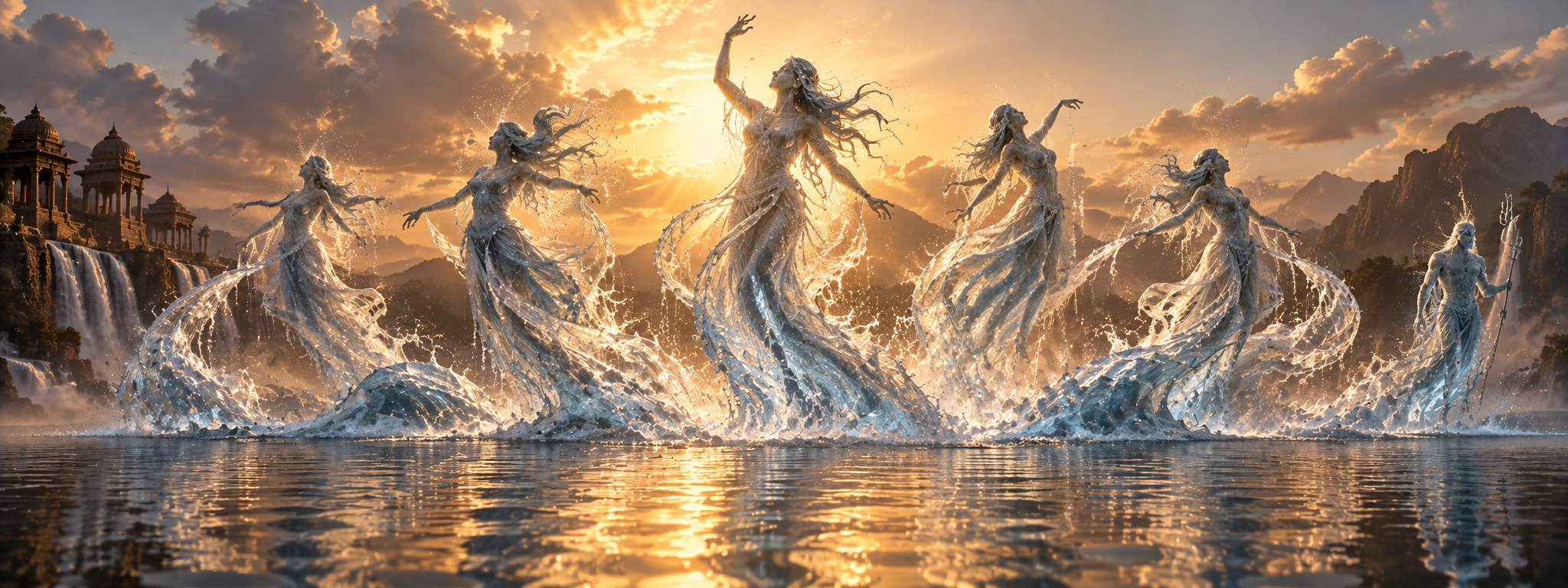
No other domain in this series gets as consistent a treatment as rivers do. Nearly every named river of any size becomes a goddess, with a birth story, a family, and usually a reason for descending or flowing where she does. That consistency makes the exceptions more visible than usual — a river whose birth story genuinely can't be pinned to one telling, a goddess whose very domain (speech, not water) keeps threatening to detach from her river entirely, and the one river given a body that isn't feminine at all.
Ganga: The Richest Descent Story in the Set
Ganga is a river before she is anything else, but the tradition gives her more biography than any other river carries: a husband in King Shantanu, a son in Bhishma, and — uniquely among this group — a documented reason for coming down from the heavens in the first place, one that Puranas don't fully agree on. The most widely told version has King Bhagiratha performing extreme penance to bring Ganga to earth so her waters can purify the ashes of his sixty thousand ancestors, incinerated by the gaze of an angered sage. Ganga's descent is powerful enough that the earth itself couldn't withstand it unbroken; Shiva catches her fall in the coils of his own matted hair, releasing her gradually onto the plains below rather than letting her force strike the ground directly.
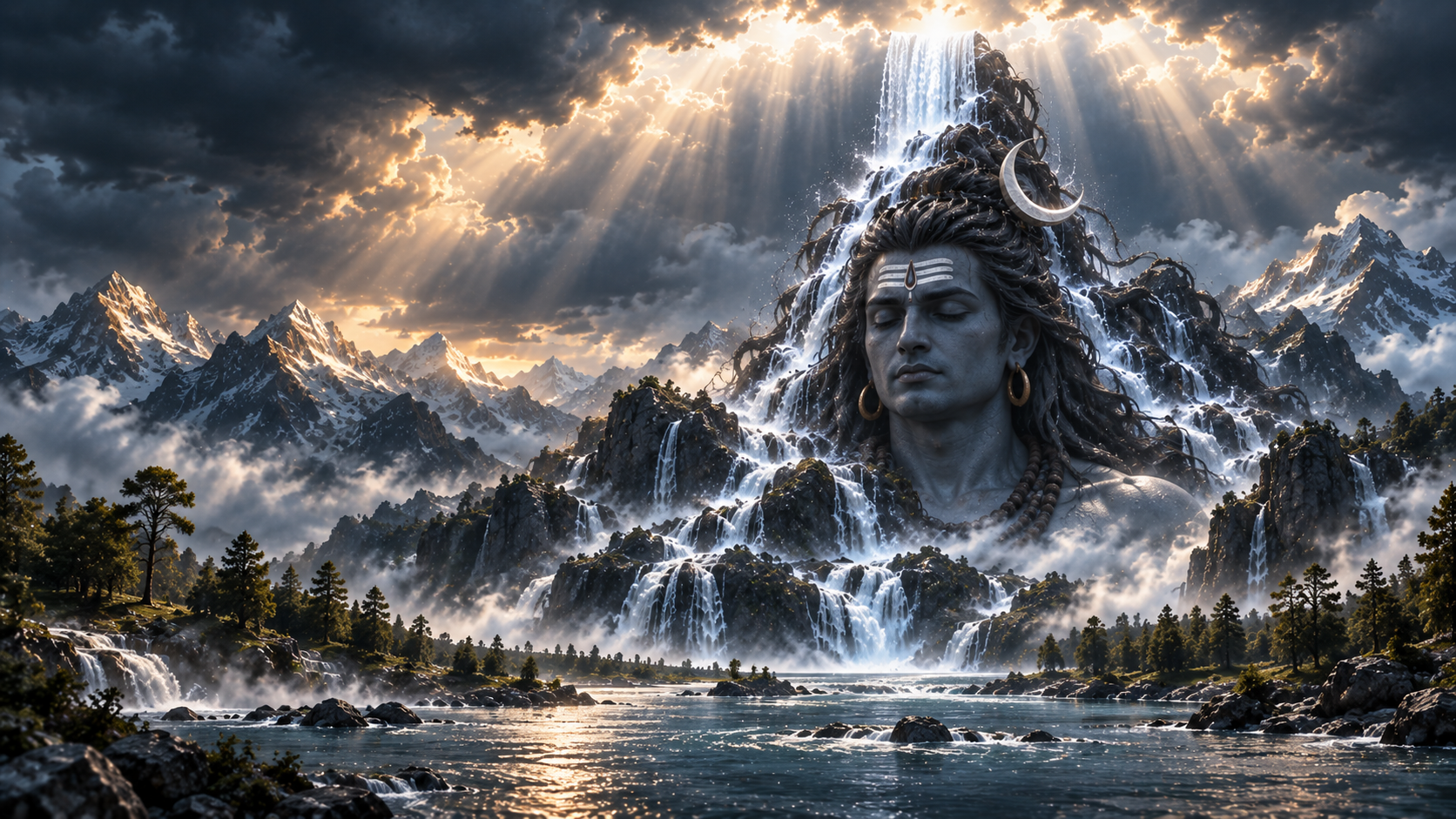
Ganga's descent, caught and tempered in Shiva's hair before reaching the plains below.
The Bhagiratha-and-the-sixty-thousand-ancestors account is the version most commonly repeated, but it isn't the only reason different Puranas give for Ganga's descent to earth, and this series follows the general pattern set in Part I of naming the variance rather than resolving it. What stays constant across every version is the mechanism, not the motive: something about Ganga's arrival is too powerful for the earth to absorb directly, and some intervention — Shiva's hair being the most widely told — is required to make her survivable.
Yamuna: The River That Shares a Father With Death
Yamuna is Yami under her river-name — the same figure already introduced in the previous article as Yama's twin, daughter of Surya (Vivasvat) and Saranyu. That means one of this series' cleanest structural echoes sits quietly inside the river-goddess cluster: Death and a major river come from the same father and the same womb. Where Yama walks the path to the world of the dead, Yamuna flows through the world of the living, and later Vaishnava tradition draws her directly into Krishna's own household as one of his consorts — a river-goddess folded into a still-living devotional tradition in a way most of the others on this list aren't.
A lesser-known sister belongs in the same breath: Tapati, daughter of Surya and Chhaya (Saranyu's shadow-double, left behind when Saranyu herself withdrew from the sun's brilliance), married to King Samvarana and counted an ancestress of the Kuru line in the Mahabharata. Tapati is a genuine river-goddess by the same mechanism as her half-sister Yamuna, simply with a much smaller cult and a much shorter modern profile.
Saraswati: A Goddess Split Between River and Speech
Saraswati carries a dual identity no other figure in this cluster has to manage: she is simultaneously a river and the goddess of speech, learning, and eloquence, and the tradition doesn't consistently decide how tightly those two identities are bound together. Some texts treat the river and the goddess of speech as fully the same figure; others keep the association looser, treating the river as one manifestation of a goddess whose primary domain is language and knowledge rather than water at all. Complicating the picture further, the Sarasvati river itself is, in the physical landscape, a vanished or underground watercourse rather than a visible, flowing one — which makes her the one river-goddess in this set whose worship long ago outgrew any dependence on a river anyone could actually point to.
The Regional Rivers
Narmada is said to have arisen from Shiva's own body — born of his sweat or bodily exertion during penance — which makes her, uniquely among the major rivers here, a direct bodily emanation of a god rather than a figure with a separate birth and genealogy of her own.
Godavari's origin ties to the sage Gautama, tricked by envious fellow sages into believing he had killed a cow (in most versions, an illusion conjured to disgrace him), who performs penance to Shiva to atone; the river released in response is honored as "the Ganga of the South," a direct southern counterpart to the north's most famous river rather than an unrelated figure.
Kaveri's founding myth in the south involves the sage Agastya, who carries her south in his water-pot (kamandalu); in the best-known version of the story it's Ganesha, in the form of a crow, who tips the pot over at Talakaveri, releasing Kaveri as a river against Agastya's own wishes — a rare case in this cluster where a river's release is caused by mischief rather than by penance or catastrophe.
Sindhu is personified as early as the Rigveda itself, one of the Sapta Sindhu ("seven rivers") the earliest hymns name directly — old enough, and central enough to the geography of the earliest Vedic communities, that the river's name became the name later applied to the entire subcontinent.
Brahmaputra: The One River Given a Different Kind of Body
Every river discussed above is personified as a goddess. Brahmaputra — "son of Brahma" — is the deliberate exception: a major river given a male body and a male genealogy. The Kalika Purana's account is more specific than the name alone suggests: the parents of record are the sage Shantanu (a different figure from the Mahabharata's Shantanu) and his pious wife Amogha, whom Brahma blesses with a son in recognition of their devotion. The child is born already taking the form of a vast body of water; Shantanu is the one who places him among four mountains, where he grows into the river. Brahma's role is the cause of the birth rather than a place in the family itself — a boon granted to an already-married mortal couple, not a union of his own — which makes "son of Brahma" closer to an honorific for how the river came to exist than a literal parentage. Nothing about the underlying mechanism of personification changes between Brahmaputra and his sisters — a natural watercourse still becomes a deity with a birth and a name — but the choice of gender stands alone in this entire cluster, and no source consulted here offers a reason why this one river, among so many, was given a different kind of body than the rest.
Nearly every river in this tradition becomes a goddess. Exactly one becomes a god — and no source explains why this was the river chosen.
Rivers are the most consistently personified natural feature in the entire tradition — almost without exception, a named river becomes a goddess with a family, a reason for flowing where she does, and often a specific catastrophe or penance behind her arrival. That very consistency is what makes Saraswati's split identity and Brahmaputra's male body stand out as sharply as they do: not failures of the pattern, but the two places where the pattern itself visibly strains, one by a domain (speech) pulling loose from a river, the other by a gender assignment nothing in the record explains.
Yamuna's twin brother Yama and the wider question of what "Kala" actually names are covered in the previous article, The Judge Who Was Once the First to Die: Kala and Yama. Ganga's other identity as Himavat's daughter and sister to Mainaka is covered in the coming Mountains article.
References
Primary and Secondary Sources
- Ramayana and Puranic accounts of the Bhagiratha legend, and the wider Puranic corpus, for Ganga's descent and the variant reasons given for it across different tellings.
- Rigveda 10.10 and the wider Surya-Saranyu genealogy, for Yami/Yamuna's parentage and her twin relationship to Yama, as established in the preceding article.
- Mahabharata (Adi Parva) for Tapati's parentage via Surya and Chhaya, and her marriage to King Samvarana.
- Puranic accounts of Saraswati as both river and goddess of speech, and the archaeological and textual record of the Sarasvati river's disappearance from the visible landscape.
- Regional Puranic material on Narmada's origin from Shiva, Godavari's origin via the sage Gautama at Trimbakeshwar, and Kaveri's release at Talakaveri via Agastya and Ganesha.
- Rigvedic references to Sindhu among the Sapta Sindhu, and the Kalika Purana for Brahmaputra's birth to the sage Shantanu and his wife Amogha through Brahma's blessing.
No source consulted here offers an explanation for why Brahmaputra alone among the major rivers discussed is personified with a male body; this is noted as an open question rather than resolved.