
Two names anchor this piece, and only one of them names a single figure. Yama has a continuous, traceable identity from the Rigveda to the Puranas, even as his job description changes completely. "Kala" does not — it's a title at least four different figures answer to, ranked against one another in the very texts that use it, and at points applied to Yama himself. Untangling that is as much the subject here as Yama's own transformation.
Yama: From the First to Die to the Judge of the Dead
Yama and his twin sister Yami are, in the Rigveda's own telling, the first two humans — children of the sun-god Vivasvat and Saranyu (also called Sanjna), daughter of the divine architect Tvashta/Vishvakarma. The Rigveda records a dialogue between them in full, hymn 10.10: Yami argues, at length, that the two of them should continue the human line together; Yama refuses, on the grounds that the gods are watching and such a union would be wrong. He is, even in this earliest telling, defined by restraint — his very name comes from a root meaning both "twin" and "to restrain."
Then Yama does something no one before him had done. Not through sickness, not through violence — the texts describe it as an act of will. He dies. In doing so he becomes the first being to map the road to whatever lies beyond life, and "the dead needed a king, and the one who had arrived first took the job." His realm, in these earliest hymns, is not a place of punishment at all: it's a bright world where the departed ancestors sit beneath a tree, drinking soma alongside the gods, with music somewhere in the air. Yama is a host, not a warden.
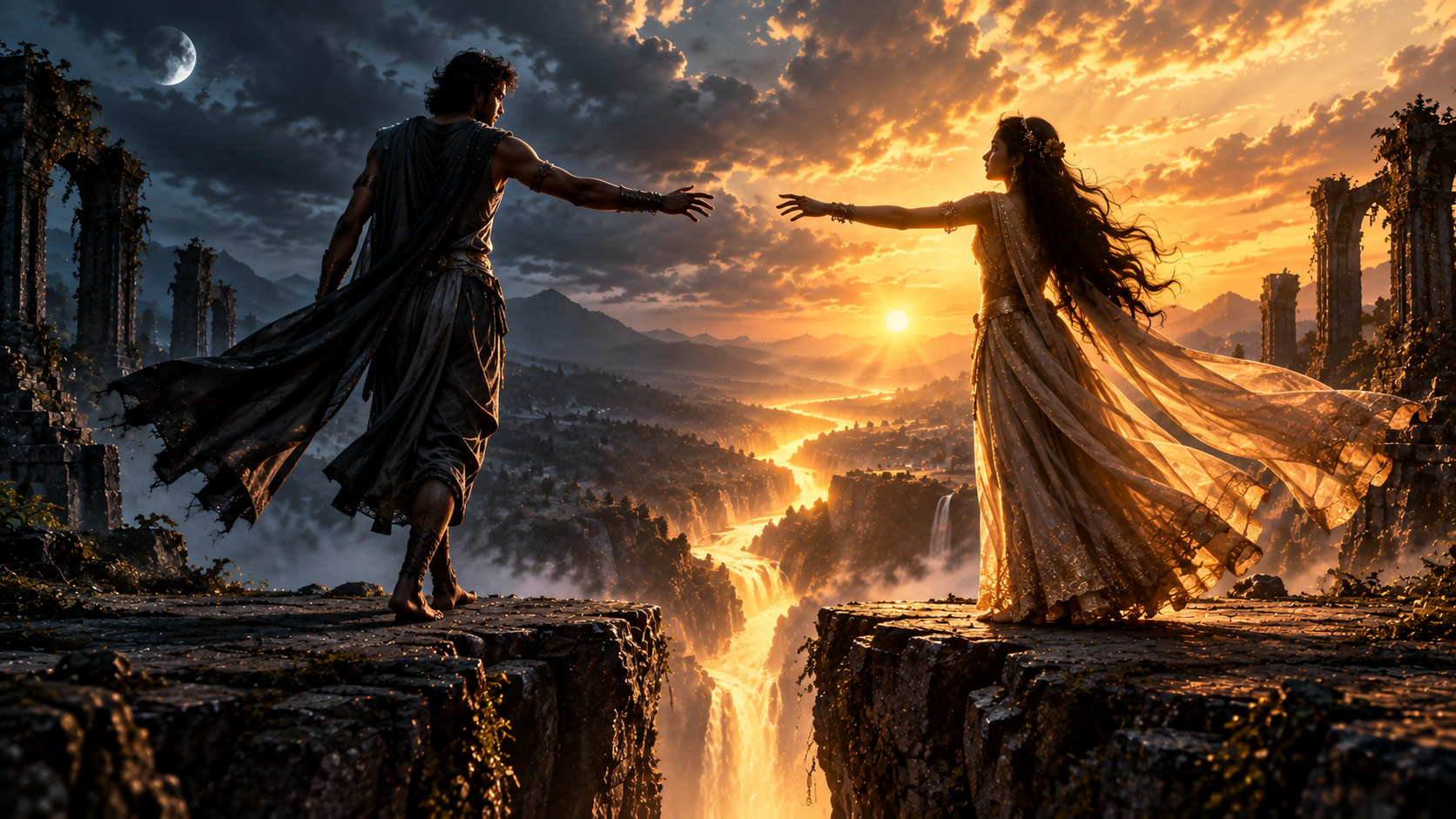
Yama and Yami, the first two mortals — the Rigveda records their parting dialogue in full, verse by verse.
Yami's grief at losing her twin is itself given a cause in the tradition: the gods, unable to console her, are said to have created the alternation of day and night specifically to give her sorrow something to move through — each day a fresh forgetting, each night a fresh reminder. It's a small, easily missed detail with an outsized implication for this series: an early myth of Yama's death is also, in effect, an origin myth for the cycle of time itself, well before "Kala" as a distinct figure enters the picture at all.
By the time of the Puranas, the job has changed entirely. Yama is now Dharmaraja, and the shining ancestral hall has become an office with a records department: the Padma Purana describes every soul, on arrival, being "confronted with Chitragupta the recorder, by whom their actions have been registered," before being sent on to Swarga or to one of the many regions of Naraka the Vishnu Purana goes on to enumerate in some detail. The pathfinder who once welcomed the dead as fellow travelers has become an accountant with a punishment to hand down. Nothing about his origin story changes to explain the shift — the office simply grows around him, generations after the Rigveda first described him walking the road alone.
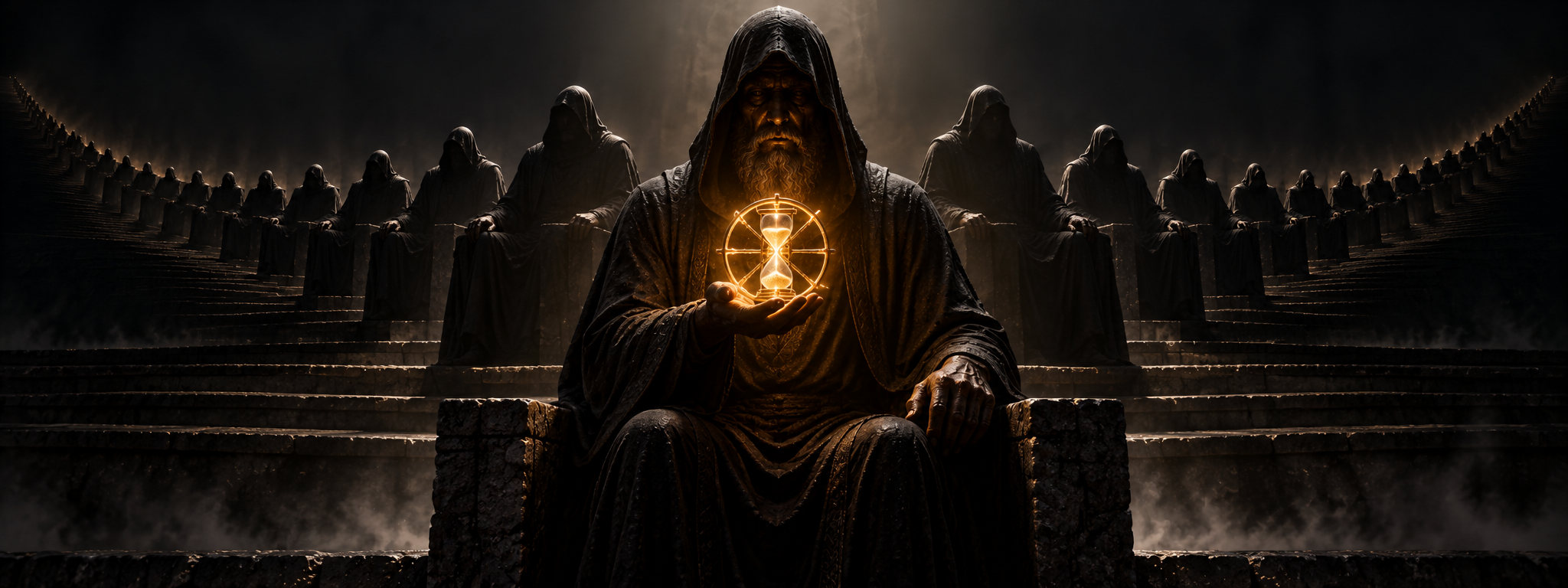
"The dead needed a king, and the one who had arrived first took the job."
— on Yama's earliest Rigvedic role, before judgment enters the pictureEven Yama isn't beyond Yama's reach
One later legend makes the point that Yama's authority, however vast, is still bounded. When the boy-sage Markandeya, fated to die at sixteen, clung to a Shiva lingam for protection, Yama cast his noose around both the devotee and the sacred stone — and Shiva erupted bodily from the lingam and struck Yama dead on the spot. Without Yama, nothing anywhere could die. The resulting disorder forced the other gods to petition Shiva directly, who revived Yama on one condition: that Markandeya remain sixteen years old forever. Yama returned to his post and mortality resumed on schedule. Tellingly, the aspect of Shiva who does the killing in this story is named Kalantaka — "ender of time" — and at least one standard account of the myth describes Yama in that moment as time itself, personified, being conquered. Which is exactly where this piece's second, more tangled subject begins.
Kala: Not One Figure, but at Least Four
"Kala" is Sanskrit for time, and the tradition personifies it more than once, at more than one scale, without fully reconciling the results. Four distinct figures answer to some form of the name, and they are not treated as interchangeable even within the same textual tradition.
| Figure | Standing | Source / association |
|---|---|---|
| Kala, grandson of Dharma | A minor, born personification | Son of Dhruva, one of the eight Vasus; covered in this series' Part I article as part of Dharma's wider family. |
| Yama-as-Kala | An epithet applied directly to Yama | Multiple sources list "Kala" among Yama's own titles — "Lord of Time" — collapsing the distinction between the judge of the dead and time itself in ordinary usage. |
| Mahakala | Explicitly ranked above the "lesser" Kala | An aspect of Shiva — "the kala of kala," time beyond time, self-originated and, per the Puranic material itself, superior in standing to the Kala who is merely one of its personifications. |
| Kalapurusha | A separate, preservative figure — and also a name reused elsewhere | An aspect of Vishnu representing time's sustaining rather than destructive face; the name is also given, in some sources, to one of Yama's own court attendants — a second collision inside the same cluster of names. |
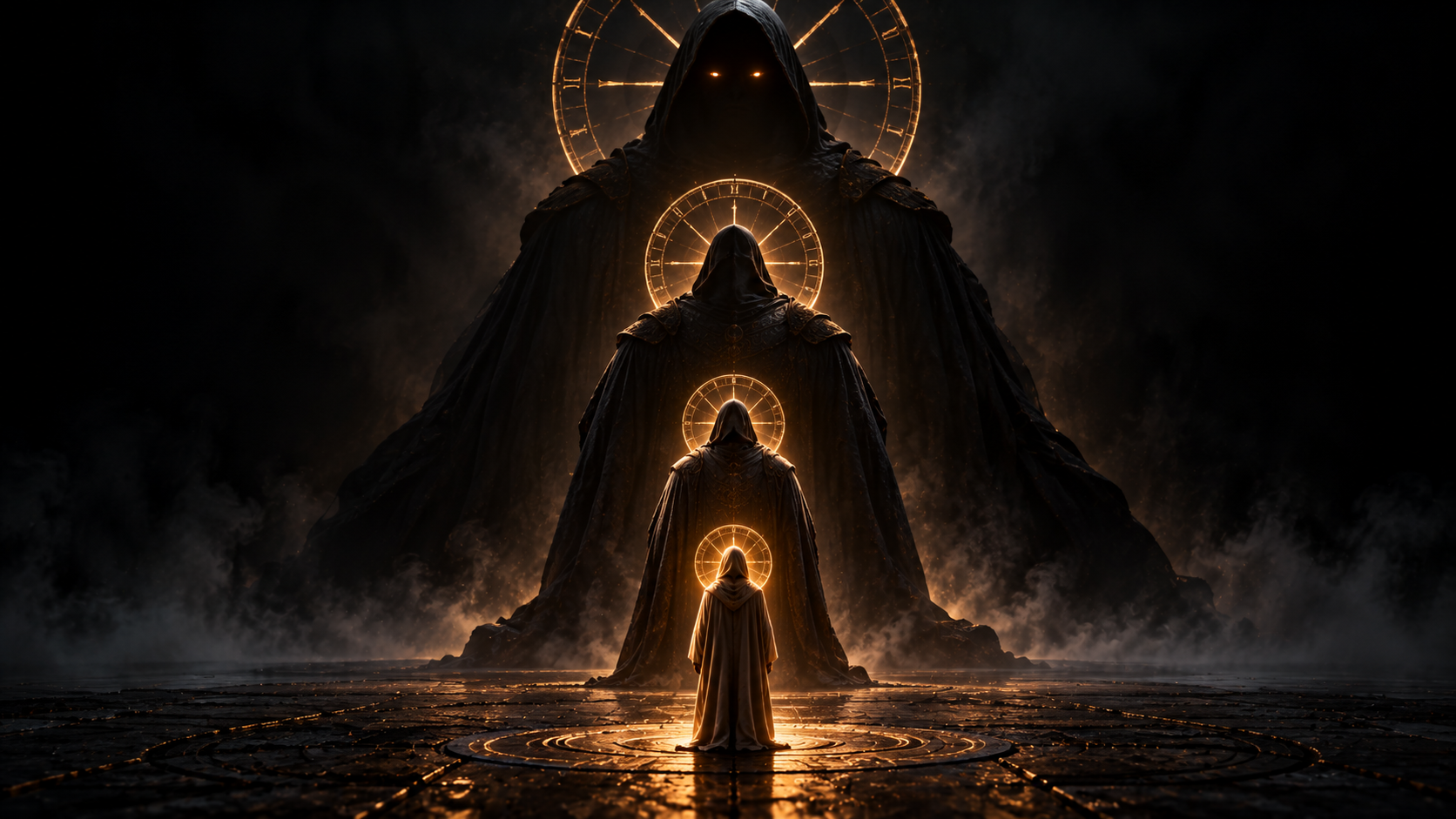
Four figures answer to some form of the name Kala — and the tradition itself ranks them, rather than treating them as one.
This isn't a case of the same figure appearing under different names in different regions, the way Dhara and Drona turned out to be in Part I. Here the sources themselves distinguish the figures and rank them: Puranic material describing Kala and Mahakala together states plainly that Kala is lesser than Mahakala, with Mahakala representing Shiva's total dominion over time rather than a bounded personification of it. Mahakala, in turn, is described as beyond time's own threefold division, self-originated, "nothing generates it" — a status no other figure on this list claims. Kalapurusha sits in a third position again, aligned with Vishnu's preserving rather than destroying function, which is why some accounts pair Mahakala (destruction) and Kalapurusha (preservation) as complementary rather than competing figures.
Layered on top of all this, "Kala" is also simply one of Yama's own epithets in general usage — so a reader encountering the word in a given text has to work out, from context alone, whether it means the minor grandson of Dharma, Yama under another name, Shiva in his ultimate aspect, or Vishnu's sustaining counterpart to that aspect. The tradition doesn't appear to have felt this needed resolving.
Yama's transformation is a genuine, traceable development: a Rigvedic ancestor-king who welcomed the dead becomes, by the Puranic era, a judge with a bureaucracy, and no myth is ever offered to explain the change — it simply accumulates around him across centuries of text. Kala's situation is different in kind. There was never one figure to transform; there were always at least four, operating at different scales and explicitly ranked against each other, with Yama's own name folded into the confusion as a fifth data point. Where the vice-genealogy in Part I resolves its name-collisions by treating them as unremarkable — the same word turning up twice, unbothered — the Kala material resolves nothing at all. The ambiguity is simply left standing, generation after generation of text.
Kala the grandson of Dhruva is introduced in Part I, Two Trees, One Root: Dharma and Adharma. Yami's later identity as the river Yamuna is covered in the next article, Water With a Face: The River-Goddesses. Yama's role as guardian of the southern direction — a second, unrelated kind of personification layered onto the same figure — is covered in Part VI, Eight Gods, Eight Directions: The Dikpalas.
References
Primary and Secondary Sources
- Rigveda 10.10 — the dialogue hymn between Yama and Yami, their parentage via Vivasvat and Saranyu, and Yama's role as first mortal and pathfinder to the world of the dead.
- Padma Purana and Vishnu Purana, via Hindu Mythology, Vedic and Puranic (sacred-texts.com) — for Yama's Puranic role as judge of the dead alongside Chitragupta the recorder, and the regions of Naraka under his rule.
- Puranic and Shaiva material on Kala and Mahakala (via Wisdomlib) — for the explicit ranking of Kala as lesser than Mahakala, and Mahakala's status as self-originated and beyond time's own divisions.
- Hindu thought on Mahakala and Kalapurusha as complementary aspects of Shiva and Vishnu respectively, representing time's destructive and preservative functions.
- The Markandeya legend and the figure of Kalantaka ("ender of time") as an aspect of Shiva who defeats Yama — cited here as an instance of Yama himself being described as time personified in that specific narrative context.
The four Kala-figures tabulated above are presented as the sources describe them — genuinely distinct and explicitly ranked — rather than harmonized into a single lineage or timeline.