
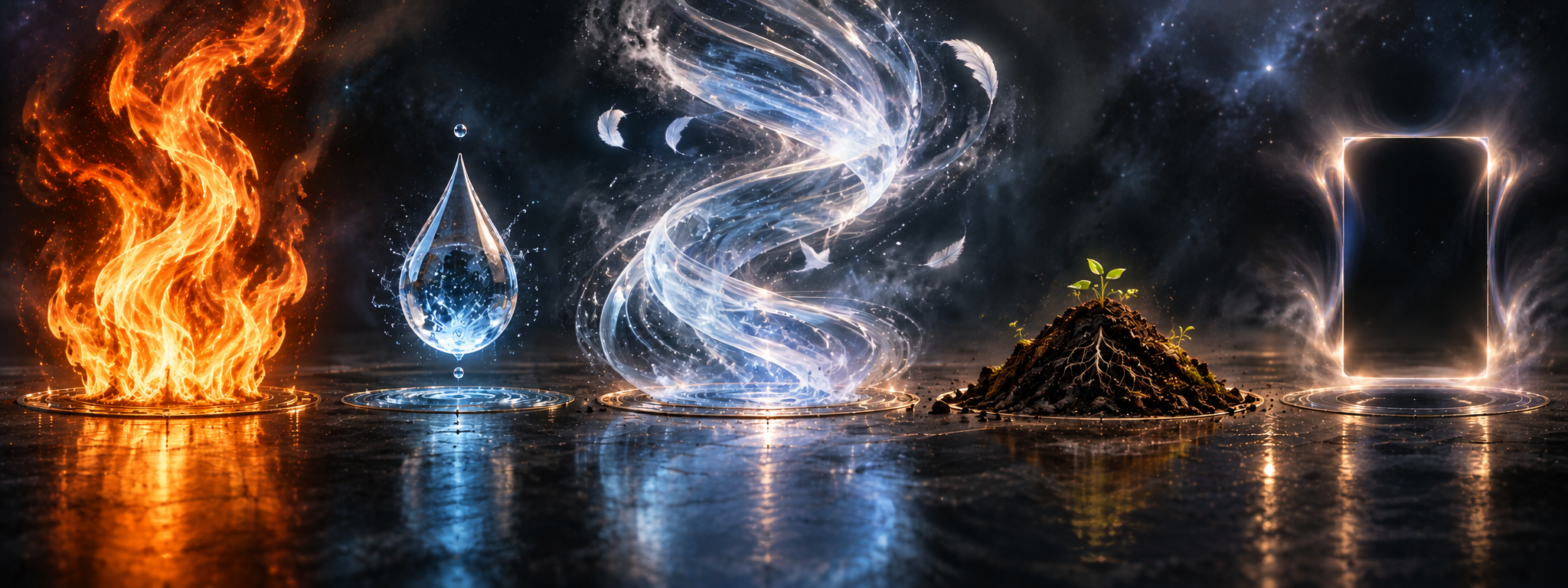
The Panchabhuta — earth, water, fire, air, and ether — is usually presented as one tidy set, five equal members of a single classification. Held up against everything else in this series, though, the five don't actually belong to the same category of personification. Two of them were major, independent deities with an enormous devotional and textual presence long before anyone organized the elements into a system of five at all. The other three range from a genuine personified goddess, to a loosely personified plural, to something the tradition barely bothered to give a face.
Agni and Vayu: Gods First, Elements Second
Agni is one of the most extensively hymned deities in the entire Rigveda — second only to Indra in the sheer number of hymns addressed to him — and his role has nothing to do with being "the personification of fire" in the way Dharma is the personification of moral law. Agni is the sacrificial messenger: every offering placed in ritual fire is understood to reach the gods through him specifically, which makes him not a symbol standing in for combustion but an active intermediary with an ongoing job. He's described across three simultaneous forms — fire in the sky as the sun, fire in the atmosphere as lightning, and fire on earth as the sacrificial flame — a single deity operating at three scales at once, well before any five-part elemental scheme existed to place him in.
Vayu, wind and breath, carries the same kind of seniority. He already appears twice in this series' own Mountains article — as Mainaka's rescuer and, in the very next paragraph, as Meru's friend-turned-adversary — doing real narrative work with agency and relationships of his own, nothing like a passive stand-in for moving air. Vayu is closely paired with Indra as his charioteer in Vedic ritual, and is separately identified with prana, the breath animating all living beings — a deity with cosmological and physiological significance that has nothing to do with which slot he'd eventually occupy in a five-element chart.
This is the distinction worth holding onto for the whole piece: Agni and Vayu aren't abstractions that got personified to fit an elemental slot — they're established, independently significant gods that a later classificatory system happened to file under "fire" and "air." Everything else in this series so far involved a quality or a phenomenon that didn't have a deity until the tradition gave it one. Agni and Vayu already had deities. The element system found them, not the other way around.
Apas: A Plural, Not a Person
Water's position in this set is stranger than fire's or air's. The Rigveda personifies the waters collectively as Apas — invoked together, in the plural, as a group of goddesses rather than as one individual figure with a name, a family, and a story. That's a genuinely different mode of personification than anything else catalogued in this series: not a single deity standing in for an abstraction, but an undifferentiated collective given divine status as a group. Overlapping with this, but not identical to it, is Varuna — an old and major sovereign god whose domain includes the cosmic ocean and who upholds Rta, cosmic and moral order, more broadly. Varuna oversees water in a governing sense the way a king oversees a kingdom; Apas simply is water, deified without ever consolidating into a single face.
Akasha: The Element the Tradition Almost Left Alone
Ether — space, or the medium in which sound is said to travel — is the thinnest personification of the five by a wide margin. No single deity is consistently and widely worshipped as "the god of Akasha" the way Agni is worshipped as fire's intermediary or Varuna governs the waters. It functions in classical philosophy primarily as a category to complete the set of five, present because the scheme requires five terms, without the tradition investing much narrative energy in giving it a face at all.
Four of the five elements got a god. The fifth mostly got a placeholder.
Prithvi: The One True Personification, Held for Later
Earth is the exception that keeps this article honest: Prithvi genuinely is a personified goddess in her own right, paired with Dyaus (the sky) as one of the oldest couples in the tradition — a real birth-and-family personification, not a plural collective or a placeholder. She isn't given her full treatment here, though; earth's fuller story belongs with the series' other early Vedic goddesses, and is covered in full in the next article rather than repeated in two places.
Sorted by what kind of thing each one actually is, the Panchabhuta splits three ways rather than sitting as one uniform category: Agni and Vayu are major independent deities the element system absorbed rather than created; Apas is a plural collective, water deified without ever becoming one person, standing apart from Varuna's separate governing role over the same domain; Akasha is close to an empty seat, present to complete the count more than to be worshipped as a figure; and Prithvi is the set's only clean case of a true personification, housed for narrative reasons in a different article. A series about how the tradition turns an idea into a god finds, in this one classification, an example of the opposite motion too — gods and near-absences alike, gathered afterward into a category built to hold five things evenly.
Vayu's fuller narrative role with Mainaka and Meru is covered in Mountains That Once Had Wings. Prithvi's full treatment as a primordial mother-goddess is covered in the next article, Speech, Boundlessness, and the Wild: The Vedic Goddesses.
References
Primary and Secondary Sources
- Rigveda — Agni's hymns (second in number only to Indra's), his threefold form across sky, atmosphere, and earth, and his role as sacrificial intermediary.
- Rigveda and wider Vedic tradition — Vayu's pairing with Indra as charioteer, and his identification with prana, the animating breath.
- Rigveda — the Apas as a plural, collectively invoked group of water goddesses, distinct from Varuna's separate sovereign role over cosmic order and the ocean.
- Classical Samkhya and Puranic material on the Panchabhuta as a five-part elemental classification, and Akasha's comparatively undeveloped personification within it.
This article deliberately does not attempt to personify Akasha further than the sources themselves do; its thinness is treated as a finding, not a gap to fill in.