
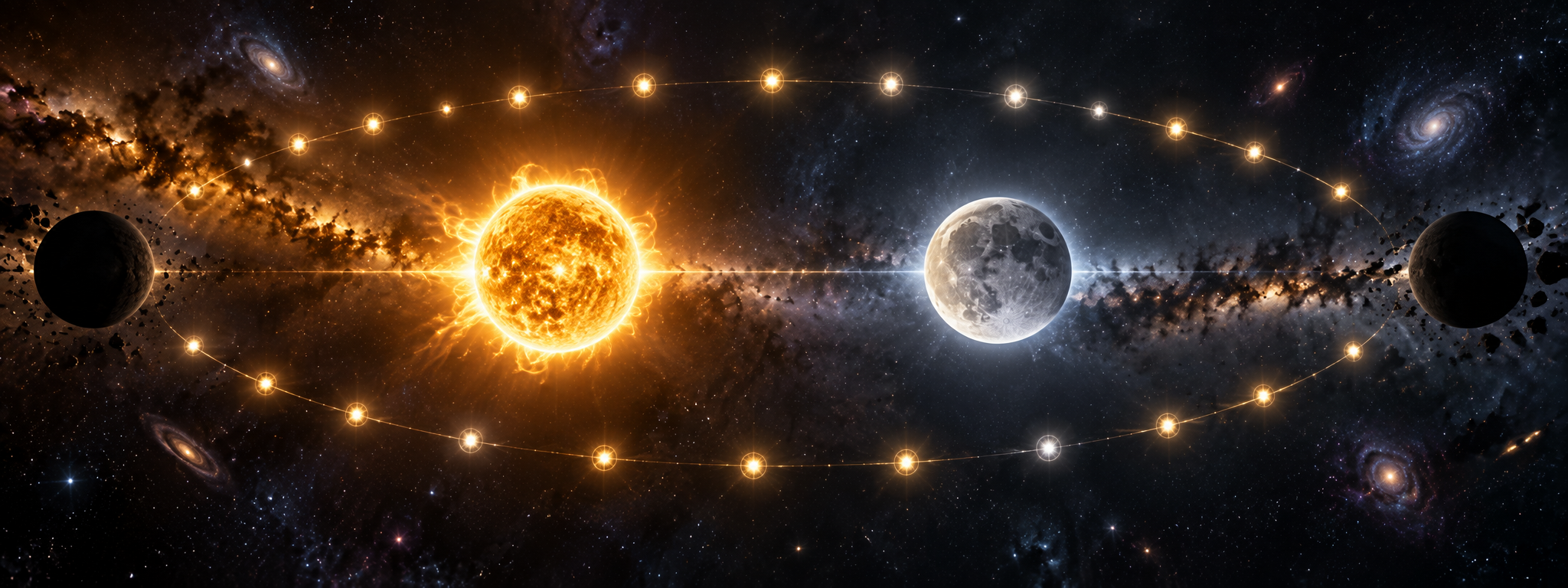
This series has already met most of Surya's household without naming him directly — Yama and Yamuna in an earlier article both trace back to him. Here he gets the fuller picture, alongside his counterpart in the sky, Chandra the moon, whose own myth turns an astronomical cycle into a story about favoritism and its consequences. And at the edge of this family sit two figures who aren't natural phenomena at all: Rahu and Ketu, planets by classification, with no body anyone could ever actually see.
Surya: One Father, Two Households
Surya, son of the sage Kashyapa and Aditi, fathers two distinct sets of children through two different circumstances involving the same wife. With Sanjna (also called Saranyu), his union produces Yama and Yami — already covered in this series — along with the twin physician-gods the Ashvins and, in some accounts, the warrior Revanta. Unable to bear Surya's full radiance, Sanjna is said to have left behind a shadow-double of herself, Chhaya, to take her place; with Chhaya, Surya fathers Shani (Saturn, personified in his own right within the Navagraha) and Tapati, the minor river-goddess already noted alongside her half-sister Yamuna. Two wives, one substitution myth, and a household that quietly threads through several other articles in this series before this one ever names him directly.
Chandra: Twenty-Seven Wives, One Favorite, and a Curse That Became the Moon's Phases
Chandra, the moon, marries all twenty-seven Nakshatras — the star-goddesses of the lunar mansions, daughters of the sage-patriarch Daksha — in a single mass alliance. The trouble is that Chandra keeps one wife, Rohini, far closer than the rest, neglecting the other twenty-six so completely that Daksha, hearing his daughters' complaints, curses Chandra with a wasting disease. The moon begins to disappear entirely. With the world losing its night-light altogether, the gods intervene and persuade Daksha to soften the curse rather than lift it: instead of vanishing for good, Chandra is condemned to wane and wax on a fixed cycle, forever paying for his favoritism in fortnightly installments rather than all at once. It's a rare case in this series of an ongoing astronomical cycle being explained entirely as a moral consequence, still being paid out.
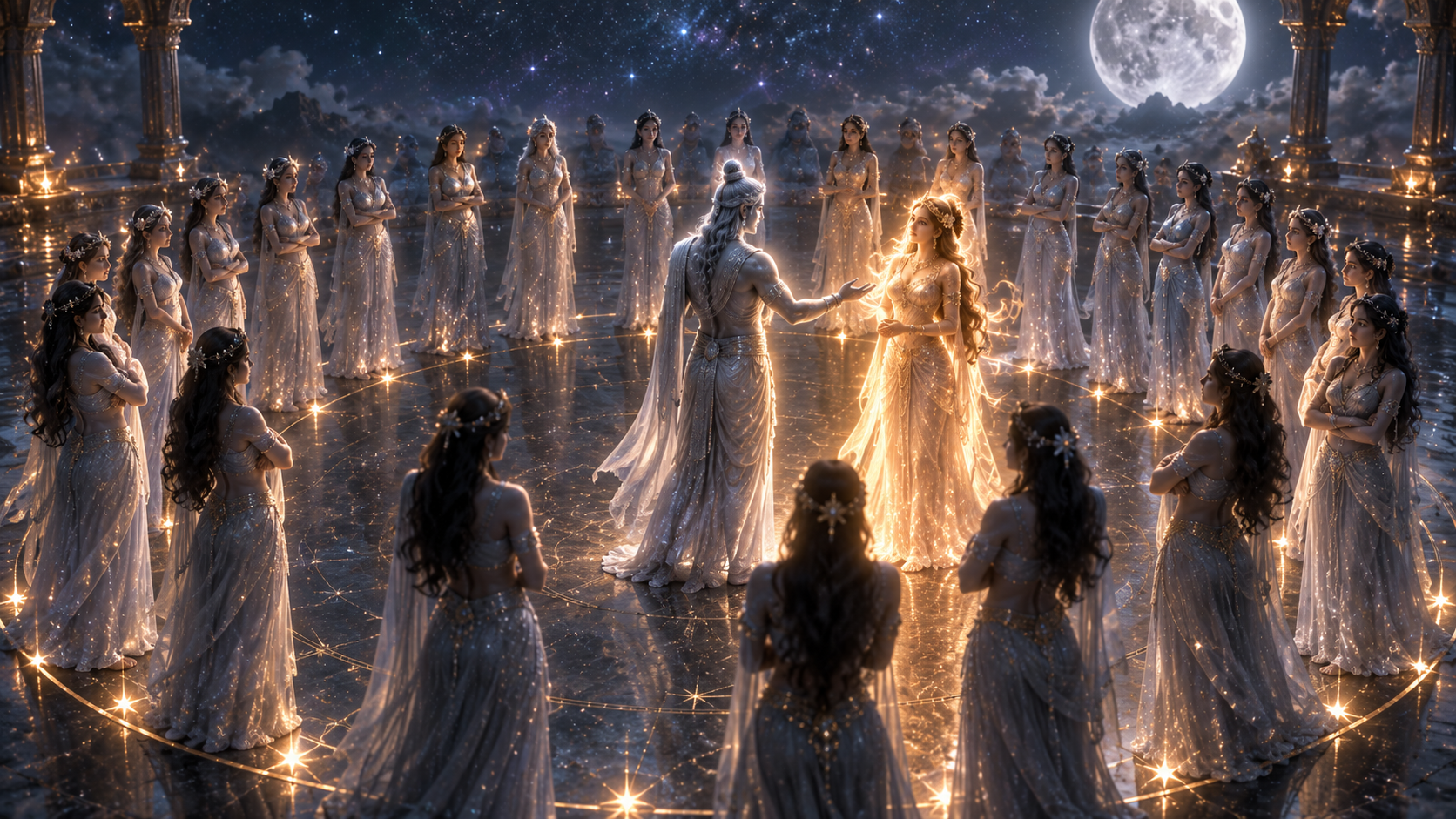
Chandra and his twenty-seven wives — with one held closer than the rest, and a curse that became the moon's phases.
Chandra's own origin isn't settled the same way his curse is. One tradition makes him the mind-born son of the sage Atri, arising from his ascetic energy. A separate and equally well-known tradition instead places Chandra's birth during the churning of the cosmic ocean, Samudra Manthan — one of the fourteen treasures that rise from the sea alongside the nectar of immortality, Lakshmi, and the physician Dhanvantari. Both accounts are current in the tradition; this piece doesn't treat either as the corrected version, and the Samudra Manthan account is worth holding onto, since the same churning is where Rahu and Ketu's own story begins.
Rahu and Ketu: Full Godhood, No Body at All
Every figure discussed elsewhere in this series, however strange its origin, is at minimum a natural phenomenon that can be pointed to — a river, a mountain, the visible sun and moon. Rahu and Ketu break that pattern entirely. Astronomically, they aren't objects; they're the two points where the moon's orbit crosses the sun's apparent path, points in space with no mass and no light of their own. Mythologically, the tradition gives them a single, shared origin story to explain that emptiness: during the churning of the ocean, a daitya secretly drank a portion of the nectar of immortality while disguised among the gods. Sun and Moon spotted the deception and alerted Vishnu, who severed the daitya's head with the discus before the nectar passed his throat — but by then the nectar had already taken effect. Head and body both survived, immortal and separated forever: the head became Rahu, the body Ketu, and both are said to chase Sun and Moon eternally in revenge, swallowing them briefly whenever they catch them — the traditional explanation for eclipses.
Two full members of the Navagraha have no mass, no light, and no body an eye could ever find. The tradition gave them godhood anyway.
Of everything catalogued across this entire series — a river with a body, a mountain with pride, even Time itself split across four ranked figures — Rahu and Ketu are the cleanest possible case of the pattern this series exists to trace. There was never a phenomenon here waiting to be given a body. There was an absence, a mathematical point, and the tradition simply declined to leave it unnamed.
The rest of the Navagraha — Mangala, Budha, Brihaspati, Shukra, and Shani alongside Surya and Chandra covered here — are already profiled in this project's own database and aren't repeated in full in this series; the interesting case for a series about abstraction-as-deity was never the five visible planets, but the two that were never visible to begin with. Rahu and Ketu earn the closing word in this article for exactly that reason.
Yama and Yami, two of Surya's children by Sanjna, are covered in The Judge Who Was Once the First to Die: Kala and Yama. Tapati, Surya's daughter by Chhaya, appears alongside her half-sister Yamuna in Water With a Face: The River-Goddesses. The wider Navagraha tradition, including Shani, Mangala, and the rest, is covered in this project's separate planetary profiles rather than repeated here.
References
Primary and Secondary Sources
- Puranic genealogies of Surya via Kashyapa and Aditi, and his children through Sanjna and Chhaya, including the shadow-substitution myth.
- Puranic accounts of Chandra's marriage to the 27 Nakshatras, his favoritism toward Rohini, Daksha's curse, and the gods' intervention converting the curse into a cyclical waxing and waning.
- Puranic material on Chandra's alternate origins — as the mind-born son of the sage Atri, and as one of the treasures produced during Samudra Manthan.
- Puranic accounts of Samudra Manthan and the daitya's beheading by Vishnu's discus, giving rise to Rahu and Ketu as the immortal head and body, and their role in eclipse mythology.
This project's own Navagraha profiles cover Mangala, Budha, Brihaspati, Shukra, and Shani in full; they are referenced here only where they intersect directly with this series' subject.