
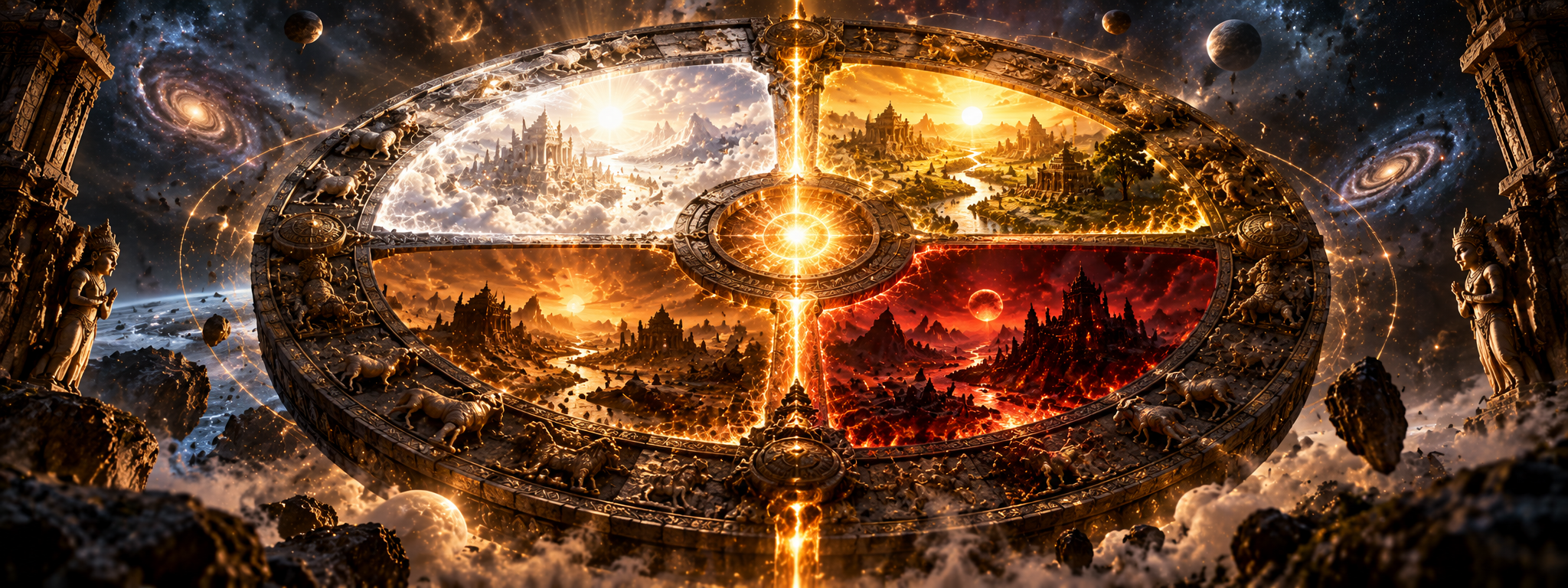
Every chronicle on this site eventually drops a date into the story — "this happened in Treta Yuga," "we are living in Kali Yuga now," "after fourteen Manus the world dissolves." These aren't vague poetic gestures. The Puranas describe an actual, numbered clock: four ages of declining dharma nested inside a much longer cycle of fourteen supervising Manus, itself nested inside a single day in the life of Brahma. This article lays out that clock in full — and places this exact moment somewhere on its face.
The Four Yugas
A Mahayuga, or "Great Age," is built from four successive Yugas of shrinking length and shrinking dharma. The image the Puranas use is a bull — Dharma himself, standing on four legs in the first age, and losing one leg each age after, until in the present age he balances on a single leg alone. Time is measured here in divine years, each equal to 360 human years, a conversion that turns already enormous numbers into truly vast ones.
| Yuga | Divine Years | Human Years | Dharma's Legs | Character |
|---|---|---|---|---|
| Satya (Krita) | 4,800 | 1,728,000 | 4 of 4 | Truth and spiritual knowledge complete; no ritual or law is yet needed because none is yet broken |
| Treta | 3,600 | 1,296,000 | 3 of 4 | Virtue begins to erode; sacrifice and formal duty become necessary for the first time — traditionally Rama's age |
| Dvapara | 2,400 | 864,000 | 2 of 4 | Disease, desire, and disagreement multiply; the single Veda has already had to be divided into four — traditionally Krishna's age |
| Kali | 1,200 | 432,000 | 1 of 4 | The present age — conflict, hypocrisy, and moral confusion prevail; began with Krishna's departure from the world |
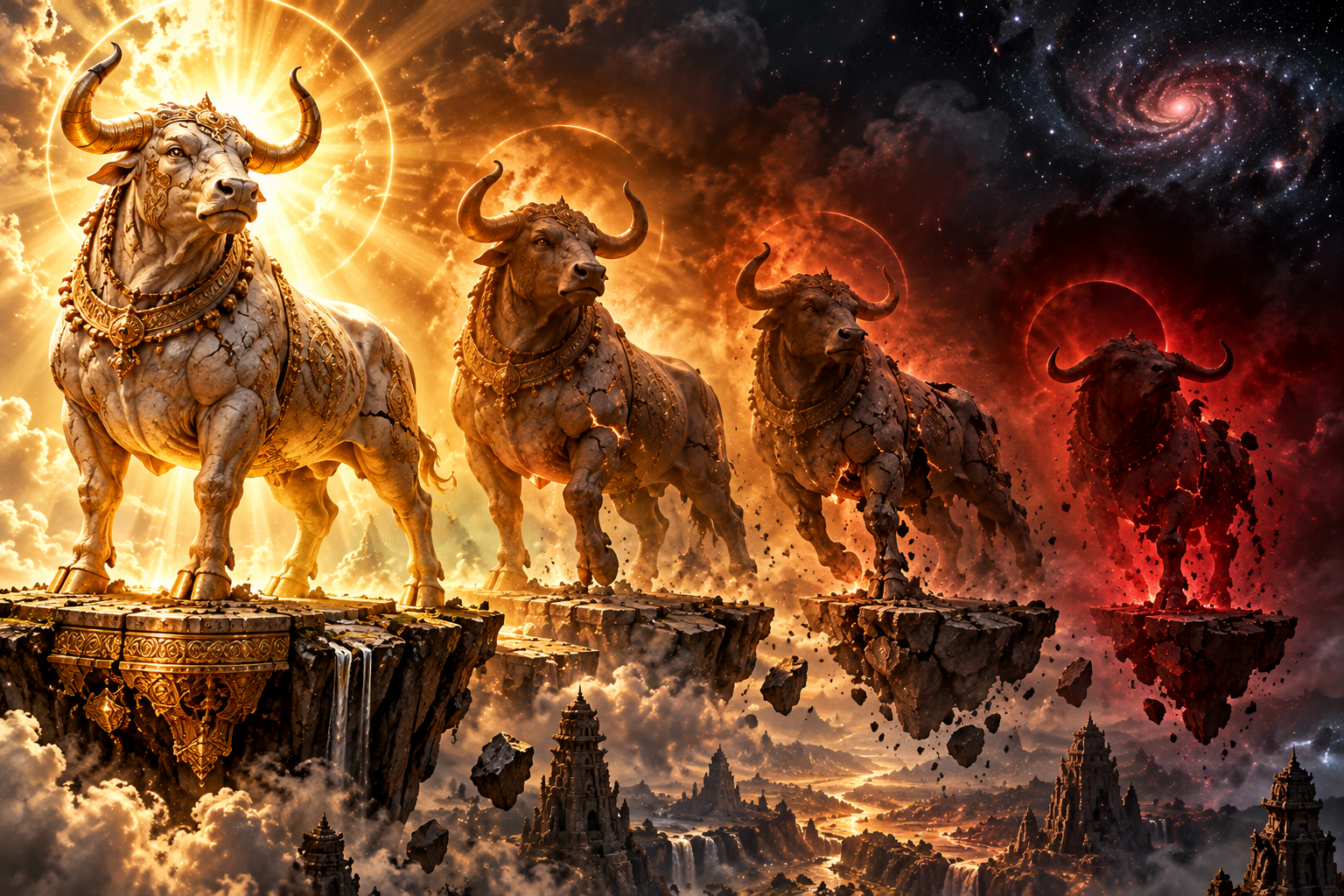
Four ages, one bull, one leg lost each time
One Mahayuga, One Manvantara, One Kalpa
Add the four Yugas together and their divine years come to 12,000 — 4,320,000 human years — one Mahayuga. This is the basic building block for everything larger. A little over seventy-one Mahayugas, plus a twilight period roughly as long as one Satya Yuga, make up one Manvantara: the reign of a single Manu, together with his own Indra, his own set of seven sages, and his own generation of gods. Fourteen Manvantaras, in turn, make up one Kalpa — exactly 1,000 Mahayugas, or roughly 4.32 billion human years — which the Puranas call a single day in the life of Brahma.
The Fourteen Manvantaras
Each Manvantara takes its name from the Manu who presides over it — the archetypal first man of that era, progenitor and lawgiver for everyone born within it. The present Manvantara is the seventh, ruled by Manu Vaivasvata.
| # | Manu | Notes |
|---|---|---|
| 1 | Svayambhuva | The first Manu, mind-born rather than born of a Manvantara before him; father of Priyavrata and Uttanapada by his wife Shatarupa |
| 2 | Svarochisha | Son of Agni; sons headed by Dyumat, Sushena, and Rochishmat; some tellings credit him with inventing clothing for mankind |
| 3 | Uttama | Son of Priyavrata — making him a grandson of the first Manu, Svayambhuva, rather than a fresh lineage; sons headed by Pavana, Srinjaya, and Yajnahotra |
| 4 | Tamasa | Twin brother of the next Manu, Raivata |
| 5 | Raivata | Twin brother of Tamasa; sons headed by Arjuna, Bali, and Vindhya — all distinct namesakes, not the epic Arjuna or the Mahabali of this site's own chronicles |
| 6 | Chakshusha | Son of the minor deity Chakshu; married Nadvala, daughter of Prajapati Vairaja; ten sons including a Kuru and a Puru — again namesakes, not the Chandravamsha's own Kuru or Puru this site's Celestial Dynasties traces |
| 7 | Vaivasvata — CURRENT | Son of Surya (Vivasvan); the Manu the Matsya avatar rescued from the great deluge; father of Ikshvaku, founder of the Suryavamsha, and — in the telling this site's own Celestial Dynasties follows — of Ila, whose line becomes the root of the Chandravamsha |
| 8 | Savarni | Son of Surya and his wife Chhaya — a half-brother of Vaivasvata Manu, also Surya's son but by a different wife; sons headed by Nirmoka and Virajaska. The Indra of this coming age is already named in the Puranas: Mahabali, son of Virochana — the very boon Vishnu's Vamana avatar granted him |
| 9 | Daksha-savarni | Son of the demigod Varuna; sons headed by Bhutaketu and Diptaketu |
| 10 | Brahma-savarni | Son of Upashloka |
| 11 | Dharma-savarni | Son of Ruci and Akuti — Akuti herself a daughter of the very first Manu, Svayambhuva, tying this future Manvantara back to where this table began. Despite the name, not a son of Dharma himself |
| 12 | Rudra-savarni | Son of Rudra (Shiva); sons headed by Devavan, Upadeva, and Devashrestha |
| 13 | Deva-savarni (Raucya) | Son of Ruci and Malini — a different wife of the same sage, making him and Dharma-savarni half-brothers despite ruling seven Manvantaras apart |
| 14 | Indra-savarni (Bhautya) | Son of Bhuti; sons headed by Uru, Gambhira, and a Budha — again a namesake, distinct from the Budha this site's Celestial Dynasties already traces in the Chandravamsha. Future and final Manvantara of this Kalpa |

The flood that opened the present Manvantara — the same Matsya this site's Dashavatara covers in full
The seven sages traditionally said to guide this seventh Manvantara — Vashistha, Vishvamitra, Bharadvaja, Gautama, Jamadagni, Kashyapa, and Atri — are the same seven this site's own Saptarishi Chronicles follows, which is not a coincidence: they are specifically the Saptarishi of Manu Vaivasvata's own age, not a timeless fixed group.
The order of the seven future Manus after Vaivasvata is not identical across every source — the Bhagavata Purana and Vishnu Purana disagree on whether "Deva-savarni" or "Brahma-savarni" occupies a given later slot, and on a couple of these Manus' names outright. Since none of them have arrived yet, this hasn't mattered much to how the tradition is actually used — but it's worth knowing the list firms up for the first seven and loosens for the last seven.
Kalpa, Pralaya, and a Day in Brahma's Life
A Kalpa — 1,000 Mahayugas, all fourteen Manvantaras together — is one full day of Brahma. His night is of equal length: a Pralaya, a partial dissolution in which the three worlds are destroyed and submerged, and Vishnu reclines on Shesha in the causal ocean this site's Fourteen Lokas article already described, until the next day of creation begins. Brahma's entire life runs to 100 such Brahma-years — traditionally reckoned at roughly 311 trillion human years — after which comes the Mahapralaya, a total dissolution in which even Brahma himself is reabsorbed, before a wholly new cycle of creation begins under a new Brahma.
Each Kalpa also carries its own name. The present one is the Shveta Varaha Kalpa, the "White Boar" age — named because it opened with Vishnu's Varaha avatar lifting the earth clear of the cosmic waters, the same rescue this site's Dashavatara chronicle covers in full. The Kalpa immediately before this one is traditionally called the Padma Kalpa, the "Lotus" age — and a few later commentators, reading both names as pointing at the same act of creation from different angles, treat Varaha-Kalpa and Padma-Kalpa as alternate names for this one present Kalpa rather than as two separate Kalpas in sequence.
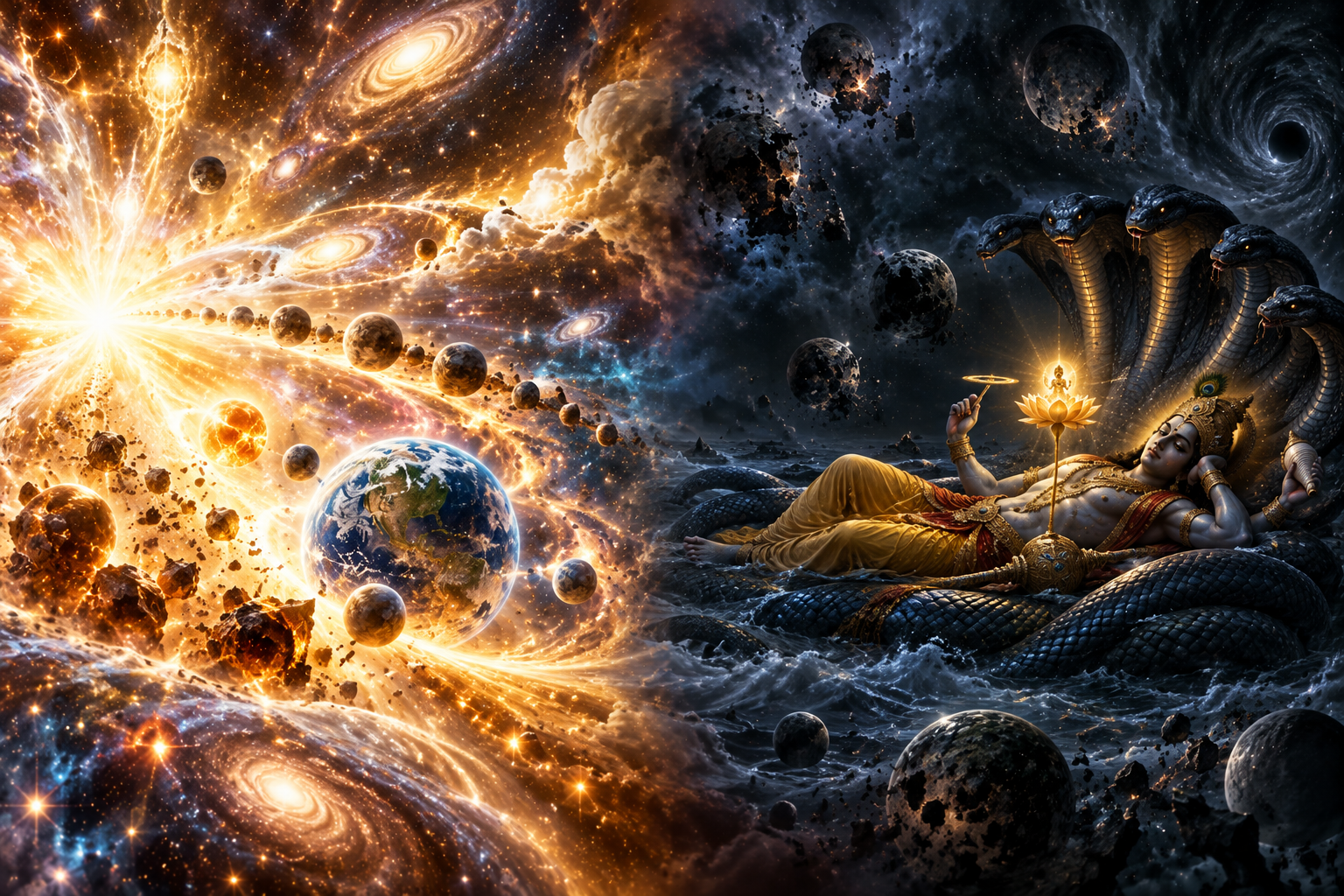
One day, one night, one Brahma — and the ocean underneath both
A commonly repeated claim places the present moment specifically in "the first day of the fifty-first year" of the current Brahma's life. It's popular and widely quoted, but it rests on a particular chain of traditional calculation rather than a single universally cited verse — worth knowing as a widely-repeated figure rather than a settled one, consistent with how the rest of this series treats large traditional numbers.
Where We Are Right Now
Stacking all of this together: we are in the seventh Manvantara, ruled by Manu Vaivasvata; within it, in the twenty-eighth Mahayuga since his reign began; within that Mahayuga, in its fourth and final Yuga — Kali — which Puranic sources date to Krishna's departure from the world, traditionally placed at 3102 BCE. Kali Yuga is not open-ended. It closes when Kalki, Vishnu's final avatar in this cycle, arrives to end it outright — at which point a new Mahayuga begins with a fresh Satya Yuga, still within this same seventh Manvantara, still within this same Kalpa, dharma briefly restored to all four legs before the long decline starts again.
Nothing in this scheme actually ends. It only ever resets — a bull finding its footing again, one leg at a time, inside a day that is itself only one of thirty-six thousand.
You now have the clock every date in these chronicles assumes: four Yugas inside a Mahayuga, seventy-one-odd Mahayugas inside a Manvantara, fourteen Manvantaras inside a Kalpa, and a Kalpa as one day in a life that itself runs to a hundred such years. Manu Vaivasvata, the Matsya avatar that saved him, the seven sages of this site's own Saptarishi Chronicles, and both dynasties traced in Celestial Dynasties all turn out to share a single root in this one Manvantara — and Kalki, waiting at the far end of the present Kali Yuga, is the next turn of the same wheel. Even Mahabali's own story turns out to reach this far forward: the Indra-ship Vishnu's Vamana avatar promised him isn't a vague future reward, it's a named seat in the very next Manvantara, the eighth.
This closes out Puranic Foundations' eight companion articles. From here, the narrative chronicles themselves are the natural next stop — The Twelve Cosmic Wars is where this site's story series begins.
References
Primary Sources
- Vishnu Purana, Book I (Yuga, Manvantara, and Kalpa durations, and the list of fourteen Manus)
- Bhagavata Purana, Canto 3 and Canto 8 (the Manvantara descriptions and the Manu-Matsya flood narrative)
- Manusmriti, Chapter I (the Yuga-length verses this article's conversion figures follow)
Traditional sources agree closely on the first seven Manvantaras and the Yuga durations, but diverge more on the naming and ordering of the seven Manvantaras still to come, and on the exact calculation behind "which year of Brahma's life" the present moment falls in — both flagged honestly above rather than presented as settled.