
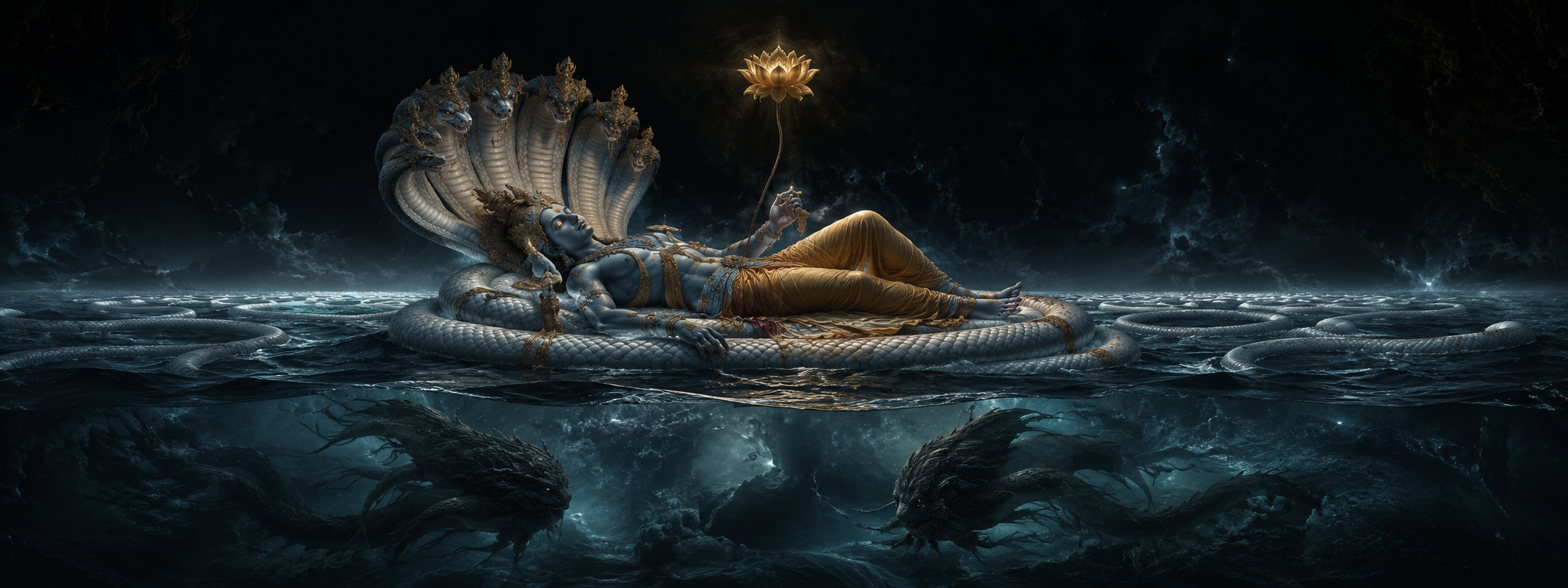
Every war needs a battlefield, and the war that opens the Devi Mahatmya is fought on the strangest one this saga will ever visit: a universe that does not yet properly exist. The Prathama Charita — the First Charita, occupying the whole of chapter 1 of the Markandeya Purana's Devi Mahatmya — is set at a point of cosmic dissolution, the interval between one cycle of creation and the next, when everything that had been the manifest world has been folded back into a single, shoreless ocean.
Upon that ocean, coiled on the great serpent Ananta-Shesha, lies Vishnu — not dead, not absent, but withdrawn into yoganidra, the yogic sleep in which the preserver-god rests between universes. This is the strangest opening in the entire Devi Mahatmya. The wars against Mahishasura and Shumbha-Nishumbha are fought to restore a heaven that has been conquered. This war is fought before there is a heaven, or a creation, or even a clear boundary between the gods and the ocean they are floating on. And yet by its end, the Devi Mahatmya has made its foundational theological statement — the one all three Charitas exist to demonstrate — with the quietest possible economy: Vishnu acts only when the Goddess permits him to.
The Sleep at the End of Time
The Devi Mahatmya's frame narrative locates this story within a conversation between the sage Medhas and two men in pain — King Suratha, dispossessed of his kingdom, and the merchant Samadhi, abandoned by his own family. Both men know intellectually that the people who wronged them do not deserve their continued attachment, and yet they cannot stop feeling it. Medhas answers their question — why does the mind cling to what harms it? — by telling them the three Charitas. The first of those stories begins before time itself is running.
At the dissolution between cosmic cycles, all of creation — every world, every creature, every god — is dissolved back into the primordial ocean. Vishnu rests upon Ananta-Shesha, the infinite serpent whose many hoods shade the sleeping god. From Vishnu's navel, a lotus stalk rises toward a darkness that has no sky yet, and at the top of that stalk sits Brahma, newly arisen, already reciting the Vedas in the silence of a universe that has no audience but himself.
It is worth holding this image before moving to the conflict that follows. The Devi Mahatmya's very first picture is not of battle but of profound stillness — a stillness held in place by a goddess the text is about to name. Yoganidra, the divine sleep, has settled over Vishnu's eyes. The universe waits.
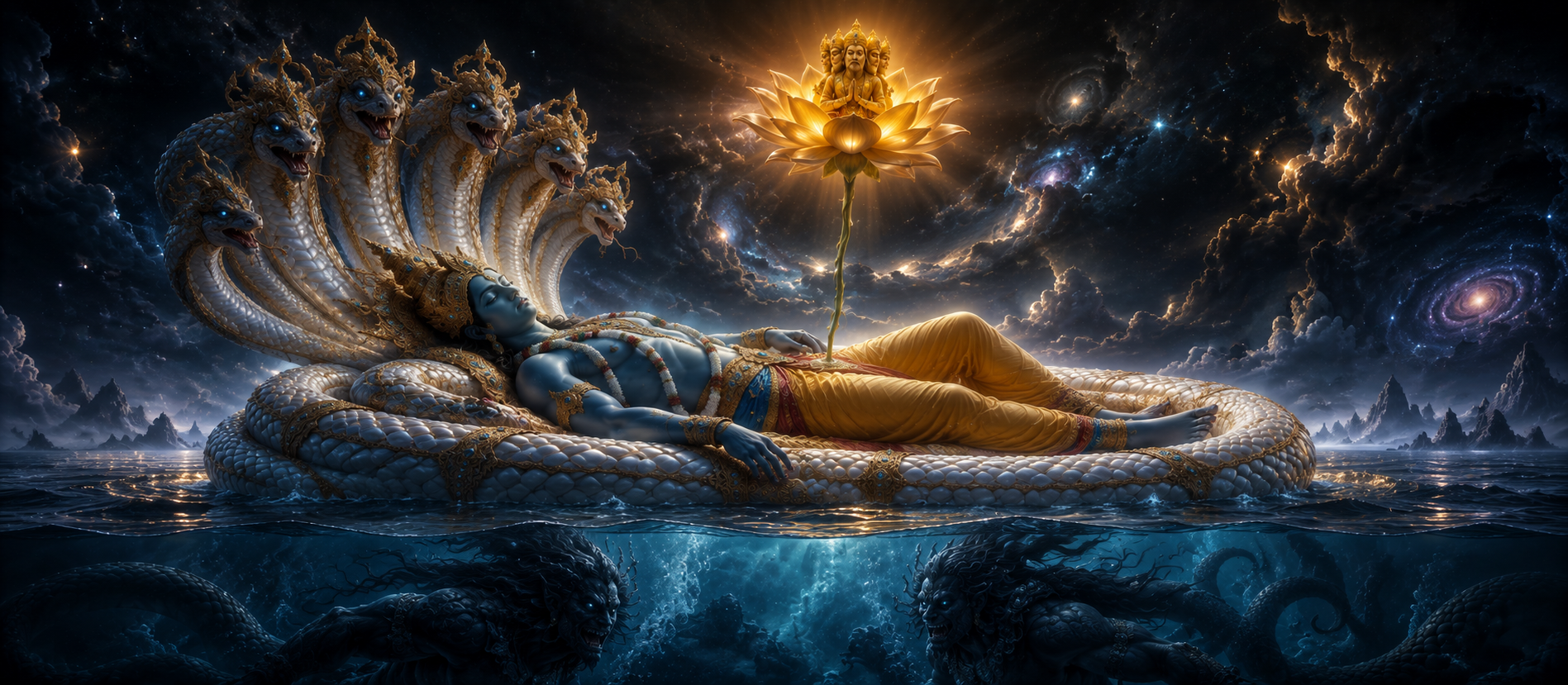
Before the war begins: the cosmic still-point. Brahma meditates on his lotus above a sleeping Vishnu, while the primordial ocean prepares to produce its first and most dangerous surprise.
Two Drops From the Sleeper's Ear
As Vishnu sleeps, wax forms in his ears — and from that wax, two demons coalesce: Madhu and Kaitabha. Some renderings of the episode preserve a more granular account of their origin: that two dewdrops formed atop the navel-lotus itself, one as sweet as honey and bearing the quality of tamas (inertia, darkness), the other hard and bearing the quality of rajas (passion, restless activity) — and that Madhu and Kaitabha sprang respectively from these. Whichever account one follows, the two demons awaken already powerful, already aggressive, and already fixed on a single target: the meditating, undefended Brahma seated on the lotus.
Their names carry meaning: madhu is honey or sweetness, a strange name for a demon — an irony the tradition notices — while kaitabha is associated with hardness and persistence. The pairing of sweetness and rigidity, or of tamas and rajas, running through their origin gives the First Charita its subtle internal structure: these are not random demons but embodiments of the qualities that keep consciousness asleep — the inertia that resists awakening and the passion that distorts whatever does wake.
Variant Tradition — A Penance and a Different Boon
The Devi Mahatmya's own account gives Madhu and Kaitabha no penance and no boon at their birth — they are simply formed, already strong, already malevolent. The Devi Bhagavata Purana tells a fuller version: that the two demons, after their strange birth from Vishnu's earwax, undertook long austerities devoted specifically to the Goddess herself, and were granted by her a boon that they could die only when they themselves desired death. This detail, while absent from the Devi Mahatmya's own chapter 1, supplies a satisfying explanation for why Vishnu's eventual trick — manoeuvring the demons into offering him a boon — works as a resolution at all: by the Devi Bhagavata's logic, getting them to grant him the boon of slaying them is functionally the same as getting them to desire their own deaths, closing a loophole the base text leaves implicit.
Key Combatants
Divine Forces
Vishnu & Brahma
- Vishnu (Narayana) — The Preserver; held in cosmic sleep by Yoganidra at the episode's opening. Once awakened, fights Madhu and Kaitabha with his bare hands for five thousand years. The first divine champion of the Devi Mahatmya's three wars — but one who acts entirely within the limits the Goddess sets.
- Brahma (Chaturmukha) — The newly arisen Creator; seated on the lotus, entirely unarmed and defenceless. His only available resource is song — the hymn to Yoganidra that becomes the episode's theological pivot.
- Yoganidra (Mahamaya / Mahakali) — The Goddess in her First Charita form. She does not fight; she sleeps and wakes. Her withdrawal from Vishnu's body is the war's decisive event. The entire episode exists to establish that she is the precondition for every divine action that follows.
The Demons
Madhu & Kaitabha
- Madhu — "Honey"; born from the left ear of the sleeping Vishnu; associated with tamas (inertia, darkness). Powerful, arrogant, possessed of a self-image as a being of honour and dharma — the very self-image that will undo him.
- Kaitabha — Born from the right ear of the sleeping Vishnu; associated with rajas (passion, activity). Equally powerful, equally arrogant. Together, the two are able to fight the awakened Vishnu to a standstill for five thousand divine years — the longest single combat in the entire Devi Mahatmya.
- Their boon (Devi Bhagavata variant) — Death only when they themselves desire it; an escape clause they believe makes them unkillable, and which Vishnu's stratagem turns precisely against them.
Brahma's Hymn — The Ratri Suktam
Brahma, newly created and entirely unarmed, has exactly one resource available to him: the god whose own body he is sitting on, asleep a few feet away. But Vishnu is not merely sleeping. He is held in sleep by a power separate from himself — Yoganidra, the divine sleep, who has settled over Vishnu's eyes as his blessed slumber. Brahma cannot simply rouse him. He must instead persuade the power holding him under to let go. And so Brahma does the only thing available to a being with no weapons: he turns to face neither the demons nor the sleeping god, but the sleep itself, and begins to sing.
Brahma's hymn — preserved in the tradition as the seed of the Ratri Suktam, a hymn whose roots reach back to the Rigveda itself — is one of the most theologically dense passages in the entire Devi Mahatmya. He does not call on a warrior-goddess or a slayer of demons. He calls on the power of sleep, of night, of concealment and dissolution itself. The cascade of epithets he uses names the Goddess at every level of cosmic function — from the most intimate (Nidra, Sleep) to the most sovereign (Vishweshwari, Ruler of the Universe), from the most cosmological (Kalaratri, Night of Time) to the most philosophical (Mahamaya, Great Illusion).
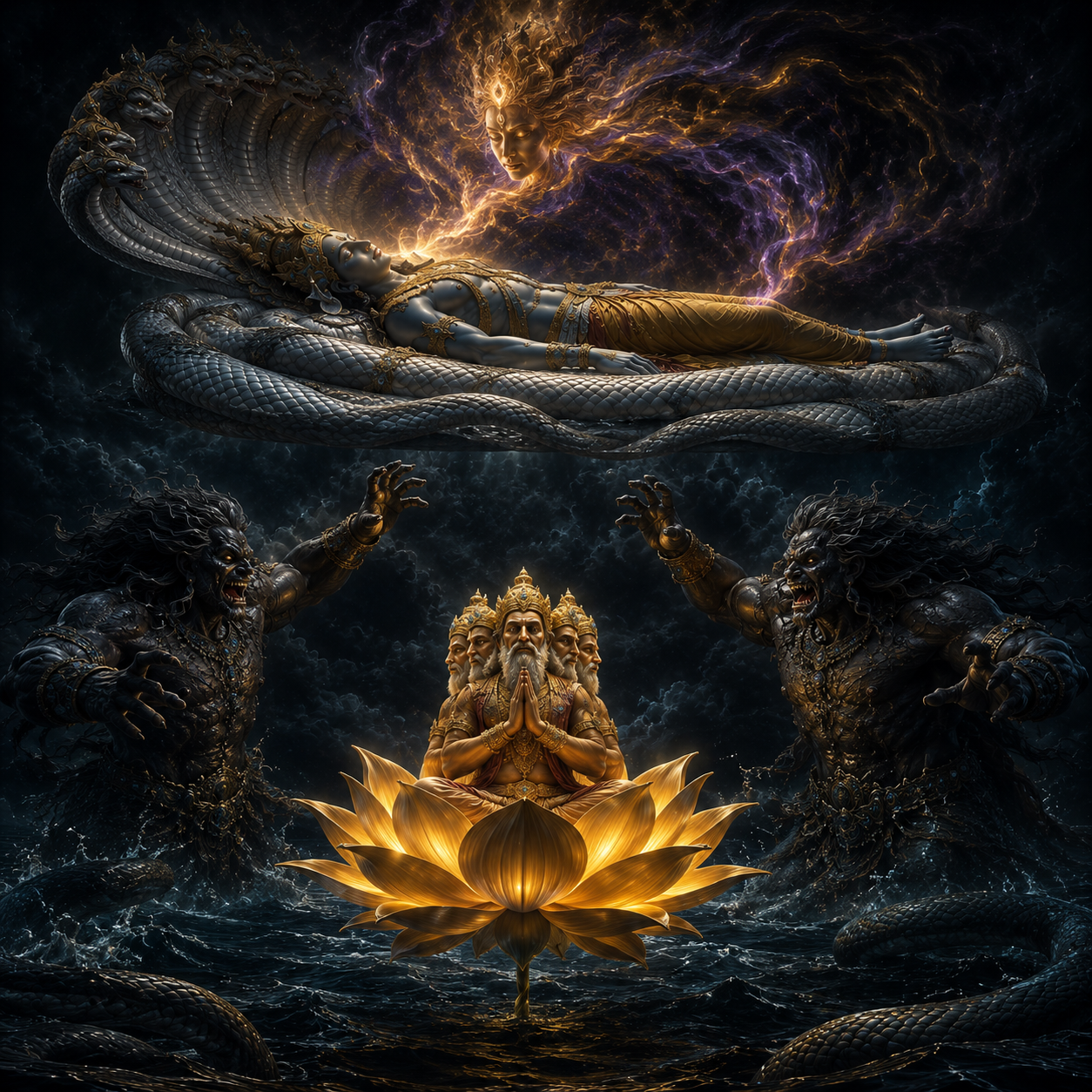
Brahma's only weapon: a hymn addressed not to a warrior but to the goddess of sleep itself — the Ratri Suktam, whose roots reach back to the Rigveda.
The epithets Brahma invokes for Yoganidra are among the most philosophically rich in the Devi Mahatmya. Each name is a different face of the same power:
"By You, even he Who Creates, Protects, and Devours the world is subdued with sleep. Who, then, is fit to praise You here?"
Brahma's hymn to Yoganidra — Devi Mahatmya Chapter 1, verse 83 (paraphrased)The theological point being made in the text's very first chapter is one that will echo across the entire Devi Mahatmya and surface explicitly in Kaushiki's declaration to Shumbha three episodes later: that Vishnu's sleep is not an absence of power but an exercise of it; that he is "subdued" by a force placed above his own creative and preservative functions; and that nothing in this cosmos — not even the universe's own preserver — moves except by her leave.
The Withdrawal of Yoganidra
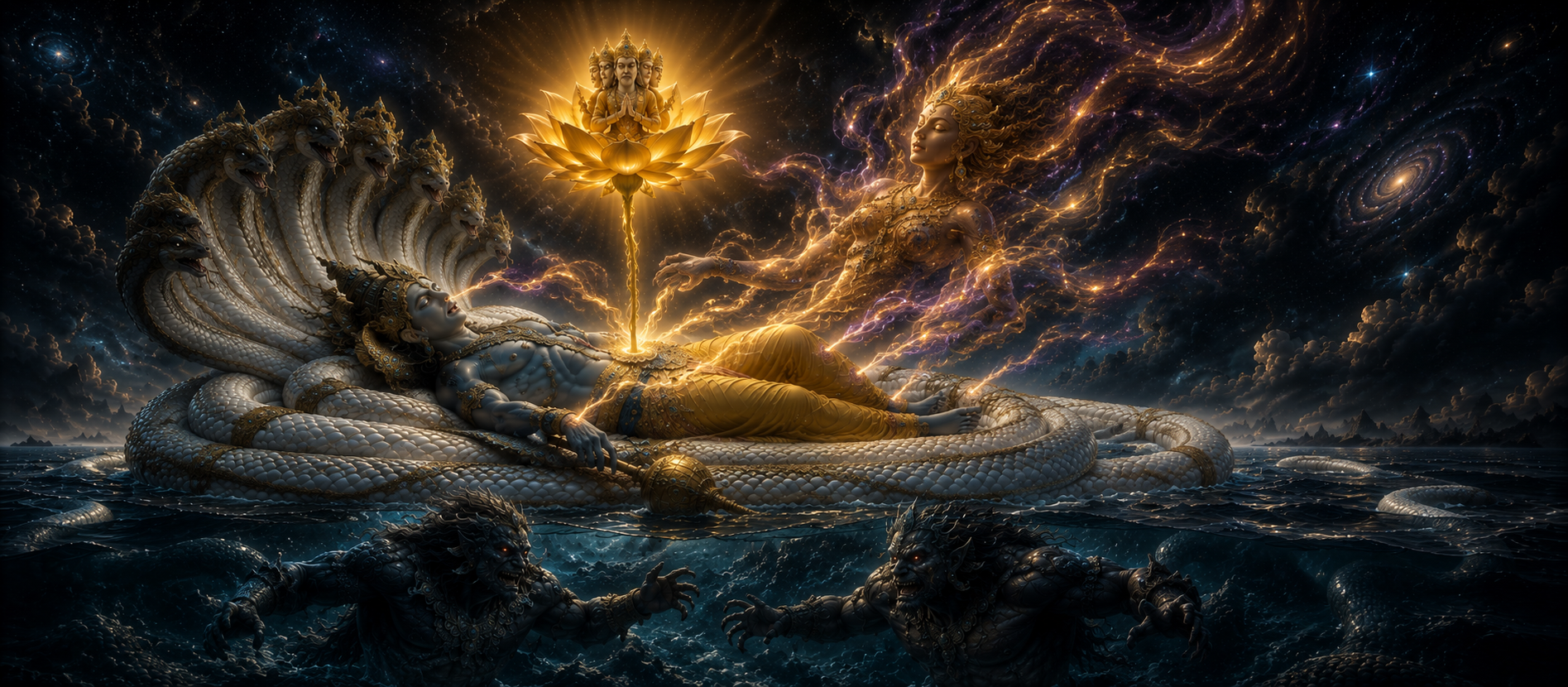
The war's decisive event — not a weapon strike or a divine manifestation, but a departure: Yoganidra leaving Vishnu's body, releasing the Preserver from the sleep that was hers to give and hers to withdraw.
Pleased by the hymn, Yoganidra does not simply vanish — she departs visibly, emerging from Vishnu's own body through his eyes, his nose, his arms, his heart, and his chest, a goddess physically leaving the god she had been holding under, made briefly manifest in the act of letting him go. The instant she withdraws, Vishnu's eyes open. He sees, in the same moment, the lotus, the meditating Brahma, and the two demons closing on him — and rises.
This moment of emergence is theologically significant. The Goddess does not appear as a warrior here, as she will in the Second and Third Charitas. She appears as a presence that has always been there, inside the god's own body, now choosing to make herself temporarily visible in the act of departure. Her power in the First Charita is entirely expressed through presence and absence — she is the condition of Vishnu's action, not the action itself.
Five Thousand Years of an Even Match
What follows is, by any measure, one of the strangest and most quietly staggering images in the entire Devi Mahatmya: Vishnu does not summon a weapon, does not call on any other god, and does not deploy any of the iconographic arsenal — discus, conch, mace — that defines him everywhere else in this literature. He fights Madhu and Kaitabha with his own body, hand to hand, on an ocean with no shore and no audience but a newborn creator on a flower. And the combat does not resolve quickly.
The text gives the duration in a figure that is meant to be felt rather than merely read: five thousand years, with neither side gaining a decisive advantage, neither demon weakening, neither god able to land the blow that ends it. There is something almost unbearably patient about this image when held up against the rest of the saga — Dhumralochana destroyed in a single breath, Raktabija undone by a single tactical insight. Here, the text seems content to let two evenly matched forces grind against each other across a span of time that dwarfs every other conflict in this entire chronicle, with no goddess present to break the deadlock through superior strategy. The resolution, when it finally comes, will not come from strength at all.
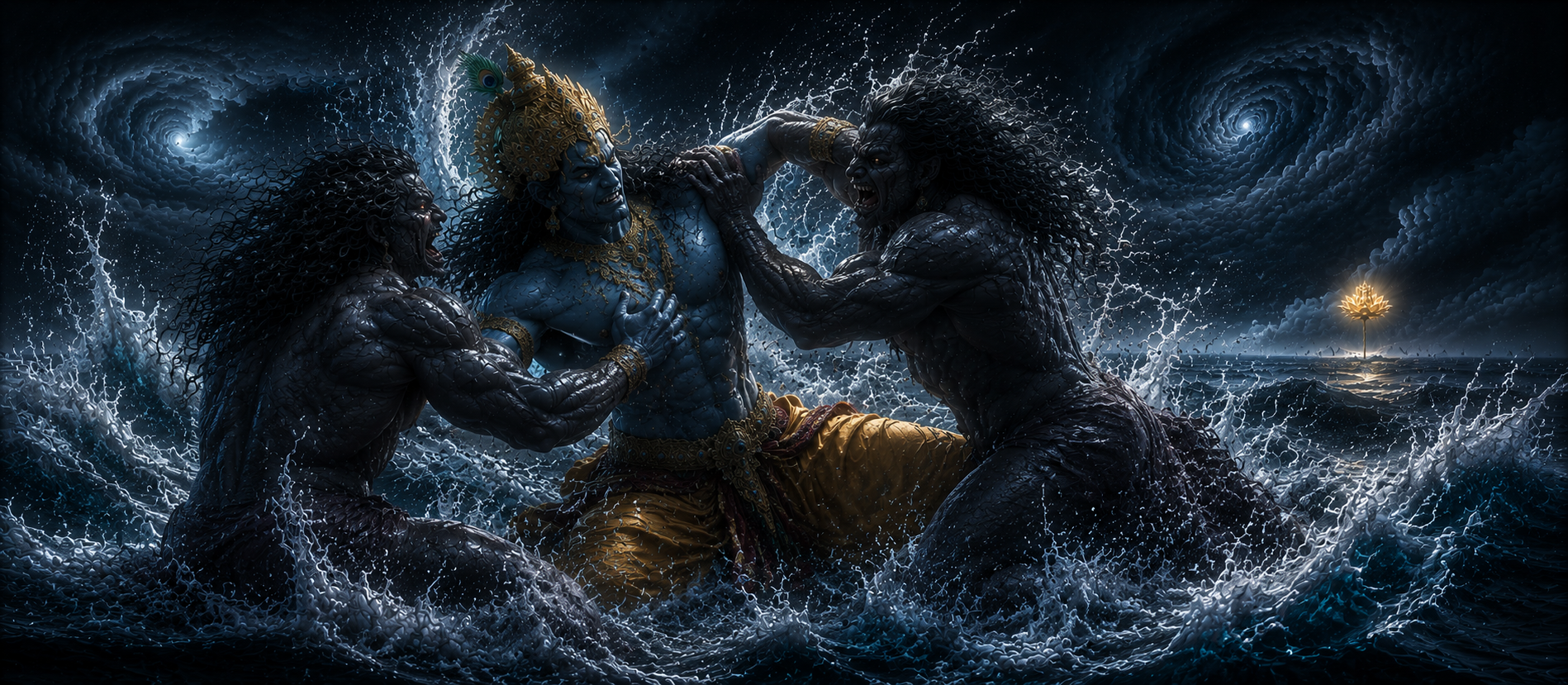
Five thousand years of combat — neither side gaining ground, neither god able to end it by strength alone. The deadlock sets up the war's true resolution: not force but wit.
The Boon That Undid Them
It is the demons' own self-image, not their strength, that finally breaks the deadlock. Madhu and Kaitabha, the text is careful to note, consider themselves bound by a code of truth and dharma — a strange, almost formal self-conception for two beings born from earwax. Having endured five thousand years against an opponent neither of them can defeat, and grown intoxicated by the sheer fact of their own continued survival against Vishnu himself, they make the offer that custom, in this kind of duel between worthy opponents, seems to demand: they propose that Vishnu name a boon, as though they were now in a position to grant one.
Vishnu's response is the single cleverest move in this saga. He does not ask for treasure, or territory, or the release of the Vedas they had threatened to seize. He asks that they grant him a boon instead — and the boon he names is simply that he be permitted to slay them by his own hand. Madhu and Kaitabha are trapped by the exact quality they had just been congratulating themselves on. Having styled themselves as devotees of truth and dharma throughout the duel, they cannot refuse a counter-boon without abandoning the self-conception that justified the offer in the first place. They must agree.
But they are not without one final piece of cunning. In a last attempt to make the boon they have just granted impossible to fulfil, Madhu and Kaitabha impose a condition on the manner of their own death: Vishnu may kill them only in a place that is not covered. It is, on the face of it, an airtight escape clause. The entire universe, at this point in the story, is still submerged beneath the ocean of dissolution. There is, as far as either demon can see, no uncovered ground anywhere in existence for the killing blow to land on.
The Structural Pattern — A Boon-Trap Prototype
This escape clause is structurally identical to every other boon-loophole the Devi Mahatmya will revisit across its three Charitas — Shumbha and Nishumbha's protection against beings who existed at the time of their boon, Raktabija's protection through self-replication. In each case, demons who believe they have found an unbreakable condition are undone not by brute force but by an opponent who finds the one literal reading of the condition's wording that its authors failed to anticipate. Madhu and Kaitabha are, in this sense, the prototype for every boon-trap that follows them across the entire Devi Mahatmya. The saga introduces its central tactical motif — wit over strength, exact reading over brute power — in its very first episode.
Dry Ground on a Drowned World
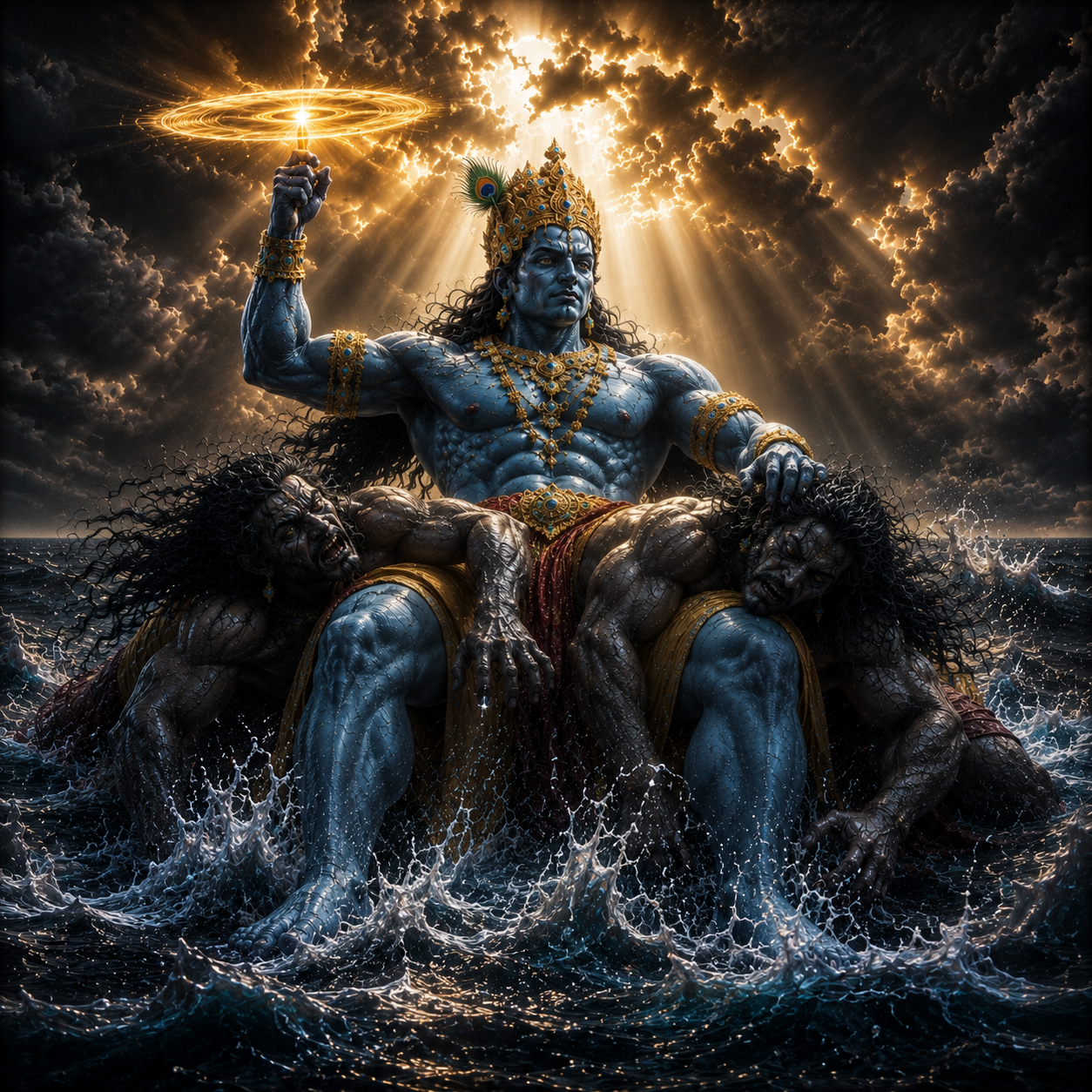
The fulfillment of the boon — and its defeat. Vishnu's own thighs, raised above the primordial flood, are the one uncovered ground. The demons' escape clause becomes their execution site.
Vishnu finds the loophole in an instant: his own thighs, raised above the water as he stands in the ocean, are themselves uncovered ground — dry, exposed, touched by nothing. He lifts the two demons onto his own lap, and there, on the one piece of "uncovered" space in an entirely submerged universe, he raises the Sudarshana Chakra and severs both their heads, fulfilling the letter of the boon he was granted while denying them the protection they believed it guaranteed.
The demons' escape clause had assumed that "uncovered ground" would require the existence of dry land somewhere in the cosmos. Vishnu turns the clause inward — uncovered ground exists in his own body, elevated above the flood. The resolution honors the wording completely while subverting its intent entirely. This is the Devi Mahatmya's first statement of a principle it will repeat twice more: that the Asuras' own carefully worded protections contain, by their very precision, the seeds of their defeat.
"Where, then, is there uncovered ground?" they had asked, certain of the answer. There was one place: his own body, raised above the flood.
Devi Mahatmya, Chapter 1 — paraphrase of the episode's climaxThe Earth Named for a Demon's Marrow
The episode closes with a small etymological coda that several retellings preserve: that the marrow or fatty tissue (medas) of Madhu's slain body spread out across the surface of the cosmic ocean and, in time, became solid ground — the earth itself, named in some traditions Medini after this exact substance. Whether or not one takes this detail as more than folk etymology, it gives the episode a strange symmetry: a war fought before the world existed ends by quite literally providing the material the world will be made from. The demon's dissolution is the ground of creation.
This coda is not unique to the Devi Mahatmya — parallel accounts appear in the Bhagavata Purana and the Devi Bhagavata, each with slightly different details about which substance from which demon's body became the earth. What they share is the structural insight: the primordial enemies of creation become, in their defeat, the very substance of the world the creator had been trying to protect. Destruction and creation are not opposed in this moment. They are the same event viewed from different angles.
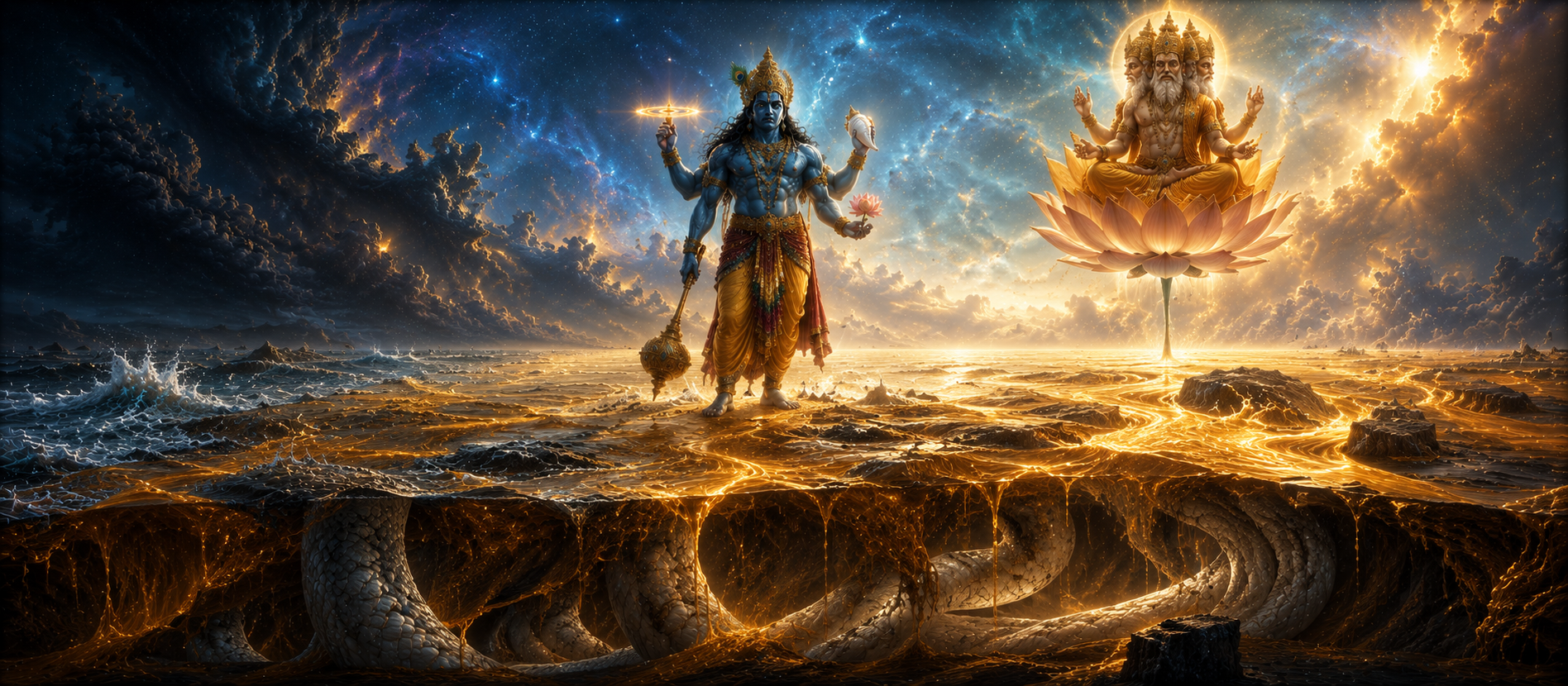
Medini — the earth, named for the demon's marrow. A war fought before the world existed ends by providing the material from which the world is made.
Key Terms
| Term | Meaning & Significance |
|---|---|
| Madhu | "Honey" or "sweetness." Associated with tamas (inertia, darkness). The softer of the two demon-qualities — but no less dangerous. Some traditions associate Madhu with the drop from the left ear of Vishnu. |
| Kaitabha | Associated with rajas (passion, restless activity) and hardness. The driving, aggressive quality paired with Madhu's sweet inertia. Some traditions associate Kaitabha with the drop from the right ear. |
| Yoganidra | "The sleep of yoga" — the Goddess in her First Charita form. She does not appear as a visible warrior but as the divine condition of Vishnu's rest, and as the power whose withdrawal makes all action possible. Identified with Mahakali in the tradition's three-fold guna framework. |
| Mahamaya | "Great illusion" — one of the epithets Brahma uses for Yoganidra. Points to the philosophical dimension of the First Charita: the sleep that holds Vishnu under is not mere unconsciousness but the cosmic power of Maya that makes the manifest world possible and impossible to see through without the Goddess's grace. |
| Ananta-Shesha | "The infinite remainder" — the cosmic serpent on whose coils Vishnu rests during the interval between creations. Shesha's name means "what remains" when all of creation is dissolved back into the primordial ocean. |
| Medini | A name for the earth, traced in some traditions to the marrow (medas) of the slain Madhu. The etymological coda giving the First Charita its strange creative conclusion: the demon's dissolution becomes the world's substance. |
| Ratri Suktam | The hymn to the goddess of night, whose roots are in the Rigveda (X.127). Brahma's hymn to Yoganidra in chapter 1 of the Devi Mahatmya is understood in the tradition as the developed form of this ancient hymn — the Vedic hymn to Night becoming, in the Puranic elaboration, a hymn to the divine sleep that governs the interval between cosmic ages. |
| Tamas | The first of the three gunas (cosmic qualities) in Samkhya philosophy: darkness, inertia, heaviness, the tendency toward dissolution and concealment. The First Charita is associated with Tamas and Mahakali — the war fought in the deepest darkness, before the light of creation is restored. |
Why the Saga Begins Here
Of the three wars that make up the Devi Mahatmya, this is the only one in which the Goddess herself does not pick up a weapon. She does not fight Madhu and Kaitabha; she withdraws so that Vishnu can. And yet the text's own theological argument is that this episode belongs to her every bit as much as the wars against Mahishasura and Shumbha-Nishumbha — because Vishnu's victory was never available to him independently. He wins only once Yoganidra chooses to let him. The Prathama Charita's enduring argument, carried forward into both of the wars that follow it, is that even the preserver of the universe acts within limits the Goddess herself sets and lifts at will.
This makes the First Charita, counterintuitively, the most radical of the three theological statements the Devi Mahatmya makes. The Second Charita shows the Goddess surpassing the combined power of all the gods. The Third shows her as the sole reality behind all apparent multiplicity. But the First does something even more foundational: it shows the Goddess as the condition of divine action itself. Before Vishnu can do anything — before he can fight, before he can protect, before he can preserve — she must consent to let him wake up. This is not a goddess who enters the cosmic drama from outside. This is the power the drama runs on.
It is this episode that the tradition associates with Mahakali and the tamas guna — inertia, concealment, the primordial darkness that must be lifted before any other form of divine action becomes possible at all. The frame narrative makes the personal application clear: King Suratha and the merchant Samadhi cannot act rightly in their own lives because they are held under by their own version of Yoganidra — attachment, the Maya that makes what harms them feel indispensable. The First Charita is the text's first answer to their question: the same power that holds consciousness asleep also, when approached with the right hymn, releases it. The sage is not simply telling stories. He is prescribing a practice.
Outcome Summary
Military result: Vishnu awakened by Yoganidra's withdrawal; five-thousand-year hand-to-hand combat with Madhu and Kaitabha; demons slain on Vishnu's own thighs — the one "uncovered" ground in the submerged universe — fulfilling the letter of their escape-clause boon while denying its protection.
Cosmological result: The marrow (medas) of the slain demons spreads across the primordial ocean and solidifies into the earth, named Medini. A war fought before the world existed ends by providing the material from which the world is made.
Theological statement: The Goddess does not fight in the First Charita — she sleeps, and wakes, and in that transition, makes all divine action possible. Vishnu's victory is entirely conditional on her consent. The Devi Mahatmya establishes from its very first chapter that no divine power operates independently of the feminine principle that underlies it.
Textual Sources & Variants
The Madhu-Kaitabha episode is among the most widely attested in Puranic literature, appearing in the Mahabharata, the Vishnu Purana, the Devi Bhagavata, and several other texts alongside the Devi Mahatmya's primary account. The core facts are stable across all versions; the major variant concerns whether Madhu and Kaitabha received a boon from the Goddess before the episode begins — a detail absent from the Devi Mahatmya itself but present in the Devi Bhagavata's more elaborate account.
| Source | Detail | Variant / Note |
|---|---|---|
| Devi Mahatmya Ch. 1 |
Primary account: Vishnu asleep, demons born from earwax, Brahma's hymn to Yoganidra, her withdrawal, five-thousand-year combat, boon-exchange, slaying on Vishnu's thighs. Earth-naming coda (Medini) present. | No boon given to Madhu-Kaitabha by the Goddess in this version — they are simply formed and malevolent from birth. |
| Devi Bhagavata Purana |
More elaborate version: Madhu and Kaitabha perform tapasya after their birth and receive a boon from the Goddess herself — they can die only when they desire death. This supplies a complete explanation for how Vishnu's counter-boon strategy works. | The Devi Bhagavata's version gives the Goddess a more active role in the episode's setup — the demons' eventual defeat is already seeded in a boon she granted them, which Vishnu's stratagem triggers. |
| Vishnu Purana Book I |
Parallel account; Vishnu's cosmic sleep and the birth of Madhu-Kaitabha present. The Goddess's role as Yoganidra is less foregrounded — the account is less explicitly Shakta in its theological framing. | The non-Shakta parallel confirms the story's antiquity while showing how the Devi Mahatmya's version reframes it by making Yoganidra theologically central rather than incidental. |
| Mahabharata Shanti Parva |
Madhu and Kaitabha story referenced in a cosmological context; the episode is treated as known prior tradition. Vishnu's slaying on his thighs attested. | The Mahabharata does not foreground the Goddess's role; the episode appears as a Vaishnava narrative rather than a Shakta one. Confirms the story's existence in the tradition before the Devi Mahatmya's composition. |
References
Primary Sources
- Markandeya Purana — Chapter 81 (Devi Mahatmya, Durga Saptashati Chapter 1, "The Slaying of Madhu and Kaitabha") — primary source for the entire episode: Vishnu's yoganidra, birth of the demons, Brahma's hymn, Yoganidra's withdrawal, five-thousand-year combat, boon-exchange, and the beheading on Vishnu's thighs.
- Devi Bhagavata Purana — Book 1 (variant tradition of Madhu and Kaitabha's penance and the boon of "death only when desired" granted by the Goddess herself.)
- Vishnu Purana — Book I (parallel, non-Shakta account of the same episode; Goddess's role as Yoganidra not foregrounded.)
- Mahabharata, Shanti Parva — (Madhu-Kaitabha episode referenced as prior tradition; Vishnu's slaying on his thighs confirmed.)
- Rigveda — Mandala X, Hymn 127 (Ratri Suktam — the Vedic hymn to Night, whose tradition Brahma's hymn in the Devi Mahatmya develops.)
Secondary Sources
- Coburn, Thomas B. Devī-Māhātmya: The Crystallization of the Goddess Tradition. Motilal Banarsidass, 1984. (Analysis of the Ratri Suktam, the theology of Yoganidra, and the episode's place as the text's opening theological statement.)
- Coburn, Thomas B. (trans.). Encountering the Goddess: A Translation of the Devī-Māhātmya and a Study of Its Interpretation. SUNY Press, 1991.
- Kinsley, David. Hindu Goddesses: Visions of the Divine Feminine in the Hindu Religious Tradition. University of California Press, 1986. (On Mahakali, the tamas guna, and the gunas-based reading of the Devi Mahatmya's three episodes.)
- Mani, Vettam. Puranic Encyclopaedia. Motilal Banarsidass, 1975. Entries: "Madhu," "Kaitabha," "Yoganidra," "Medini."
The "uncovered ground" boon-condition and its resolution on Vishnu's thighs appears across multiple Puranic sources with largely consistent details. The Medini / earth-naming etymological coda is a more loosely attested folk tradition rather than a detail fixed in the Devi Mahatmya's own verses, and is presented here as such.