
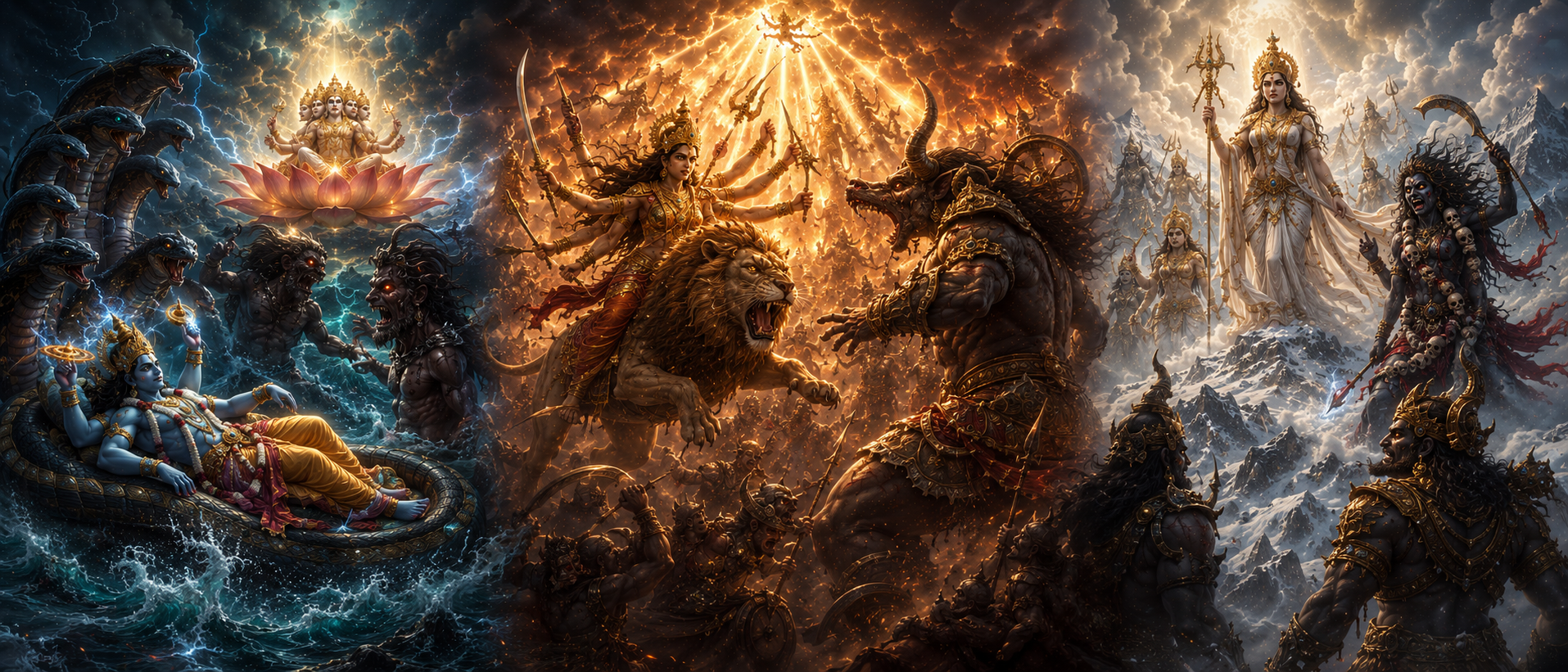
The Devi Mahatmya — "Glory of the Goddess" — is one of the most extraordinary texts in the Sanskrit tradition. Composed between the 5th and 6th centuries CE and embedded in chapters 81–93 of the Markandeya Purana, it is the first Sanskrit text to present the Goddess not as a consort or helper of the male gods but as the supreme power of the universe — the source from which all divine energy, including the energy of the Trimurti, derives. Its 700 verses across 13 chapters are divided into three distinct episodes called Charitas — "exploits" or "acts" — each narrating a great battle between the Goddess and a different category of demonic adversary.
Each Charita is presided over by a different aspect of the supreme Goddess — Mahakali, Mahalakshmi, and Mahasaraswati — corresponding to the three cosmic qualities of Tamas, Rajas, and Sattva. Together the three Charitas argue that the Goddess is not one power among many but the single power through which all reality is produced, sustained, and dissolved. The text is also known as the Durga Saptashati (seven hundred verses on Durga) and the Chandi Patha — recited in full across India during Navaratri every year without interruption since at least the 7th century CE.
The Frame and the Three Episodes
The Devi Mahatmya does not begin with a battle. It begins with two men in pain. A dispossessed king named Suratha — driven from his kingdom by enemies — and a merchant named Samadhi, betrayed by his own family, wander into a forest and encounter the sage Medhas at his hermitage. Both men confess the paradox that is consuming them: they know intellectually that those who wronged them do not deserve their continued attachment, yet they cannot stop feeling it. The sage's answer — the three Charitas that follow — is not a philosophical treatise but a sequence of stories. The Goddess defeats what all the male gods together could not overcome; and in the pattern of those defeats, Suratha and Samadhi find what they need.
The three Charitas form a deliberate progression. The First is the most cosmologically primordial — a threat arising before the universe is properly established, fought by Vishnu himself under the Goddess's direction. The Second is the most politically iconic — the usurpation of cosmic sovereignty by Mahishasura and the Goddess born from all the gods' combined energy to address what none of them could separately. The Third is the most philosophically complex — nine chapters of escalating battle culminating in the Goddess's revelation that all her apparently multiple forms are one, and that the "others" Shumbha accuses her of depending on are her own expressions. The sequence is an ascent from elemental force (Tamas) through sovereign action (Rajas) to the non-dual truth (Sattva) that underlies both.
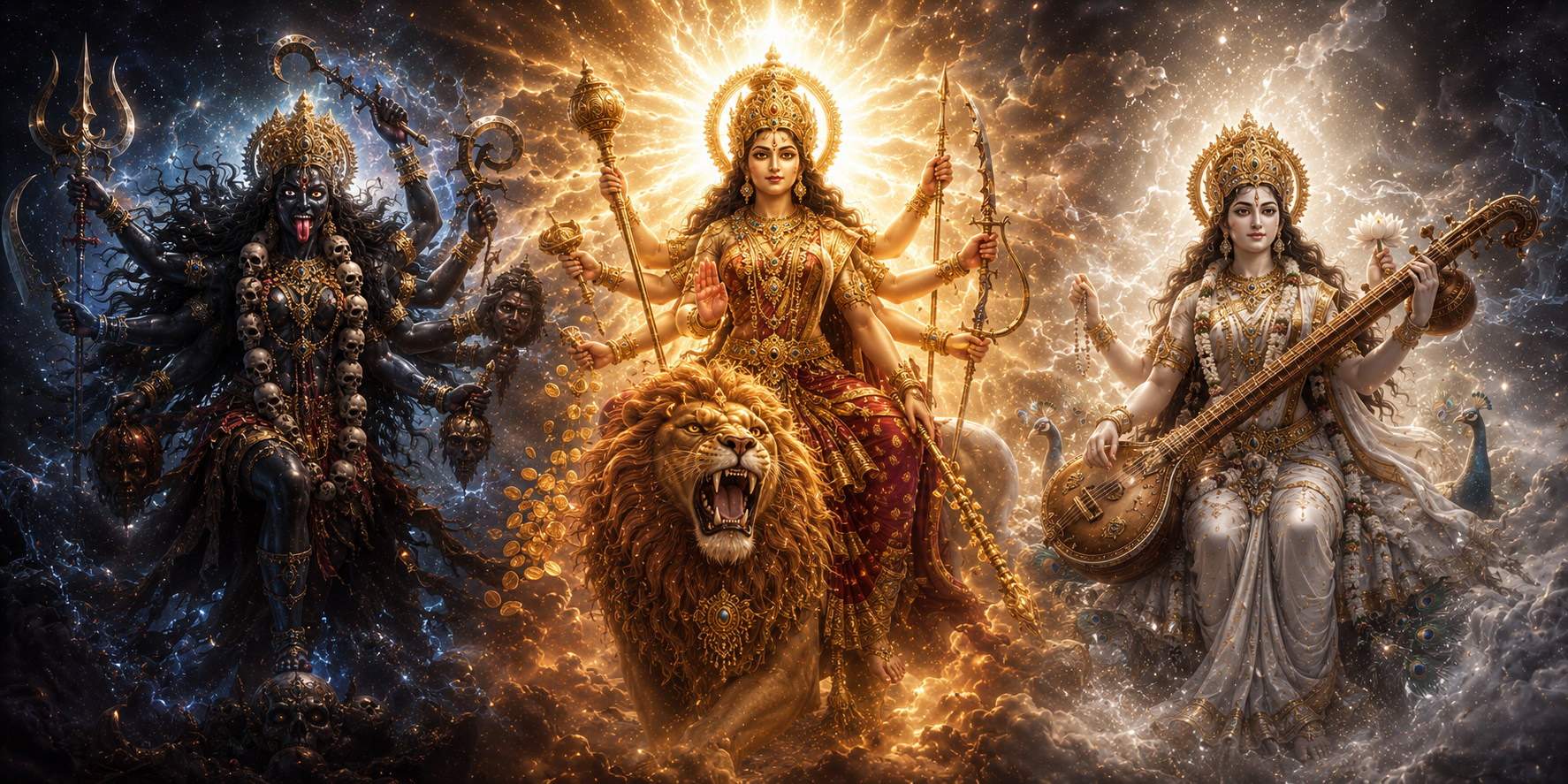
Mahakali in midnight blue, Mahalakshmi in radiant gold, Mahasaraswati in luminous white — one supreme power in three cosmic registers.
"By her the universe is pervaded. By her the three worlds were created. By her alone all things are protected. She is both knowledge and ignorance, both liberation and bondage — she is the supreme Goddess."
Devi Mahatmya, Chapter 1 — Mahakali Stuti| Charita | Chapters | Presiding Goddess | Guna | Adversary | Articles |
|---|---|---|---|---|---|
| I — Prathama | Ch. 1 · ~82 verses | Mahakali | Tamas | Madhu & Kaitabha | 1 article |
| II — Madhyama | Ch. 2–4 · ~233 verses | Mahalakshmi | Rajas | Mahishasura | 1 article (with 3 acts) |
| III — Uttama | Ch. 5–13 · ~385 verses | Mahasaraswati | Sattva | Shumbha & Nishumbha | 1 article (with 6 acts) |
The Three Wars
The Madhu-Kaitabha War
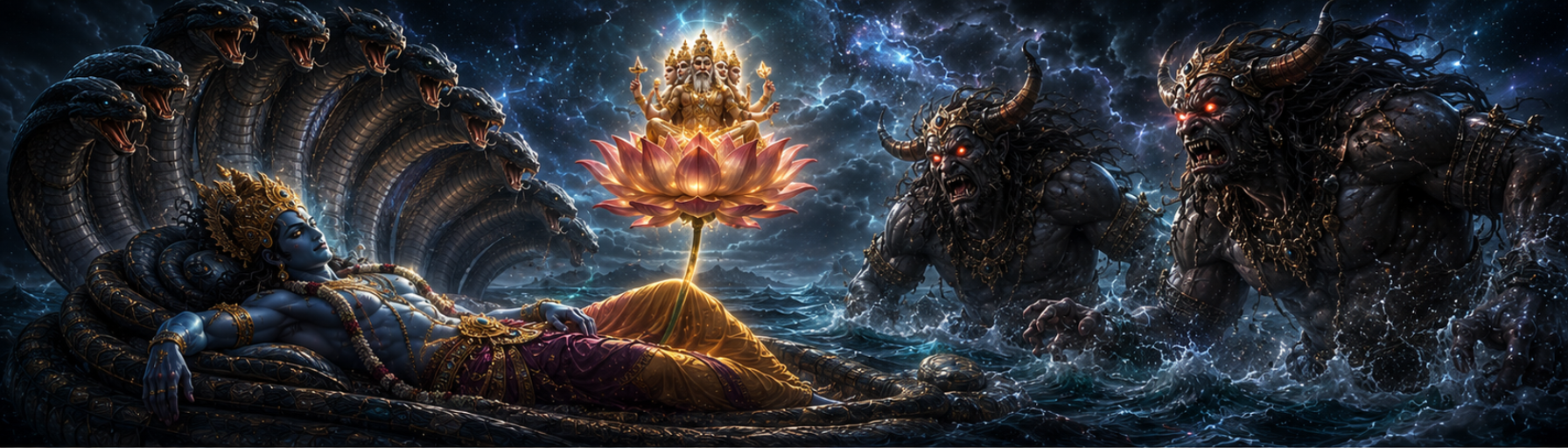
Before the universe was properly established — before Brahma had completed creation, before the Devas and Asuras had taken their places — Vishnu lay in cosmic sleep on the serpent Shesha in the primal ocean. From the wax of his ears, two demons arose unbidden: Madhu and Kaitabha, filled with Tamas, the quality of darkness and inertia. They threatened Brahma, who sat on the lotus from Vishnu's navel, unable to act while the Preserver slept. Brahma prayed to Yoganidra — the divine sleep itself, the Goddess in her Mahakali form — asking her to release Vishnu. She withdrew from Vishnu, he awoke, and after a battle of five thousand years, he slew Madhu and Kaitabha by a stratagem: when they claimed the boon of dying only where the earth was dry, Vishnu expanded his own thighs above the primordial ocean and slew them there.
The First Charita establishes the Devi Mahatmya's foundational theological claim in its most concentrated form: that the Goddess controls even Vishnu's capacity to act. Without her permission — without Yoganidra releasing the Preserver from his cosmic sleep — there is no Vishnu to fight, no Brahma to create, no universe to protect. She is not the power behind the gods. She is the power the gods are made of.
Markandeya Purana Ch. 81 · Devi Mahatmya Ch. 11 article · Complete chronicle of the First Charita
Read the Madhu-Kaitabha Chronicle →
The Mahishasura War
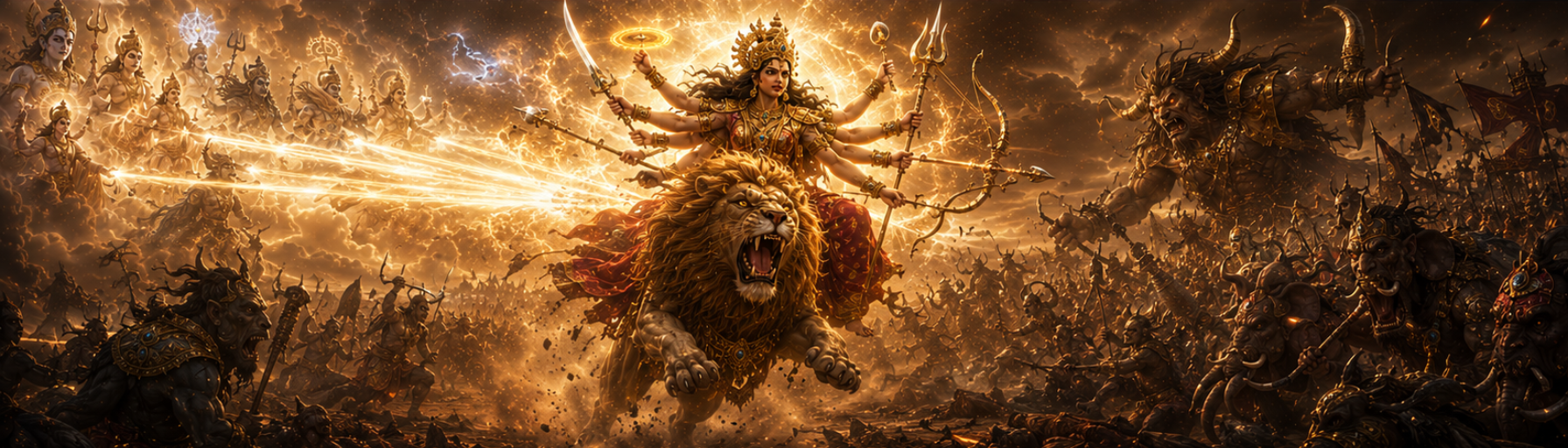
The most celebrated of the three Charitas — the source of Durga's most iconic image as Mahishasuramardini, the Slayer of the Buffalo Demon. Mahishasura had obtained a boon from Brahma that no male being could kill him. He then conquered the three worlds, expelled the Devas from Svargaloka, and installed himself as sovereign of the universe. The defeated gods, unable to fight him, did something unprecedented: each god's divine energy — tejas — poured forth from their bodies and combined into a single supreme feminine form. This was Durga, Mahalakshmi, the Goddess in her sovereign aspect. Armed with every god's own weapon, riding a lion, she met Mahishasura's vast army and ultimately killed the demon himself as he shape-shifted through multiple forms — buffalo, lion, man, elephant — before his final defeat.
The Middle Charita establishes the Shakta doctrine at its most politically explicit: the combined power of all the male gods is insufficient for certain cosmic crises. The Goddess is not assembled from their power as a subordinate creation — she exceeds them from the moment of her emergence. She is the concentrated essence of all divine power, which is why she alone can address what none of them separately or collectively could.
Markandeya Purana Ch. 82–84 · Devi Mahatmya Ch. 2–41 article with 3 acts · Prologue, three acts of battle, aftermath
Read the Mahishasura Chronicle →
The Shumbha-Nishumbha War
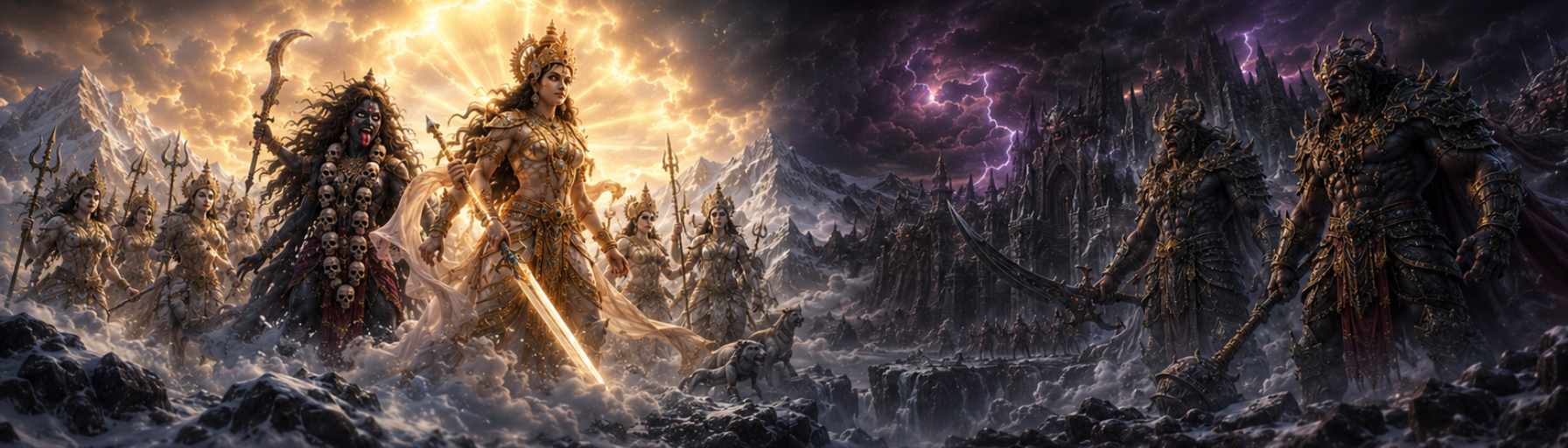
The longest and most complex of the three Charitas — nine chapters covering the full arc of the war between the Goddess and the Asura brothers Shumbha and Nishumbha, who had obtained a boon of invincibility against all male beings. The war unfolds in six escalating acts. Shumbha's emissary Sugriva demands the Goddess submit; she refuses with the vow that she will marry only one who defeats her in battle. Shumbha sends his general Dhumralochana, whom she destroys with a single syllable. He sends Chanda and Munda; from the Goddess's furrowed brow erupts Kali — black, skeletal, terrible — who slays both generals and earns the name Chamunda. He sends his vast armies with Raktabija at their head — the demon whose every blood-drop spawns a new demon — and Kali spreads her tongue across the battlefield, consuming every drop before it can multiply. Finally Nishumbha falls, and then Shumbha himself — but not before his accusation: "You fight with the help of others." Her answer is the philosophical climax of the entire text: she withdraws all her forms back into herself, stands alone, and replies — "Where are the others you speak of? All of this was my own expression."
Markandeya Purana Ch. 85–93 · Devi Mahatmya Ch. 5–131 article with 6 acts · Prologue, six acts of battle, aftermath
Read the Shumbha-Nishumbha Chronicle →
The Theological Arc — Three Battles, One Argument
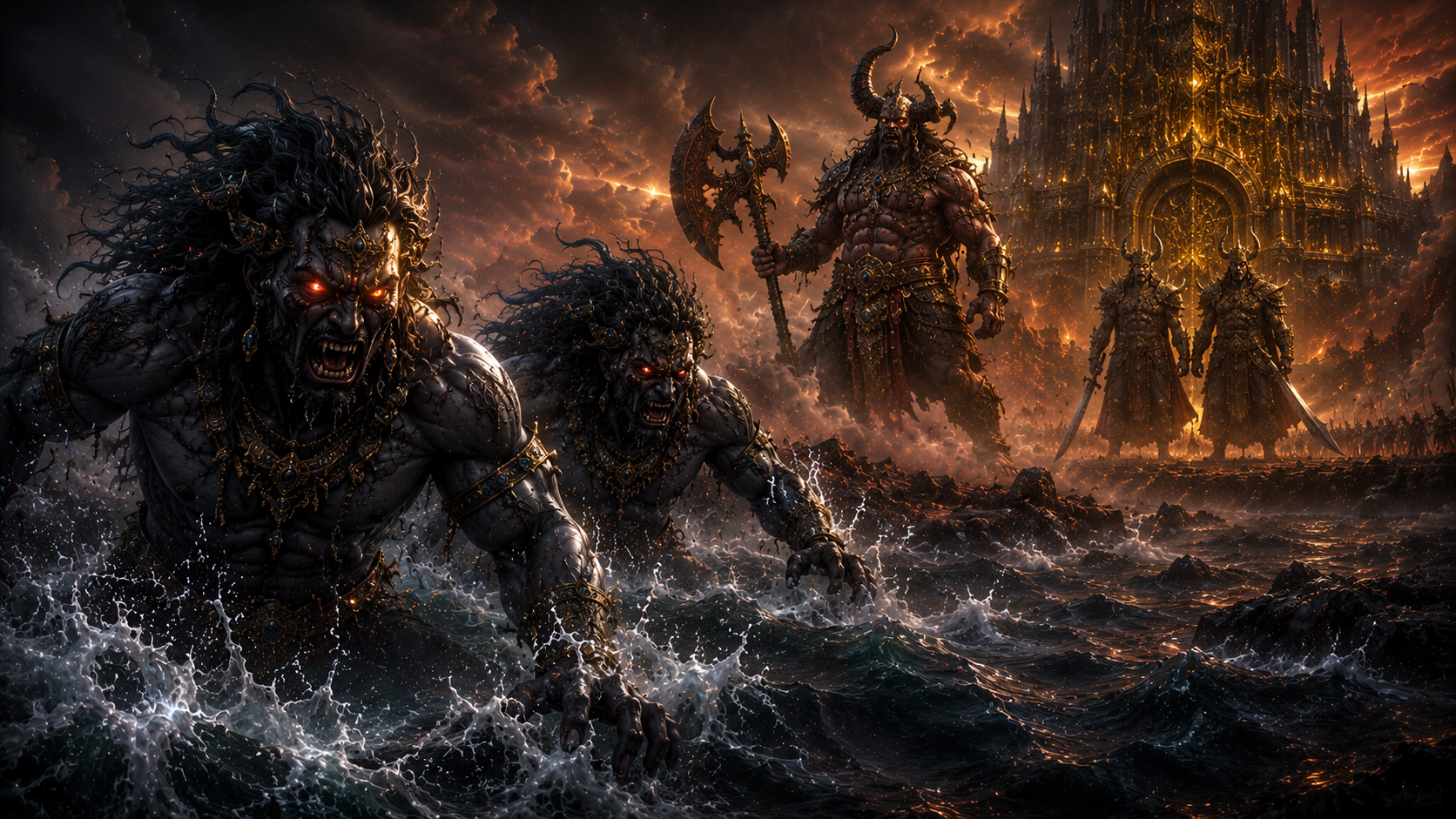
The three adversaries and what they represent: Tamas darkness, Rajas pride, and Sattva’s subtlest disruption — the false belief in masculine self-sufficiency.
Read in sequence, the three Charitas make a single sustained argument about the nature of divine power. The First Charita establishes that the Goddess is the ground of all divine action — Vishnu cannot act without her. The Second establishes that the Goddess is the concentrated essence of all divine power — she surpasses what any god or combination of gods can do. The Third establishes that the Goddess is the sole reality behind all apparent multiplicity — what looks like many deities is her own unitary power in different expressions.
The three-guna correspondence deepens the argument. Tamas (First Charita) represents the most elemental disruption: darkness arising before form exists, fought in the body of the universe before the universe is properly made. Rajas (Second Charita) represents active political usurpation: a demon who has conquered the cosmic order through legitimate boon-power, requiring a sovereign feminine response. Sattva (Third Charita) represents the most subtle disruption: pride, illusion, and the false belief in masculine self-sufficiency, defeated not ultimately by force but by the revelation of non-dual truth.
The Devi Mahatmya is not, finally, a war text. It is a text about the nature of reality, told through the medium of war. Each demon represents a category of cosmic disruption — and also, in the tradition's reading, a category of inner disruption that the devotee must face. Madhu and Kaitabha are the inertia that keeps the mind asleep. Mahishasura is the ego that usurps the throne of consciousness. Shumbha is the pride of self-sufficiency; Nishumbha the rejection of what is other; Raktabija the multiplication of desire when attacked by ordinary means. The Goddess defeats each of them — and the sage tells these stories to two men in pain because the battle the Goddess fights is also the battle each of them must fight within themselves.
References
Primary Sources
- Markandeya Purana — Chapters 81–93 (the complete Devi Mahatmya; composed c. 400–600 CE)
- Devi Mahatmya, Chapter 1 — Prathama Charita: Madhu-Kaitabha Vadha; Mahakali Stuti
- Devi Mahatmya, Chapters 2–4 — Madhyama Charita: Mahishasura Vadha; birth of Durga from the gods' tejas; Shakradi Stuti
- Devi Mahatmya, Chapters 5–13 — Uttama Charita: Shumbha-Nishumbha Vadha; Dhumralochana, Chanda-Munda, Raktabija, Nishumbha, Shumbha; Narayani Stuti; Phala Shruti; boons to Suratha and Samadhi
- Devi Bhagavata Purana — Book 5 (variant account of Shumbha-Nishumbha's tapasya and origins)
Secondary Sources
- Coburn, Thomas B. Devī-Māhātmya: The Crystallization of the Goddess Tradition. Motilal Banarsidass, 1984.
- Coburn, Thomas B. (trans.). Encountering the Goddess: A Translation of the Devī-Māhātmya and a Study of Its Interpretation. SUNY Press, 1991.
- Jagadiswarananda, Swami (trans.). Devi Mahatmyam. Sri Ramakrishna Math, 1953.
- Kinsley, David. Hindu Goddesses. University of California Press, 1986.
- Mani, Vettam. Puranic Encyclopaedia. Motilal Banarsidass, 1975. Entries: "Devi Mahatmya," "Madhu-Kaitabha," "Mahishasura," "Shumbha," "Nishumbha," "Raktabija."