
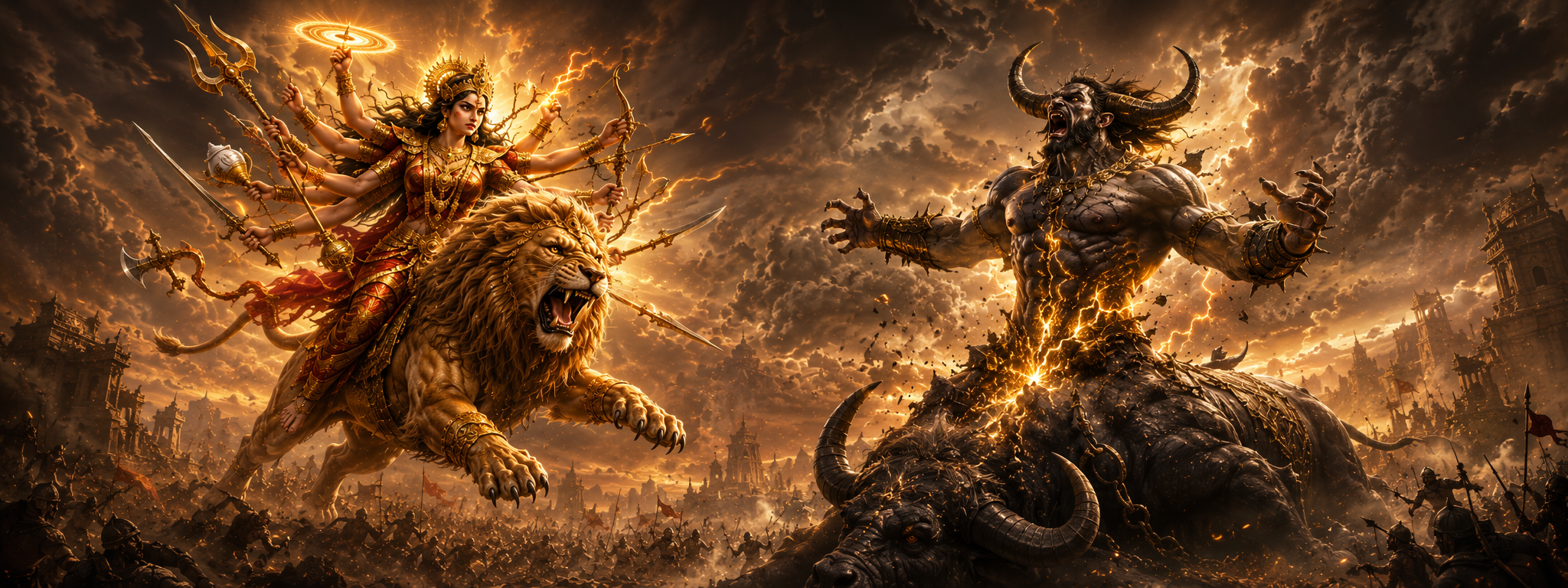
This is the complete chronicle of the second and middle episode of the Devi Mahatmya — the Madhyama Charita, occupying chapters 2 through 4 of the text (chapters 82–84 of the Markandeya Purana). It is the episode most people picture when they picture the Goddess at all: a multi-armed warrior on a lion, a buffalo demon dissolving through one shape after another, nine days and nights of war that give Navaratri and Vijayadashami their entire reason for existing.
It is also, read closely, an episode about composition — about what it actually takes, in the Devi Mahatmya's own theology, to assemble a being powerful enough to end a threat that no single god could end alone. What follows is told in three acts: the forging of the goddess herself from the combined fury of the Trimurti, the long and genuinely bloody campaign against Mahishasura's named generals, and the demon's own final, shape-shifting last stand. Material from outside the Devi Mahatmya's own verses — the Vamana Purana's account of Mahishasura's birth, the Devi Bhagavata's elaborations, regional traditions tying the battle to Mysore — is flagged inline as supplementary rather than blended silently into the base narrative.
Dramatis Personae
| Figure | Role |
|---|---|
| Mahishasura | The buffalo-demon king; conqueror of heaven, shape-shifter, the war's central antagonist |
| Durga (Chandika, Ambika) | The goddess assembled from the combined tejas of Brahma, Vishnu, and Shiva — and of every lesser god besides |
| Indra & the Devas | Defeated and exiled gods whose plea to the Trimurti sets the war in motion |
| Brahma, Vishnu, Shiva | The Trimurti, whose united fury is the seed from which the goddess's form first coalesces |
| Himavat | Lord of the mountains, Parvati's father, who gifts the goddess her lion mount and jewels |
| Chikshura | Mahishasura's commander-in-chief, the first general to fall |
| Chamara & the named generals | Mahishasura's officer corps — over a dozen named demons, each given a distinct death in the text |
Prologue: The Conquest of Heaven
Mahishasura's war against the gods does not begin in the Devi Mahatmya's own pages — by the time chapter 2 opens, it is already won. Mahishasura, lord of the asuras, had already met Indra's forces in open battle and broken them decisively, seizing not just the throne of heaven but the specific offices and functions that kept the cosmos running: the roles of Surya the sun, Chandra the moon, Kubera the treasurer, Varuna the god of waters, Vayu of the winds, and Agni of fire, each one stripped from its rightful holder and exercised personally by Mahishasura or his appointees. Indra and the dispossessed devas, reduced to wandering the earth as ordinary mortals, had nowhere left to appeal but upward — past the gods who had already lost, to the three who stand above the entire cycle of cosmic administration: Brahma, Vishnu, and Shiva.
Variant Tradition — Mahishasura's Birth
The Devi Mahatmya itself does not narrate Mahishasura's origin before his conquest begins. The Vamana Purana supplies this background: Mahishasura as the son of the asura king Rambha and a female buffalo named Mahishi, a parentage that explains both his name (mahisha, "buffalo") and his signature shape-shifting affinity for the buffalo form he keeps returning to throughout the war's final act. This detail is a later elaboration rather than part of the Devi Mahatmya's own verses, and is noted here as such.
The full account of what happens once the devas reach the Trimurti — the fury that becomes a face, the face that becomes a goddess — opens Act I below.
The Three Acts
Each act below is summarized here and told in full in its own chronicle.
The Forging of the Goddess
Brahma, Vishnu, and Shiva, hearing the devas' plea, do not deliberate — their fury becomes visible light, and that light, joined by the combined radiance of every lesser god in turn, coalesces into a single, fully formed goddess. Each god then arms her with a weapon drawn from his own arsenal; Himavat, lord of the mountains, gives her jewels and the lion she will ride into every battle that follows.
Read the full chronicle of Act I →The General's Campaign
Chikshura, Mahishasura's commander-in-chief, leads more than a dozen named generals against the goddess in a campaign that the Devi Mahatmya narrates general by general, death by death — by spear, by trident, by sword, by the goddess's own lion. It is the longest sustained battle sequence anywhere in the Devi Mahatmya's three episodes.
Read the full chronicle of Act II →The Shape-Shifter's Last Stand
With his entire army destroyed, Mahishasura enters the field himself — and discovers that no single form can hold against the goddess for long. Buffalo, lion, man, elephant, and buffalo again: every shape he takes is met and broken, until the goddess pins him underfoot in the one moment he cannot transform fast enough to escape.
Read the full chronicle of Act III →Aftermath — What the Victory Left Behind
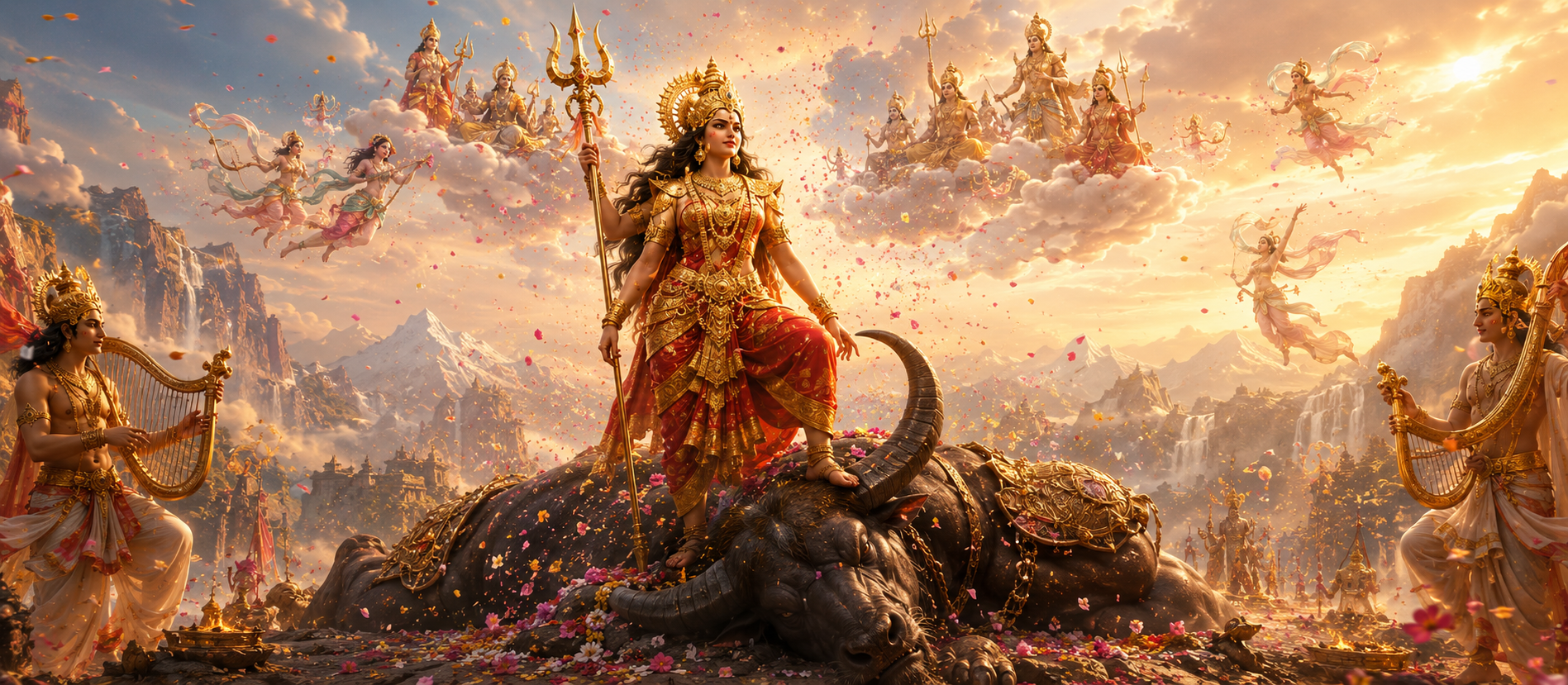
The Devi Stuti: gods shower flowers as the goddess who was assembled from their own fury is praised as the power behind it.
The Devi Stuti
With Mahishasura dead, Indra and the devas — restored at last to the offices Mahishasura had stripped from them — gather to sing the Devi Mahatmya's second great hymn, the Devi Stuti of chapter 4. Where the Madhu-Kaitabha episode established the Goddess as the power that even Vishnu's own creative and preservative functions depend on, this hymn extends the claim outward to the entire pantheon: she is praised here as Shri to those who act well and as the misfortune of those who act wickedly, as the substance of the Rig and Sama Vedas, as a power the assembled gods — Brahma, Hari, and Hara among them — confess they lack the capacity to fully describe. The hymn closes with the devas asking her protection in every direction and every world, and the Goddess, pleased, granting it before withdrawing from their sight.
An Epithet That Outlasted the War
It is from this victory that the goddess receives the name by which this entire episode is most widely known outside specialist circles: Mahishasuramardini, "she who crushed Mahishasura." Regional tradition in southern India ties the battle's location directly to the landscape: the city of Mysore (from Mahishooru) and the nearby Chamundi Hills are traditionally identified as the site of the demon's death, with the goddess worshipped there as Chamundeshwari. The festival cycle built around this victory — Navaratri's nine nights, culminating in Vijayadashami — remains, alongside Durga Puja in the eastern states, one of the largest annually recurring observances connected to any single episode of the Devi Mahatmya.
Why This War Needed This Goddess
Mahishasura's boon, in every account, protected him specifically against any single male being — god, man, or beast. The structural answer the Devi Mahatmya gives is not a new goddess born outside the boon's terms, as the third episode will require for Shumbha and Nishumbha, but a composite one: a being formed not by any one god acting alone but by the joined fury of the entire pantheon at once, female by the boon's own technical exclusion and irreducibly plural in her origin even as she fights as a single warrior. The shape-shifting climax of Act III makes the same point from the demon's side of the field: Mahishasura's ability to become buffalo, lion, man, and elephant in turn is a literalized desperation to find some category the goddess's composite nature has not already accounted for — and the war's entire structure is built around the fact that no such category exists.
Complete Bibliography
Primary Sources
- Markandeya Purana — Chapters 82–84 (Devi Mahatmya, Durga Saptashati Chapters 2–4) — primary source for the entire saga: the conquest of heaven, the forging of the goddess, the weapons-and-gifts scene, the campaign against the named generals, Mahishasura's shape-shifting last stand, and the Devi Stuti.
- Vamana Purana — Mahishasura's birth from Rambha and the buffalo Mahishi.
- Devi Bhagavata Purana — parallel elaborations of the Mahishasura narrative and the goddess's composite origin.
- Shiva Purana — material connecting Durga's role in this episode to her identity as an emanation of Parvati.
- Adi Shankaracharya (attrib.), Mahishasura Mardini Stotram (c. 9th century CE) — a devotional hymn extolling the Devi's powers across all three episodes, with particular focus on this one.
Secondary Sources
- Coburn, Thomas B. Devi-Mahatmya: The Crystallization of the Goddess Tradition. Motilal Banarsidass, 1984.
- Coburn, Thomas B. Encountering the Goddess. SUNY Press, 1991.
- Kinsley, David. Hindu Goddesses. University of California Press, 1986. On Durga's composite origin, the rajas guna reading of this episode, and Mahishasuramardini iconography.
- Mani, Vettam. Puranic Encyclopaedia. Motilal Banarsidass, 1975. Consolidated entries on Mahishasura and his named generals.
Variant material from the Vamana, Devi Bhagavata, and Shiva Puranas, and regional traditions connecting the battle to Mysore and the Chamundi Hills, is flagged inline throughout the saga as supplementary to, rather than fused silently with, the Devi Mahatmya's own account.