
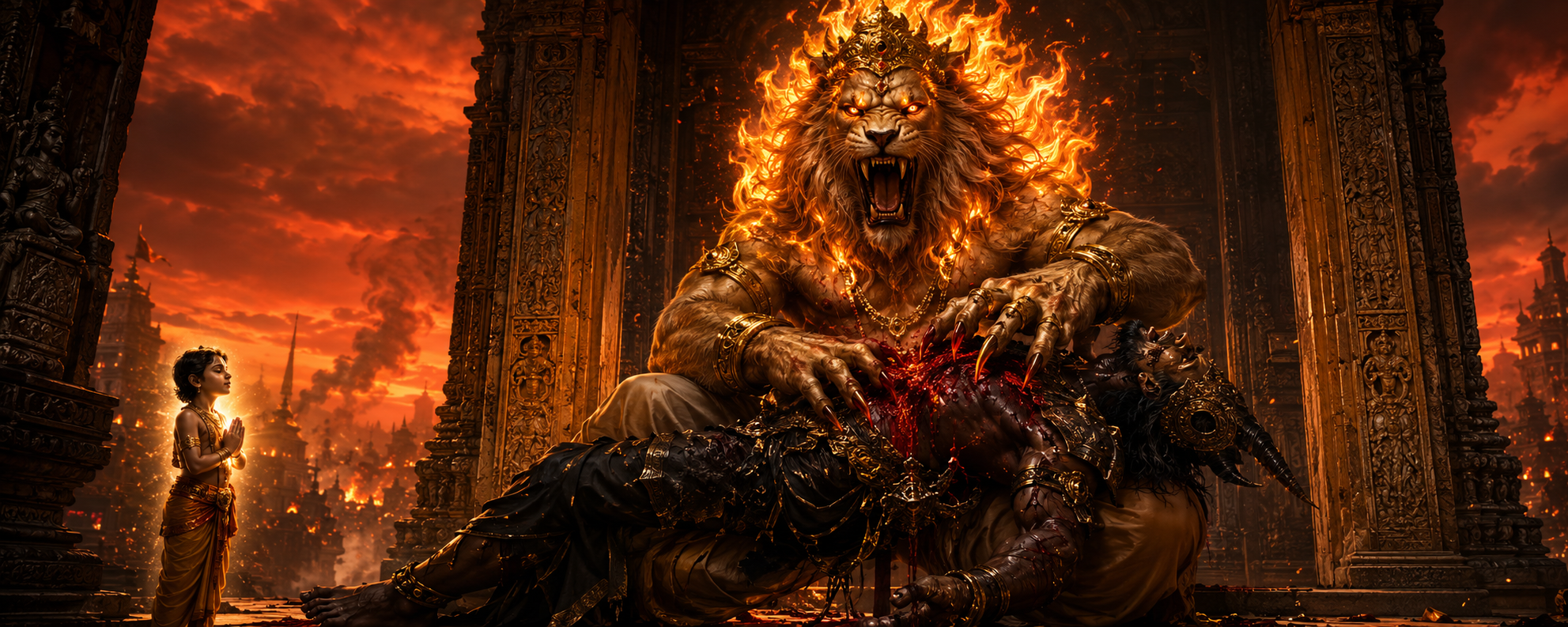
The Narasimha War is the most philosophically intricate of the avatar conflicts. It is not merely a war between a god and a demon — it is a war between a divine promise and an apparently unbreakable boon. Brahma had granted Hiranyakashipu a set of protections so exhaustive that destruction seemed impossible. What follows is the Puranic tradition's most celebrated demonstration of a principle: that no boon granted by Brahma can override the will of Vishnu, because Vishnu exists outside the conditions that any boon can specify.
It is also the only war in the twelve triggered not by cosmic theft or territorial conquest, but by a father's attempt to kill his own son for the crime of devotion. The victim of Hiranyakashipu's tyranny was not a god, not a sage, but a child — Prahlada — whose unwavering faith becomes the instrument by which the entire Daitya empire falls.
Background & Cause
Hiranyakashipu was the elder brother of Hiranyaksha, slain by the Varaha avatar in the second war. His response to his brother's death was not grief but rage — and the channelling of that rage into the most extreme act of spiritual will available to any being in the Puranic universe: austerity. He performed tapas so severe that the heat generated by his penance threatened to burn the three worlds. Brahma appeared and asked what boon he desired.
Hiranyakashipu's boon request was the most carefully constructed in Puranic literature. He had studied the manner of his brother's death and reasoned that broad invincibility was insufficient — that he needed to enumerate every possible condition of death and exclude it. Brahma agreed.
| Condition Excluded | Hiranyakashipu's Boon Term | How Narasimha Satisfied It |
|---|---|---|
| By a human | Not killed by man | Narasimha is half-lion — not fully human |
| By an animal | Not killed by beast | Narasimha is half-man — not fully animal |
| By a god | Not killed by any deity | Narasimha is an avatar, beyond the category of "deity" |
| By day | Not killed during daytime | The killing occurs at dusk — neither day nor night |
| By night | Not killed during nighttime | The killing occurs at dusk — neither day nor night |
| Inside a building | Not killed indoors | The killing occurs at the threshold — neither inside nor outside |
| Outside a building | Not killed outdoors | The killing occurs at the threshold — neither inside nor outside |
| On the ground | Not killed on earth | Hiranyakashipu is placed across Narasimha's lap — neither on earth nor in sky |
| In the sky | Not killed in the air | Hiranyakashipu is placed across Narasimha's lap — neither on earth nor in sky |
| By any weapon | Not killed by animate or inanimate weapon | Narasimha tears him apart with bare claws — no weapon used |
Armed with this fortress of conditions, Hiranyakashipu conquered the three worlds, overthrew the Devas from Svarga, and installed himself as the supreme ruler of the universe. He then did something no other conqueror in the twelve wars had done: he turned his tyranny inward, against his own household. He banned the worship of Vishnu throughout his empire — and discovered that his own son Prahlada refused to comply.
Prahlada — The Devotee at the Centre
Prahlada was not a warrior. He was a child — prince of the Daityas, son of their greatest king — who had developed an unshakeable devotion to Vishnu from infancy. The Bhagavata Purana devotes several chapters to Prahlada's philosophy, presented as teachings he gave to his fellow students, which are among the most celebrated passages of Vaishnava theology in Sanskrit literature.
Hiranyakashipu tried every means available to turn or destroy his son. He had Prahlada thrown from a cliff — the boy was unharmed. He had him trampled by elephants — the elephants would not crush him. He had him thrown into fire — Prahlada sat in the flames unburned, singing the names of Vishnu. He had serpents bite him — the venom had no effect. He had him thrown into the ocean with boulders tied to his neck — Prahlada sat peacefully on the ocean floor, still meditating.
Each failed attempt deepened Hiranyakashipu's rage. Finally, in a confrontation that the Bhagavata Purana presents as the crisis point of the entire war, Hiranyakashipu demanded of his son: where is this Vishnu you speak of? Is he in this pillar? And Prahlada replied — he is everywhere, even in that pillar. Hiranyakashipu struck the pillar with his fist.
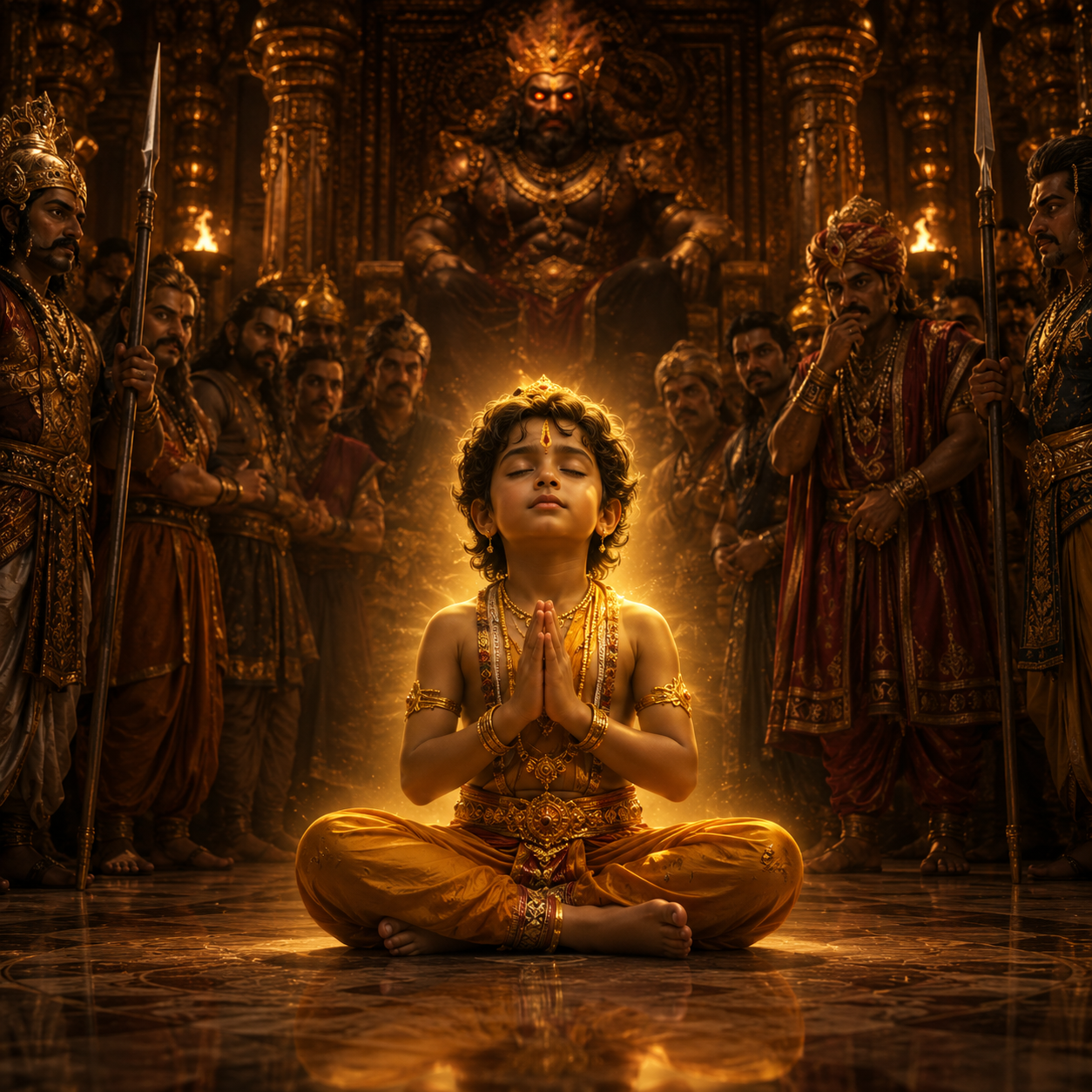
Prahlada's unbreakable devotion to Vishnu in the very court of the god's greatest enemy is the theological heart of the Narasimha War.
Key Combatants
Divine Champion
Vishnu as Narasimha
- Vishnu (Narasimha Avatar) — Half-man, half-lion form; emerged from the pillar struck by Hiranyakashipu. The fourth avatar of Vishnu in most Dashavatara lists. Armed only with his bare claws. His form is described in the Bhagavata as terrifying beyond measure — a roar that split the heavens, eyes blazing like molten gold, a mane of fire.
- Prahlada — Not a combatant but the devotee whose faith precipitates the avatar's appearance. His calm amid the chaos is contrasted repeatedly with the fury of both Hiranyakashipu and Narasimha.
- Brahma and the Devas — Watch from a safe distance; powerless to approach the enraged Narasimha until Prahlada himself steps forward to calm him.
Adversary
Hiranyakashipu
- Hiranyakashipu — Elder brother of Hiranyaksha; son of Kashyapa and Diti. Name means "golden-garmented." Possessed Brahma's boon of ten-fold invincibility. Ruler of all three worlds; had expelled the Devas and banned Vishnu-worship. Father of Prahlada.
- His power base — The most comprehensively worded boon in Puranic literature; political sovereignty over all three worlds; his own formidable physical strength and demonic power.
- Shukracharya and the Daitya ministers — Political support structure; present but unable to intervene when Narasimha appears.
The Appearance of Narasimha
When Hiranyakashipu struck the pillar, it split open with a sound like the end of a Kalpa. From within it emerged Narasimha — not summoned, not called, simply present, as Vishnu is always present everywhere if one knows where to look. The Bhagavata Purana's description of the avatar's emergence is one of the most viscerally powerful passages in Sanskrit literature: a form neither fully human nor fully animal, blazing, roaring, filling the hall with a terror that sent the assembled demons fleeing in all directions.
Hiranyakashipu, armed and formidable, did not flee. He was a king and a warrior; he attacked. The combat between Hiranyakashipu and Narasimha is described as brief but fierce — the demon deploying every weapon in his arsenal, Narasimha brushing each aside. This was not a war of equals. The boon that Hiranyakashipu had thought made him invincible had been perfectly circumvented before the battle even began.
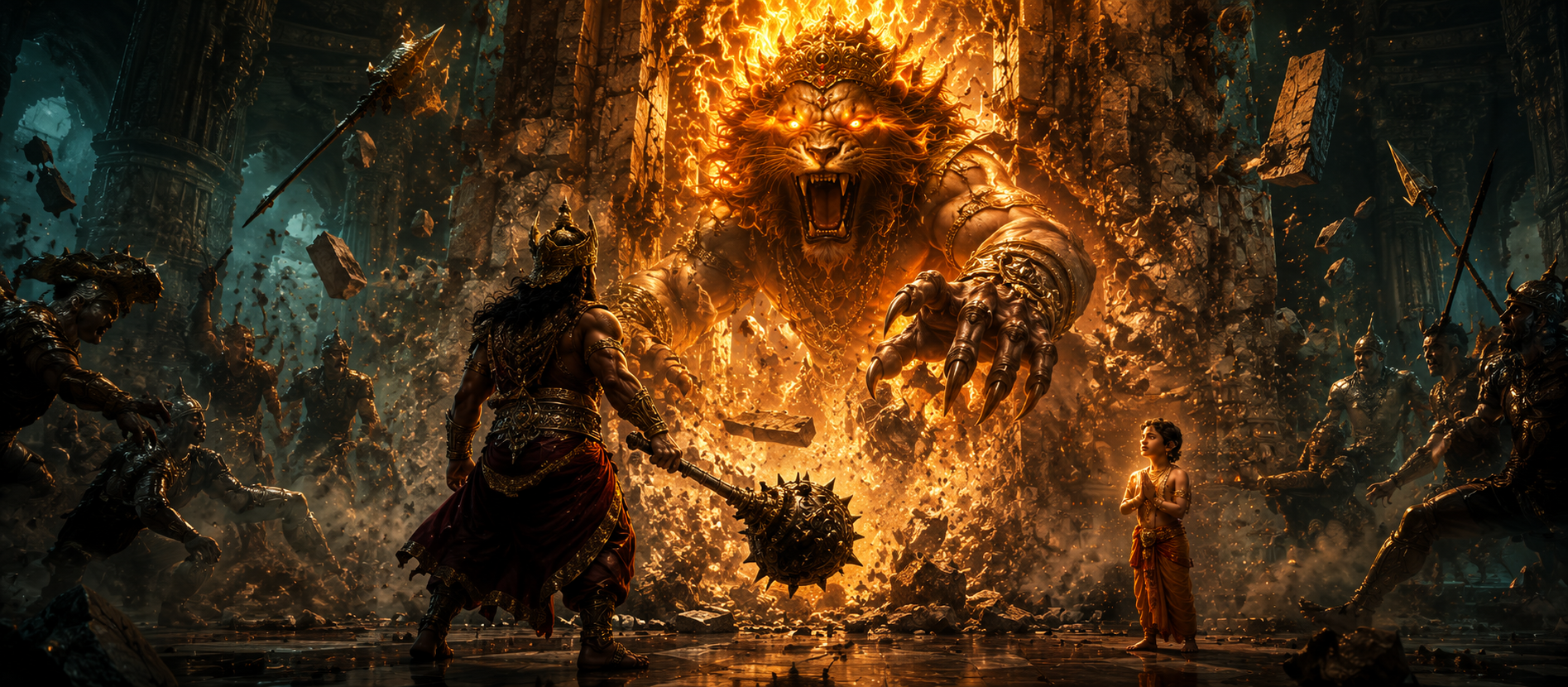
The emergence of Narasimha from the pillar is the theological climax of the war — Vishnu manifesting from within the very fabric of the universe to answer his devotee's faith.
"Narasimha placed Hiranyakashipu across his lap at the threshold of the palace, at the hour of dusk, and tore him apart with his bare claws. No condition of the boon had been violated. Every condition of the boon had been met."
Bhagavata Purana, Skandha VIIThe Killing — and the Calming of Narasimha
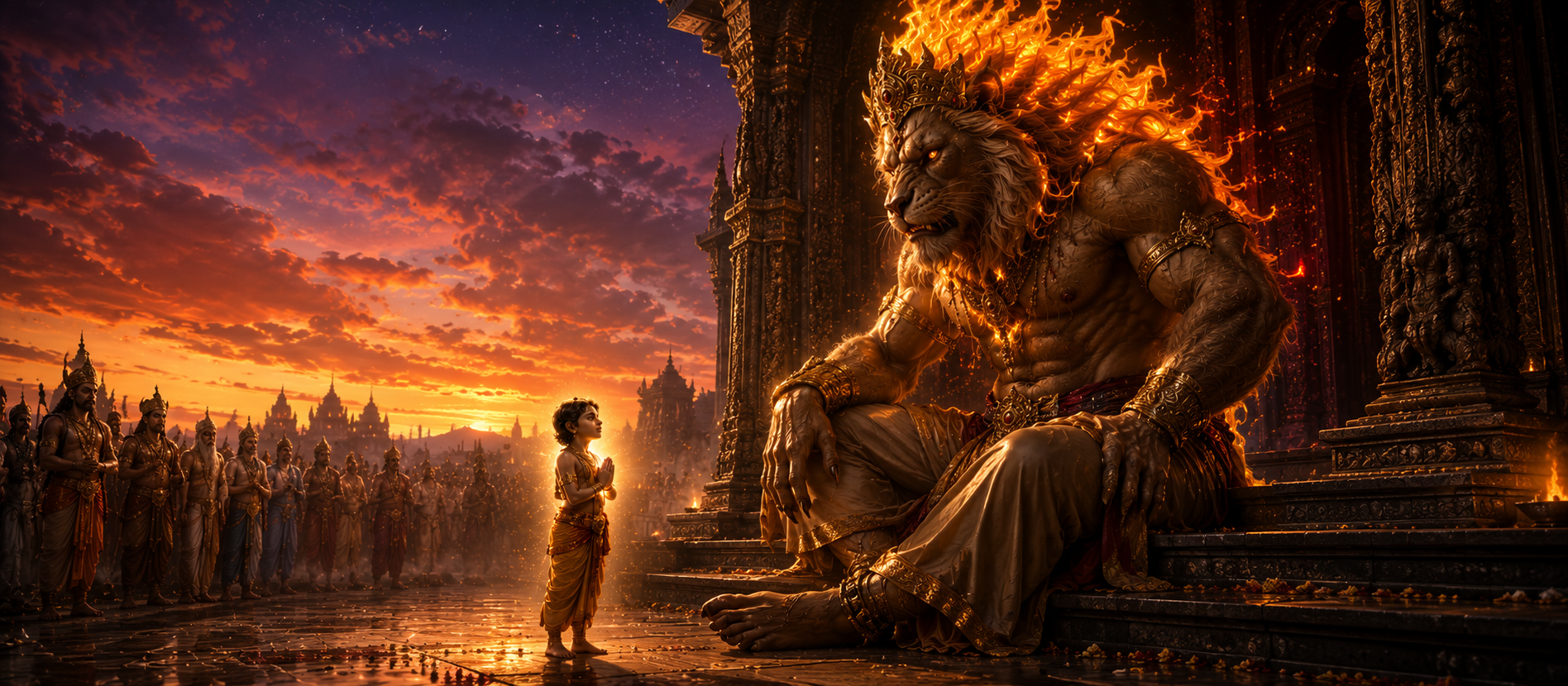
The calming of Narasimha by Prahlada's devotion is theologically as significant as the killing itself — only the pure devotee could approach what terrified even the gods.
After the killing, the Bhagavata Purana records a remarkable scene. Narasimha's fury did not immediately subside. He sat at the threshold, still blazing, still roaring, his form so terrifying that none of the assembled gods — not Brahma, not Shiva, not Indra — dared approach him. They sent Lakshmi. She too could not approach. Finally, Brahma turned to Prahlada, the child whose devotion had caused all of this, and asked him to pacify the avatar.
Prahlada walked forward alone, fell prostrate before Narasimha, and began to sing. The Bhagavata preserves his hymn — nine verses of pure devotion, called the Prahlada Stuti — in which the boy praises Vishnu not for his power or his ferocity but for his immanence, his presence within all beings, his availability to even the lowest devotee. As Prahlada sang, Narasimha's fury subsided. He placed his hand on the boy's head. The avatar had been calmed by the very faith that had invoked it.
Prahlada was then installed as king of the Daityas — a remarkable outcome, given that the war had been fought against his own people. Vishnu blessed him and promised that the lineage of Prahlada would always have divine protection, regardless of the enmity of the Daitya line with the Devas. It is a promise the Puranas honour: Prahlada's grandson would be the virtuous king Mahabali, the subject of the very next war.
Outcome Summary
Military result: Decisive Deva victory. Hiranyakashipu was torn apart by Narasimha at the threshold of his own palace at dusk, with every condition of his boon technically satisfied and simultaneously circumvented. The Daitya empire was dissolved and Prahlada was installed as king in his father's place.
Theological significance: The Narasimha War is the Puranic tradition's definitive statement on the limits of Brahma's boon-granting authority relative to Vishnu's will. It also establishes the doctrine of divine immanence — Vishnu present within the pillar, within all things — as distinct from the distant-deity model. The avatar arose not from external summons but from the pressure of a devotee's faith against the fabric of the universe.
Dynastic consequence: Prahlada's kingship and Vishnu's promise of protection to his line sets up the fourth war directly — Prahlada's grandson Mahabali will be both the subject and the unexpected hero of the Vamana War.
Cosmic Significance
Among all the avatar wars, the Narasimha War has generated the richest theological commentary. The precision with which the boon is circumvented — ten conditions, each satisfied by the avatar's form, location, and timing — has been analysed by Vaishnava philosophers as a demonstration that divine will operates in a logical space that transcends the categories available to any created being, even Brahma. The boon was not broken; it was made irrelevant.
The war also introduces the most important structural element of the Bhagavata Purana's theological project: the idea that divine protection flows not through power or status but through devotion. Prahlada had no weapons, no boons, no political authority. He had only faith. And it was his faith — not the collective power of the Devas, not Brahma's mediation, not any weapon in the divine arsenal — that ultimately produced the avatar and ended the tyranny.
This is why the Narasimha War, alone among the twelve, is commemorated annually as a major festival — Narasimha Jayanti — celebrated across the Vaishnava tradition. The other wars are remembered as cosmological events; this one is remembered as a devotional miracle.
Textual Sources & Variants
The Narasimha narrative is among the most widely attested in Puranic literature, appearing in detailed form across multiple Mahapuranas. The core facts are consistent; the variants lie primarily in the number and nature of Prahlada's ordeals and in the theological elaboration of Narasimha's post-killing fury.
| Source | Detail | Variant / Note |
|---|---|---|
| Bhagavata Purana Skandha VII |
Fullest account: Prahlada's birth, education, multiple failed attempts on his life, the pillar episode, Narasimha's emergence and killing, post-killing fury, calming by Prahlada's hymn, Prahlada installed as king. Prahlada's philosophical discourses preserved in full. | Primary narrative source. Most theologically elaborate; strongest Bhakti emphasis. The Prahlada Stuti (nine-verse hymn) preserved here. |
| Vishnu Purana Book I |
Full Narasimha narrative present; Prahlada's story told in comparable detail. Slightly different enumeration of Prahlada's ordeals. | Older layer of the tradition; less devotional elaboration but consistent on all core narrative facts. |
| Matsya Purana |
Narasimha account present; focuses more on the cosmological dimensions of the killing — the disruption to the three worlds during Narasimha's fury. | Less Prahlada narrative detail; more emphasis on the gods' fear of Narasimha post-killing. |
| Agni Purana |
Shorter account; records the boon terms and the killing but does not elaborate Prahlada's story or the post-killing episode. | Allusive; treats the story as established prior knowledge rather than narrating it fresh. |
| Mahabharata Udyoga Parva |
Narasimha referenced in lists of Vishnu's avatars; Hiranyakashipu's story mentioned but not narrated in full. | The Mahabharata knows the story but does not reproduce it — consistent with it being well-established oral tradition by the epic's composition. |
References
Primary Sources
- Bhagavata Purana — Skandha VII, Chapters 1–10 (Prahlada's story, Narasimha avatar, killing of Hiranyakashipu, Prahlada Stuti, Prahlada's installation as king)
- Vishnu Purana — Book I, Chapters 16–20 (Hiranyakashipu's boon, Prahlada's ordeals, Narasimha killing)
- Matsya Purana — Chapters 161–163 (Narasimha account; cosmological disruption during fury)
- Agni Purana — Chapter 4 (Narasimha listed and briefly described among the Dashavatara)
- Mahabharata, Udyoga Parva — Section 68 (Narasimha referenced among Vishnu's forms)
- Brahmanda Purana — Varaha Kalpa section (Narasimha War named third in the twelve-war list)
Secondary Sources
- Mani, Vettam. Puranic Encyclopaedia. Motilal Banarsidass, 1975. Entries: "Hiranyakashipu," "Narasimha," "Prahlada."
- Tagare, G. V. (trans.). The Bhagavata Purana. Motilal Banarsidass, 1976. Skandha VII.
- Wilson, H. H. (trans.). The Vishnu Purana. Trübner & Co., 1865. Book I.
- Sheridan, Daniel P. The Advaitic Theism of the Bhāgavata Purāṇa. Motilal Banarsidass, 1986. (On Prahlada's philosophy and the Bhakti theology of the Narasimha episode.)
- Hudson, D. Dennis. "Narasimha." In The Hindu World, ed. Sushil Mittal and Gene Thursby. Routledge, 2004.