
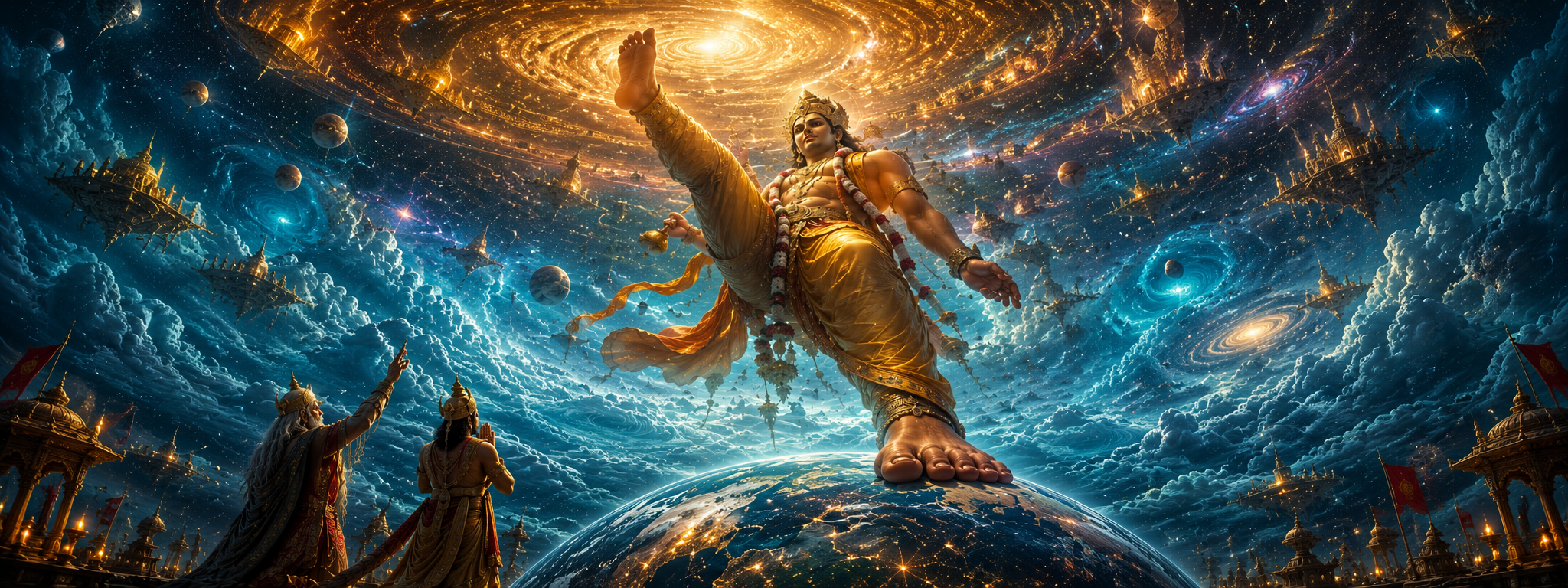
The Vamana War stands apart from every other conflict in the twelve. There is no battle. No weapon is raised. No demon is slain. The war is won entirely through the mechanism of dharmic obligation — a king's unbreakable commitment to honour a gift once promised. It is the Puranic tradition's most sophisticated demonstration that cosmic order can be restored not by force but by law, and that even the most virtuous ruler can be made an instrument of a greater will without being diminished by it.
What makes this war theologically unusual is its antagonist. Mahabali was not cruel, not tyrannical, not a persecutor of devotees. He was, by every measure the Puranas use, a good king — generous, dharmic, beloved by his subjects. The Vamana War forces the reader to confront an uncomfortable question: why does Vishnu act against a virtuous ruler? The answer the Puranas give is one of the most carefully reasoned in all of Hindu cosmological thought.
Background & Cause
Mahabali was the grandson of Prahlada — the devoted boy whose faith had precipitated the Narasimha War. He inherited from his grandfather both the Daitya lineage and, remarkably, Prahlada's quality of dharmic virtue. Through conquest and through the performance of the Vishvajit yajna — a sacrifice whose completion granted sovereignty over all three worlds — Mahabali became emperor of the universe. He was a just and generous ruler; under his reign, the kingdom prospered, poverty was unknown, and dharma was upheld.
The problem, from the Puranic perspective, was structural rather than moral. The three worlds had a divinely ordained order: Svargaloka, the celestial realm, was the domain of the Devas under Indra's kingship. When Mahabali occupied it — however virtuously — the Devas were displaced from their cosmic function. Aditi, mother of the gods, performed an extended austerity called the Payovrata over twelve days, appealing to Vishnu to restore her sons to their rightful place.
Vishnu agreed — and was born as Aditi's son: Vamana, a dwarf Brahmin boy, the fifth of the Dashavatara. He then walked to Mahabali's great sacrificial ground, where the king was conducting his hundredth Ashvamedha yajna. Completion of a hundred such yajnas would give Mahabali a claim even on Indra's throne that could not be contested. Vishnu had arrived at the last possible moment.
Key Combatants
Divine Champion
Vishnu as Vamana
- Vishnu (Vamana Avatar) — Born as the son of Kashyapa and Aditi; a dwarf Brahmin boy carrying a water pot, an umbrella, and a deerskin. His weapon is not a sword or a chakra but a gift request — three paces of land — and the dharmic obligation it creates.
- Indra and the Devas — The displaced beneficiaries of the war; present but passive. The restoration of their position is the war's objective but they do not fight for it.
- Aditi — Whose twelve-day Payovrata austerity sets the entire war in motion; Vamana is born from her devotion.
Adversary
Mahabali
- Mahabali — Grandson of Prahlada; son of Virochana. Legitimate ruler of all three worlds by conquest and yajna. Extraordinarily generous — his commitment to never refuse a gift to a Brahmin is the mechanism of his own displacement.
- Shukracharya — Preceptor of the Daityas; recognises Vamana as Vishnu immediately and urgently warns Mahabali not to make the gift. Mahabali overrules him — the only moment in the war where a clear choice is made.
- The Daitya ministers and army — Present but irrelevant; no physical force can address what is unfolding by cosmic law.
The Request — Three Paces of Land
Vamana arrived at Mahabali's sacrifice as any Brahmin guest would — requesting an audience and a gift. Mahabali received him with honour, offered him whatever he wished, and invited him to name it. The dwarf boy's request was so modest it seemed almost absurd: three paces of land, measured by his own small feet.
Mahabali laughed and immediately agreed. Shukracharya, watching, saw what Mahabali did not. He called his king aside and warned him with startling directness: this dwarf is Vishnu himself, come to take everything from you under the guise of a small gift. Do not make this promise. Mahabali heard him — and refused his counsel. His reasoning, preserved in the Bhagavata Purana, is one of the most morally complex speeches in Puranic literature.
"If this dwarf is indeed Vishnu himself, then I am more blessed than any man alive that he has come to my yajna to receive my gift. To refuse Vishnu is the only dishonour I could not survive."
Mahabali — Bhagavata Purana, Skandha VIIIThe gift was formalised through the ritual of sankalpa — Mahabali pouring water from a golden vessel over Vamana's hands, making the promise irrevocable under dharmic law. It is at this moment that Shukracharya made one final attempt to intervene: he shrank himself and hid inside the spout of the water vessel, blocking the water's flow. Vamana quietly picked up a blade of kusha grass and inserted it into the spout, unblocking it — and blinding Shukracharya in one eye in the process. The water flowed. The gift was made.
Vamana then began to grow. What had been a small boy expanded — first to the height of a man, then to the height of a mountain, then to a form that filled the sky, then to a cosmic form whose feet touched the earth and whose head reached the highest heavens. This is Trivikrama — Vishnu in his cosmic three-stride form, one of his most celebrated iconographic manifestations.
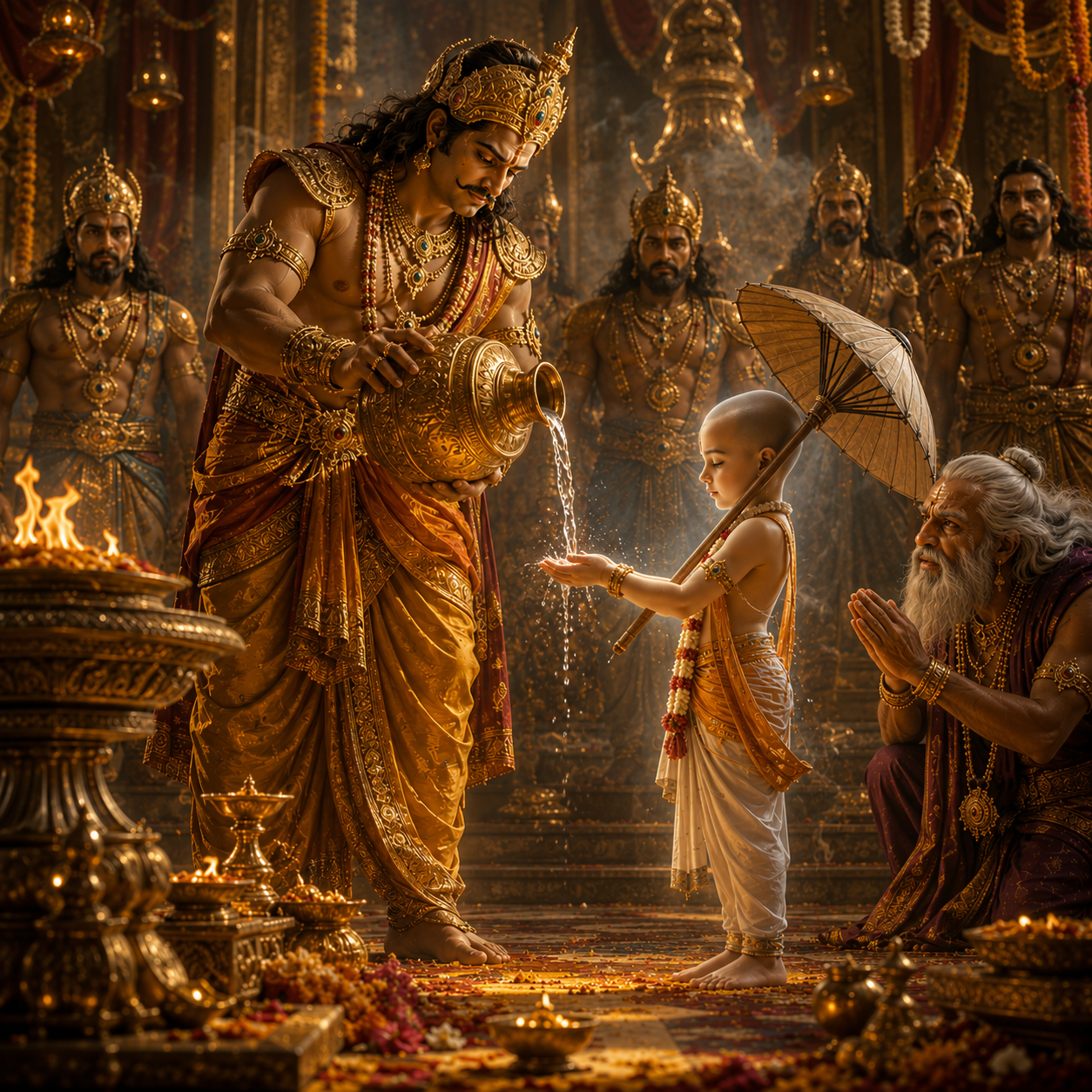
The moment the water flows, the promise becomes irrevocable — and the fate of the three worlds is sealed by Mahabali's own dharmic commitment.
The Three Strides of Trivikrama
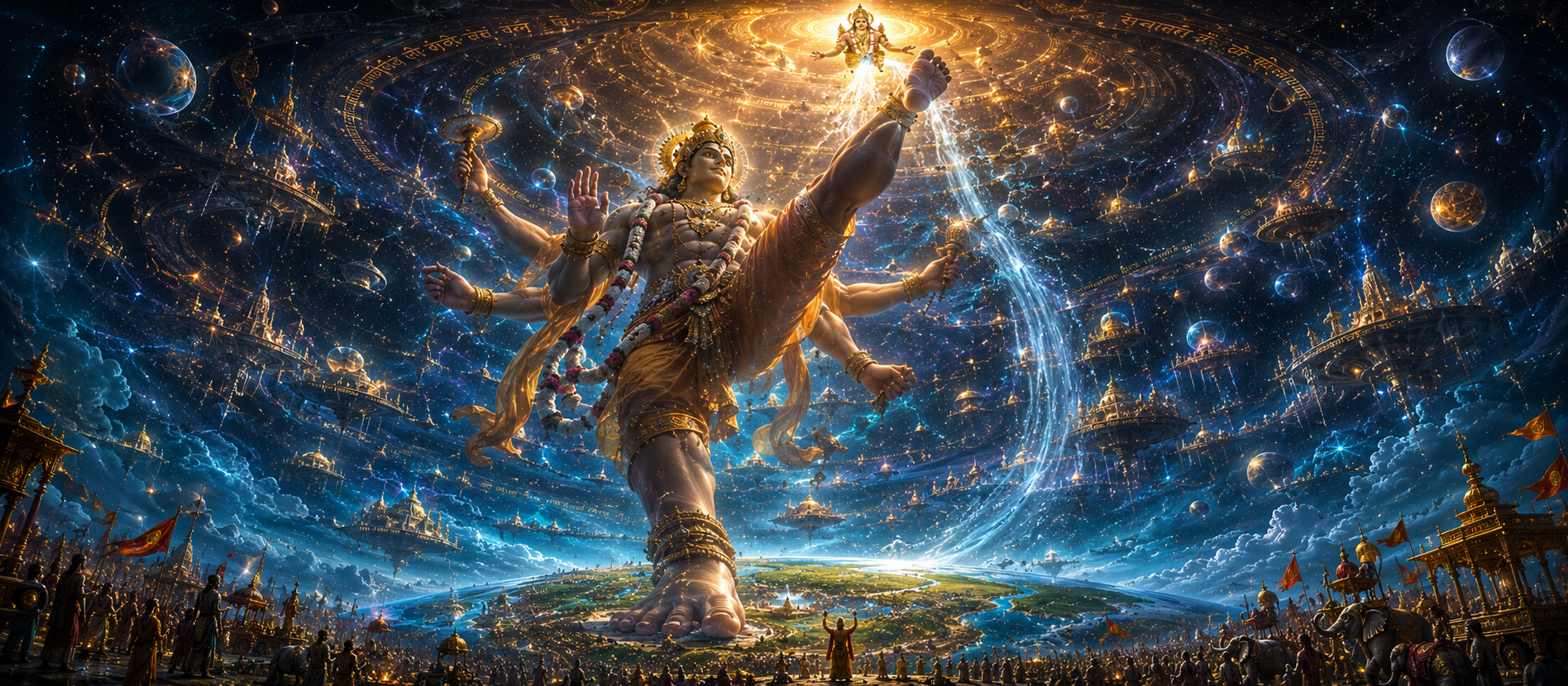
The cosmic form of Trivikrama — Vishnu spanning the entire universe in three strides — is among the most awe-inspiring images in all of Puranic iconography.
With his first stride, Trivikrama covered the entire Earth. With his second stride, he covered all of the heavens — Svargaloka, the realm Mahabali had conquered from the Devas. As his foot reached the cosmic ceiling, Brahma was there, and he washed Trivikrama's foot with water from his kamandalu — that water became the Ganga, the sacred river that descended from the heavens to earth. This origin of the Ganga as the washing-water from Vishnu's foot is one of the river's most celebrated mythological genealogies.
There was no space left for the third stride. Mahabali had promised three paces — and only two had been taken. All of creation had been covered. Trivikrama turned to Mahabali and asked: where shall I place my third foot?
| Stride | What Was Covered | Cosmic Significance |
|---|---|---|
| First Stride | The entire Earth — Bhurloka — all terrestrial creation | Everything Mahabali had built his kingdom upon was claimed in a single step |
| Second Stride | All of the heavens — Svargaloka — including the realm taken from the Devas | Brahma's washing of Trivikrama's foot at the cosmic ceiling produced the sacred river Ganga |
| Third Stride | Placed on Mahabali's head — sending him to Patala, the underworld | Fulfilled the promise; honoured Mahabali's virtue; granted him sovereignty over Patala and a promise of return |
Mahabali's Surrender — and Vishnu's Honour
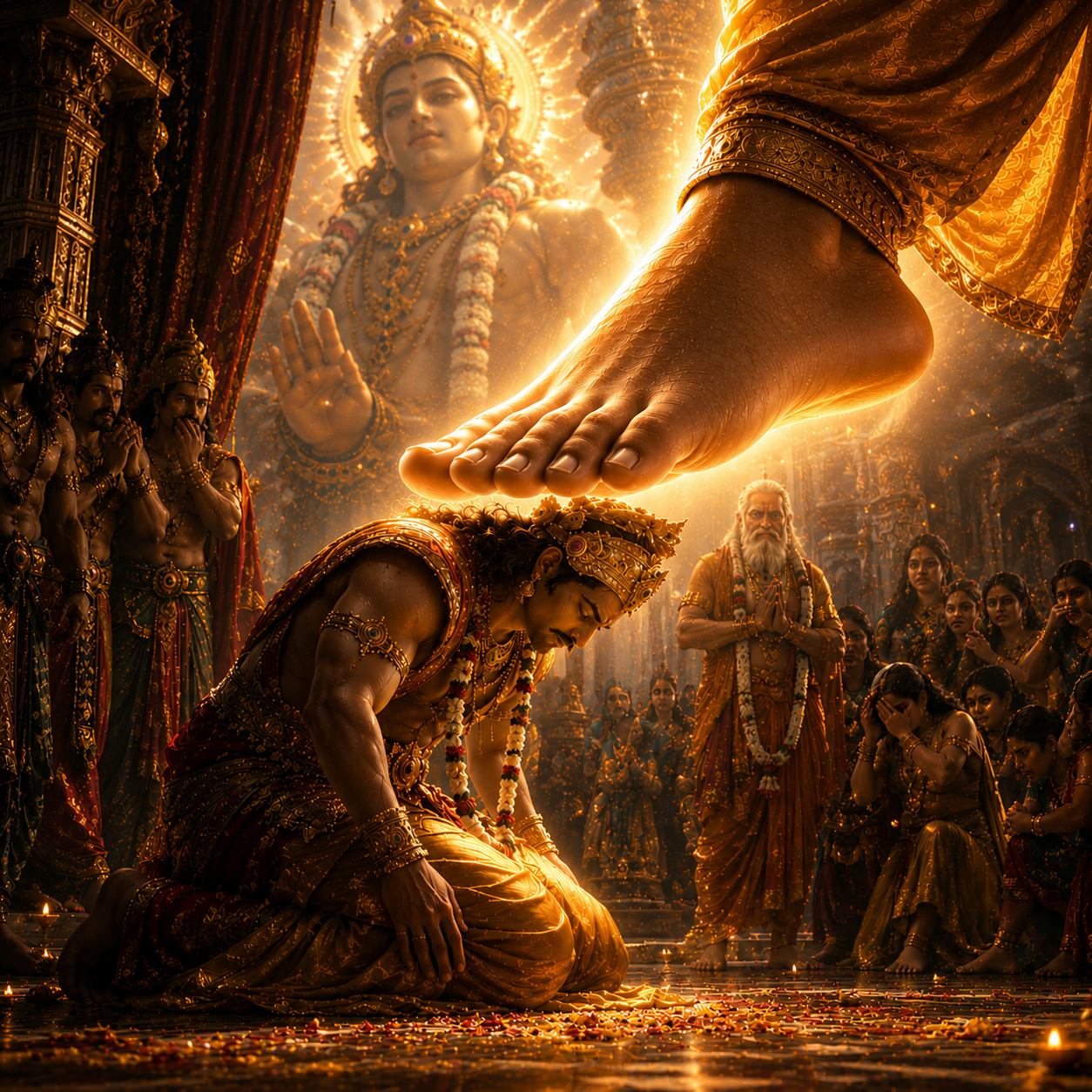
Mahabali's surrender is not a defeat in the ordinary sense — it is the act that elevates him to the highest place in the Puranas' moral hierarchy of kings.
Mahabali's answer was immediate. He bowed his head and offered it as the place for the third stride. It is the moment that defines his character in all of Puranic memory — not his conquest of the three worlds, not his hundred Ashvamedha yajnas, but this: a voluntary surrender to a cosmic law he fully understood, made without resentment and without loss of dignity.
Trivikrama placed his foot on Mahabali's head and pressed him down into Patala — the realm beneath the earth. But what followed was not punishment in any conventional sense. Vishnu, moved by Mahabali's virtue and his willing acceptance of cosmic law, granted him several remarkable boons: sovereignty over Patala, where he would rule as a just king; immortality; and the promise that he would be Indra — king of the gods — in the next Manvantara. And Vishnu himself would stand guard at the gates of Patala as Mahabali's doorkeeper, honouring the man who had honoured him.
In the Kerala tradition, Mahabali is believed to return to visit his people once a year — during the festival of Onam — welcomed with flowers, feasts, and the deepest affection of a people who remember him not as a defeated demon but as the best king who ever ruled.
Outcome Summary
Military result: Deva restoration achieved without combat. Mahabali was displaced from the three worlds through the mechanism of his own gift-promise and sent to rule Patala. Indra and the Devas were restored to Svargaloka.
Theological significance: The Vamana War is the Puranic tradition's meditation on the relationship between individual virtue and cosmic order. Mahabali was virtuous — and still had to be displaced, because individual virtue, however great, cannot override the structural requirements of the cosmos. The war also explores the paradox of divine deception: Vishnu came as a Brahmin boy, concealing his true form, to recover what could not be recovered by force. The means were deceptive; the end was dharmic.
Cultural legacy: Of all the twelve wars, the Vamana War has the most living cultural presence. The festival of Onam, celebrated across Kerala and the Malayalam diaspora worldwide, commemorates Mahabali's annual return. He is remembered not as a villain but as the ideal king — generous, dharmic, noble even in defeat.
Cosmic Significance
The Vamana War completes a trilogy within the twelve conflicts. Wars II, III, and IV are all avatar wars — Vishnu taking specific forms to address specific crises. But where Varaha was a war of pure physical rescue and Narasimha was a war of invincible devotion against invincible boons, Vamana is a war of law. The avatar's weapon is not strength or cleverness but the irresistible force of dharmic obligation: a promise made cannot be unmade.
It is also the point in the sequence where the identity of the "enemy" becomes most morally complex. Hiranyaksha had seized the Earth. Hiranyakashipu had tyrannised the three worlds and attempted to kill his own son. Mahabali had done none of these things. The Vamana War asks whether the restoration of cosmic order requires the displacement of even the good — and answers yes, because cosmic order is not merely about the moral quality of individuals but about the structure within which all beings can fulfil their cosmic functions.
The Vamana avatar also establishes one of the most important theological precedents in the Bhagavata Purana: that Vishnu's relationship with his devotees transcends the normal categories of victory and defeat. Mahabali is displaced but honoured. He loses the three worlds but gains Vishnu as his doorkeeper. In the economy of bhakti, this is presented as the superior outcome — to have Vishnu standing guard at your gate is worth more than all the kingdoms of the universe.
Textual Sources & Variants
The Vamana story is attested across a wide range of Puranic and epic sources. The Vamana Purana devotes its entire text to this avatar and provides the most elaborate account. The Bhagavata Purana's version in Skandha VIII is the most widely read. Significant variants exist regarding Shukracharya's blinding and the precise terms of Mahabali's boons.
| Source | Detail | Variant / Note |
|---|---|---|
| Bhagavata Purana Skandha VIII |
Fullest theological account: Aditi's Payovrata, Vamana's birth, the yajna approach, Mahabali's speech overruling Shukracharya, Shukracharya's blinding, the three strides, Mahabali sent to Patala, Vishnu's promise to stand guard, Devas restored. | Primary theological source. Strongest Bhakti framing — the war as an act of grace toward both Mahabali and the Devas simultaneously. |
| Vamana Purana |
Dedicated text; narrates the Vamana story at full length with additional episodes not present in the Bhagavata — including detailed accounts of the cosmological impact of the three strides and the establishment of Vamana temples. | Most elaborate narrative; some details differ from Bhagavata — particularly on the boons granted to Mahabali and their precise terms. |
| Vishnu Purana Book III |
Vamana account present; broadly consistent with Bhagavata. Less theological elaboration; more emphasis on the dynastic context of Mahabali within the Daitya lineage. | No detailed account of Shukracharya's blinding; focus on the three strides and their cosmic consequences. |
| Mahabharata Udyoga & Shanti Parva |
Vamana referenced multiple times; the three strides described in summary form. The story is treated as well-known prior tradition. | No narrative elaboration; confirms the story's antiquity as established oral tradition by the epic period. |
| Rigveda I.22, I.154 |
The three strides of Vishnu (Trivikrama) are among the oldest attested elements in Sanskrit literature — predating the full Vamana narrative by centuries. | The Rigvedic hymns do not name Vamana or Mahabali; the three-stride motif is ancient and was elaborated into the full Vamana story in the Puranic period. |
References
Primary Sources
- Bhagavata Purana — Skandha VIII, Chapters 15–23 (Aditi's Payovrata, Vamana's birth and approach, the gift, three strides, Mahabali sent to Patala, Devas restored)
- Vamana Purana — Full text (dedicated account of the Vamana avatar; most elaborate narrative)
- Vishnu Purana — Book III, Chapter 1 (Vamana account; dynastic context of Mahabali)
- Mahabharata, Udyoga Parva — Section 68; Shanti Parva — Section 340 (Vamana and Trivikrama referenced)
- Rigveda — Mandala I, Hymns 22 and 154 (Vishnu's three strides — the oldest layer of the Trivikrama tradition)
- Brahmanda Purana — Varaha Kalpa section (Vamana War named fourth in the twelve-war list)
Secondary Sources
- Mani, Vettam. Puranic Encyclopaedia. Motilal Banarsidass, 1975. Entries: "Mahabali," "Vamana," "Trivikrama," "Shukracharya."
- Tagare, G. V. (trans.). The Bhagavata Purana. Motilal Banarsidass, 1976. Skandha VIII.
- Anantha Krishna Sastri, R. (trans.). The Vamana Purana. All India Kashiraj Trust, 1968.
- Gonda, Jan. Aspects of Early Viṣṇuism. Motilal Banarsidass, 1969. (On the Rigvedic Trivikrama and its development into the Vamana narrative.)
- Narayanan, Vasudha. "The Vamana Festival and Onam." In Religions of India in Practice, ed. Donald Lopez. Princeton University Press, 1995.