
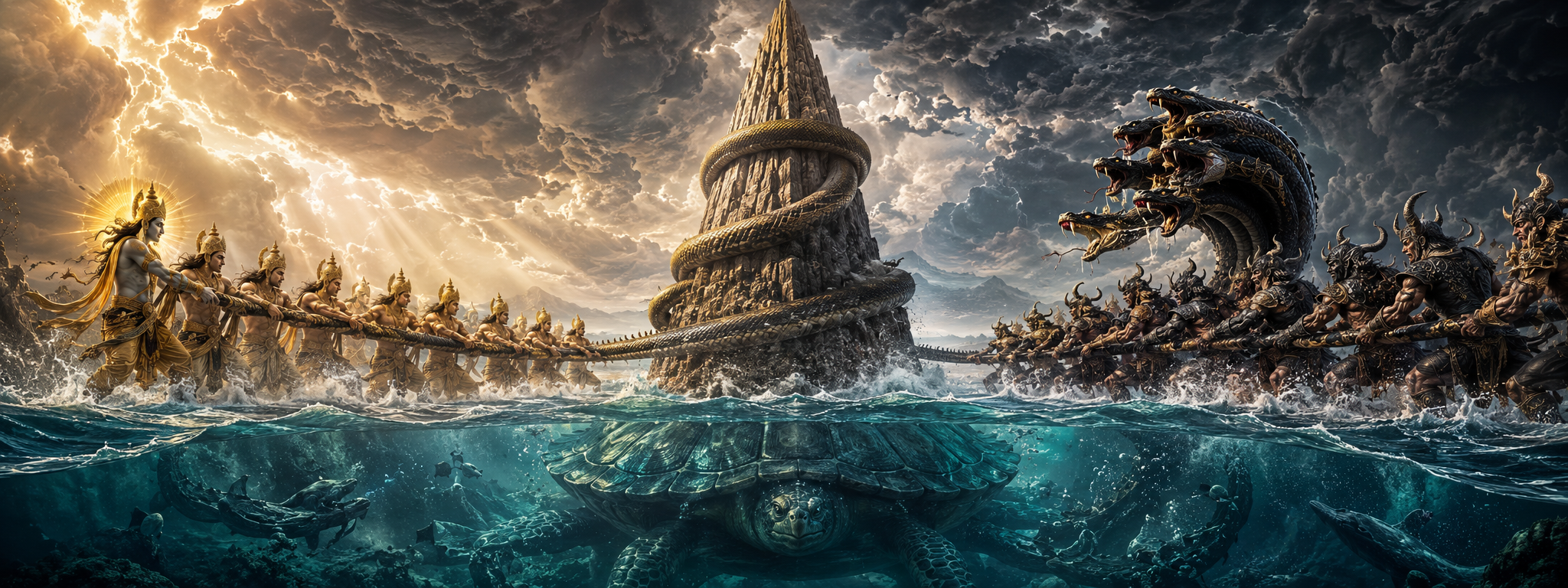
The Samudra Manthana — the Churning of the Cosmic Ocean — is the most elaborate event in the entire sequence of twelve wars, and the only one that begins as a cooperative enterprise between the Devas and the Asuras. It is an alliance born of necessity, sustained by mutual ambition, and destined to collapse the moment its ultimate prize appears. The war it generates is not fought with armies or weapons but with deception, transformation, and the most carefully timed act of cosmic misdirection in all of Puranic literature.
It is also the richest single episode in terms of what it produces. Fourteen distinct treasures emerge from the churned ocean — divine beings, sacred objects, animals, and substances — each of which becomes a permanent fixture of the Puranic cosmos. The Samudra Manthana is, in this sense, a creation myth embedded within a war narrative: the churning does not merely resolve a crisis but actively generates the divine infrastructure of the present universe.
Background & Cause — The Curse of Durvasa
The Samudra Manthana was set in motion by an act of carelessness. The sage Durvasa — famous in Puranic literature for the volcanic fury of his curses — was wandering through the heavens when he encountered Indra, king of the gods, riding his divine elephant Airavata. Durvasa offered Indra a garland of flowers from the Nandana garden, imbued with divine fragrance and power. Indra accepted it — and then placed it on Airavata's head, who swatted it off his forehead to the ground.
Durvasa's response was immediate and devastating. He cursed Indra and all the Devas: let the prosperity, strength, and vitality that Lakshmi embodies depart from you entirely. The curse took effect at once. The Devas began to lose their divine energy — their weapons lost power, their sacrifices bore no fruit, their minds grew confused and their bodies weak. The Asuras, sensing their opportunity, launched an offensive that swept the Devas out of Svargaloka entirely.
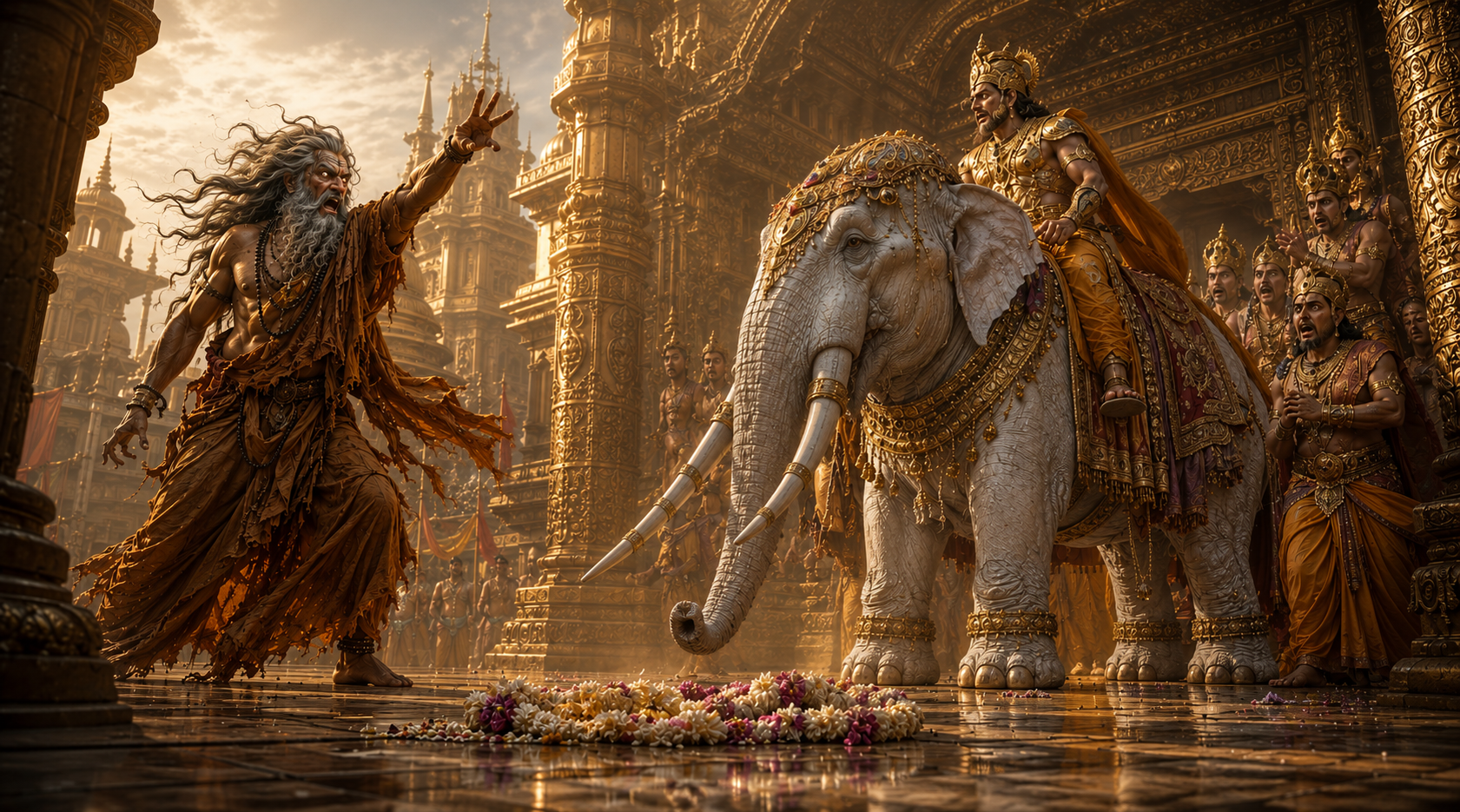
The curse of Durvasa — a moment of carelessness that would set the entire cosmic order into crisis and ultimately produce fourteen divine treasures.
The dispossessed Devas went to Brahma, who directed them to Vishnu. Vishnu's counsel was unexpected: make peace with the Asuras, he said, and propose a joint enterprise. Churn the cosmic ocean — the Kshirasagara, the Ocean of Milk — using Mount Mandara as a churning rod and the great serpent Vasuki as a rope. From the churning will emerge the Amrita, the nectar of immortality. Share everything that emerges — except the Amrita, which I will ensure reaches only you. The Asuras would be enlisted as co-labourers in their own eventual defeat.
The Churning Apparatus
The logistics of churning the cosmic ocean required divine engineering on a scale commensurate with the task. Mount Mandara — one of the great cosmic mountains, eighty-four thousand yojanas tall above the earth and eighty-four thousand below — was uprooted and carried to the ocean. But when it was placed in the water, it began to sink. Vishnu, taking the form of the Kurma (tortoise) avatar, dived beneath it and supported it on his back, giving the churning rod a foundation in the depths.
Vasuki — the great king of serpents, who wears Shiva's form as an ornament — was wound around Mount Mandara as the churning rope. The arrangement of the two sides was itself a matter of strategic calculation by Vishnu: the Asuras insisted on holding the head end of Vasuki (the more prestigious position), not realising that the serpent's fiery breath would exhaust and weaken them throughout the churning. The Devas held the tail end — the less honoured position, and the advantageous one.
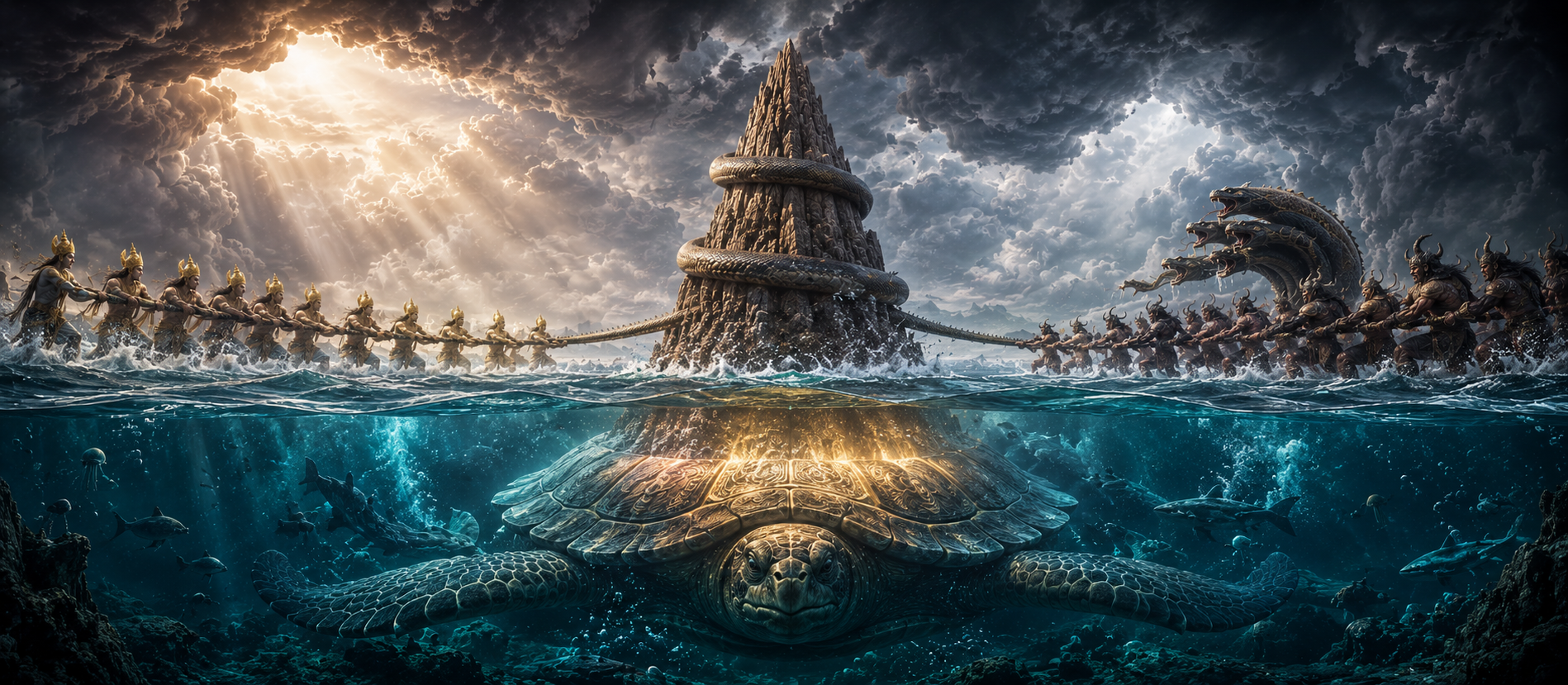
The Kurma avatar — Vishnu as cosmic tortoise — supporting Mount Mandara from the ocean floor, preventing it from sinking and making the churning possible.
The Fourteen Treasures of the Ocean
The churning proceeded with enormous effort on both sides — the Devas and Asuras pulling Vasuki back and forth, the mountain rotating and churning the ocean. What emerged did so in sequence, each treasure arising from the deepening churning of the primordial waters. The Bhagavata Purana, Vishnu Purana, and Mahabharata all provide lists, with minor variations in order and composition. The following reflects the most widely attested sequence.
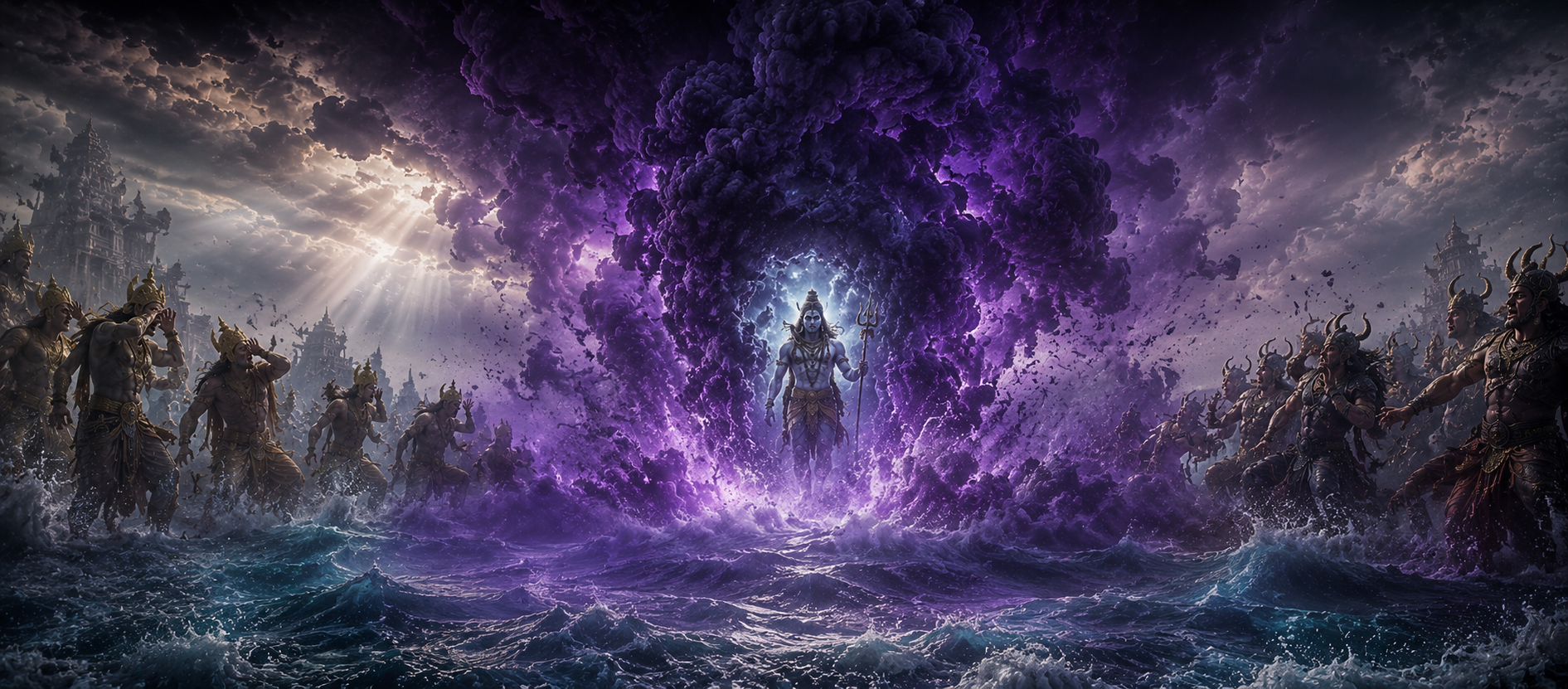
The Halahala — the first emergence from the churning — was not a treasure but a catastrophe: a poison so lethal it threatened to destroy all of creation before the Amrita could be reached.
| # | Treasure | Sanskrit Name | What It Is / Significance |
|---|---|---|---|
| 1 | Halahala Poison | Hālāhala | Lethal cosmic poison; threatened to destroy all life. Shiva consumed it to save the universe, holding it in his throat — turning his throat blue and earning the name Nilakantha (blue-throated). |
| 2 | Kamadhenu | Kāmadhenu | The wish-fulfilling divine cow; given to the sages to provide the butter needed for yajnas. |
| 3 | Ucchaishravas | Uccaiḥśravas | The divine white horse; claimed by the Asura king Bali (a different Bali from Mahabali). Later became the model of the ideal horse. |
| 4 | Airavata | Airāvata | The divine white elephant with four tusks; became Indra's mount — the same elephant that had disrespected Durvasa's garland and caused this entire sequence of events. |
| 5 | Kaustubha Gem | Kaustubha | The most brilliant jewel in the universe; claimed by Vishnu and worn forever on his chest. |
| 6 | Parijata Tree | Pārijāta | The divine flowering tree of Svargaloka, whose flowers never wither; planted in Indra's garden. |
| 7 | Apsaras | Apsaras | The celestial dancers and musicians of Svargaloka; many in number, of extraordinary beauty — neither Devas nor Asuras claimed them exclusively. |
| 8 | Varuni (Sura) | Vāruṇī / Surā | The goddess of wine; accepted by the Asuras — giving the Asuras their association with sura (wine) and by negation giving the Devas the name Asura (those who refused sura). The etymology is debated but preserved in multiple Puranas. |
| 9 | Chandra (Moon) | Candra | The moon god, emerging in his full brilliance; claimed by Shiva and placed on his matted hair — explaining the moon's association with Shiva in iconography. |
| 10 | Sharnga Bow | Śārṅga | The divine bow; claimed by Vishnu as his weapon. |
| 11 | Dhanvantari | Dhanvantari | The divine physician, emerging with the pot of Amrita in his hands — healer of the gods, originator of Ayurveda. His emergence holding the Amrita triggers the second phase of the war. |
| 12 | Lakshmi | Lakṣmī | The goddess of prosperity and divine grace — Vishnu's consort — emerging in full radiance from the ocean. Her emergence is accompanied by the singing of the Gandharvas and the showering of celestial flowers. She chose Vishnu as her consort from among all assembled beings. |
| 13 | Varuna's Wine Pot | Vāruṇa Kalaśa | A pot of divine wine from Varuna's ocean; mentioned in some accounts as a separate emergence. |
| 14 | Amrita | Amṛta | The nectar of immortality — the ultimate object of the entire enterprise. Its emergence in Dhanvantari's hands immediately precipitates the collapse of the Deva-Asura alliance and the second phase of the war. |
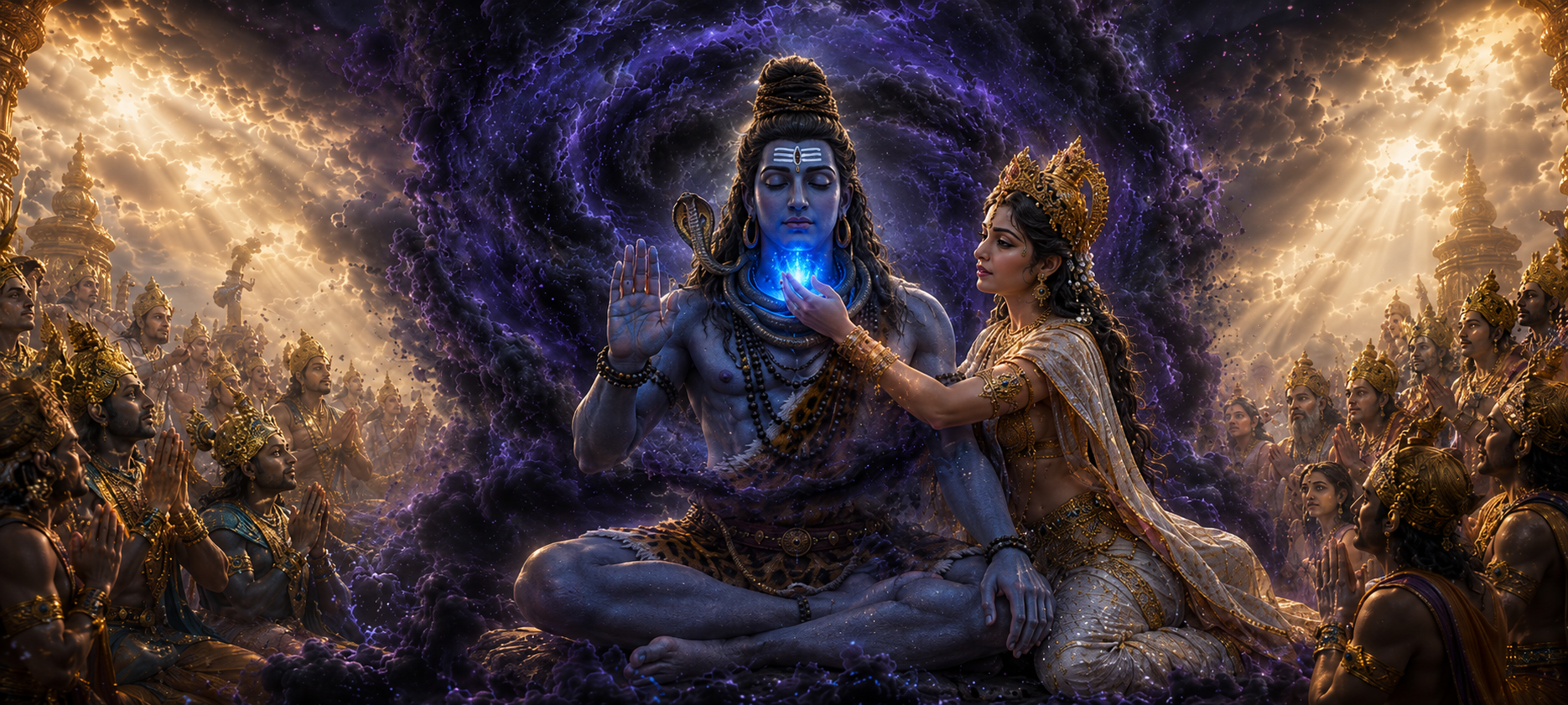
Shiva as Nilakantha — the blue-throated one — holding the cosmic poison that would have destroyed the universe. The blue of his throat is among the most recognisable elements of Shaiva iconography.
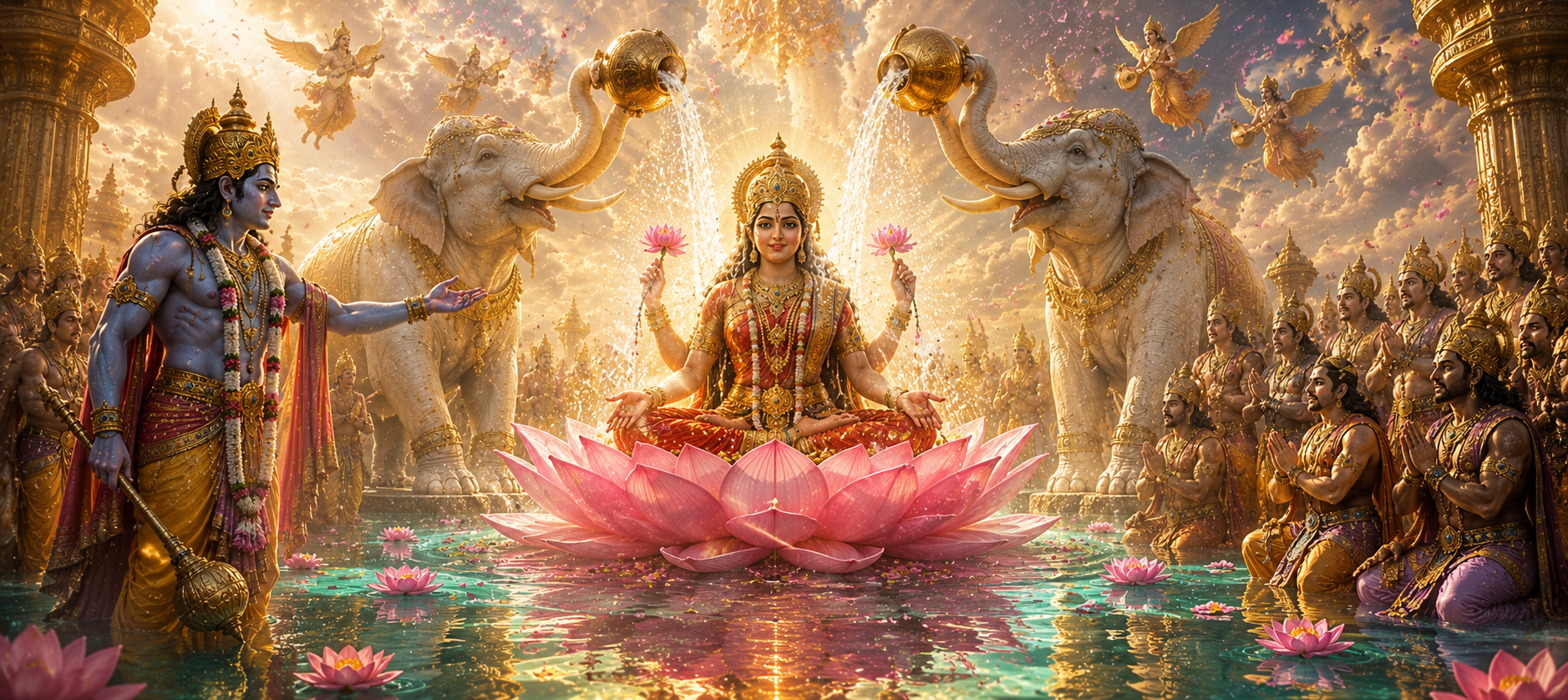
The emergence of Lakshmi from the Samudra Manthana is among the most celebrated moments in all of Puranic narrative — the goddess of cosmic prosperity choosing Vishnu as her eternal consort.
The Collapse of the Alliance — Dhanvantari and the Amrita
The alliance held through eleven treasures. It collapsed the instant the twelfth appeared. When Dhanvantari rose from the ocean carrying the Amrita in his golden pot, the Asuras snatched it immediately and fled. The cooperative enterprise of the Samudra Manthana was over. What began as a joint venture was now a war — the Devas pursuing the Amrita, the Asuras defending possession of it.
The Asuras fell to quarrelling among themselves over which of them should drink first, and who should guard the pot. Different Asura factions began to pull the pot in different directions. In the midst of this chaos, Vishnu intervened — in the form most unexpected and most irresistible possible.
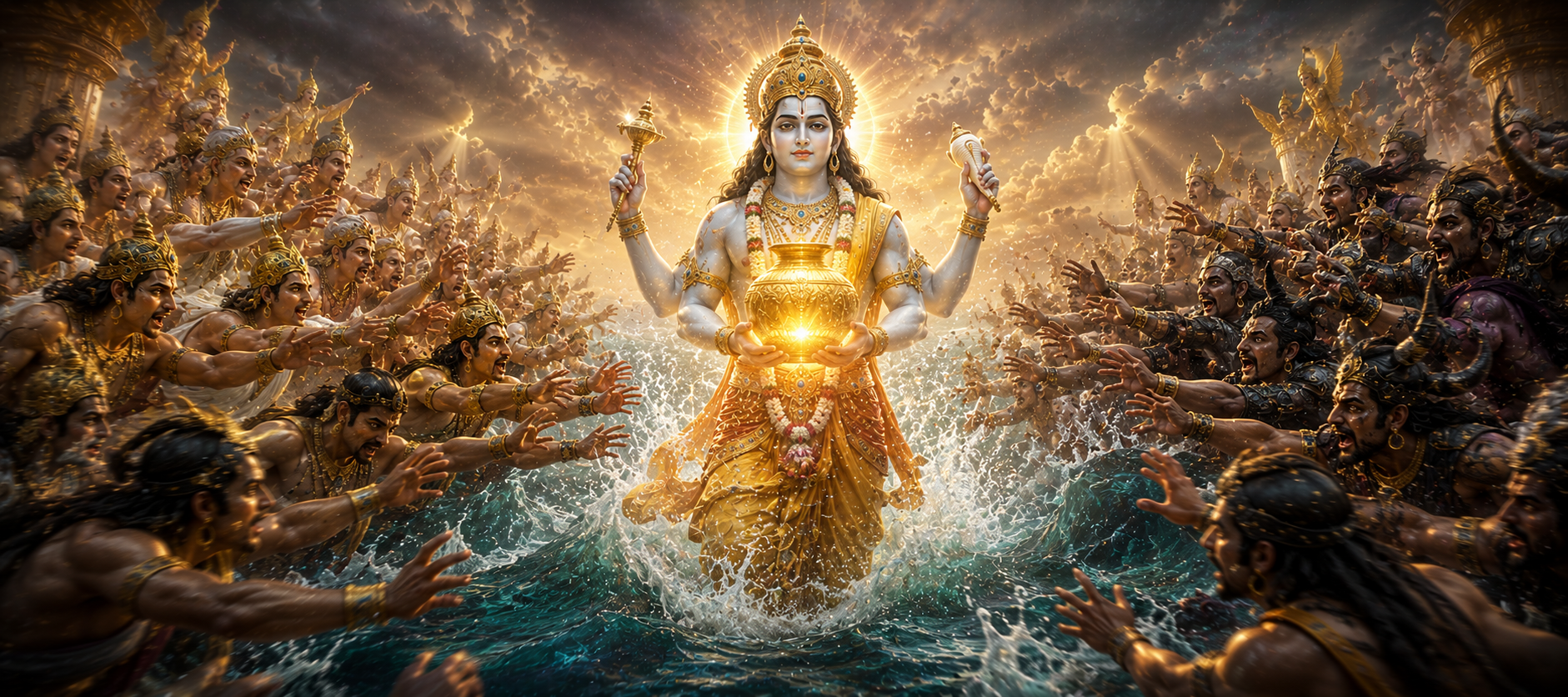
The emergence of Dhanvantari with the Amrita — the moment the Samudra Manthana transformed from a cooperative churning into a war for immortality.
Mohini — The Divine Enchantress
Vishnu took the form of Mohini — a woman of such extraordinary beauty that every Asura who saw her lost all capacity for rational thought. He approached the quarrelling Asuras, who immediately forgot their argument, forgot the Amrita, and forgot everything except their desire to impress this apparition. They agreed to let her distribute the nectar fairly between Devas and Asuras.
Mohini arranged the Devas and Asuras in separate rows and began to distribute the Amrita — moving down the row of the Devas, pouring a share for each one, entertaining the Asuras with glances and conversation that kept them distracted. She distributed the entire pot to the Devas and gave the Asuras nothing but her attention.
One Asura saw through the deception. Svarbhanu disguised himself as a Deva and sat in their row, receiving a share of the Amrita. The moment the nectar touched his lips, the sun and moon — who were seated nearby — recognised him and alerted Vishnu. He immediately threw his Sudarshana Chakra and severed Svarbhanu's head from his body. But the Amrita had already touched his throat. Both the head and the body became immortal — becoming Rahu (the head) and Ketu (the tail), the celestial shadow bodies that cause eclipses by perpetually pursuing the sun and moon in revenge.
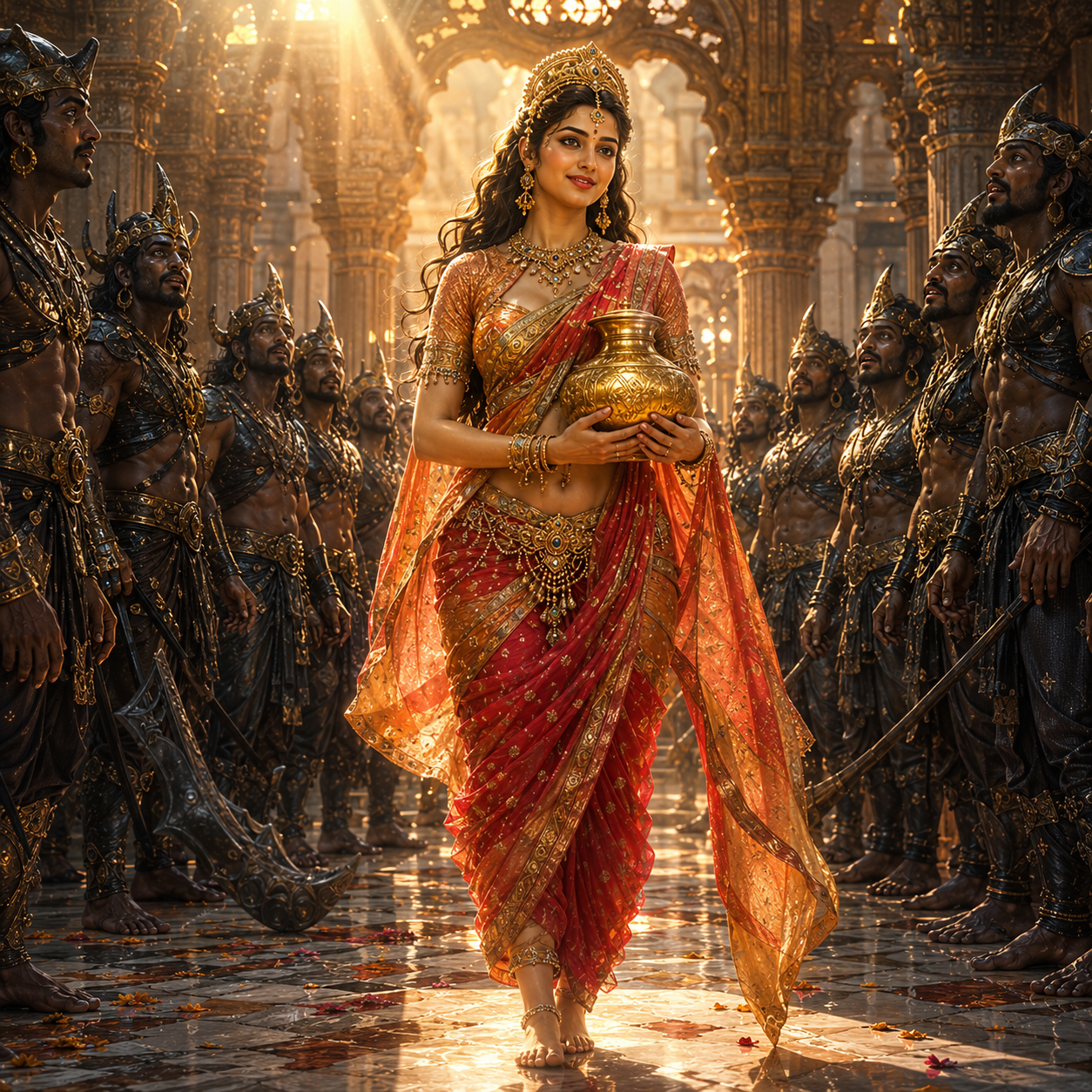
Mohini — Vishnu's most celebrated transformation — turned the Asuras' own desire against them, securing the Amrita through enchantment where force alone could not have succeeded.
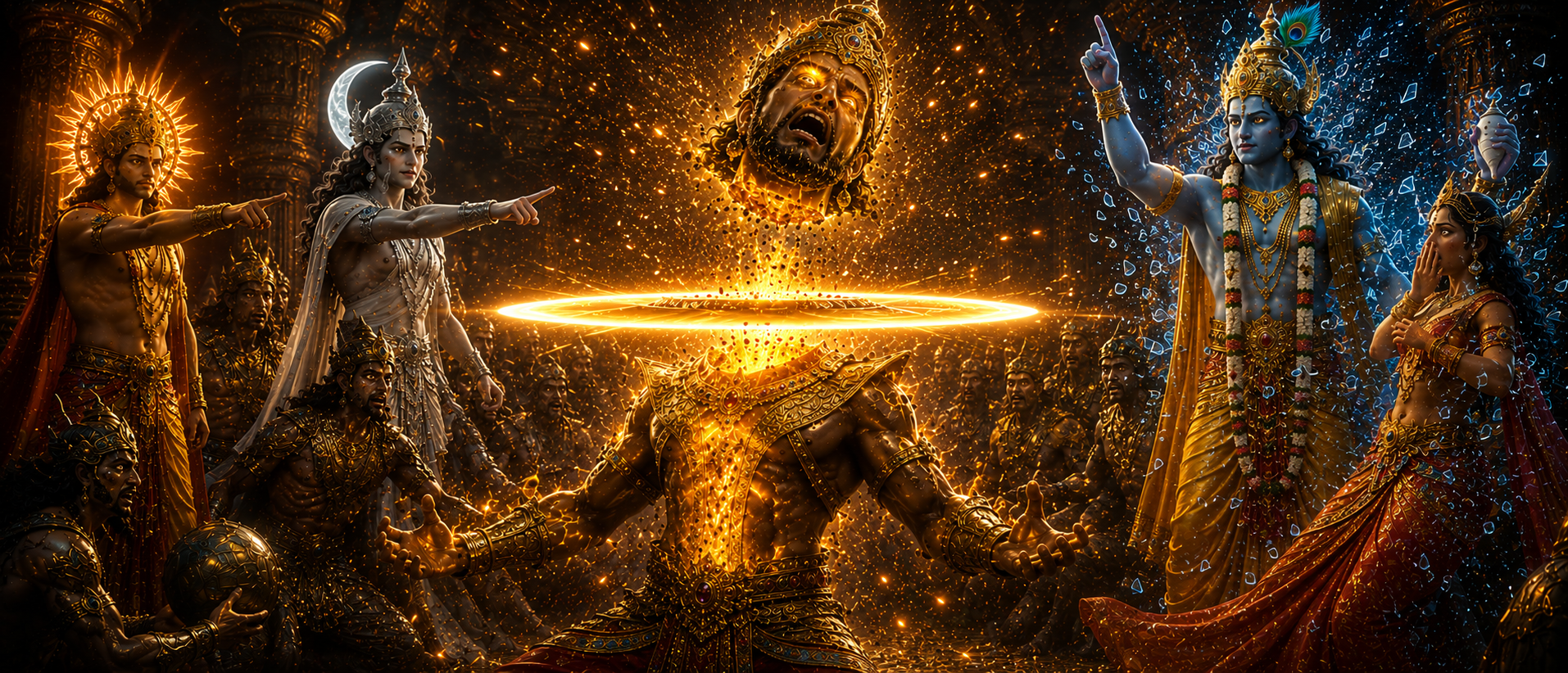
The origin of Rahu and Ketu — the shadow bodies that cause eclipses — is a direct consequence of the Samudra Manthana. Their eternal pursuit of the sun and moon is the cosmic memory of Svarbhanu's thwarted immortality.
The Battle for the Amrita
When the Asuras realised they had been deceived — that the beautiful woman had given the entire Amrita to the Devas and left them with nothing — they were furious. They recovered the Amrita pot and the battle began in earnest: a full-scale war between the now-immortal Devas and the still-mortal Asuras for possession of the nectar.
The outcome was no longer in doubt. The Devas, fortified by the Amrita, fought with renewed power. Vishnu abandoned the Mohini form and took up his own weapons. The Asuras, denied the nectar and exhausted from the churning, were routed. The Amrita was secured. The Devas returned to Svargaloka and the cosmic order, disrupted by Durvasa's curse and the Asura conquest, was restored.
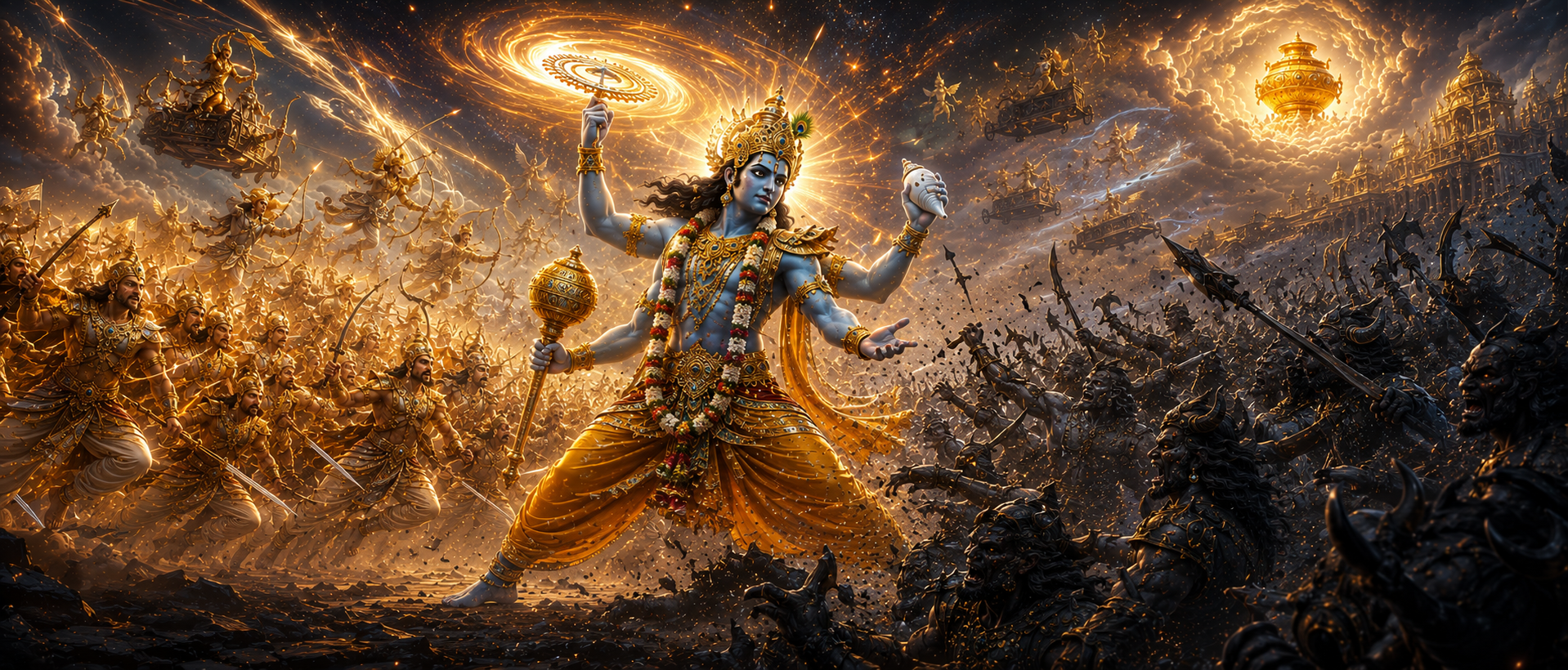
The second phase of the Samudra Manthana — the war for the Amrita — was brief and decisive. The Devas, now immortal, could not be defeated by Asuras who had been denied the nectar.
"The Devas and Asuras churned the ocean together as if they were friends. But it was never friendship — it was two sides of a single rope, each pulling toward a prize that could only go to one."
Bhagavata Purana, Skandha VIIIKey Participants
Deva Side
The Gods
- Vishnu — Architect of the entire plan; supports Mandara as Kurma; later deceives the Asuras as Mohini; fights in the final battle. The unseen hand throughout.
- Indra — King of the Devas; whose carelessness with Durvasa's garland started the crisis; restored to Svargaloka at the end.
- Shiva — Consumes the Halahala poison to save the universe; receives the moon as it emerges from the churning.
- Brahma — Mediates and advises; does not participate directly in the churning or the battle.
- Sun and Moon — Identify Svarbhanu's disguise, precipitating the Rahu-Ketu episode.
Asura Side
The Demons
- Bali (Asura king) — Not the same as the virtuous Mahabali of War IV; leads the Asuras as co-churners and later as claimants of the Amrita.
- Svarbhanu — The Asura who infiltrated the Deva row to steal the Amrita; decapitated by Vishnu's Sudarshana Chakra; his immortal head and body become Rahu and Ketu.
- Shukracharya — Preceptor of the Asuras; present throughout; unable to prevent their eventual deception by Mohini.
- Vasuki — The serpent king who serves as the churning rope; technically a participant on neither side, though his position (head-end to Asuras) causes them suffering throughout.
Outcome Summary
Military result: Deva victory in the second phase. The Asuras were defeated in the battle for the Amrita after being deprived of it through Mohini's deception. The Devas, now immortal, returned to Svargaloka.
Cosmic products: Fourteen divine treasures including Kamadhenu, Airavata, Lakshmi, the Kaustubha gem, Dhanvantari, and the Amrita permanently entered the Puranic universe. Shiva's consumption of the Halahala created Nilakantha iconography. The origin of Rahu and Ketu as eclipse-causers was established. The Ganga's heavenly origin was reinforced in War IV's connection to Trivikrama's stride.
Theological significance: The Samudra Manthana is the Puranic tradition's most elaborate statement on the nature of cosmic cooperation and betrayal — that even the most bitter enemies can work together when their interests align, and that such alliances are inherently unstable. It is also the event that most clearly demonstrates Vishnu's role as the hidden director of cosmic history: not always fighting, often deceiving, always ensuring that dharma prevails.
Cosmic Significance
The Samudra Manthana is unique among the twelve wars in being simultaneously a creation event and a conflict. Virtually every major divine being and sacred object in the Puranic universe has its origin or its defining moment here — Lakshmi chose her consort, Shiva received the moon, Airavata was born, Dhanvantari established medicine, and the Ganga began its heavenly existence. The churning did not merely restore a disrupted order; it actively enriched the cosmos with new divine presences.
The war also establishes the definitive account of the Deva-Asura relationship: they are structurally opposed but cosmically interdependent. They cannot churn the ocean without each other — the ocean is too vast, the rope requires two sides, the task requires the full creative and destructive power of both orders of being. This interdependence is not resolved by the war's end; it is a permanent feature of the cosmos, which is why the sequence of Deva-Asura conflicts continues through War XII.
The Rahu-Ketu episode provides the mythological explanation for one of the most practically significant astronomical phenomena observed in ancient India — solar and lunar eclipses. By embedding this explanation within the Samudra Manthana narrative, the Puranas connect the observable cosmos to the mythological one with particular elegance: every eclipse is a reminder of the great churning, of what was gained and what was lost, and of one Asura's moment of successful deception that Vishnu could punish but not fully undo.
Textual Sources & Variants
The Samudra Manthana is one of the most widely narrated episodes in all of Sanskrit literature, appearing in detailed form from the Rigveda period onward. The Mahabharata's version in the Adi Parva is among the oldest extended prose accounts. The Bhagavata Purana's Skandha VIII provides the most theologically elaborate telling. The lists of fourteen treasures vary between sources — some list fewer, some combine entries differently.
| Source | Detail | Variant / Note |
|---|---|---|
| Bhagavata Purana Skandha VIII |
Fullest theological account: Durvasa's curse, Vishnu's plan, Kurma support, all fourteen treasures named, Shiva and the Halahala, Lakshmi's emergence and choice of Vishnu, Dhanvantari, Mohini deception, Svarbhanu/Rahu-Ketu, battle for Amrita, Deva restoration. | Primary theological source. Strongest Bhakti framing — Vishnu as the hidden director throughout. Most widely read version. |
| Mahabharata Adi Parva Ch. 15–17 |
One of the earliest extended prose accounts; thirteen treasures listed (some entries combined differently); Mohini episode present but briefer; focus more on the churning mechanics and the treasure sequence than on the theological meaning. | Oldest major narrative version. No Durvasa curse as the cause — the churning is motivated differently (the Devas simply want the Amrita). The framing is more martial epic than devotional theology. |
| Vishnu Purana Book I |
Full account present; broadly consistent with Bhagavata. Durvasa curse present as cause. Fourteen treasures listed with some variation in order. | Slightly less elaborate on the Mohini episode; does not narrate Svarbhanu's infiltration in as much detail. |
| Matsya Purana |
Full account; some variation in the treasure list — Sharnga bow placed differently in sequence; Varuni's emergence and the etymology of Deva/Asura names given slightly different treatment. | More emphasis on the cosmic scale of the churning itself and less on the individual treasures' subsequent histories. |
| Ramayana Bala Kanda |
Samudra Manthana narrated by the sage Vishvamitra to Rama as background mythology; briefer but consistent with core facts. | Confirms the story's status as established shared mythology by the Ramayana's composition period. |
References
Primary Sources
- Bhagavata Purana — Skandha VIII, Chapters 5–12 (Durvasa curse, churning setup, fourteen treasures, Mohini, Rahu-Ketu, battle for Amrita, Deva restoration)
- Mahabharata, Adi Parva — Chapters 15–17 (one of the oldest prose accounts of the Samudra Manthana)
- Vishnu Purana — Book I, Chapters 9–10 (full churning narrative; treasure list)
- Matsya Purana — Chapters 249–252 (Samudra Manthana; variant treasure sequence)
- Valmiki Ramayana, Bala Kanda — Chapter 45 (Vishvamitra's narration to Rama)
- Brahmanda Purana — Varaha Kalpa section (Samudra Manthana named fifth in the twelve-war list)
Secondary Sources
- Mani, Vettam. Puranic Encyclopaedia. Motilal Banarsidass, 1975. Entries: "Samudra Manthana," "Amrita," "Dhanvantari," "Mohini," "Rahu," "Ketu," "Nilakantha."
- Tagare, G. V. (trans.). The Bhagavata Purana. Motilal Banarsidass, 1976. Skandha VIII.
- Ganguli, K. M. (trans.). The Mahabharata. Pratap Chandra Roy, 1883–1896. Adi Parva.
- Dimmitt, Cornelia and J. A. B. van Buitenen (eds. and trans.). Classical Hindu Mythology. Temple University Press, 1978. (Chapter on the churning of the ocean.)
- O'Flaherty, Wendy Doniger. Hindu Myths. Penguin, 1975. (Translation and analysis of the Samudra Manthana from multiple sources.)