
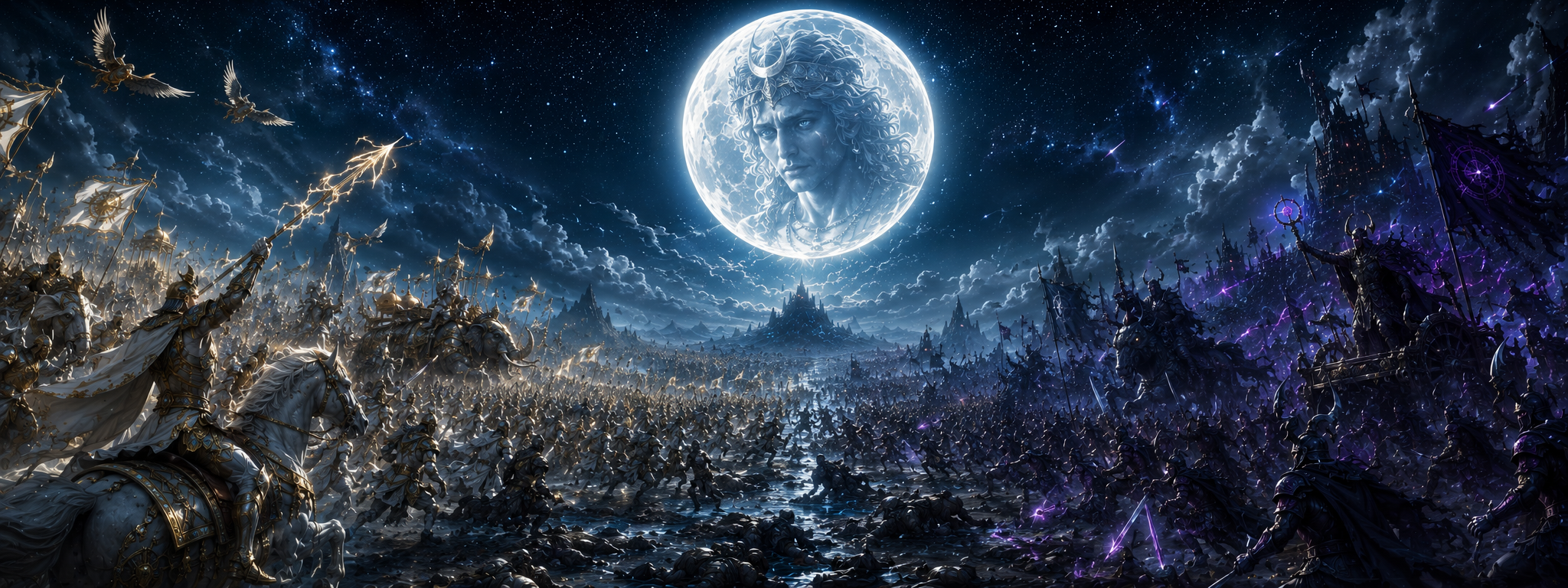
The Tarakamaya War is the most morally ambiguous conflict in the entire sequence of twelve. Every preceding war had a clear aggressor: an Asura or demon who had committed an act of cosmic disruption — seizing the Earth, tyrannising the three worlds, blocking the waters of creation. The Tarakamaya War begins with an act committed not by a demon but by a god: Soma, the moon, who abducted Tara, the wife of Brihaspati, the preceptor of the very gods who would be drawn into fighting on his behalf.
What followed was the largest alliance war in the twelve — a conflict that drew in virtually every major celestial power, divided them along lines that cut across the usual Deva-Asura boundary, and produced, in its aftermath, one of the most significant figures in all of Puranic genealogy: Budha, the planet Mercury, ancestor of the entire Chandravamsha lunar dynasty from which the Pandavas and Kauravas of the Mahabharata would descend.
Background & Cause — Soma's Transgression
Brihaspati — Angiras's son, the divine preceptor of the gods — was one of the most revered sages in the Puranic cosmos. As guru of the Devas, his household was under the protection of divine law. His wife Tara was among the most beautiful beings in the three worlds — and Soma, the moon god, desired her.
Despite every appeal — from Brihaspati himself, from the assembled Devas, from Brahma — Soma refused to return Tara. The Puranas do not fully explain the moon's reasoning; what they convey is an uncharacteristic obstinacy from a deity who was otherwise associated with grace, coolness, and the sustaining energy of the plant world. Whatever his motive, Soma's refusal to release Tara despite the authority of Brahma himself constitutes one of the most severe violations of dharmic order in the Puranic record.
The crisis forced an alignment that was structurally strange. Shukracharya — preceptor of the Asuras and perennial adversary of the Devas — sided with Soma out of what the texts describe variously as personal enmity with Brihaspati or as a calculated strategy to weaken the Deva side by prolonging the conflict. The Daityas and Danavas rallied to Shukracharya's banner. On the other side, Indra and the Devas joined Brihaspati in demanding Tara's return. Even Rudra, who had been a recipient of Soma's soma-offerings, initially sided with Soma before being persuaded by Brahma to withdraw.
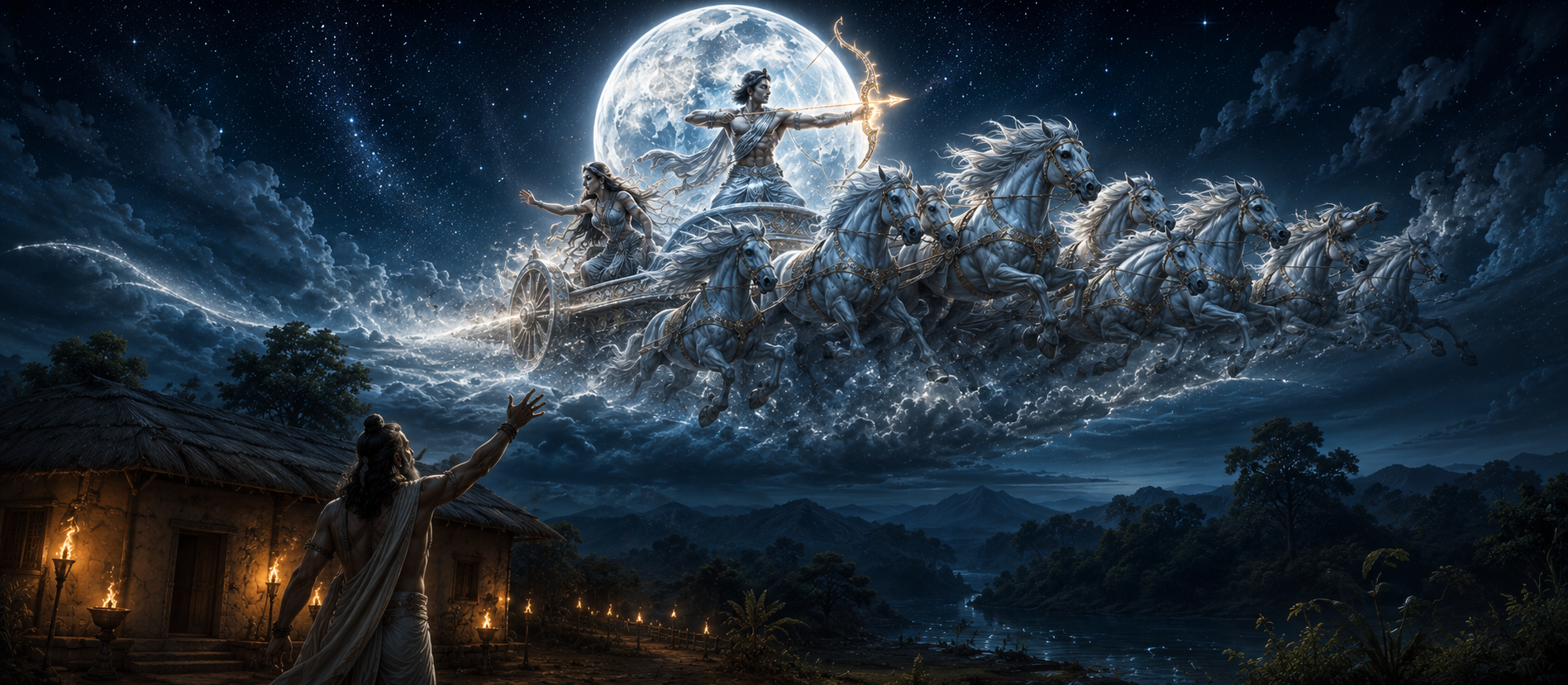
Soma's abduction of Tara — wife of the divine preceptor Brihaspati — is one of the most scandalous acts by a god in all of Puranic literature, and the direct trigger of the Tarakamaya War.
The Alliances — A War That Cut Across All Lines
What made the Tarakamaya War unusual was the composition of its two sides. This was not a straightforward Deva-Asura conflict. The alignment of forces reflected personal allegiances, old enmities, and the specific outrage that Soma's act had produced among those who upheld dharmic law.
| Side | Participants | Reason for Alignment |
|---|---|---|
| Pro-Brihaspati (Deva side) |
Indra and the Devas; the Angiras sages (Brihaspati's kinsmen); Vishnu; initially Brahma as mediator | Defence of dharmic order — the inviolability of a guru's household and the requirement to return an abducted wife on demand by the sage community and Brahma. |
| Pro-Soma (Asura side) |
Soma himself; Shukracharya and the Asuras; the Daityas; the Danavas; initially Rudra | Shukracharya's enmity with Brihaspati; the Asuras' standing opposition to the Devas; Soma's personal network of alliances from the distribution of soma-offerings. |
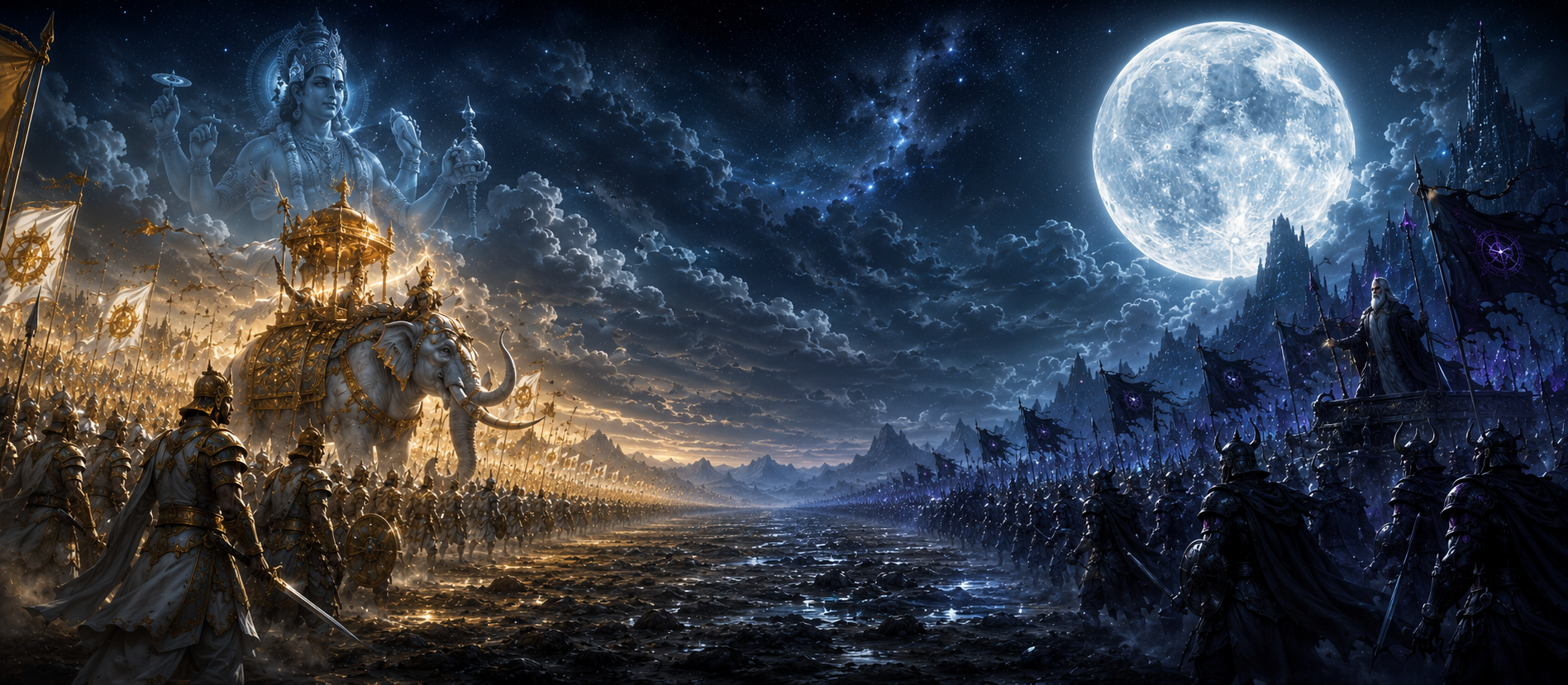
The Tarakamaya War was the largest alliance conflict in the twelve wars — virtually every major celestial power choosing a side in a dispute that began with the moon god's personal transgression.
Key Combatants
Pro-Brihaspati Forces
The Deva Alliance
- Indra — Commander of the Deva forces; leads the campaign to compel Soma's compliance. Wields the Vajra; commands the celestial army.
- Brihaspati — The aggrieved party; does not fight personally but is the moral cause of the war. His authority as guru of the gods gives his cause an unassailable dharmic standing.
- Vishnu — Supports the Deva side; his presence signals where cosmic dharma ultimately lies in this dispute.
- The Angiras sages — Brihaspati's kinsmen; join the campaign in solidarity with their lineage head.
Pro-Soma Forces
The Asura Alliance
- Soma — The moon god; the cause of the war and its most morally compromised figure. Possessed of great celestial power but fighting in defence of an indefensible position.
- Shukracharya — Preceptor of the Asuras; the strategic architect of the Asura alliance; his enmity with Brihaspati makes the conflict partly a guru-rivalry played out on the cosmic stage.
- The Daityas and Danavas — The Asura armies; align with Shukracharya as their habitual ally against the Deva order.
- Rudra (initially) — Allied with Soma at first due to soma-offering bonds; later withdraws under Brahma's authority.
The War
The Tarakamaya War was long and inconclusive in its military dimension. The two sides were too evenly matched for either to achieve decisive victory — the Asuras' numbers and Shukracharya's strategic skill balanced against the Devas' divine weapons and Indra's fury. The texts describe prolonged fighting across the celestial planes, with heavy losses on both sides and no resolution in sight.
The war's actual turning point came not from combat but from authority. Brahma — who had been appealing to Soma from the beginning — finally intervened with the full weight of his creative sovereignty. He commanded Soma to return Tara, making clear that the continued prosecution of the war over so clear a dharmic violation was inexcusable. This time, Soma complied.
But the return of Tara raised an immediate and painful question. She was found to be pregnant. And the question of the child's paternity — Soma's or Brihaspati's — became the second crisis of the war, as both claimed the child. The assembled gods and sages demanded that Tara speak. After initial silence — the Bhagavata Purana presents her hesitation as one of the most poignant moments in the narrative — she acknowledged that the child was Soma's.
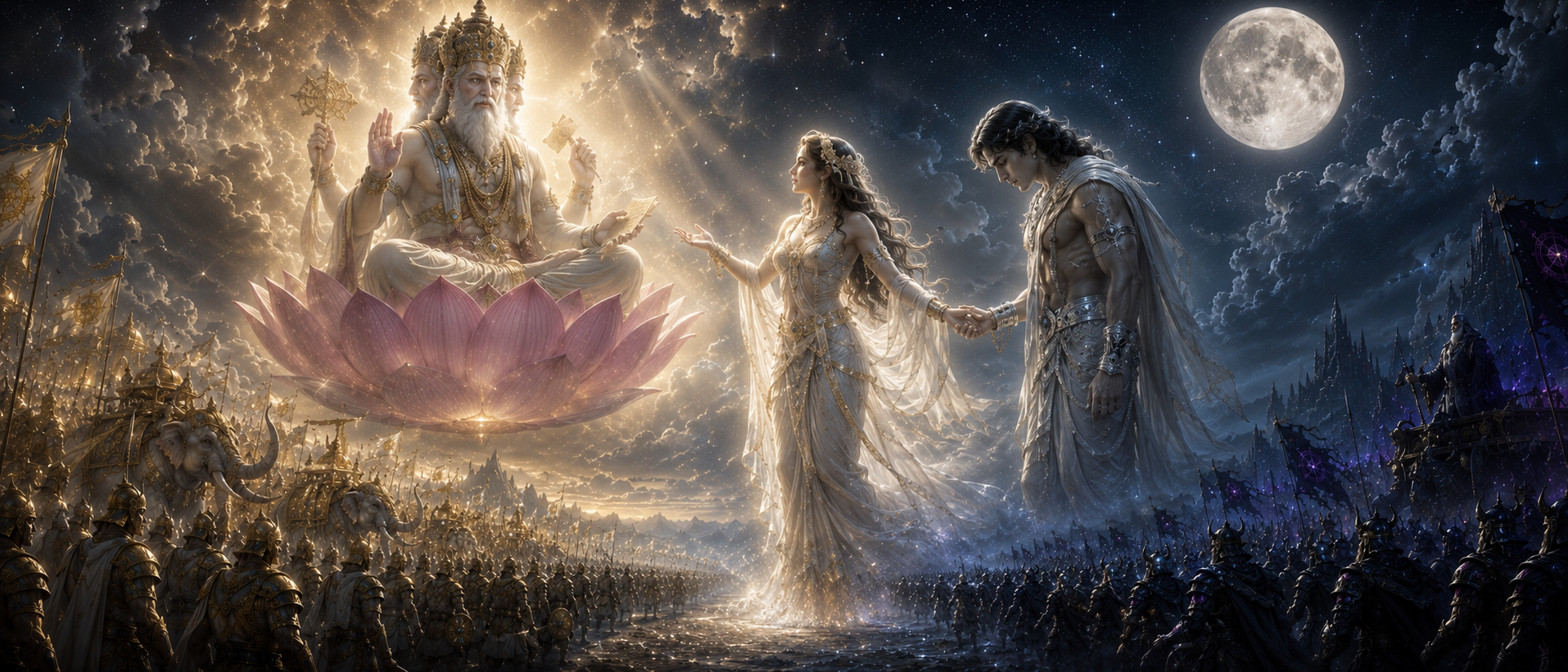
Brahma's direct intervention ended what military force could not — compelling Soma's compliance through the weight of creative authority that no being in the cosmos could refuse.
"All the sages and gods demanded of Tara — who is the father of this child? She was silent for long. When they pressed her, she said softly: it is Soma's. Brihaspati turned away. Soma wept."
Matsya PuranaBudha — The Child the War Produced
The child born was Budha — the planet Mercury, the most intellectually brilliant of the nine planetary beings (Navagrahas). Despite the circumstances of his birth, Budha was recognised from infancy as possessed of extraordinary mental gifts — the Puranas describe him as radiating intelligence in the way that Soma radiates light.
Budha's significance extends far beyond the war itself. He would later marry Ila — daughter of Manu Vaivasvata and first sovereign of the Solar dynasty — and from their union was born Pururavas, the first king of the Lunar dynasty. Through Pururavas, Budha became the progenitor of the entire Chandravamsha — the lineage that would eventually produce the Yadavas, the Pandavas, and the Kauravas, making the Tarakamaya War one of the genealogical foundations of the entire Mahabharata.
The Tarakamaya War thus ends not with the resolution of a military conflict but with the birth of a child — whose very existence embodies both the scandal and the creativity of the war's cause. Budha is simultaneously the product of Soma's transgression and one of the most important ancestral figures in all of Puranic genealogy.
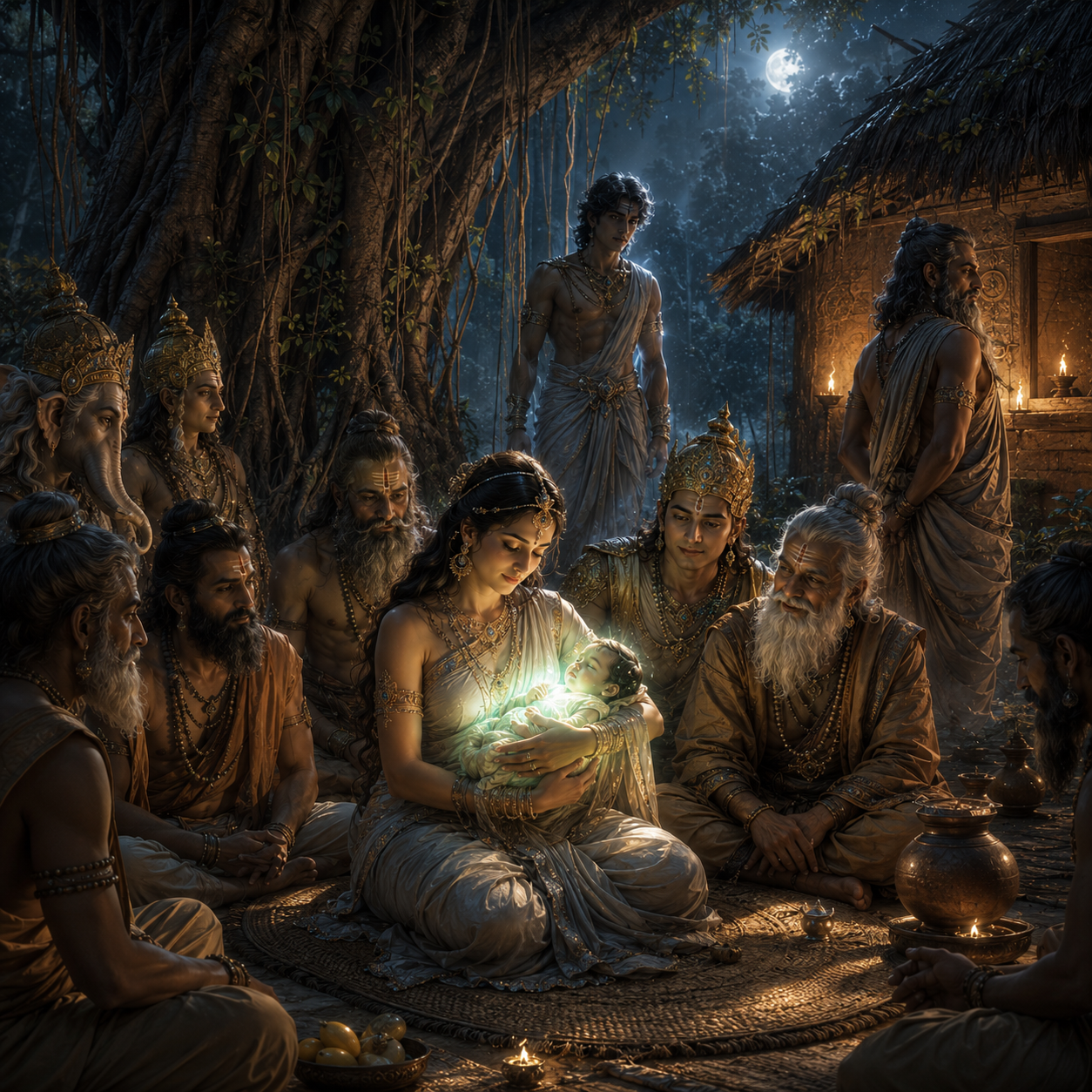
The birth of Budha — product of Soma's transgression and one of the most consequential figures in Puranic genealogy — as the living resolution of the Tarakamaya War.
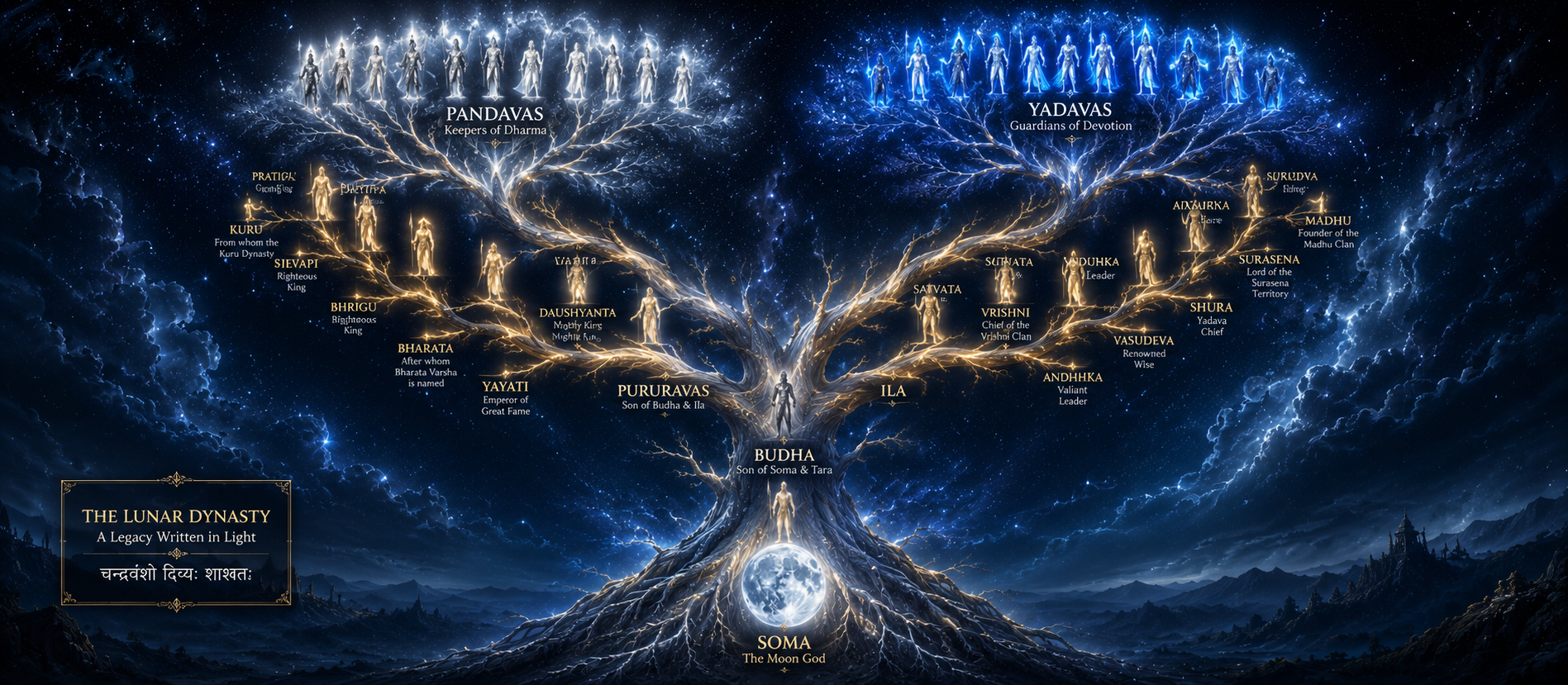
The genealogical legacy of the Tarakamaya War — Budha's descendants form the entire Chandravamsha lunar dynasty, making this war one of the foundational events of the Mahabharata's ancestry.
Outcome Summary
Military result: Inconclusive in combat; resolved by Brahma's direct intervention. Soma returned Tara to Brihaspati's hermitage. The Asura alliance dispersed. The Devas returned to Svargaloka.
Personal consequences for Soma: Brahma cursed Soma for his obstinacy — the moon's waxing and waning (the lunar phases) is explained in the Puranas as the result of this curse: Soma loses his light progressively as punishment and regains it as the curse is periodically lifted. This mythological explanation for the lunar cycle is one of the Tarakamaya War's most enduring cosmological contributions.
Genealogical consequence: The child Budha, born of Soma and Tara, became the progenitor of the entire Chandravamsha lunar dynasty — the lineage of the Pandavas, Kauravas, and Yadavas. The Tarakamaya War is therefore one of the cosmological foundations of the Mahabharata itself.
Theological significance: The Tarakamaya War is the Puranic tradition's most direct examination of moral failure within the divine order. It does not involve a demon or an Asura as the primary transgressor. The disruption was caused by a god — Soma — whose desire overrode his dharmic obligations. The war's resolution through Brahma's authority rather than military force reinforces that cosmic order ultimately rests on creative sovereignty, not on power.
Cosmic Significance
The Tarakamaya War occupies a hinge position in the sequence of twelve conflicts. The first five wars all involved conflicts where the transgressor was recognisably an Asura or a demonic force — even the Samudra Manthana, despite its cooperative beginning, ended with the Asuras attempting to seize what was not rightfully theirs. The Tarakamaya War is the first in which the transgressor is a Deva — and not a minor one, but Soma, one of the most celebrated and hymned deities in the Vedic tradition.
This shift is theologically significant. It establishes that the dharmic order the twelve wars collectively defend is not the order of the Devas as such — it is a cosmic law that applies to all beings including the gods themselves. The Devas are not inherently righteous; they can be righteous or transgressive depending on their choices. The war's structure — Devas defending dharma against another Deva's transgression, with Asuras exploiting the disruption — is more complex than any of the preceding five conflicts.
The Tarakamaya War also establishes the mythological explanation for two observable astronomical phenomena: the lunar phases (Soma's waxing and waning as the result of Brahma's curse) and the planet Mercury's unusual position in the night sky (Budha, child of the moon, always moving close to the sun — explained as Budha remaining near his mother Tara, who returned to the sun-adjacent realm of the divine sages).
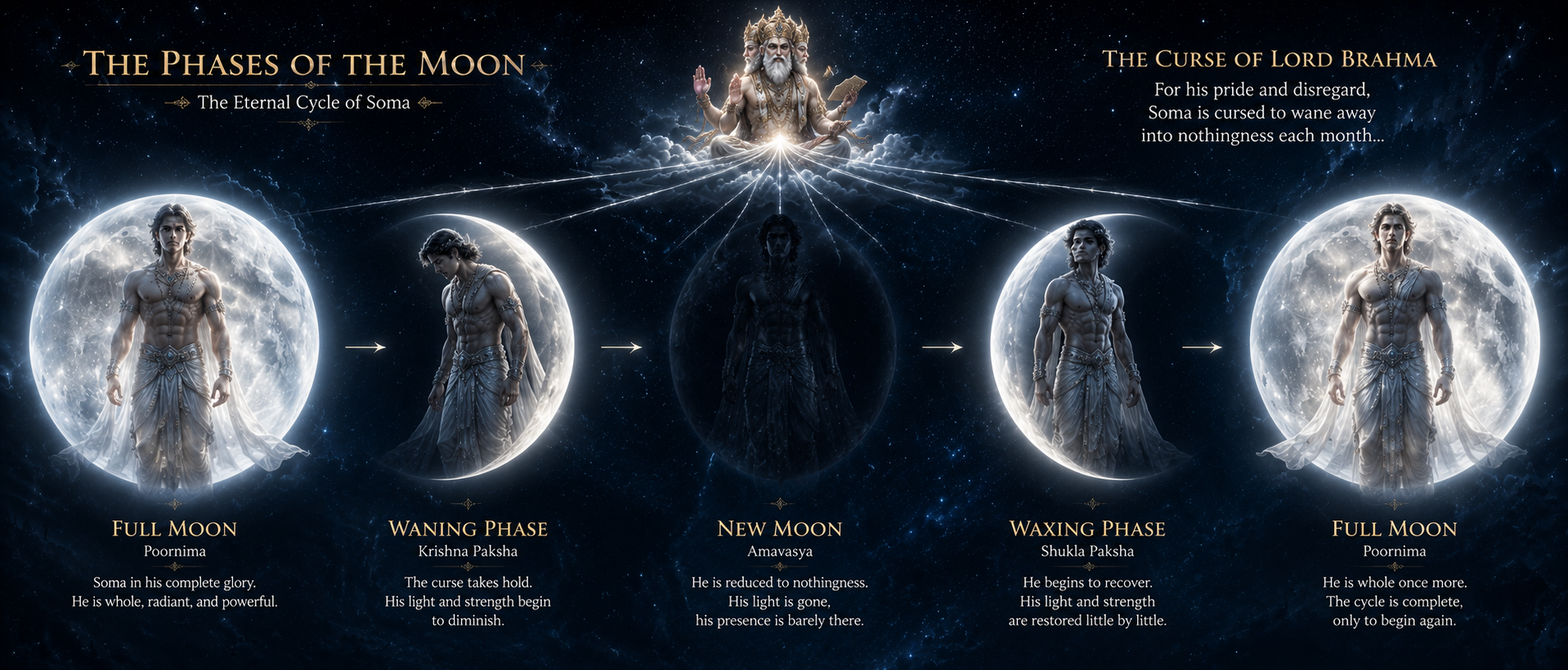
The waxing and waning of the moon — one of the most familiar phenomena in the night sky — is explained in the Puranic tradition as Brahma's ongoing curse upon Soma for the transgression that caused the Tarakamaya War.
Textual Sources & Variants
The Tarakamaya War is attested across several Mahapuranas and in the Mahabharata. The Matsya Purana provides the most detailed account; the Vishnu Purana has a full but slightly briefer version. The Mahabharata references the war in the Adi Parva as part of the genealogical background of the Chandravamsha. The Bhagavata Purana mentions it in the context of Budha's birth and the Chandravamsha lineage rather than narrating the war in full.
| Source | Detail | Variant / Note |
|---|---|---|
| Matsya Purana Ch. 23–24 |
Fullest narrative: Soma's abduction, Brihaspati's appeals, the alliances, Brahma's mediation, Tara's disclosure, Budha's birth and radiant character, Soma's curse and the lunar phases. Most detailed account of the military phase of the war. | Primary source for the war's military narrative. Most explicit account of Rudra's initial alignment with Soma and subsequent withdrawal. |
| Vishnu Purana Book IV, Ch. 6 |
Full account of the Tarakamaya War in the context of the Chandravamsha genealogy. Budha's birth and his marriage to Ila given extended treatment as the basis of the Lunar dynasty. | Frames the war primarily as the genealogical origin event of the Chandravamsha rather than as a cosmic conflict in its own right. Less detail on the military alliances. |
| Mahabharata Adi Parva Ch. 75 |
The Tarakamaya War referenced in the genealogical summary of the Chandravamsha; Soma, Tara, and Budha's birth mentioned but the war itself not narrated. | Treats the war as known prior tradition. Confirms its status as established mythology by the epic's composition period. |
| Bhagavata Purana Skandha IX |
Budha's birth from Soma and Tara mentioned in the Chandravamsha genealogy chapter; war not narrated in detail. | Focused on the genealogical consequence (Budha → Pururavas → Chandravamsha) rather than the war's narrative. |
| Brahmanda Purana |
Tarakamaya War named sixth in the list of twelve wars of the Varaha Kalpa; narrative detail limited. | Framework source; confirms the war's position in the canonical sequence of twelve. |
References
Primary Sources
- Matsya Purana — Chapters 23–24 (Tarakamaya War: fullest military and narrative account; Soma's curse and lunar phases)
- Vishnu Purana — Book IV, Chapter 6 (Tarakamaya War in the context of the Chandravamsha genealogy; Budha's birth and marriage to Ila)
- Mahabharata, Adi Parva — Chapter 75 (Chandravamsha genealogical summary; Tarakamaya War referenced)
- Bhagavata Purana — Skandha IX, Chapter 14 (Budha's birth; Chandravamsha lineage from Soma)
- Brahmanda Purana — Varaha Kalpa section (Tarakamaya War named sixth in the twelve-war list)
Secondary Sources
- Mani, Vettam. Puranic Encyclopaedia. Motilal Banarsidass, 1975. Entries: "Tarakamaya," "Soma," "Tara," "Brihaspati," "Budha," "Chandravamsha."
- Wilson, H. H. (trans.). The Vishnu Purana. Trübner & Co., 1865. Book IV.
- Tagare, G. V. (trans.). The Bhagavata Purana. Motilal Banarsidass, 1976. Skandha IX.
- Pargiter, F. E. Ancient Indian Historical Tradition. Oxford University Press, 1922. (On the Chandravamsha genealogy and its Puranic sources — Chapter on the Lunar dynasty.)
- Ganguli, K. M. (trans.). The Mahabharata. Pratap Chandra Roy, 1883–1896. Adi Parva, genealogical sections.