
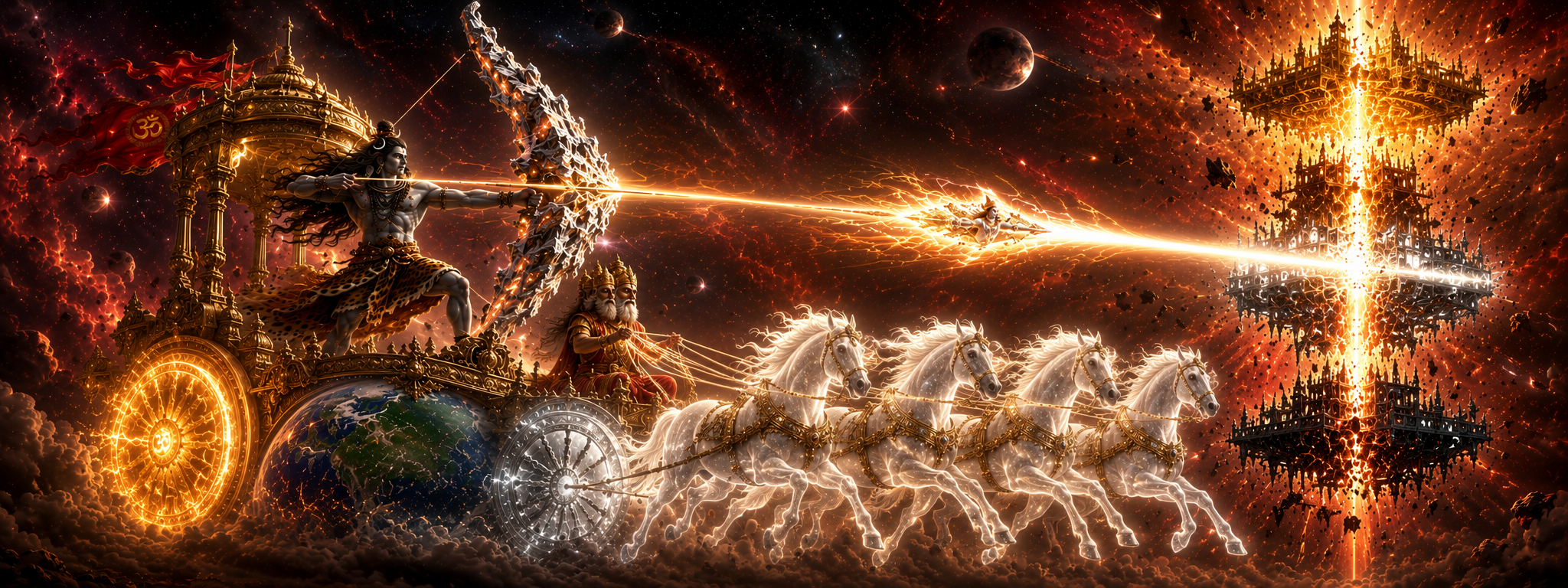
The Traipura War is the first of the twelve conflicts in which Shiva steps forward as the sole divine champion — and he does so in his most spectacular iconographic form: Tripurantaka, the Destroyer of the Three Cities. It is also the war that most perfectly embodies the principle of patience as a cosmic strategy. The three Tripura cities could only be destroyed when they aligned in a single straight line — an event that occurred once every thousand years. The entire war was therefore, in one sense, a thousand years of waiting for a single moment.
The Traipura War is among the most elaborately narrated conflicts in all of Shaiva literature. The cosmic chariot assembled for the battle is one of the most celebrated symbolic constructions in the Puranic tradition — every component a theological statement, every element a deity pressed into service as part of Shiva's weaponry. The war ends not with a battle but with a single shot. The precision is absolute. The symbolism is inexhaustible.
Background & Cause — The Sons of Tarakasura
The Tripurasuras — Tarakaksha, Vidyunmali, and Kamalaksha — were the three sons of the demon Tarakasura, who had himself been slain by Kartikeya in an earlier conflict. Their father's death left them with both a grievance against the gods and a formidable inheritance of demonic power. They chose the most direct path available in the Puranic universe for converting grievance into invincibility: they performed severe austerities directed at Brahma.
Their boon request was architecturally brilliant. Rather than asking for standard invincibility, they asked for three impregnable cities — one for each brother — that would fly through the cosmos and could only be destroyed if all three were struck by a single arrow at the one moment in every thousand years when they aligned in a straight line. Brahma granted the boon. The divine architect Maya was commissioned to build the cities.
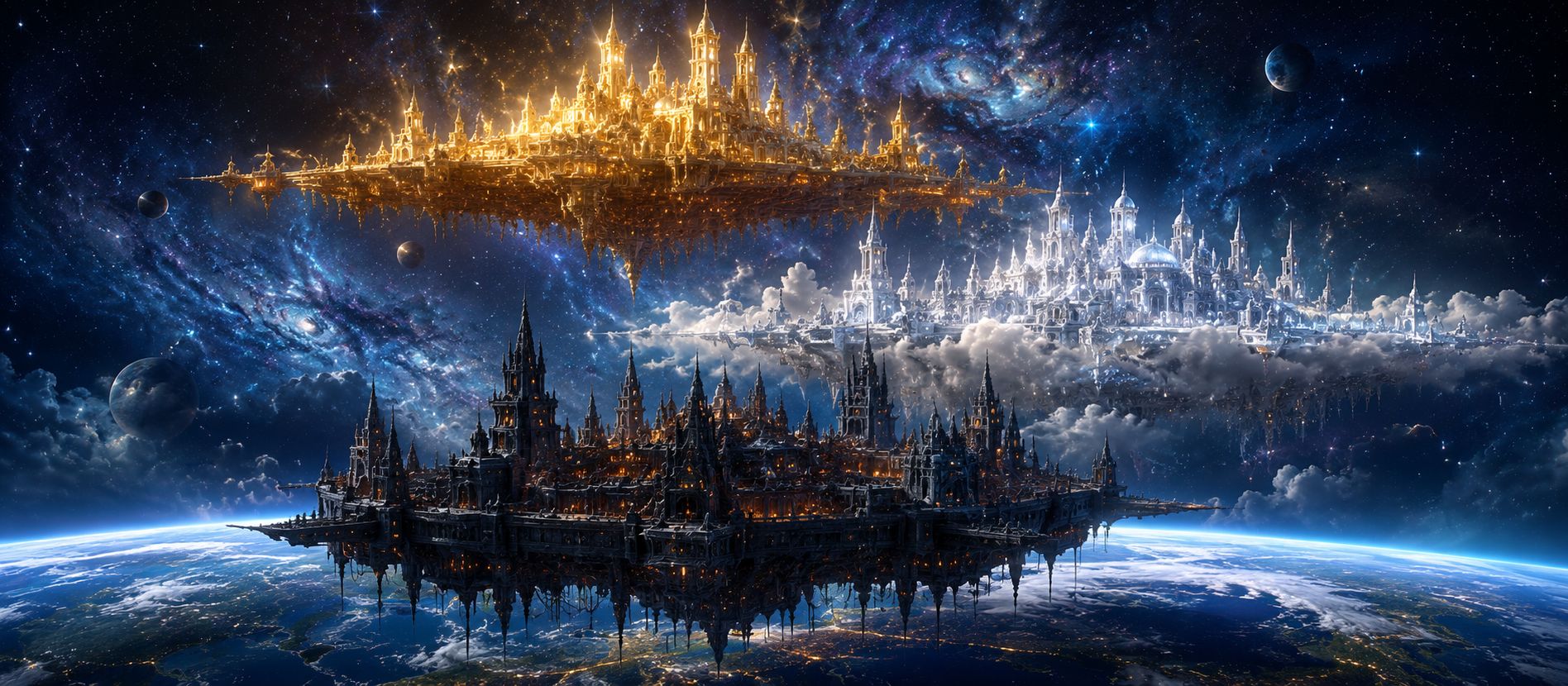
The three Tripura cities — built by the divine architect Maya — flew through different levels of the cosmos, impregnable by any weapon as long as they remained out of alignment.
The Three Cities — Architecture of Invincibility
| City | Material | Location | Ruler | Character |
|---|---|---|---|---|
| FirstTripura | Gold | The highest heavens — above Svargaloka | Tarakaksha | The eldest brother; most powerful militarily; the city from which the Tripurasuras launched their assault on the three worlds. |
| SecondTripura | Silver | The mid-sky — the atmospheric realm | Vidyunmali | The middle brother; name means "wearing a garland of lightning"; associated with the power of atmospheric forces and weather phenomena. |
| ThirdTripura | Iron | Just above the earth — the terrestrial sky | Kamalaksha | The youngest brother; name means "lotus-eyed"; ruled the city closest to the human world and most directly threatening to earthly life. |
The Shiva Purana records that within the three cities, the Tripurasuras built a complete civilisation. The cities had palaces, gardens, temples, and populations of Daityas and Danavas. They were not merely fortresses but functioning kingdoms — and Tarakaksha, the eldest, was even described as a devotee of Shiva, performing daily worship within the golden city. This detail — a demon-king devoted to the very god who would destroy him — is one of the Traipura narrative's most striking theological elements, and a point of significant commentary in the Shaiva tradition.
For a thousand years after the cities were built, the Tripurasuras ruled from their impregnable floating kingdoms. They conquered all three worlds. The Devas were expelled from Svargaloka a second time. No weapon could harm the cities while they remained unaligned. The gods appealed to Brahma, who directed them to Shiva. Shiva agreed — but not immediately. The cities could only be destroyed at the precise moment of their alignment. Until that moment, there was nothing to do but wait and prepare.
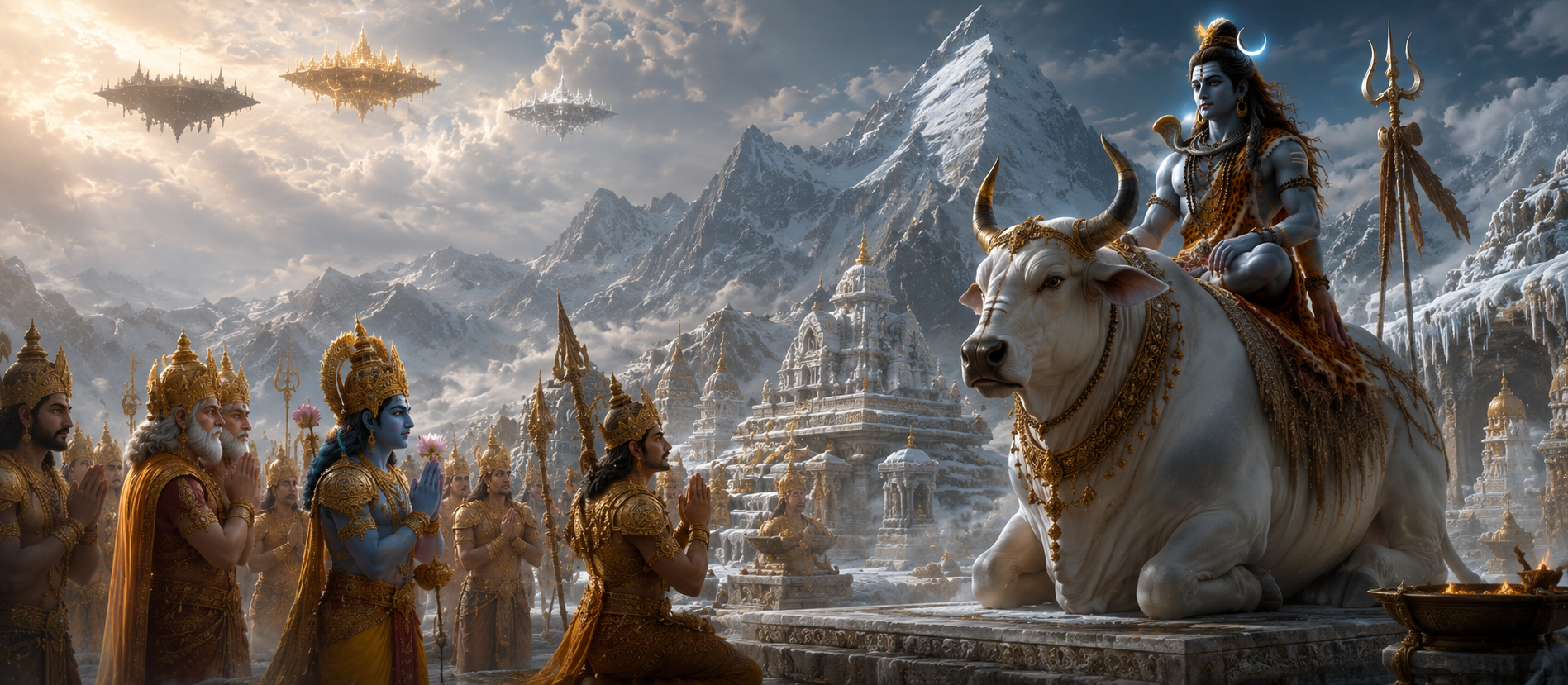
The gods turned to Shiva — the only power whose single arrow could destroy all three cities at the moment of alignment.
Key Combatants
Divine Champion
Shiva as Tripurantaka
- Shiva (Tripurantaka) — The Destroyer; takes the role of sole divine champion for the first time in the twelve wars. His weapon is a single arrow; his chariot requires the entire cosmos as its components. The name Tripurantaka means "Destroyer of the Three Cities" — one of Shiva's most celebrated epithets, earned specifically in this war.
- Vishnu — Serves as the arrow itself, taking the form of a blazing shaft. A remarkable inversion of the usual relationship — here Vishnu is the weapon, Shiva the archer.
- Brahma — Serves as the charioteer. Another inversion — the Creator driving the Destroyer to his target.
- All the Devas — Their collective divine energy is absorbed into the components of the cosmic chariot.
The Tripurasuras
The Three Brothers
- Tarakaksha — Eldest son of Tarakasura; ruler of the golden city in the highest heavens; the military leader of the three brothers; paradoxically also described as a Shiva-devotee within his own city.
- Vidyunmali — Middle brother; ruler of the silver city; associated with lightning and atmospheric power.
- Kamalaksha — Youngest brother; ruler of the iron city closest to earth; lotus-eyed; the most directly threatening to the human world.
- Maya (the architect) — Not a combatant but critical to the war's structure: he built the cities and their defences, and later attempts to use a divine lake within the golden city to resurrect Tripurasura warriors slain in battle.
The Cosmic Chariot of Tripurantaka
The preparation for the Traipura War produced one of the most elaborate symbolic constructions in all of Puranic literature. When Shiva agreed to destroy the Tripuras, the gods assembled a divine chariot — but no ordinary war vehicle. Every component was a cosmic entity, pressed into service as part of Shiva's battle apparatus. The Shiva Purana and Mahabharata's Drona Parva both describe this chariot in detail, and the description is simultaneously a theological treatise and a battle preparation.
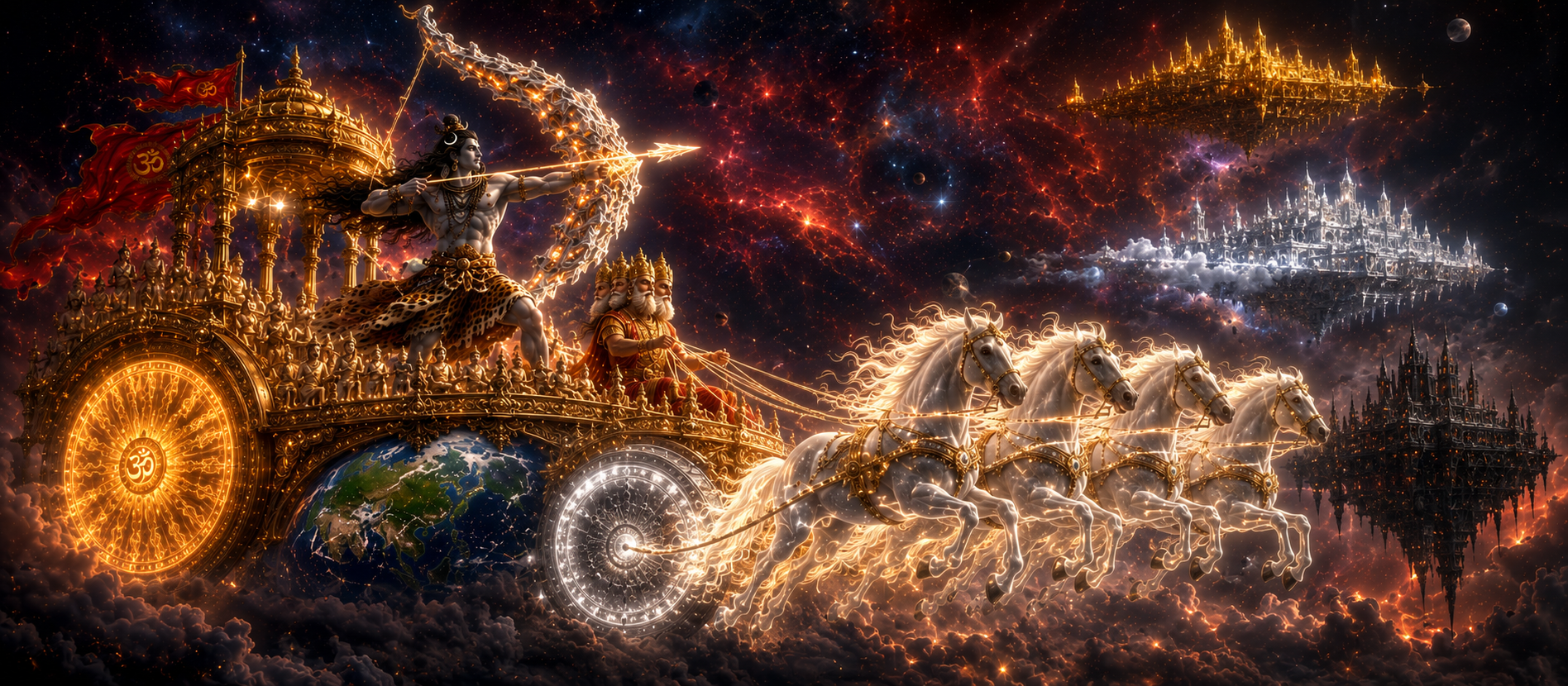
The cosmic chariot of Tripurantaka — every component a deity, every element a theological statement — assembled for the single shot that would end a thousand years of Tripurasura dominion.
| Chariot Component | Cosmic Entity | Symbolic Significance |
|---|---|---|
| The Chariot Base | The Earth (Bhudevi) | All creation as the foundation of Shiva's action |
| The Two Wheels | Sun and Moon | Time itself — day and night — as the wheels of destruction |
| The Axle | Mount Meru | The cosmic axis as the structural centre of the weapon |
| The Bow | Mount Meru (also described as Vishnu in bow-form in some accounts) | The spine of creation bent to Shiva's purpose |
| The Bowstring | The divine serpent Vasuki | The serpent of the cosmos — who had served as churning-rope in War V — now strung as Shiva's bowstring |
| The Arrow | Vishnu himself | The Preserver becomes the instrument of destruction — preservation and destruction unified in one shot |
| The Charioteer | Brahma | The Creator drives the Destroyer — the full Trimurti united in a single act |
| The Horses | The four Vedas | Sacred knowledge as the motive power of cosmic action |
| The Armour | All the sacred texts and rites | Dharma itself as Shiva's protection |
The Thousand Years of Waiting — and the Single Shot
The cosmic chariot was assembled and ready. Shiva took his position as Tripurantaka, Brahma took the reins, the gods took their places as components of the weapon. And then — they waited. The three cities were not yet aligned. The boon that protected the Tripuras could not be circumvented; it could only be met on its own terms. When the alignment came, it would last for only a moment. Everything depended on perfect timing.
The Shiva Purana and Matsya Purana record that during this period of waiting, an additional crisis emerged. Maya, the divine architect who had built the Tripuras, possessed a secret weapon within the golden city: a divine lake of amrita-like water with the power to resurrect any Tripurasura warrior slain in battle. As long as this lake existed, the war could not be won even if Shiva's arrow destroyed the cities — the warriors would simply be revived. Vishnu, in the form of a cow with Brahma as her calf, approached the lake and drank it dry before the battle, neutralising Maya's final defence.
Then the moment came. Once every thousand years, the three cities drifted into alignment — gold above silver above iron, all in a single vertical line. As the alignment occurred, Shiva drew his bow. The cosmos held its breath. Brahma held the reins still. Vishnu-as-arrow blazed on the string. And Shiva released.
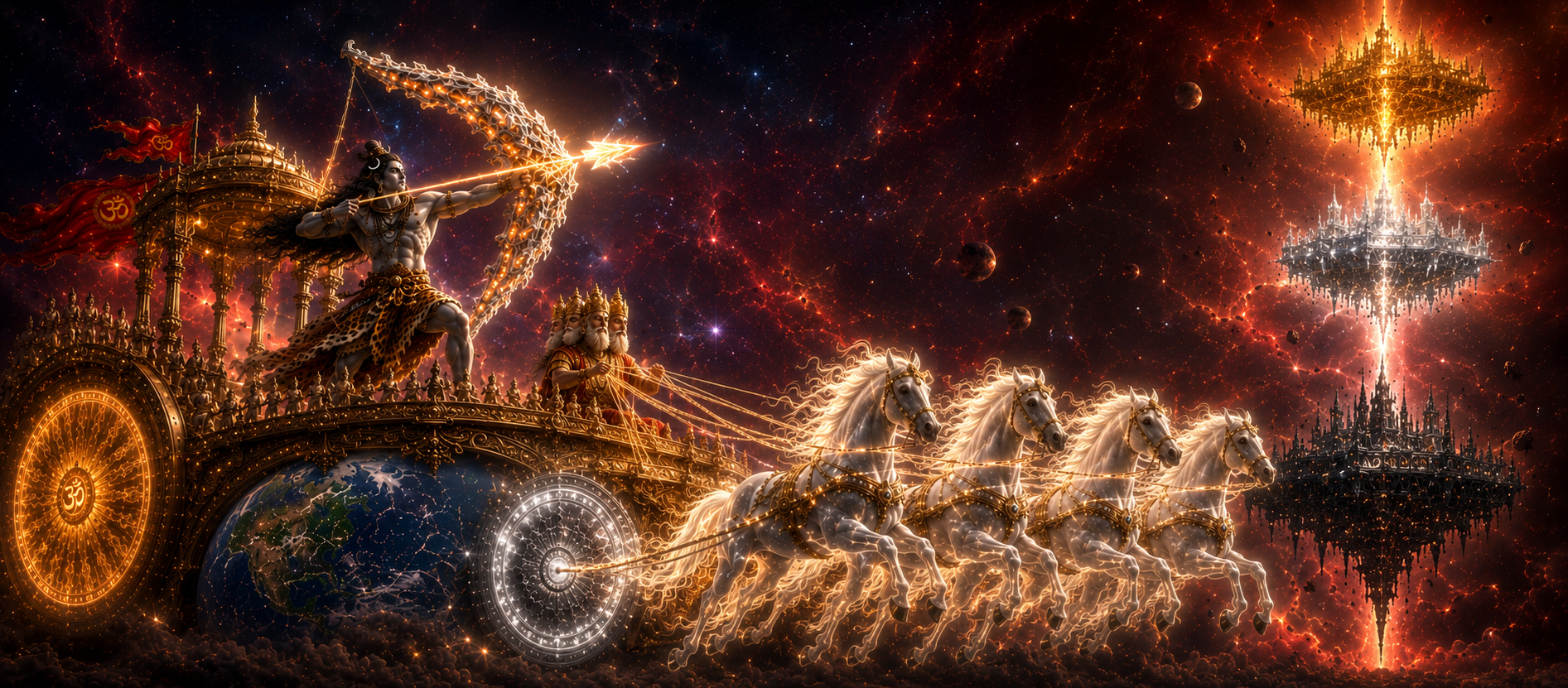
The moment of alignment — once every thousand years, the three cities formed a single line. Shiva's entire preparation had been for this instant, and the instant lasted only a moment.
"Shiva smiled. He drew the bow. He released the arrow. In the space of a single breath, all three cities blazed and fell. The universe exhaled."
Shiva Purana, Rudrasamhita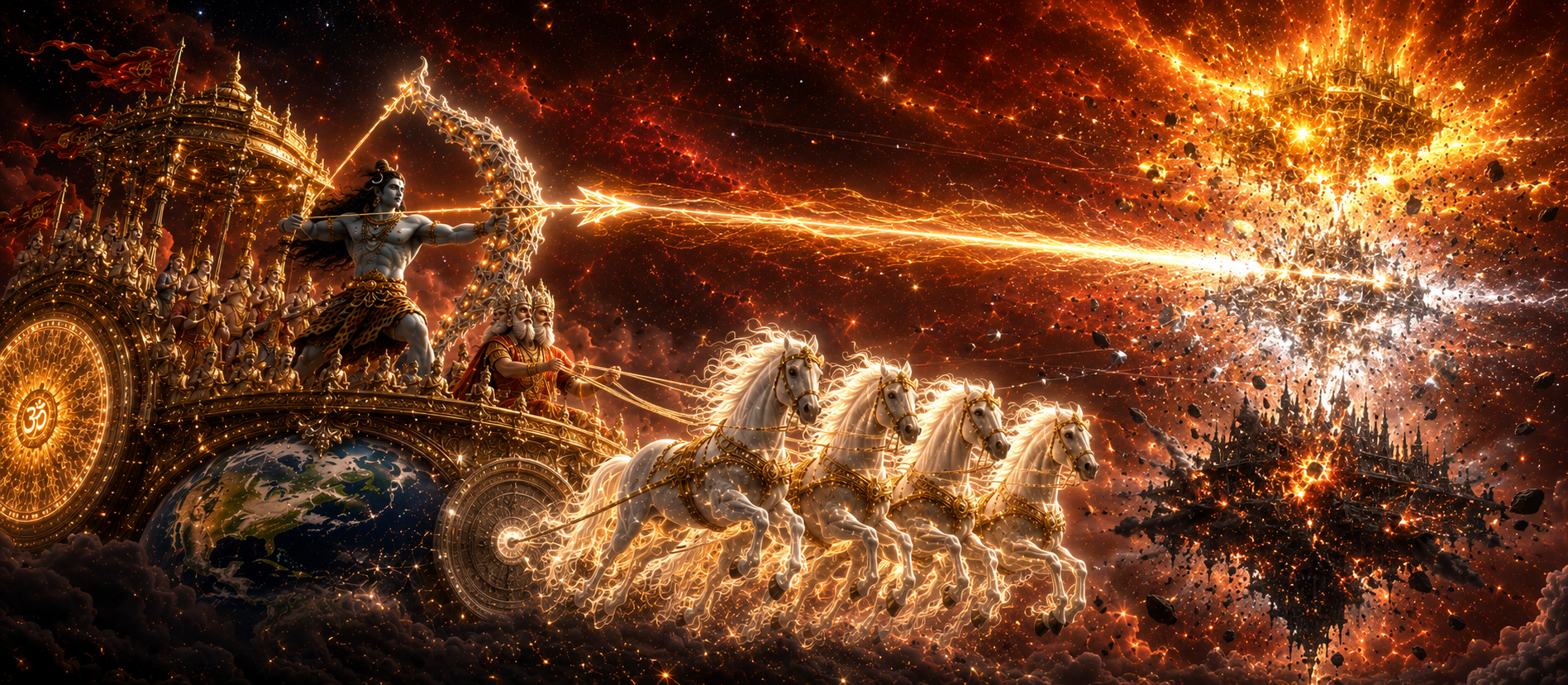
One arrow. One breath. Three cities destroyed. The Traipura War ends in the most decisive single act of destruction in all of Puranic warfare.
The Paradox — Tarakaksha the Shiva-Devotee
The Shiva Purana preserves a detail about Tarakaksha that is theologically striking: within the golden Tripura city, the eldest of the three brothers performed daily worship of Shiva. He maintained a Shiva linga in his palace and offered regular puja with devotion. He was, in the conventional devotional sense, a Shiva-bhakta — a devotee of the very god who was preparing to destroy him.
This creates one of the most complex theological problems in the Traipura narrative. How does Shiva destroy a devotee? Various Puranic commentators address this differently. The most common resolution is that Shiva's destruction of Tarakaksha was itself an act of grace — that dying by Shiva's own arrow, even in battle, is a form of liberation. Tarakaksha's death at Shiva's hands is therefore, in the Shaiva theological framework, the fulfilment of his devotion rather than its contradiction.
Some versions of the narrative specify that Tarakaksha's Vishnu-bhakti (not Shiva-bhakti) was what protected the cities spiritually, and it was only when a Narada-instigated discord broke his adherence to Vishnu-worship that the cities became vulnerable to Shiva's arrow. This variant emphasises the theological rivalry between Shaiva and Vaishnava traditions that runs as a subtext through several of the twelve wars.
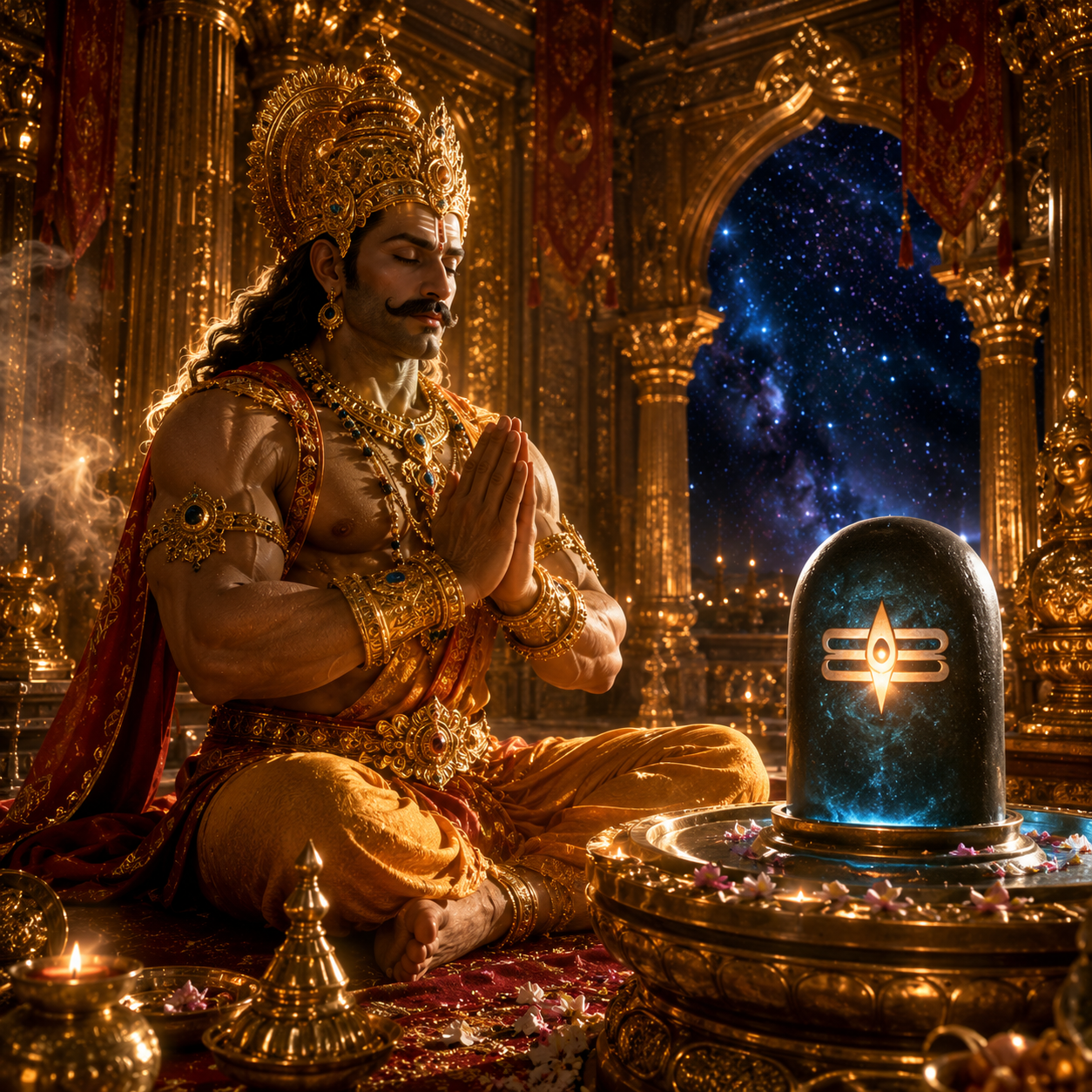
Tarakaksha's devotion to Shiva within the city Shiva would destroy is one of the most theologically provocative details in the Traipura narrative — resolved in the Shaiva tradition as destruction-as-grace.
Outcome Summary
Military result: Total and immediate. All three Tripura cities were destroyed in a single arrow-shot at the moment of their alignment. The Tripurasuras — Tarakaksha, Vidyunmali, and Kamalaksha — were killed. The three worlds were freed from their dominion. The Devas were restored to Svargaloka.
Maya's role: The divine architect Maya survived the destruction. Some accounts record that he escaped to the ocean and later constructed the city of Dvaraka for Krishna — a curious genealogical thread connecting the Traipura War to the Krishna narratives of the Mahabharata and Bhagavata Purana.
Theological significance: The Traipura War is Shaiva literature's supreme celebration of Shiva as the destroyer-god. The cosmic chariot narrative is a theological treatise in story form — asserting that the entire cosmos (Earth, Sun, Moon, Meru, the Vedas, Brahma, Vishnu) serves as the instrument of Shiva's destructive will. The single-shot resolution emphasises that Shiva's power does not require duration or effort — it requires only the right moment and the right aim. The war also marks the definitive shift in the twelve-war sequence from Vishnu-centred conflicts (Wars I–V) to Shiva-centred ones (Wars VIII–IX).
Cosmic Significance
Among the twelve wars, the Traipura War has generated the richest iconographic tradition. Shiva as Tripurantaka — standing or seated on the cosmic chariot, bow raised, arrow at the moment of release — is one of the most celebrated images in Indian art, appearing in sculpture from the Pallava and Chola periods through the medieval temple traditions of Tamil Nadu and Andhra. The single-arrow destruction of three cities has a visual power that makes it immediately comprehensible even without textual knowledge.
The war also introduces the concept of a divine weapon whose power is not in its immediate force but in its precision of timing. Shiva's arrow was not the most powerful weapon ever fired in Puranic warfare — he had weapons that could destroy the universe. What made this arrow unique was its specificity: it was calibrated to a single moment in a thousand years, to a single alignment of three cities, to a single shot that could not be repeated. The theology here is one of cosmic patience: the gods did not try to overcome the Tripuras' boon by brute force. They waited for the one condition under which the boon itself was insufficient.
The Tripurantaka form of Shiva remains one of the most widely worshipped in south India. Temples dedicated to Tripurantaka are found throughout Tamil Nadu and Karnataka. The festival of Karthikai Deepam — celebrated with the lighting of a great fire on the hill at Thiruvannamalai — is associated in the Shaiva tradition with the flames of the Tripura's destruction. The war lives in the landscape of south India as much as in its texts.
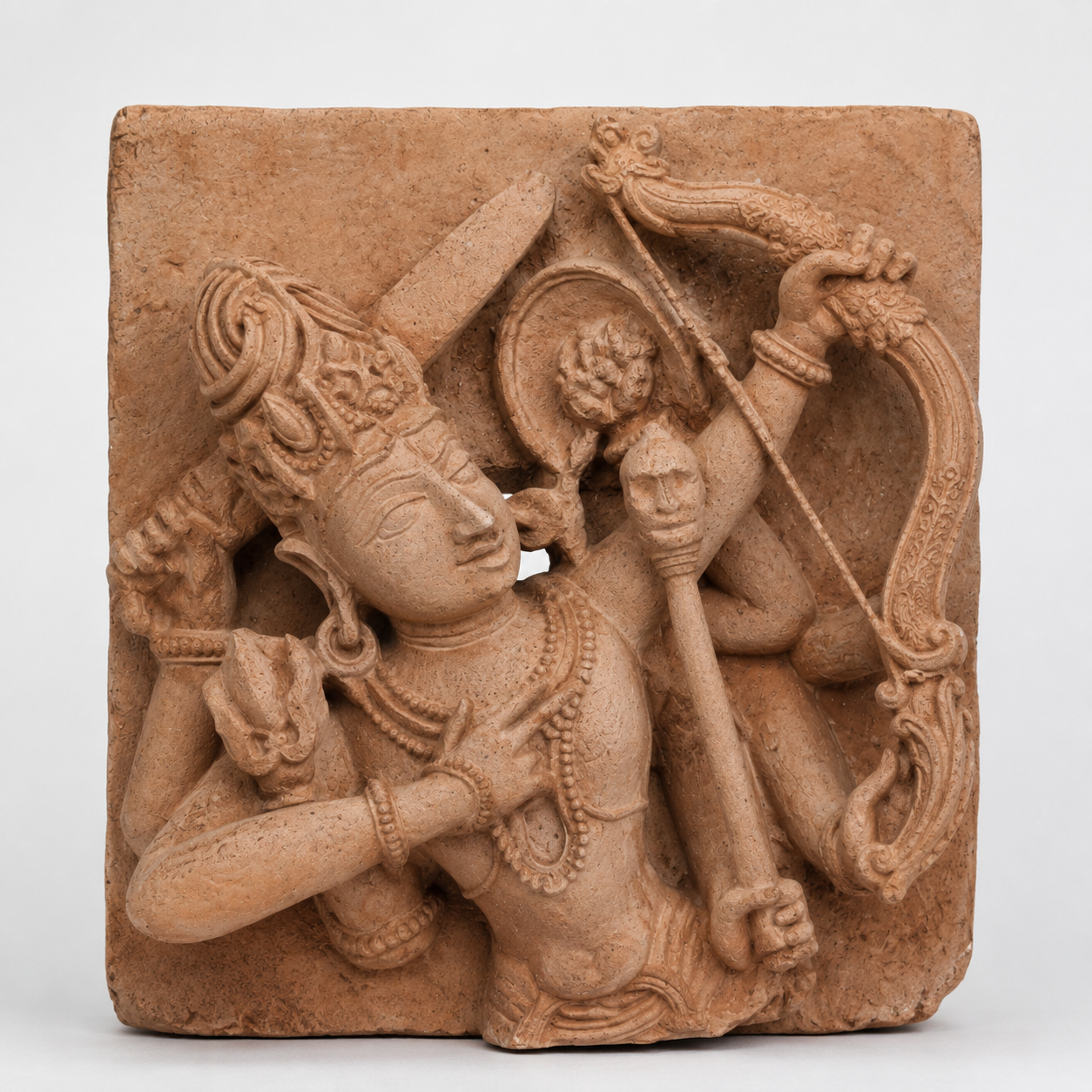
The Tripurantaka form of Shiva — one of his most celebrated iconographic manifestations — remains a living presence in south Indian temple art and festival tradition.
Textual Sources & Variants
The Traipura War is among the most widely attested of the twelve conflicts, appearing in detailed form across multiple Mahapuranas, the Mahabharata, and several Upapuranas. The Shiva Purana's Rudrasamhita provides the most theologically elaborate account; the Matsya Purana has a detailed independent narrative; the Mahabharata's Drona Parva contains a celebrated description of the cosmic chariot. Significant variants exist around the Tarakaksha devotion episode and the role of Maya's resurrection lake.
| Source | Detail | Variant / Note |
|---|---|---|
| Shiva Purana Rudrasamhita Yuddha Khanda |
Fullest account: Tarakasura's sons, boon request, Maya's cities, the thousand-year reign, Maya's resurrection lake, Vishnu draining the lake, cosmic chariot assembly in full detail, the waiting, the alignment, single shot, destruction. Tarakaksha's Shiva-devotion and its theological resolution. | Primary source. Strongest Shaiva theological framing — the entire cosmos in service of Shiva's destructive will. Most elaborate on the chariot symbolism. |
| Matsya Purana Ch. 129–136 |
Full independent account; broadly consistent with Shiva Purana. Some differences in the chariot components listed. Maya's resurrection lake present. The Narada-instigated discord that breaks Tarakaksha's devotion described here. | The Narada discord episode — not in all versions — is the Matsya Purana's explanation for why the boon's spiritual protection failed. Adds a narrative layer absent from the Shiva Purana version. |
| Mahabharata Drona Parva Ch. 202–203 |
The cosmic chariot described in detail — one of the oldest extended prose descriptions of the Tripurantaka chariot. The war itself briefly narrated. Cited as the occasion for Arjuna asking Krishna to explain the nature of Shiva's supremacy. | Epic context frames the Traipura story as theological instruction rather than narrative in its own right. The chariot description here is among the most detailed in any source. |
| Linga Purana | Full Traipura account; emphasises Shiva's supremacy over all other gods through the war. The chariot assembly narrated with the specific detail that even Vishnu begged to serve as the arrow rather than being assigned the role. | The detail of Vishnu volunteering to be the arrow — rather than being assigned — is distinctive to this and some other Shaiva texts. Emphasises devotional surrender. |
| Brahmanda Purana |
Traipura War named eighth in the twelve-war list of the Varaha Kalpa. | Framework source; confirms the war's position in the canonical sequence. |
References
Primary Sources
- Shiva Purana — Rudrasamhita, Yuddha Khanda (fullest account: boon, cities, chariot assembly, single shot, theological commentary on Tarakaksha's devotion)
- Matsya Purana — Chapters 129–136 (independent Traipura account; Narada discord episode; Maya's resurrection lake)
- Mahabharata, Drona Parva — Chapters 202–203 (cosmic chariot description; Traipura War as occasion for Shiva-theology instruction)
- Linga Purana — (Vishnu volunteering as the arrow; Shiva's supremacy framing)
- Brahmanda Purana — Varaha Kalpa section (Traipura War named eighth in the twelve-war list)
- Kena Upanishad — (Indirect reference to the Tripura story as illustrating the limits of individual divine power without Brahman)
Secondary Sources
- Mani, Vettam. Puranic Encyclopaedia. Motilal Banarsidass, 1975. Entries: "Tripura," "Tripurantaka," "Tarakaksha," "Maya (the architect)."
- Shastri, J. L. (ed.). Shiva Purana. Ancient Indian Tradition and Mythology Series, Motilal Banarsidass, 1970.
- Ganguli, K. M. (trans.). The Mahabharata. Pratap Chandra Roy, 1883–1896. Drona Parva.
- Kramrisch, Stella. The Presence of Śiva. Princeton University Press, 1981. (On the Tripurantaka iconographic tradition and its theological dimensions.)
- Clothey, Fred W. "Skanda-Ṣaṣṭhi: A Festival in Tamil India." History of Religions 13/2 (1973). (On the Traipura War's place in south Indian Shaiva festival tradition.)