
The Andhakara War is the most intimate conflict in the entire sequence of twelve. It is fought not over the three worlds or the cosmic order but over Parvati — Shiva's own consort — and the adversary is a being born from Shiva's own body. Andhaka is, in a precise cosmological sense, Shiva's shadow given independent existence: a being of darkness born from the heat of Shiva's own blocked vision, adopted by a demon, trained in war, and ultimately returning to threaten the one person Shiva holds most dear.
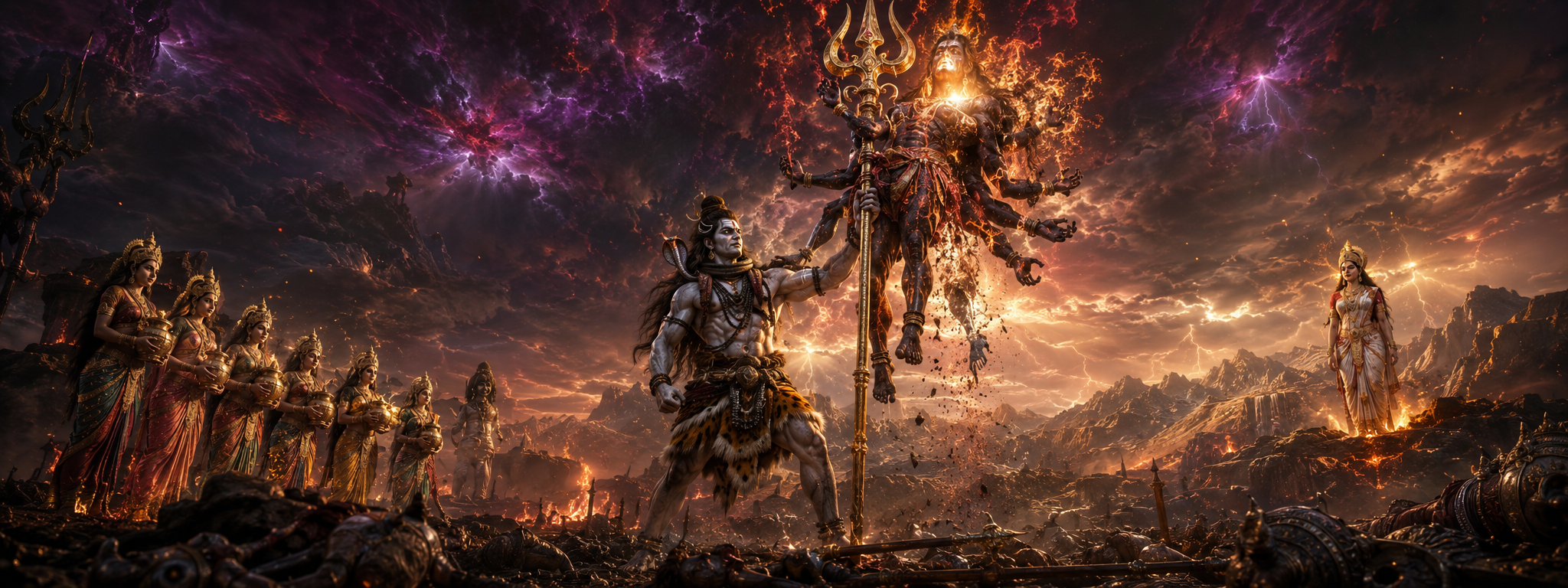
The war's most distinctive element is its ending. Andhaka is not merely defeated or killed — he is impaled on Shiva's trishula and held there, burning, until his demonic nature is entirely consumed and what remains is a purified devotee. The Andhakara War is therefore simultaneously the story of a battle and the story of a transformation: the most violent possible form of divine grace.
The Origin of Andhaka — Born from Shiva's Own Darkness
Andhaka's origin is unlike that of any other demon in Puranic literature. He was not born of a Diti or a Danu, not produced by a demon lineage, not created by Brahma's breath or shadow. He was born from Shiva himself — from a specific, accidental collision of divine forces that produced a being no one had intended to create.
The Shiva Purana and Matsya Purana describe the event: Parvati, in a playful mood, came up behind Shiva and covered his eyes with her hands. The universe, which depends on Shiva's all-seeing awareness, was plunged into temporary darkness. But the heat generated by Shiva's blocked third eye — the eye that holds the fire of cosmic dissolution — did not dissipate. It accumulated in the space between his brows and fell to the ground as drops of sweat mixed with Parvati's perspiration. From that fallen darkness, Andhaka was born: blind, dark, formless, the living embodiment of what happens when Shiva cannot see.
Hiranyaksha — who happened to be passing through the cosmic realm at that moment, and who had a history of taking in unusual foundlings — adopted the creature. He named him Andhaka (the blind one) and raised him. Under Hiranyaksha's care, Andhaka was given the best of demonic training. He proved to be a gifted warrior. And when Hiranyaksha was slain by the Varaha avatar (War II), Andhaka inherited the Daitya throne.
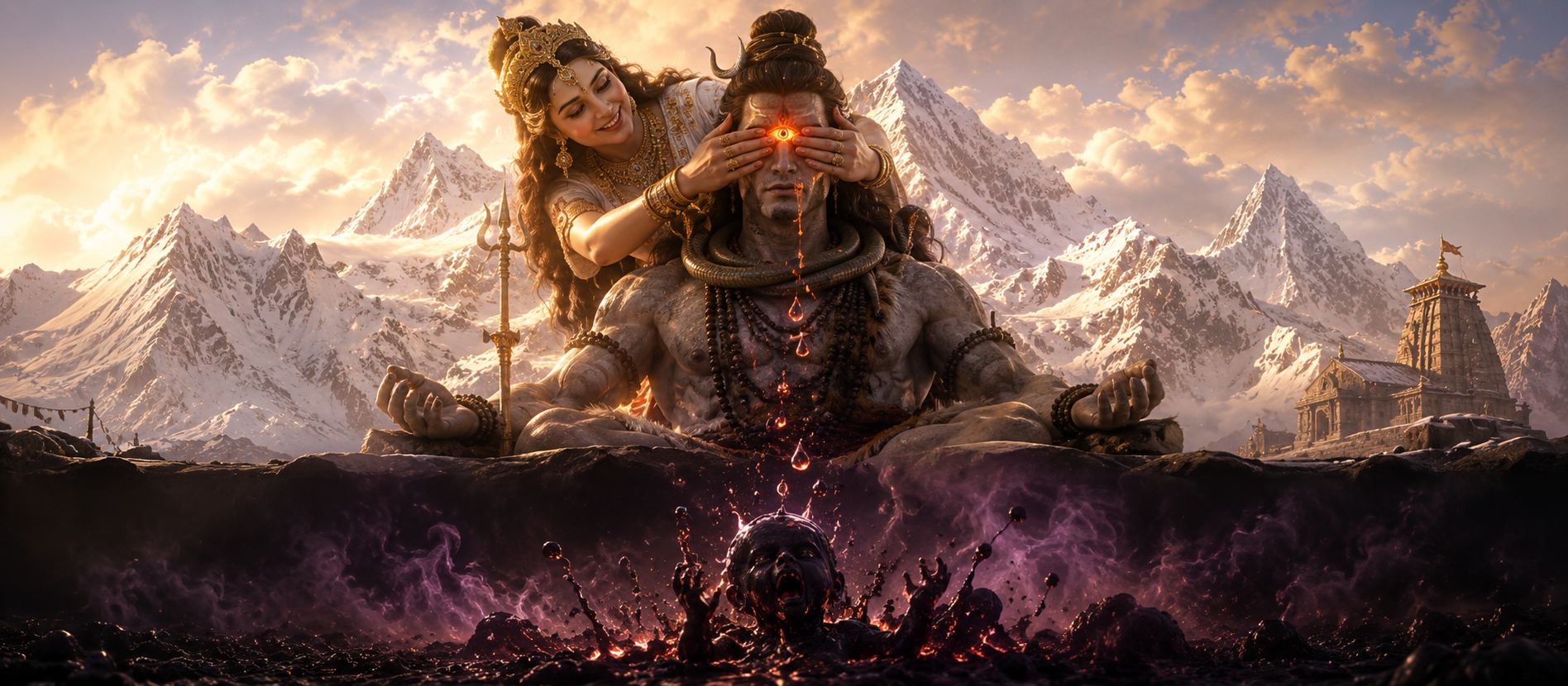
Andhaka's birth — from the heat of Shiva's blocked third eye — is one of the most unusual origin stories in Puranic literature. He is, in the most literal sense, Shiva's own darkness made flesh.
Andhaka's Rise — Brahma's Boon and the Conquest of the Worlds
Despite his blind and dark birth, Andhaka proved to have remarkable spiritual capacity. Adopted by Hiranyaksha and raised in the Daitya traditions, he performed intense austerities directed at Brahma, seeking the boon that would make him invincible. His request was characteristic of the great demon-kings of the twelve wars: he asked that no being — god or demon — be able to kill him except through a very specific condition. But Andhaka's condition was different from Hiranyakashipu's exhaustive enumeration. He asked simply that he not be slain as long as he harboured desire — specifically, the desire for a woman who resembled his own mother.
This boon seems, at first glance, easy to maintain. But the Puranas present it as a trap that Andhaka set for himself without realising it: for the woman who most resembled his mother in the three worlds was Parvati herself — who was, in a cosmological sense, exactly that, since Parvati's energy had contributed to his birth. The boon that was supposed to protect Andhaka would instead lead him directly to the one conflict he could not survive.
Armed with near-invincibility, Andhaka conquered the three worlds. He drove the Devas from Svargaloka, established Daitya sovereignty across the cosmos, and ruled for an extended period. The gods appealed to Shiva — but Shiva, uniquely among the divine champions of the twelve wars, had a personal stake in the outcome that went beyond cosmic order.
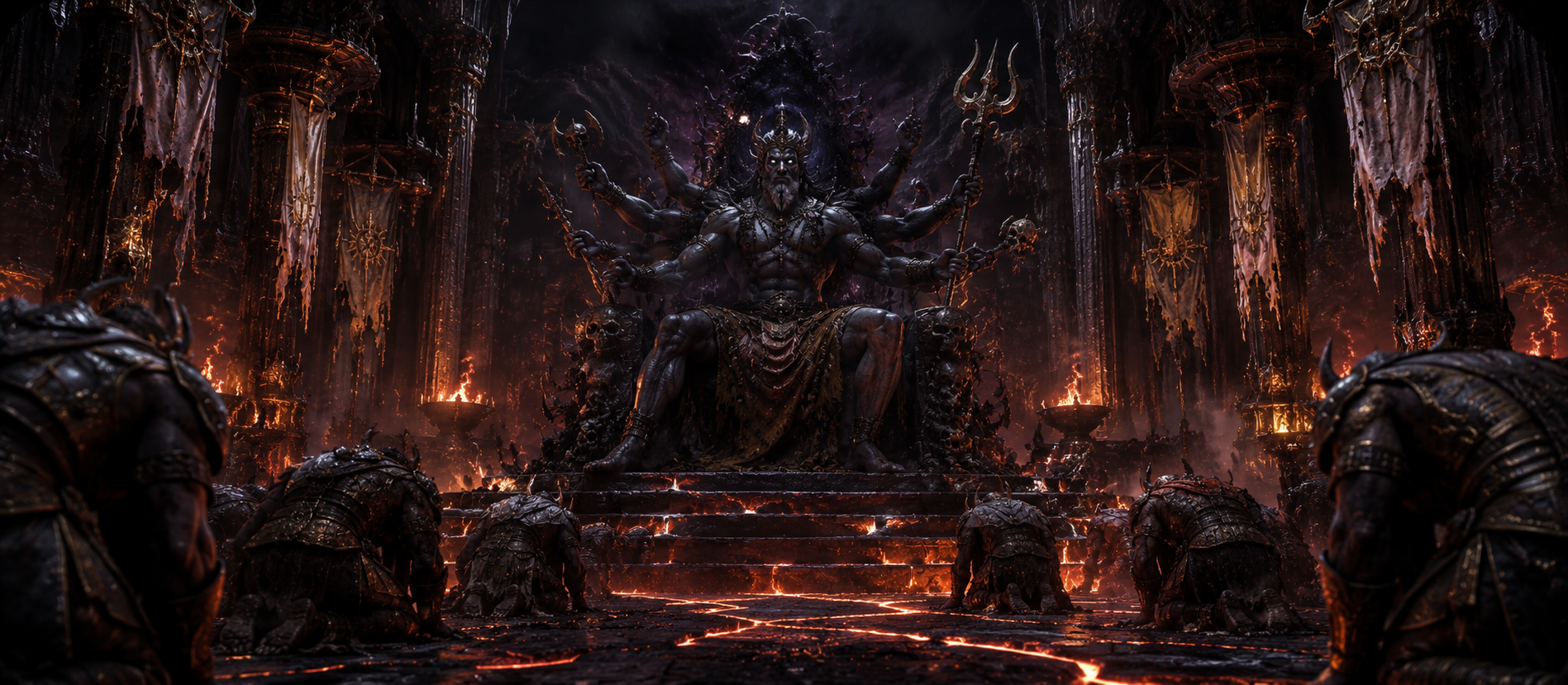
Armed with Brahma's boon and the full force of the Daitya armies, Andhaka conquered the three worlds and ruled from a throne built on the displacement of the divine order.
The Fatal Desire — Andhaka and Parvati
The trigger for the Andhakara War was, at its core, an act of cosmic recognition that Andhaka himself could not have understood. He had heard of a woman of supreme beauty residing on Kailasa — Parvati, the consort of Shiva. When his spies described her, something in Andhaka responded with a desire he had never felt for anyone else. She resembled, in some deep way he could not articulate, the idea he had of a mother — which was, given his blind birth and his adoption by Hiranyaksha, an idea assembled from fragments and longing rather than from experience.
He sent emissaries to Kailasa demanding that Shiva hand over Parvati. Shiva refused. Andhaka gathered his armies and marched on Kailasa — and the war that followed would last, by various Puranic accounts, for thousands of years.
Key Combatants
Divine Champion
Shiva and Allies
- Shiva — Fights in defence of Parvati and Kailasa. Deploys the full range of his divine weapons — the trishula, the Pashupatastra, the fire of his third eye. The war's final resolution — impalement and purification — is uniquely his.
- The Saptamatrikas — The seven divine mothers (Brahmi, Vaishnavi, Maheshvari, Kaumari, Varahi, Indrani, Chamunda) created or summoned by Shiva specifically to address Andhaka's blood regeneration power. Their role in collecting his blood is the critical tactical innovation of the war.
- Parvati — The reason for the war; does not fight directly but her divine energy ultimately contributes to Andhaka's purification. Some versions describe her taking the form of Kali or Chamunda during the battle.
- Vishnu and the Devas — Support Shiva's forces; fight against the Daitya armies but cannot overcome Andhaka's regeneration ability.
Adversary
Andhaka and Forces
- Andhaka — Born blind from Shiva's own darkness; adopted son of Hiranyaksha; ruler of the three worlds; possessor of Brahma's boon of desire-dependent invincibility. His defining power: every drop of his blood that touches the ground generates a new Andhaka — a regeneration ability that makes conventional combat futile.
- The Daitya armies — Vast forces drawn from the full strength of the Daitya and Danava lineages; command generals of great power including Duryodhana (a different figure from the Mahabharata's Duryodhana) and others.
- Raktabija (variant) — Some accounts conflate or parallel Andhaka's blood-regeneration power with the Raktabija demon of the Devi Mahatmya tradition, who possesses an identical ability. The two narratives are related but distinct.
The Blood Problem — Why the War Could Not Be Won by Force
The Andhakara War's central tactical crisis was Andhaka's blood. Every drop that fell from his body when struck in combat instantly generated a new Andhaka — identical, fully armed, and ready to fight. As the battle progressed and Andhaka was repeatedly wounded, the army facing Shiva did not diminish — it multiplied. Within a single day of fighting, thousands of Andhakas swarmed the battlefield. The Devas' weapons were worse than useless; every strike they landed made the situation worse.
The solution required a different kind of power — not destructive but consumptive. Something that could intercept the blood before it reached the ground and absorb it rather than spill more of it. Shiva summoned — or, in some accounts, created from his own yoga — the Saptamatrikas: the seven divine mothers, each a feminine aspect of a major deity's power, each with the capacity to absorb and consume what male weapons could only multiply.
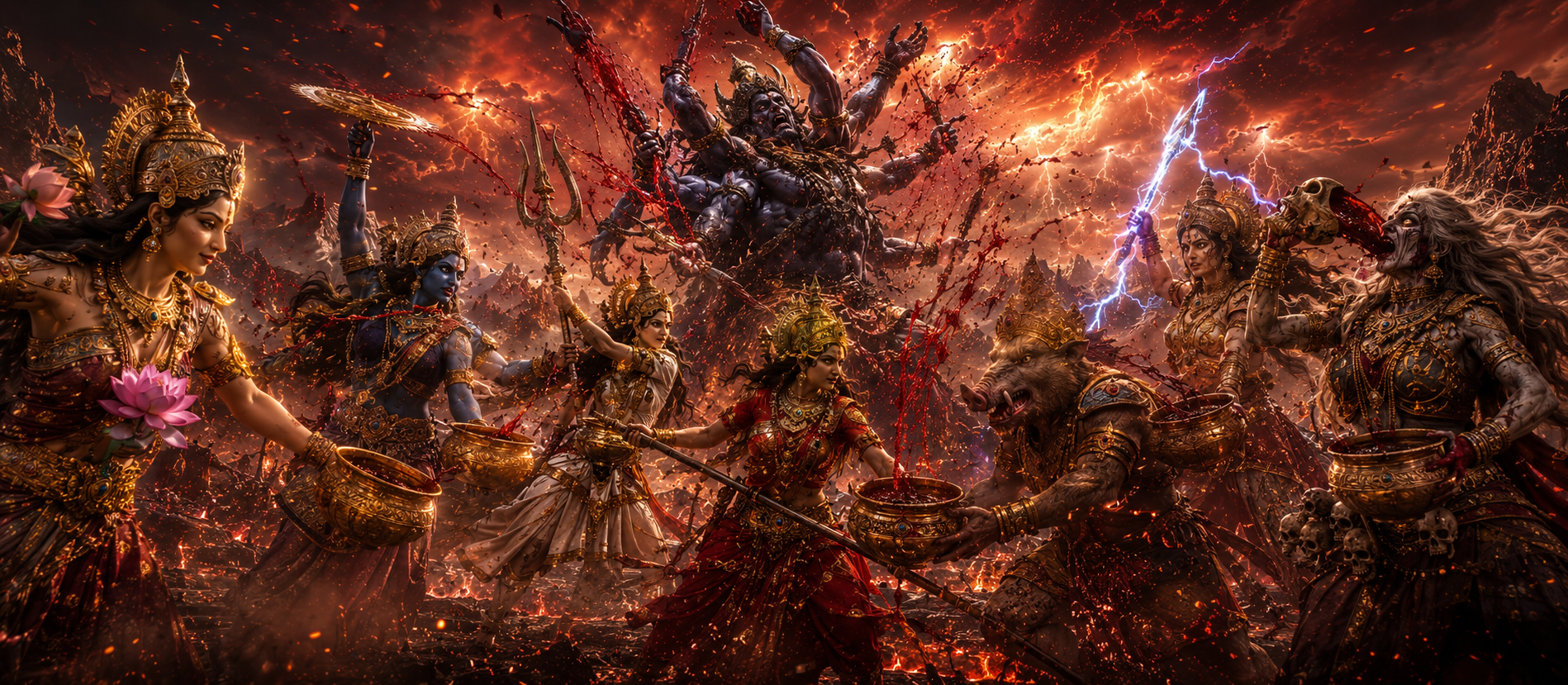
The Saptamatrikas — the seven divine mothers — are the tactical solution to what no weapon could address: their ability to consume Andhaka's blood without spilling it is what finally makes his defeat possible.
With the Saptamatrikas absorbing every drop of blood, Andhaka could now be wounded without multiplying. The war's dynamic shifted. But Andhaka himself remained formidable — a blind demon king of extraordinary power, fighting with the desperate ferocity of one who knows his only option is victory. The battle continued for thousands of years in some accounts, producing one of the most sustained conflicts in the twelve wars.
"Shiva struck him, and struck him again, and each time the Matrikas consumed what fell. At last Andhaka, exhausted and spent, was lifted on the trishula — and there Shiva held him, not to destroy him but to burn away what was not truly him."
Shiva Purana, Andhaka VadhaThe Impalement — Destruction as Grace
When the Saptamatrikas had finally neutralised Andhaka's regeneration power and the demon was sufficiently weakened, Shiva struck the final blow — but not with a killing intent in the conventional sense. He drove his trishula through Andhaka and held him there, suspended above the earth on the three prongs of the weapon, exposed to the full force of Shiva's divine fire.
What followed was not an execution but a sustained purification. Andhaka hung on the trishula as the demonic essence that had accumulated through births and boons and the cultivation of darkness was burned away by Shiva's proximity. The Shiva Purana describes this process as lasting a considerable time — Andhaka hanging on the trishula as his outer layers of darkness and desire burned off, leaving underneath a being whose core nature was, after all, Shiva's own — since he had been born from Shiva's body.
When the purification was complete, Shiva lowered the trishula and released Andhaka — who fell at Shiva's feet as a devotee. He was named Bhringi by some accounts, and given a place among Shiva's ganas (attendants). The demon who had desired Parvati now worshipped Shiva. The war that had begun with Andhaka's desire ended with Andhaka's liberation.
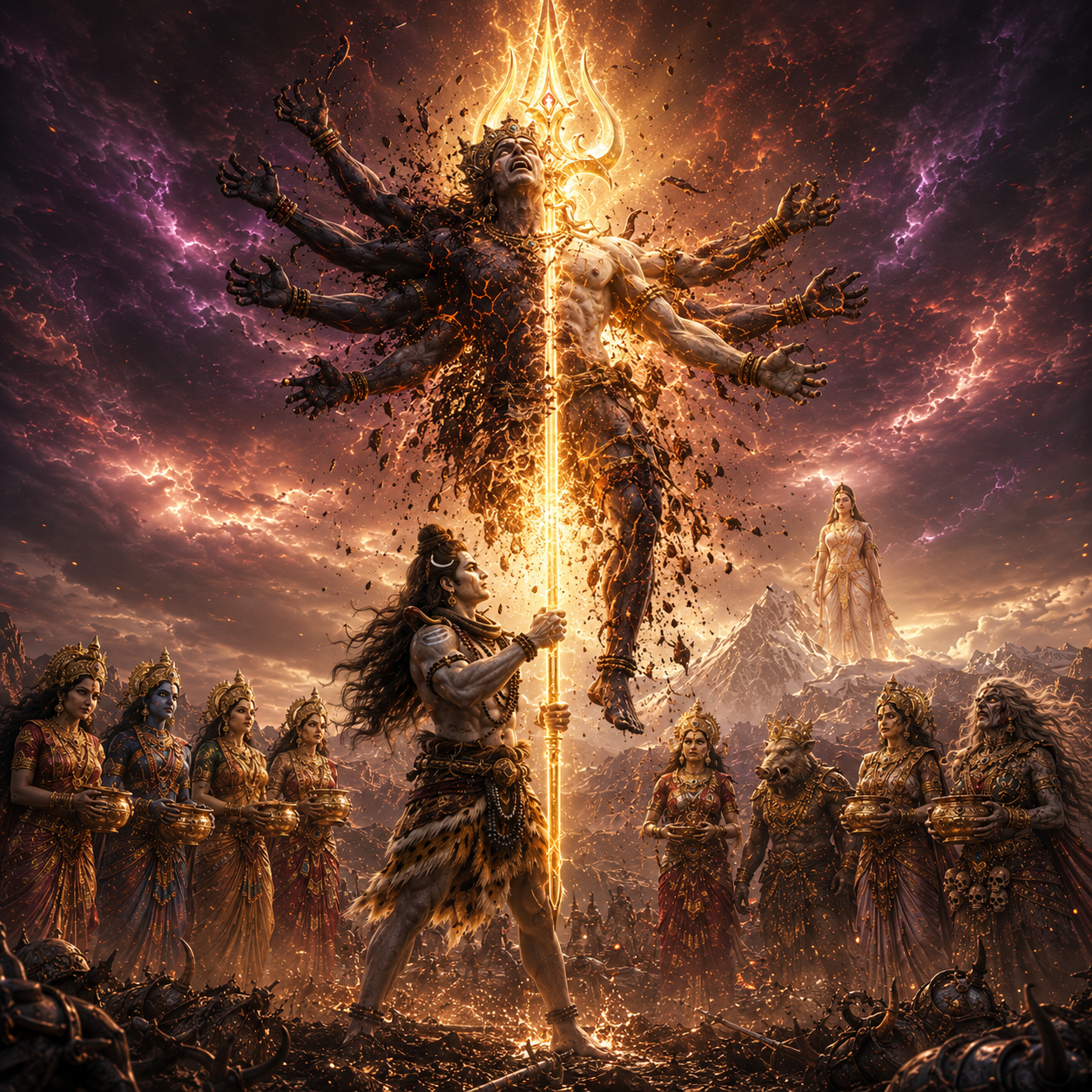
The impalement on Shiva's trishula is the Andhakara War's defining image — destruction and liberation as a single act, the most intimate form of divine grace in the Shaiva tradition.
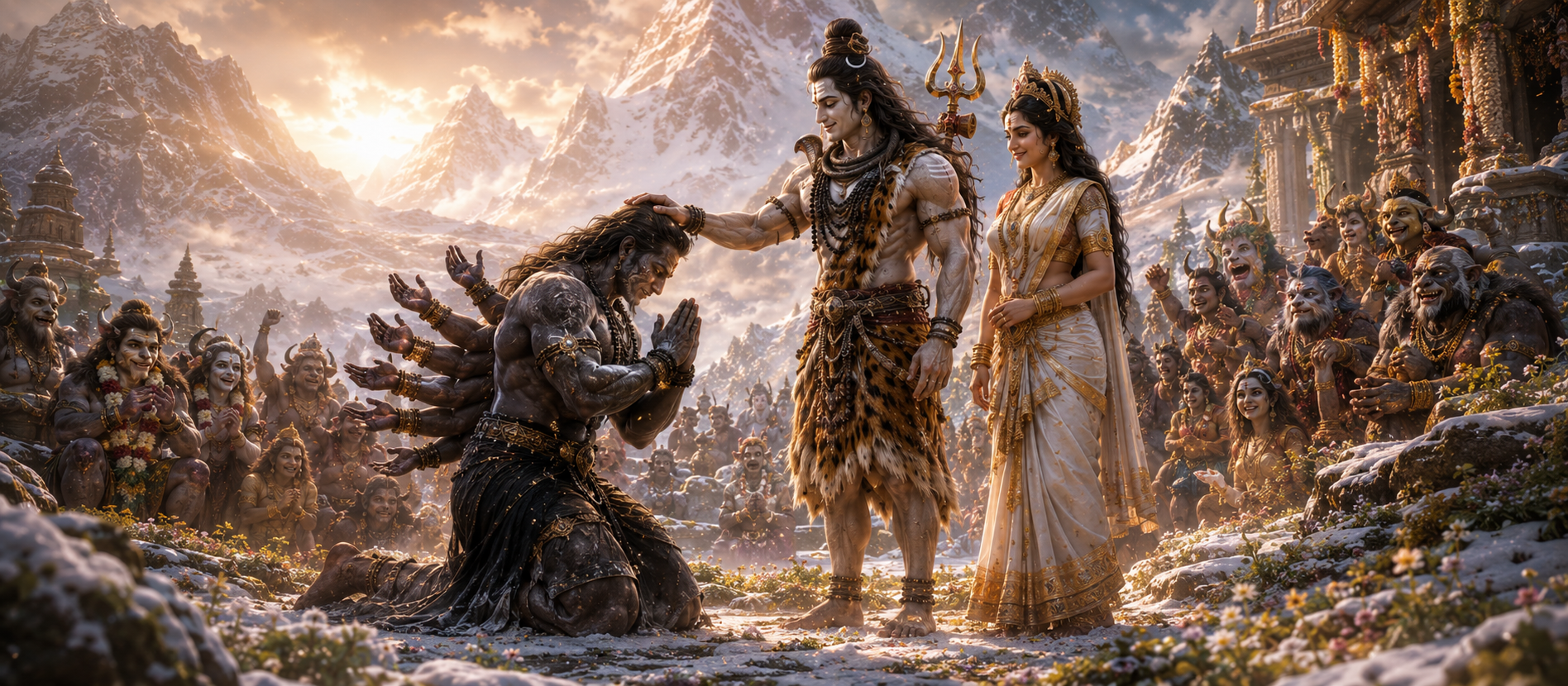
Andhaka as Bhringi — the purified devotee, numbered among Shiva's ganas. The war's outcome is not Andhaka's death but his transformation: the most complete possible resolution of a conflict born from darkness into a self.
Outcome Summary
Military result: Decisive Shiva victory. Andhaka's blood-regeneration power was neutralised by the Saptamatrikas. Andhaka himself was impaled on Shiva's trishula and held there until his demonic nature was purified away. He was released as a devotee and given the name Bhringi, joining Shiva's ganas on Kailasa.
The Saptamatrikas' role: The Andhakara War marks the first appearance of the Saptamatrikas as a divine collective in combat — their subsequent role in the Devi Mahatmya's battle against Raktabija is a direct parallel, and the two narratives are understood in the tradition as related expressions of the same cosmic principle: that feminine consumptive power can overcome what masculine destructive power only multiplies.
Theological significance: The Andhakara War is the Shaiva tradition's most profound meditation on the relationship between darkness and its source. Andhaka is not alien to Shiva — he is born from Shiva. His darkness is not foreign to the divine order; it is the divine order's own shadow. The war is therefore not a battle between good and evil in the conventional sense but a process of self-recognition: Shiva destroying the darkness that was always his own, and in doing so, recovering something that had been lost since the moment Parvati covered his eyes.
Cosmic Significance
The Andhakara War completes the pair of Shiva-centred conflicts in the twelve wars (VIII and IX) and establishes the full range of Shiva's divine capacity: in the Traipura War, he is the patient archer who destroys from a distance through precision and timing; in the Andhakara War, he is the intimate destroyer who holds his enemy close enough to transform him. The two wars together present a complete Shaiva theology of destruction — as cosmological necessity (Traipura) and as personal grace (Andhakara).
The Saptamatrikas' debut in combat during this war also establishes a theological principle that will resonate through the Devi tradition: the Shakti principle — the feminine energy that activates and completes divine power — is not peripheral to the war's resolution. It is essential. Shiva could not defeat Andhaka without the Matrikas. The masculine and feminine principles of divine power, taken separately, were insufficient; combined, they were absolute.
The detail of Andhaka's birth — from the heat of Shiva's blocked vision — carries a philosophical weight that extends beyond the narrative. In the Shaiva philosophical tradition, Andhaka represents avidya — the darkness of ignorance that arises when divine awareness is momentarily obscured. The Andhakara War is the story of avidya arising, growing strong, returning to claim what it believes is its due, and being burned away by sustained proximity to Shiva's light. It is, in this reading, not a cosmic war at all but a spiritual autobiography of the soul's liberation — told, as the Puranas always tell their deepest truths, in the language of battle and fire.
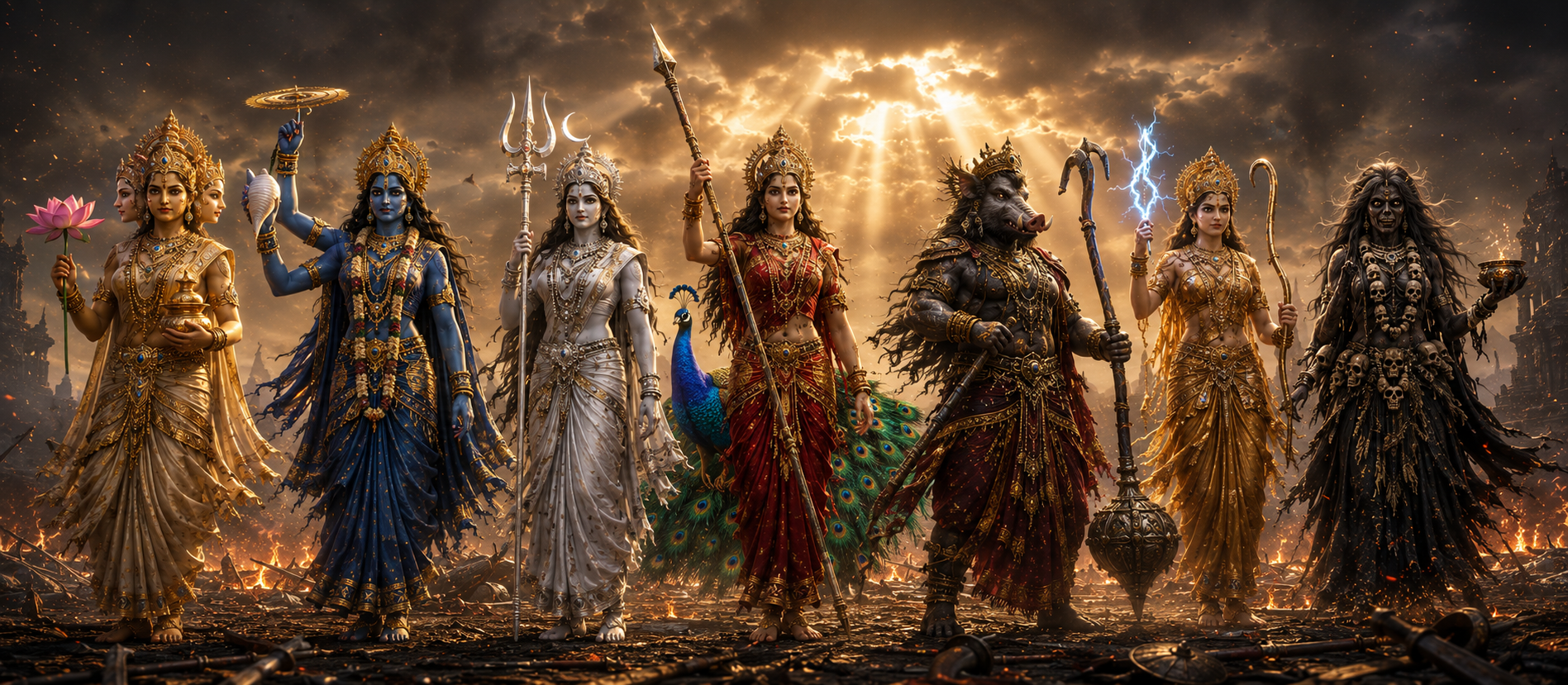
The Saptamatrikas — their first appearance as a combat collective in Puranic warfare — established the theological principle that would define the Devi tradition: feminine consumptive power overcoming what masculine destructive force only multiplies.
Textual Sources & Variants
The Andhaka narrative is attested across several Mahapuranas with broadly consistent core facts but significant variation in details of the war's duration, the nature of Andhaka's boon, and the specific role of the Saptamatrikas. The Shiva Purana gives the fullest theological account; the Matsya Purana and Vayu Purana provide independent narratives with additional military detail.
| Source | Detail | Variant / Note |
|---|---|---|
| Shiva Purana Shatarudra Samhita |
Fullest account: Andhaka's birth from Parvati's covering of Shiva's eyes, Hiranyaksha's adoption, Brahma's boon, conquest of three worlds, the desire for Parvati, long war, Saptamatrikas, impalement, purification, Andhaka as Bhringi/devotee. | Primary Shaiva source. Strongest theological framing — impalement as grace and liberation, not punishment. The detail of Parvati's perspiration contributing to Andhaka's birth given here. |
| Matsya Purana Ch. 179–180 |
Full independent narrative; Andhaka's birth described differently — from Hiranyaksha's boon rather than from Shiva's body in this version. Blood-regeneration power and Saptamatrikas present. The war's military phase described in considerable detail. | Major variant: Andhaka's origin as Hiranyaksha's boon-born son rather than Shiva's shadow-born child changes the theological character of the war entirely in this version. The two accounts represent genuinely different theological positions. |
| Vayu Purana Ch. 97–98 |
Andhaka narrative present; broadly consistent with Shiva Purana on origin. Additional detail on the Daitya generals who fight alongside Andhaka and are defeated before Andhaka himself is addressed. | More military detail than the theological accounts; names and defeats of specific generals not present in other versions. |
| Devi Mahatmya (Markandeya Purana) |
The Raktabija episode — a demon whose every blood-drop creates a new demon — is a direct parallel to Andhaka's blood-regeneration power. The Matrikas' role in defeating Raktabija closely mirrors their role in the Andhaka War. | Raktabija and Andhaka are related but distinct figures. The Devi Mahatmya's version shifts the primary divine champion from Shiva to Devi/Kali and places the event in a different narrative context. The structural parallel is too close to be coincidental. |
| Brahmanda Purana |
Andhakara War named ninth in the twelve-war list of the Varaha Kalpa. | Framework source; confirms the war's position in the canonical sequence. |
References
Primary Sources
- Shiva Purana — Shatarudra Samhita (Andhaka's birth from Shiva's blocked eye; full war narrative; impalement and purification; Andhaka as Bhringi)
- Matsya Purana — Chapters 179–180 (independent Andhaka narrative; variant birth account; detailed military phase)
- Vayu Purana — Chapters 97–98 (Andhaka narrative; named Daitya generals)
- Markandeya Purana (Devi Mahatmya) — Chapters 8–9 (Raktabija episode — parallel blood-regeneration narrative; Matrikas' role)
- Brahmanda Purana — Varaha Kalpa section (Andhakara War named ninth in the twelve-war list)
Secondary Sources
- Mani, Vettam. Puranic Encyclopaedia. Motilal Banarsidass, 1975. Entries: "Andhaka," "Saptamatrikas," "Bhringi," "Raktabija."
- Shastri, J. L. (ed.). Shiva Purana. Ancient Indian Tradition and Mythology Series, Motilal Banarsidass, 1970.
- Coburn, Thomas B. Devī-Māhātmya: The Crystallization of the Goddess Tradition. Motilal Banarsidass, 1984. (On the Raktabija parallel and the Matrikas' role in the Devi tradition.)
- Kramrisch, Stella. The Presence of Śiva. Princeton University Press, 1981. (On the Andhaka myth and its place in Shaiva cosmology.)
- Dehejia, Vidya. Yoginī Cult and Temples. National Museum, New Delhi, 1986. (On the Saptamatrikas and their iconographic tradition.)