
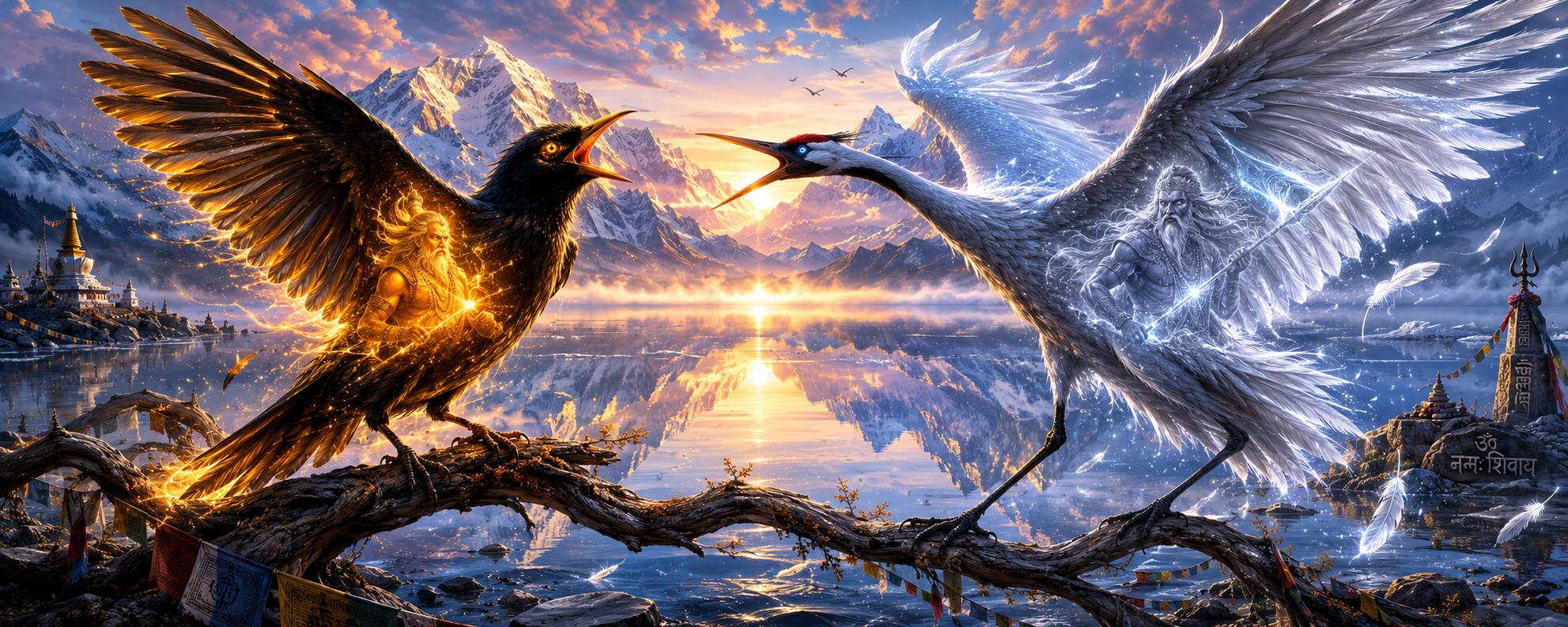
The Adibaka War is the most unusual conflict in the entire sequence of twelve. There are no armies, no divine weapons, no celestial battlefields. The combatants are two birds — a myna and a crane — who fight beside a sacred lake in the Himalayas. Yet the Devi Bhagavata Purana places this seemingly small conflict among the twelve defining wars of the Varaha Kalpa, and the reason is both the identity of the combatants and the origin of their fight.
The two birds are Vashistha and Vishvamitra — two of the greatest sages in all of Hindu tradition, reborn into avian form as the result of mutual curses. Their rivalry is one of the oldest and most sustained in Puranic and Vedic literature, running from the Rigveda through the Ramayana to the Puranas. The Adibaka War is its most literal expression: two of the cosmos's most powerful minds, stripped of their human forms and their spiritual authority, reduced to fighting as birds at the water's edge.
Vashistha and Vishvamitra — The Oldest Rivalry in Sanskrit Literature
The conflict between Vashistha and Vishvamitra spans hundreds of years of Puranic time and dozens of episodes across the Sanskrit corpus. At its heart is a structural opposition: Vashistha is the archetypal Brahmin sage, born to his spiritual authority, whose power derives from birth, lineage, and the accumulated merit of generations. Vishvamitra is the archetypal Kshatriya who became a sage through sheer force of will and austerity — a king who refused to accept that spiritual authority could not be earned by effort alone.
Their enmity began when Vishvamitra, as king Vishvaratha, attempted to take Vashistha's divine cow Nandini by force, was defeated, and then spent decades of austerity trying to surpass Vashistha's spiritual stature. The rivalry produced numerous confrontations — some physical, some through competing claims of authority — but none more strange than the one the Devi Bhagavata Purana records as the origin of the Adibaka War.
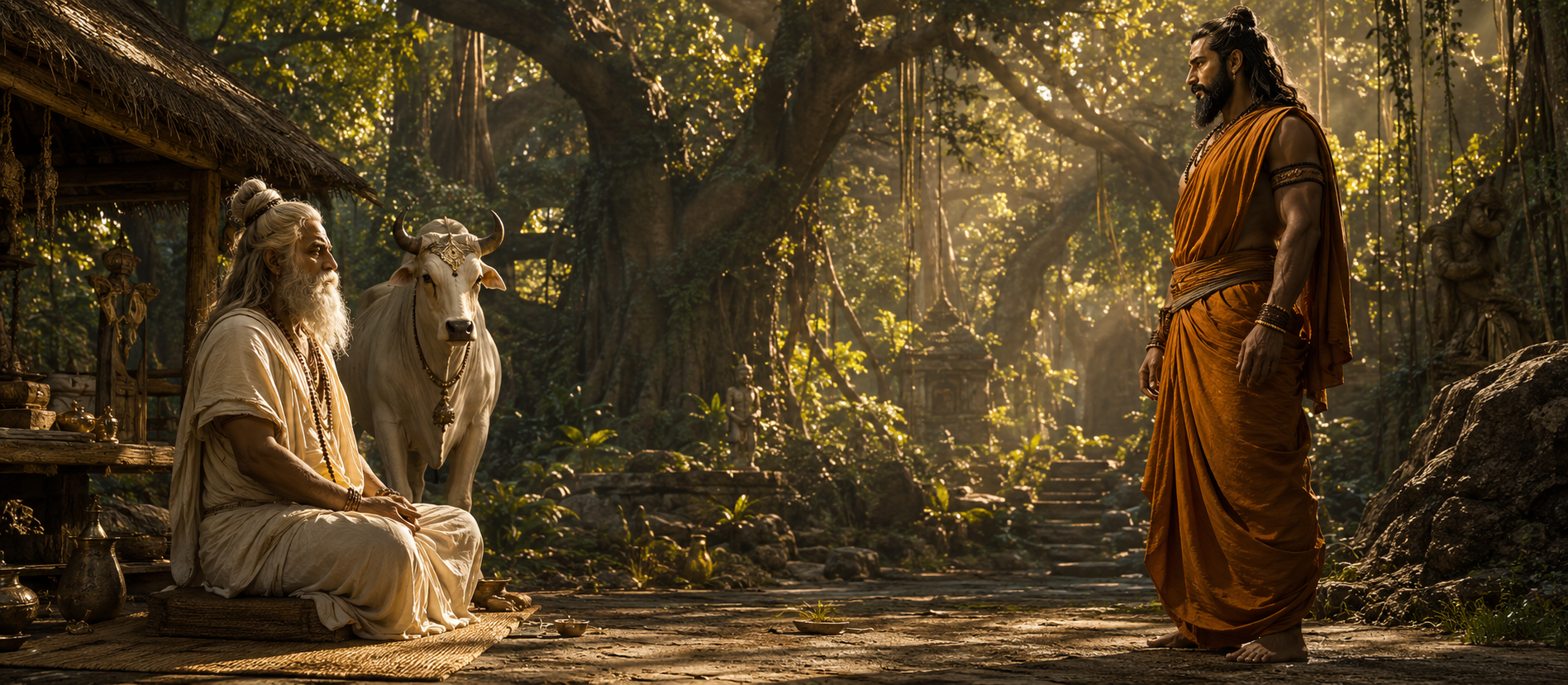
The rivalry between Vashistha and Vishvamitra — the Brahmin sage of inherited authority and the Kshatriya who became a sage through will — runs as a thread through centuries of Sanskrit literature before culminating in the Adibaka War.
The Sunasepha Episode — The Trigger of the Final Rupture
The immediate cause of the curses that produced the Adibaka War was the Sunasepha episode — one of the most dramatically complex narratives in the Valmiki Ramayana and the Devi Bhagavata Purana.
King Harishchandra — famous for his absolute commitment to truth — had promised his son to the god Varuna as a sacrifice. When the time came to fulfil the promise, he could not bring himself to sacrifice his own child. He searched for a substitute — a Brahmin boy who could be purchased and offered in his son's place. The boy he found, through a series of desperate transactions, was Sunasepha — the second son of the sage Ajigarta, who was himself a son of Bhrigu.
Sunasepha, bound at the sacrificial post, prayed to the gods in hymns of extraordinary beauty. The gods were moved. Vishvamitra — who had guided Harishchandra through the crisis and had a complex role in the events — intervened decisively: he taught Sunasepha the hymns that would release him, and then, when Sunasepha was freed, adopted him as his own son, renaming him Devarata.
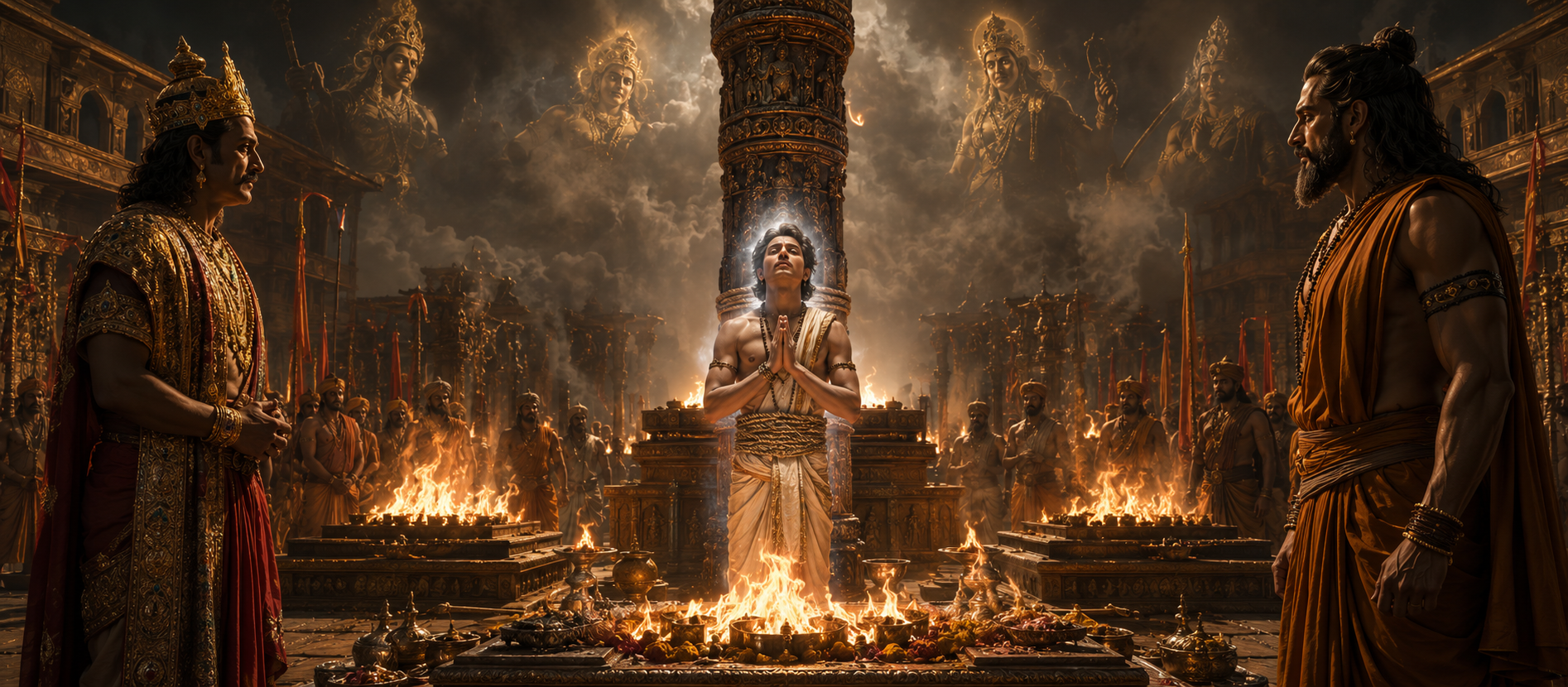
The Sunasepha episode — a boy sold as a substitute sacrifice, freed by his own prayers and by Vishvamitra's intervention — was the immediate trigger of the curses that produced the Adibaka War.
This is where Vashistha entered the confrontation. Vashistha had counselled Harishchandra earlier in the crisis — his counsel had included the suggestion of acquiring a substitute sacrifice, which led to Sunasepha's purchase. When Vishvamitra intervened to free Sunasepha and then claimed him as a son, Vashistha objected — the intervention cut across the ritual proceedings that Vashistha had helped to establish. Words were exchanged of the severest kind.
Each cursed the other: Vashistha cursed Vishvamitra to be reborn as a baka (crane) in his next birth; Vishvamitra cursed Vashistha to be reborn as an adi (myna). The Devi Bhagavata Purana records that both curses took effect — and that in their next births, the two great sages built their nests on the shores of the sacred Manasarovara lake and fought there without ceasing.
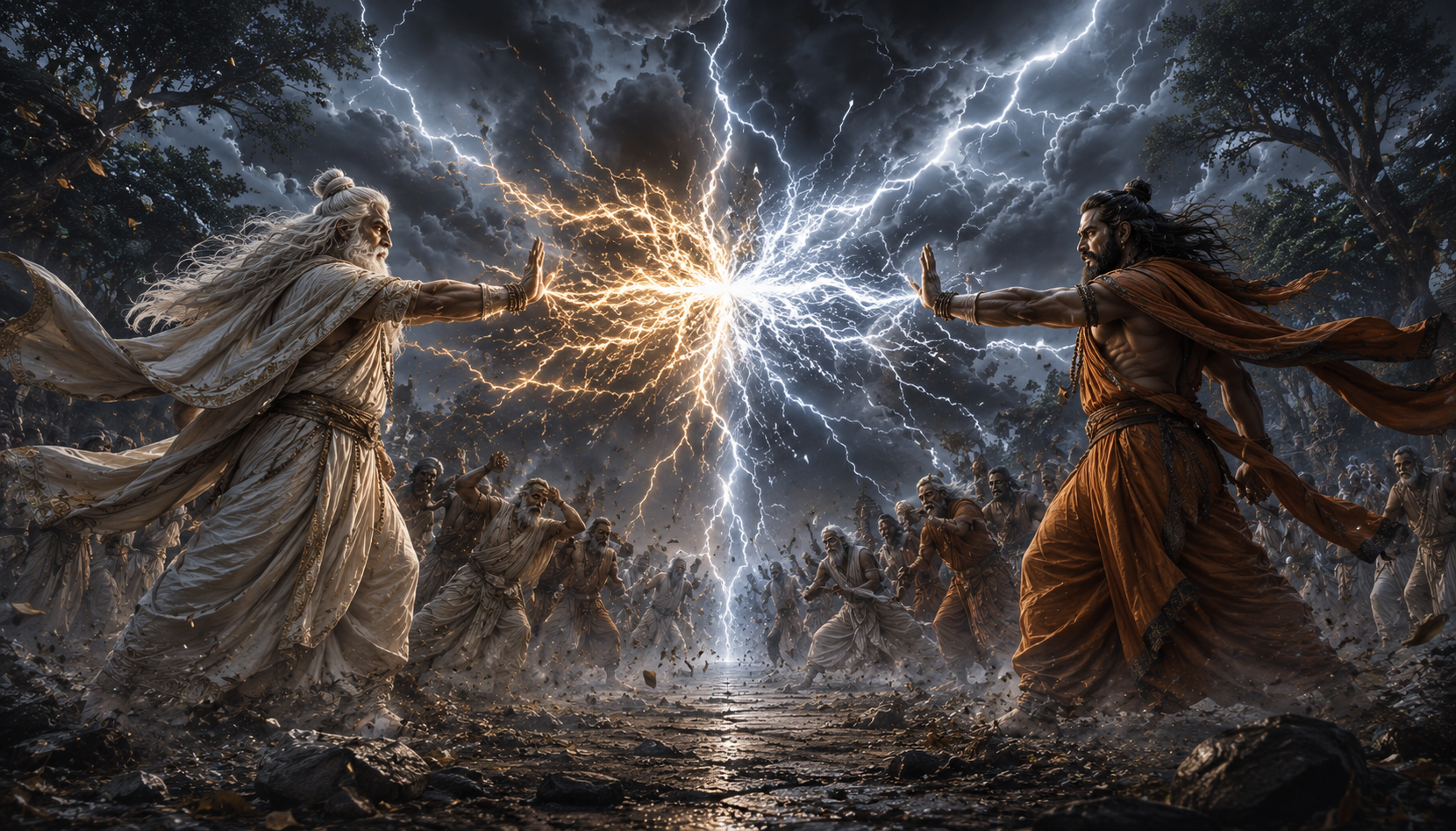
The mutual cursing — each sage condemning the other to bird-form — is the hinge point of the Adibaka War narrative. The symmetry of the curse is significant: both are diminished equally, both carry their enmity into a new and smaller form.
The Adi and the Baka — The War at Manasarovara
The Devi Bhagavata Purana records that in their rebirths, Vashistha took the form of an adi — a myna bird, known for its intelligence, mimicry, and sharp-eyed awareness — and Vishvamitra took the form of a baka — a crane, associated with patience, stillness, and the capacity to strike suddenly and with great force. The name of the war — Adibaka — combines the names of the two bird-forms.
Both birds built their nests at Manasarovara — one of the most sacred lakes in the Hindu tradition, located in the Himalayas near Mount Kailasa, believed to have been created in Brahma's mind before being manifested on earth. The choice of location is not incidental: Manasarovara is the spiritual heart of the Himalayan sacred geography, a place where the boundary between the human and divine world is understood to be especially thin. That the war between two cosmic-level sages should occur here, in this liminal space, gives it a significance beyond the scale of the combat itself.
The two birds fought continuously — the myna and the crane, each carrying within itself the full accumulated spiritual force of one of Sanskrit literature's greatest minds, expressed now only through beak, claw, and the instincts of a bird. The Puranic tradition does not describe the specific tactics of their combat; what it records is its duration and its intensity.

At Manasarovara — the sacred lake created in Brahma's mind — the two greatest sages of Sanskrit tradition fought as birds, their cosmic rivalry compressed into the limited world of wing and beak.
Key Combatants
The Adi (Myna)
Vashistha
- Human identity: Vashistha — one of the Saptarishis (seven great sages); son of Brahma; family priest (kula-guru) of the Solar dynasty including Rama's lineage; possessor of the divine cow Nandini; author of the seventh Mandala of the Rigveda.
- Bird form: Adi — the myna; known for acute intelligence, sharp perception, and the ability to replicate and outmanoeuvre. The myna's qualities reflect Vashistha's strength: precise, traditional, deeply rooted.
- Nature of authority: Brahmin by birth; his spiritual power is inherited and structural — the power of lineage and of Brahma's direct creation.
The Baka (Crane)
Vishvamitra
- Human identity: Vishvamitra — born as King Vishvaratha of the Kushika dynasty; became a Brahmarishi through extreme austerity alone; author of the Gayatri Mantra (Rigveda III.62.10) and most of the third Mandala; guided Rama and Lakshmana in their early training.
- Bird form: Baka — the crane; known for patience, precision, and explosive action at the right moment. The crane's qualities reflect Vishvamitra's strength: strategic, forceful, willing to wait.
- Nature of authority: Kshatriya by birth who earned Brahmin status; his spiritual power is achieved rather than inherited — the power of tapas and unbreakable will.
"In their next births they were reborn as birds at Manasarovara — the adi and the baka — and there beside those sacred waters they fought as birds fight, carrying within them the memory of everything they had been."
Devi Bhagavata PuranaThe Long Road to the Adibaka War — Key Episodes in the Rivalry
- The Theft of Nandini King Vishvaratha (Vishvamitra) attempts to take Vashistha's divine cow Nandini by force with his army. Vashistha's spiritual power defeats the entire army. Vishvaratha begins his first round of austerities to surpass Vashistha, renouncing kingship.
- Vishvamitra's First Recognitions After severe austerities, Vishvamitra is recognised as a Rajarshi (royal sage) and then a Maharshi. Vashistha still withholds the supreme recognition of Brahmarishi. The slight festers.
- The Trishanku Episode Vashistha refuses to perform a yajna to send King Trishanku to heaven in his physical body. Vishvamitra performs it himself, creating a separate heaven for Trishanku in mid-air when the gods refuse his entry. A direct challenge to Vashistha's priestly authority.
- The Harishchandra Crisis A complex series of events in which both sages are entangled — Vashistha as Harishchandra's traditional guru, Vishvamitra as an adversarial force testing the king's commitment to truth. The relationship between the two sages reaches its most adversarial point.
- The Sunasepha Episode Vishvamitra intervenes to free Sunasepha from the substitute sacrifice ritual and adopts him as a son. Vashistha objects. Mutual curses are pronounced. Both are condemned to bird-form at Manasarovara.
- The Adibaka War Both sages reborn as the adi (myna) and baka (crane) at Manasarovara lake. The war takes place beside those sacred waters — the culminating expression of a rivalry that had spanned the entire arc of the Varaha Kalpa's human age.
- Post-war reconciliation After both sages complete their bird-form births, they are reborn again in human form. The great Valmiki Ramayana records that Vishvamitra eventually receives the supreme recognition of Brahmarishi from Vashistha himself — the moment the rivalry finally resolves, Vashistha acknowledging what his adversary had always sought.
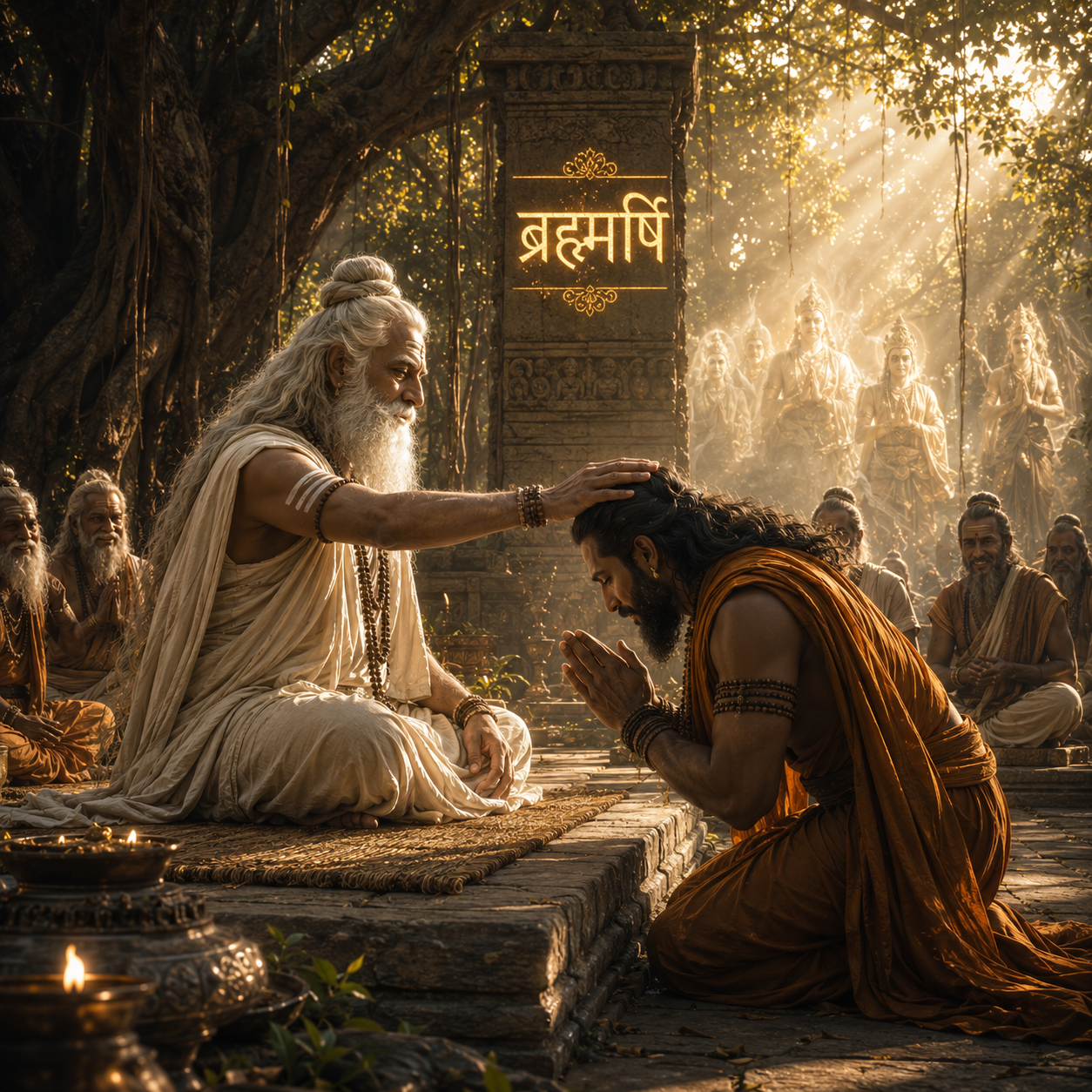
The reconciliation — Vashistha's final recognition of Vishvamitra as Brahmarishi — comes after the Adibaka War has been fought and the bird-form births exhausted. The rivalry ends not in the defeat of one by the other, but in the acknowledgement of what was always true.
The Adibaka War, strange as it is in form — two birds fighting beside a Himalayan lake — belongs to the sequence of twelve cosmic conflicts precisely because of what the combatants carry within them. The war of the adi and the baka is not a small thing. It is the entire weight of Sanskrit civilisation's most enduring intellectual and spiritual debate — whether authority is born or earned, whether lineage or achievement is the ultimate measure of a sage's worth — expressed in the most reduced and literal form possible.
The Devi Bhagavata Purana places it among the twelve wars as a reminder that the cosmic order does not only depend on the battles of gods and demons. The conflicts of sages — whose weapons are words and curses, whose battlefields are forests and sacred lakes — carry cosmic weight too. Even a fight between two birds at Manasarovara can be, in the right hands and with the right history behind it, one of the defining events of an age.
Outcome Summary
Nature of the war: Unlike the other eleven wars, the Adibaka War has no military outcome in the conventional sense — no victor, no defeated side, no restoration of a disrupted cosmic order. It is a war of exhaustion and of karma: both sages fight in bird form until the karmic weight of the curses is expended, after which both are reborn in human form to continue their respective spiritual paths.
Theological significance: The Adibaka War establishes that the category of "cosmic war" is not limited to conflicts between Devas and Asuras or between divine avatars and demons. The battles of sages — even when diminished into bird-form — carry a cosmic weight commensurate with the spiritual stature of the combatants. A war between Vashistha and Vishvamitra is a war between two of the most powerful spiritual forces in the Puranic universe, regardless of the form they inhabit.
Position in the twelve: The Adibaka War falls at the centre of the twelve-war sequence — seventh of twelve — at the hinge between the avatar-and-battle phase (Wars I–VI) and the Shaiva-and-Indra phase (Wars VIII–XII). Its placement here is structurally significant: it is the one war that has no divine champion, no defeated demon, and no cosmic order restored. It is a pause — a reminder that the cosmos is shaped by sage-rivalries as much as by god-demon conflicts.
Cosmic Significance
The Adibaka War is the Devi Bhagavata Purana's most original contribution to the twelve-war sequence. The other eleven wars are, with some variation, attested across multiple Mahapuranas. The Adibaka War — in this specific form, as the seventh of twelve, explicitly named and placed within the Varaha Kalpa framework — appears primarily in the Devi Bhagavata. Its inclusion reflects the Devi Bhagavata's distinctive theological interests: the text is concerned not only with cosmic warfare between gods and demons but with the full range of forces that shape the universe, including the spiritual energy of sages.
The war also carries an implicit statement about the nature of karma. Both Vashistha and Vishvamitra are presented in the Puranas as virtually immune to ordinary karmic consequence — sages of such accumulated merit that most actions pass through them without binding force. Yet the mutual curses bind them both, condemning them to bird-births they cannot escape through tapas or meditation. This is the Puranic tradition's acknowledgement that even the greatest sages are not above the law of cause and effect when they act from anger rather than from righteousness.
Manasarovara as the setting adds another layer of significance. The lake is understood as the first thought of Brahma — created in his mind before the physical world existed, and therefore carrying a cosmic priority that even Kailasa does not have in quite the same way. That the diminished forms of Vashistha and Vishvamitra fight here — at the origin-point of Brahma's creative imagination — gives their bird-war a dignity it would lack anywhere else.
Textual Sources & Variants
The Adibaka War as a named cosmic conflict is primarily attested in the Devi Bhagavata Purana. The underlying narrative — the Vashistha-Vishvamitra rivalry, the Sunasepha episode, and the mutual cursing — is attested across a much wider range of texts including the Valmiki Ramayana, the Mahabharata, and multiple Mahapuranas. The specific identification of the mutual-curse episode as producing the "Adibaka War" and its placement as seventh in the Varaha Kalpa sequence is distinctive to the Devi Bhagavata.
| Source | Detail | Variant / Note |
|---|---|---|
| Devi Bhagavata Purana |
The Adibaka War named as the seventh of twelve cosmic wars of the Varaha Kalpa. The mutual curses, bird-forms at Manasarovara, and the war between adi and baka all attested. The Sunasepha episode given as the trigger. | Primary and nearly exclusive source for the war as a named cosmic conflict. The Shakta theological framing of the Devi Bhagavata gives the sage-war a cosmic dignity equal to the divine wars. |
| Valmiki Ramayana Bala Kanda |
The Vashistha-Vishvamitra rivalry narrated at length across many chapters. The Sunasepha episode in full detail. The mutual cursing episode present. No mention of the Adibaka War as a named cosmic conflict. | The richest source for the underlying narrative; does not frame it as one of twelve cosmic wars. The Ramayana ends the rivalry with Vashistha's recognition of Vishvamitra as Brahmarishi. |
| Mahabharata Adi Parva |
Vashistha-Vishvamitra rivalry referenced multiple times; the Sunasepha episode mentioned. The mutual cursing and bird-births not narrated in detail in the surviving text. | Confirms the rivalry's canonical status. The Mahabharata's treatment is allusive rather than narrative on the bird-curse episode specifically. |
| Vishnu Purana & other Mahapuranas |
The Vashistha-Vishvamitra rivalry attested; some mention the mutual curses. The bird-forms at Manasarovara not consistently narrated as a distinct episode. | The rivalry is pan-Puranic; the specific Adibaka War framing is not. Multiple Puranas preserve elements of the story without assembling them into the named war narrative. |
| Brahmanda Purana |
Adibaka War named seventh in the twelve-war list of the Varaha Kalpa. | Framework source only; no narrative elaboration of the war itself. |
References
Primary Sources
- Devi Bhagavata Purana — (Adibaka War named as seventh of twelve; Sunasepha episode and mutual curses; bird-forms at Manasarovara)
- Valmiki Ramayana, Bala Kanda — Chapters 51–65 (Vashistha-Vishvamitra rivalry; Sunasepha episode in full; Vishvamitra's recognition as Brahmarishi)
- Mahabharata, Adi Parva — Chapter 65 (Vashistha-Vishvamitra rivalry referenced in genealogical context)
- Vishnu Purana — Book IV (Vashistha and Vishvamitra in the context of Solar dynasty genealogy)
- Brahmanda Purana — Varaha Kalpa section (Adibaka War named seventh in the twelve-war list)
- Rigveda — Mandala VII (Vashistha's hymns); Mandala III (Vishvamitra's hymns, including III.62.10 — the Gayatri Mantra)
Secondary Sources
- Mani, Vettam. Puranic Encyclopaedia. Motilal Banarsidass, 1975. Entries: "Vashistha," "Vishvamitra," "Sunasepha," "Adibaka," "Manasarovara."
- Goldman, Robert P. (trans.). The Rāmāyaṇa of Vālmīki, Vol. I: Bālakāṇḍa. Princeton University Press, 1984. (Vashistha-Vishvamitra rivalry and Sunasepha episode.)
- Bhattacharji, Sukumari. The Indian Theogony. Cambridge University Press, 1970. (On the structural opposition between Vashistha and Vishvamitra in the Vedic and Puranic traditions.)
- Pargiter, F. E. Ancient Indian Historical Tradition. Oxford University Press, 1922. (On the Vashistha and Vishvamitra lineages and their place in Puranic chronology.)
- Doniger O'Flaherty, Wendy. The Origins of Evil in Hindu Mythology. University of California Press, 1976. (On the sage-rivalry tradition and its cosmological dimensions.)