
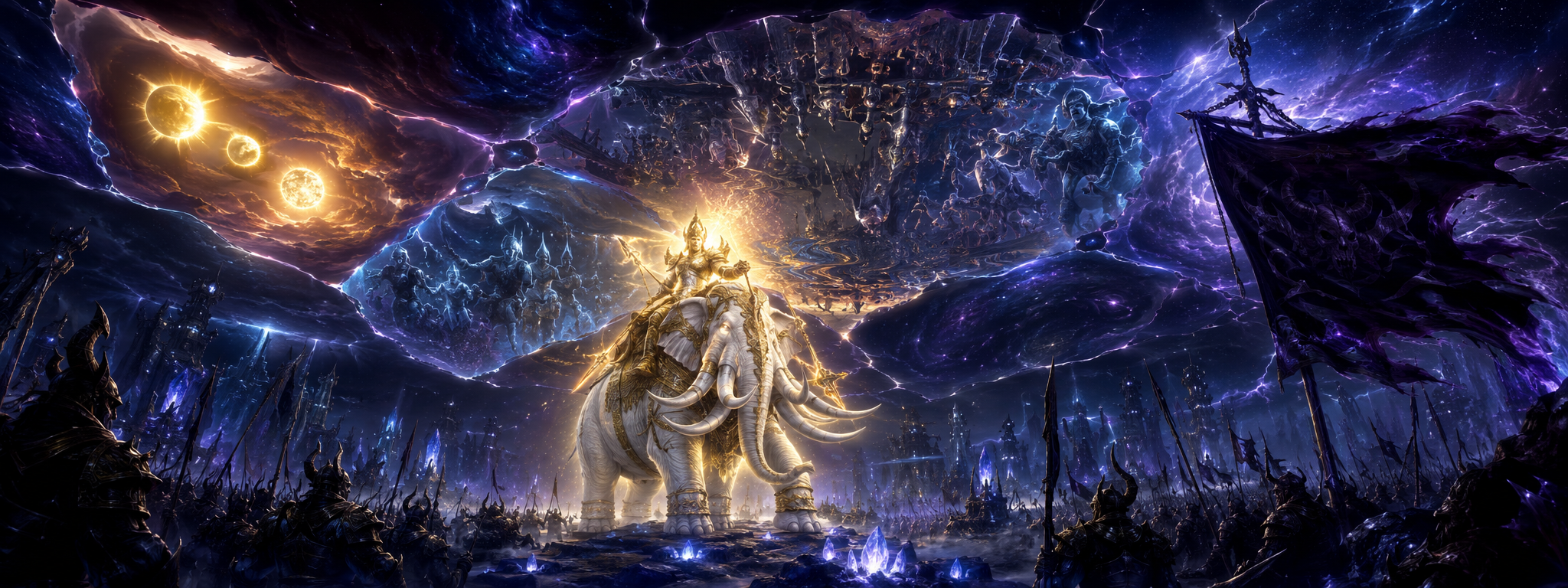
The Dhvaja War marks a significant transition in the sequence of twelve conflicts. With the great Shaiva wars of VIII and IX concluded, the stage shifts to Indra — king of the gods and the most politically central figure in the Puranic celestial order — who now faces the tenth and eleventh wars in sequence. Where Shiva fought as the cosmic destroyer, Indra fights as the administrator of the divine order: not as an avatar, not as a cosmic principle, but as the king who must defend his realm against a specific and formidable adversary.
Vipracitti is one of the most distinguished figures in the Danava tradition. He is not a newcomer or a peripheral demon king — he is a figure of ancient lineage, vast power, and a particular kind of intelligence: mastery of Maya, the power of cosmic illusion. The Dhvaja War is therefore not primarily a war of weapons but a war of perception — a conflict in which the primary weapon is the manipulation of reality itself, and the challenge facing Indra is not just to survive the battle but to see through it.
Vipracitti — The Danava King and Master of Maya
Vipracitti's lineage places him at the very heart of the Danava tradition. He was the son of Kashyapa and Danu — making him one of the elder Danavas, born in the earliest phase of the Varaha Kalpa's population of celestial and demonic beings. His name is connected in some Puranic genealogies to the root vipra (illuminated, wise) combined with chitti (consciousness) — suggesting an original association with heightened or transformed awareness, which finds its expression in his mastery of Maya.
He was also the father-in-law of Hiranyakashipu — whose story was told in War III — making him part of the web of dynastic relationships that connects the major Daitya and Danava adversaries of the twelve wars. His daughters were among the most celebrated in the Danava tradition: Sinhika (mother of Rahu, who appears in the Samudra Manthana narrative) and Holika are among those attributed to him in various Puranic sources.
What distinguished Vipracitti from the brute-force demon kings of earlier wars was his strategic sophistication. He did not simply conquer by overwhelming power. He destabilised. His Maya-craft allowed him to create false realities — phantom armies, counterfeit heavens, simulated victories and defeats — that confused both gods and mortals about what was actually happening. Under his influence, the gods could not trust their own perceptions. Battles that appeared to be won were actually being lost. Allies were turned against each other by illusions of betrayal. The three worlds began to lose coherence.
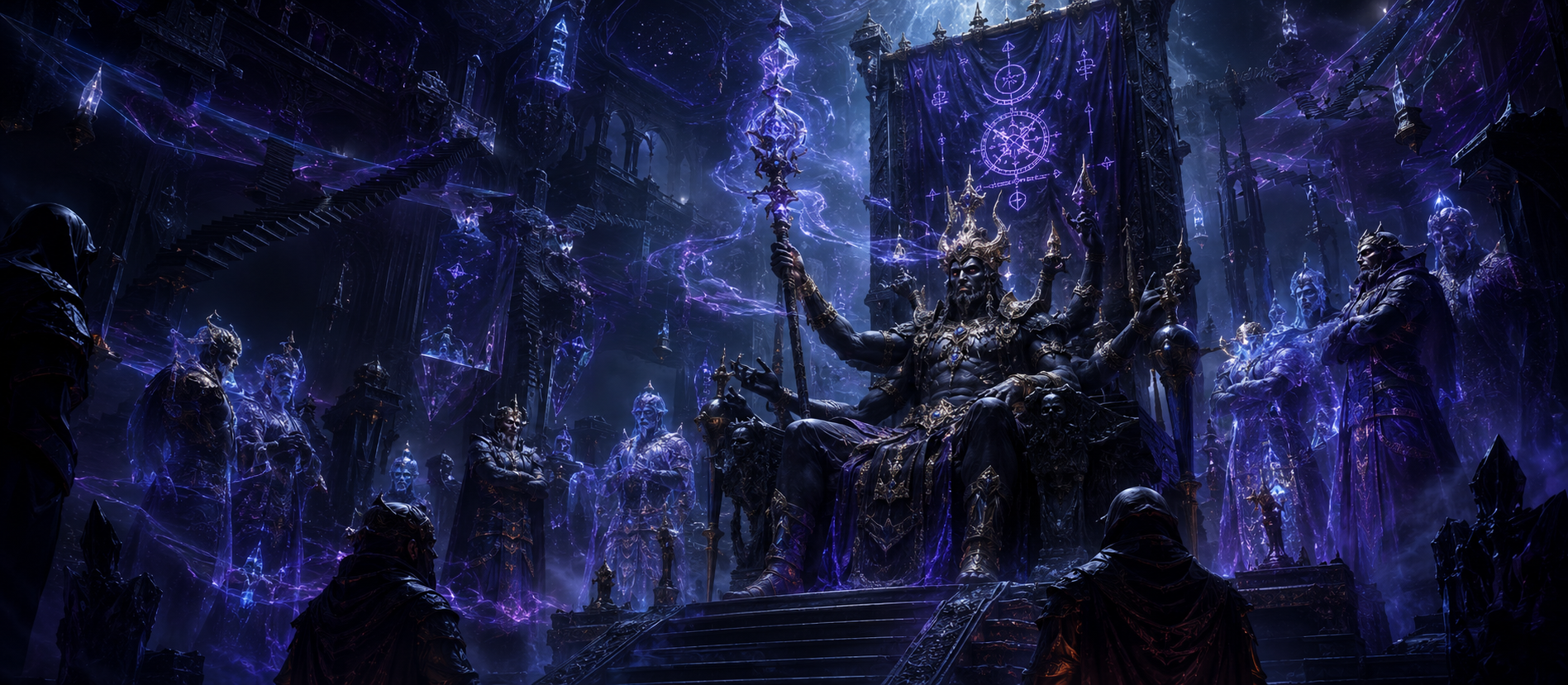
Vipracitti — master of Maya and one of the most distinguished figures in the Danava tradition — whose weapon was not force but the manipulation of reality itself.
The Dhvaja — The Battle Standard as Declaration of War
The war takes its name from the Dhvaja — the battle standard that Vipracitti raised in defiance of the cosmic order. In the Puranic military tradition, the raising of a Dhvaja was not merely a tactical signal; it was a formal declaration of sovereignty — an assertion that the banner-holder claimed authority over the territory beneath it. When Vipracitti raised his Dhvaja over the three worlds, he was not simply challenging the Devas to battle; he was asserting that the three worlds were his to govern.
The particular significance of Vipracitti's Dhvaja was that it was itself imbued with Maya. Those who looked upon it saw different things: some Devas saw their own standards reflected in it, creating confusion about who held sovereignty; others saw the Dhvaja as a sign of victory they had already won — and relaxed their vigilance at precisely the wrong moment. The banner was the first weapon Vipracitti deployed, before a single army had marched.
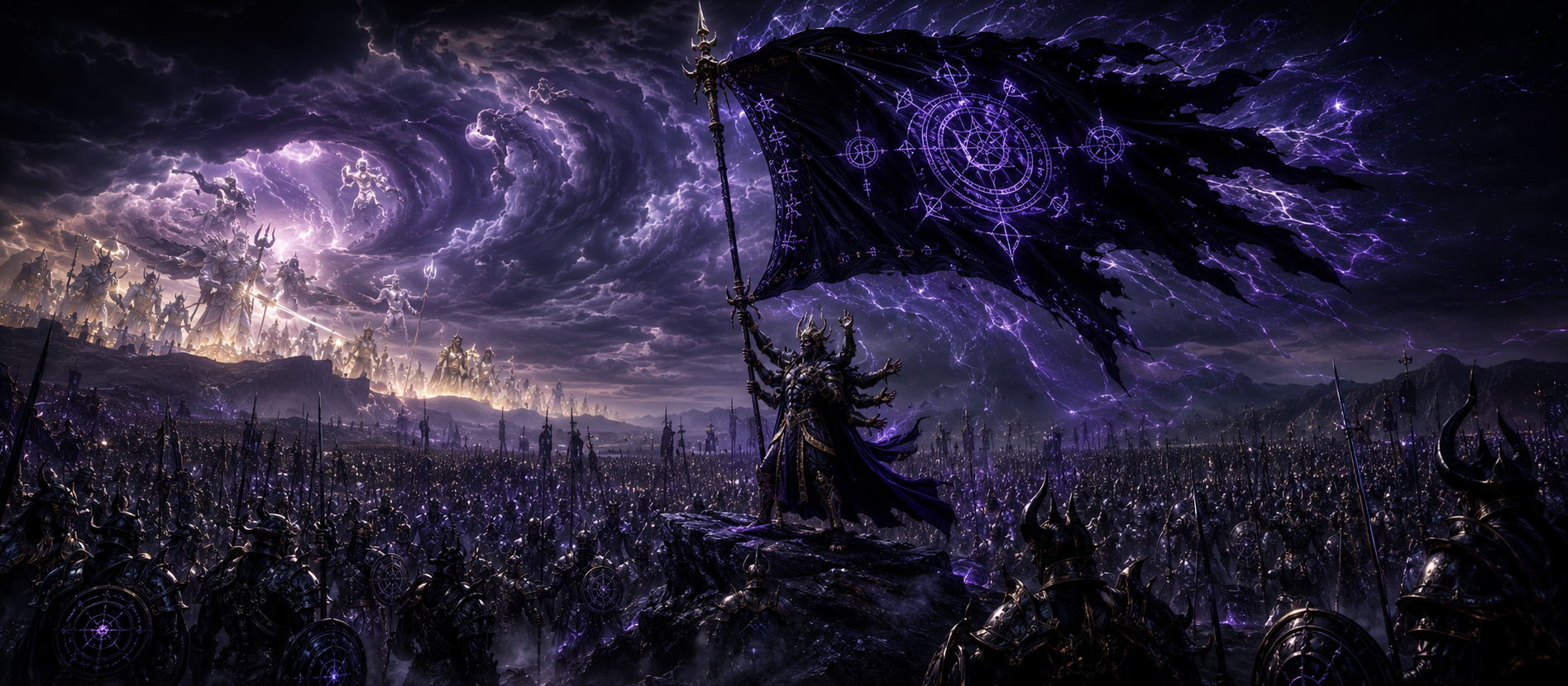
The raising of the Dhvaja — the war's namesake act — is itself the first deployment of Vipracitti's Maya, causing the Devas to perceive false realities before the first arrow has been fired.
Key Combatants
Divine Champion
Indra and the Devas
- Indra — King of the Devas; wielder of the Vajra (thunderbolt); rides the divine elephant Airavata. The Dhvaja War marks the first of Indra's two sequential appearances as sole divine champion (Wars X and XI). His characteristic strength is force and decisiveness — direct qualities tested severely by an enemy who fights through deception.
- The Deva army — Full celestial forces; commanders including Agni, Vayu, and the divine generals of Svargaloka.
- Vishnu — Supports the Deva side; his presence helps Indra pierce through Vipracitti's illusions when they are at their most dense. Some accounts give Vishnu a specific role in neutralising particular Maya constructs.
- Brihaspati — The divine preceptor; his counsel helps Indra strategise against an enemy whose weapon is not force but perception.
Adversary
Vipracitti and the Danavas
- Vipracitti — Son of Kashyapa and Danu; one of the elder Danavas; father-in-law of Hiranyakashipu; master of Maya. His illusion-craft is his primary weapon — the ability to make what is false appear real and what is real appear false.
- The Danava armies — Vast forces drawn from the full Danava lineage. Many are themselves skilled in minor forms of Maya, compounding the confusion Vipracitti creates at the macro level.
- Sinhika — Daughter of Vipracitti, mother of Rahu. Not a combatant but her connection to the Rahu episode of War V threads the Danava family into the earlier wars of the sequence.
The Weapons of Maya — Vipracitti's Arsenal of Illusion
The Puranic accounts of the Dhvaja War give particular attention to the specific forms of Maya that Vipracitti deployed — a taxonomy of illusion that represents the tradition's most sophisticated treatment of deception as a war-making tool. These were not simple disguises or camouflages; they were fundamental alterations to the perceived nature of reality.
| Maya Form | What It Created | Effect on the Deva Forces |
|---|---|---|
| Phantom armies | Vast illusory Danava forces that appeared to attack from directions where no real forces existed | Devas expended energy fighting enemies that dissolved when struck; real attacks came from unexpected directions |
| False victories | Illusions in which the Devas appeared to be winning decisively and the enemy retreating | Devas relaxed their guard, pursued phantom enemies, and found themselves surrounded by real ones |
| Mirror armies | Perfect copies of the Deva commanders fighting on the Danava side | Devas could not identify their own generals; friendly fire and confusion resulted |
| False terrain | Illusions of mountains, rivers, and obstacles that did not exist; absence of illusions of real obstacles that did | Deva armies marched into traps believing them to be open ground, or halted before apparent obstacles that were phantom |
| Counter-Vajra illusion | A Maya-construct that made Indra's Vajra appear to miss its target even when it struck truly | Indra lost confidence in his primary weapon; hesitated between strikes; disrupted his combat rhythm |
| False cosmic signs | Illusions of divine omens — false rainbows, counterfeit celestial phenomena — suggesting Deva defeat was fated | Deva morale suffered; some celestial beings withdrew from battle under the impression that the outcome was predetermined |
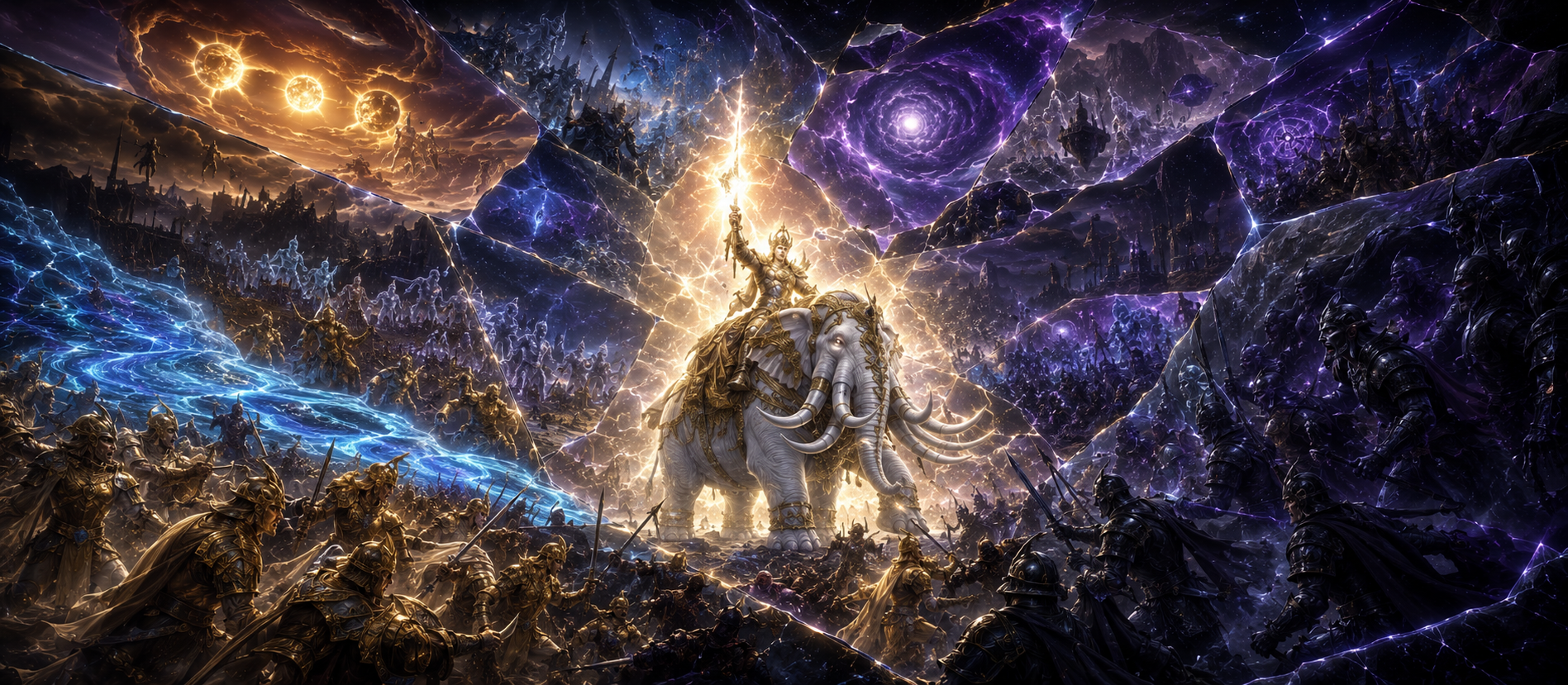
Vipracitti's battlefield — where multiple false realities overlay the actual conflict. The Dhvaja War is fought as much against illusion as against armies.
Indra's Response — Seeing Through the Maya
The Puranic accounts of the Dhvaja War do not present Indra as immune to Vipracitti's Maya. He is confused, misdirected, and at times deeply disoriented by the layers of illusion. What distinguishes him is his response to that confusion: rather than acting on false perceptions, he sought clarity. He consulted Brihaspati — whose divine wisdom allowed him to identify the patterns of Maya and provide Indra with a framework for distinguishing what was real from what was constructed.
Brihaspati's counsel was, in essence, philosophical as well as tactical: to trust the Vajra above all other perceptions, because the Vajra was not subject to Maya in the way that eyes and minds were. The thunderbolt was Indra's truth-telling weapon — it struck where Indra's divine will directed it, not where his deceived perception thought it should go. The advice to trust the weapon over the eyes proved to be the key to piercing Vipracitti's defences.
Vishnu's support was also critical. Some accounts describe Vishnu deploying his Sudarshana Chakra specifically against Vipracitti's grandest Maya constructs — the Chakra's spinning reality-cutting edge able to dissolve the largest of the false constructions and reveal the actual Danava forces beneath them. With the major illusions stripped away, the real battle could finally be fought.

The counsel of Brihaspati — to trust the Vajra above all perceptions — is the philosophical turning point of the Dhvaja War. Divine wisdom, not divine force, is what pierces the veil of Maya.
Armed with Brihaspati's insight and with Vishnu's support in dissolving the largest illusion-constructs, Indra re-entered the battle with a different quality of attention. He no longer tried to interpret what he saw; he acted on what he knew. The Vajra, guided by divine will rather than deceived perception, began to find its marks with increasing accuracy.
The Puranas describe the final phase of the Dhvaja War as a more conventional battle — the Maya constructs collapsing one by one as Vishnu's Chakra and Indra's Vajra cut through them, the real Danava forces revealed and engaged. Vipracitti, deprived of his primary weapon, was left fighting on even terms — and on even terms, Indra was the stronger.
The final confrontation between Indra and Vipracitti was direct and decisive. Indra struck Vipracitti with the Vajra and slew him. The Danava army, suddenly deprived of both their leader and the illusions that had sustained their advantage, broke and fled. The three worlds were freed from the Danava grip and the Devas were restored to Svargaloka.
"Indra did not defeat Vipracitti by seeing more clearly. He defeated him by learning which things were not worth seeing — and trusting the weapon that did not need eyes."
Brahmanda Purana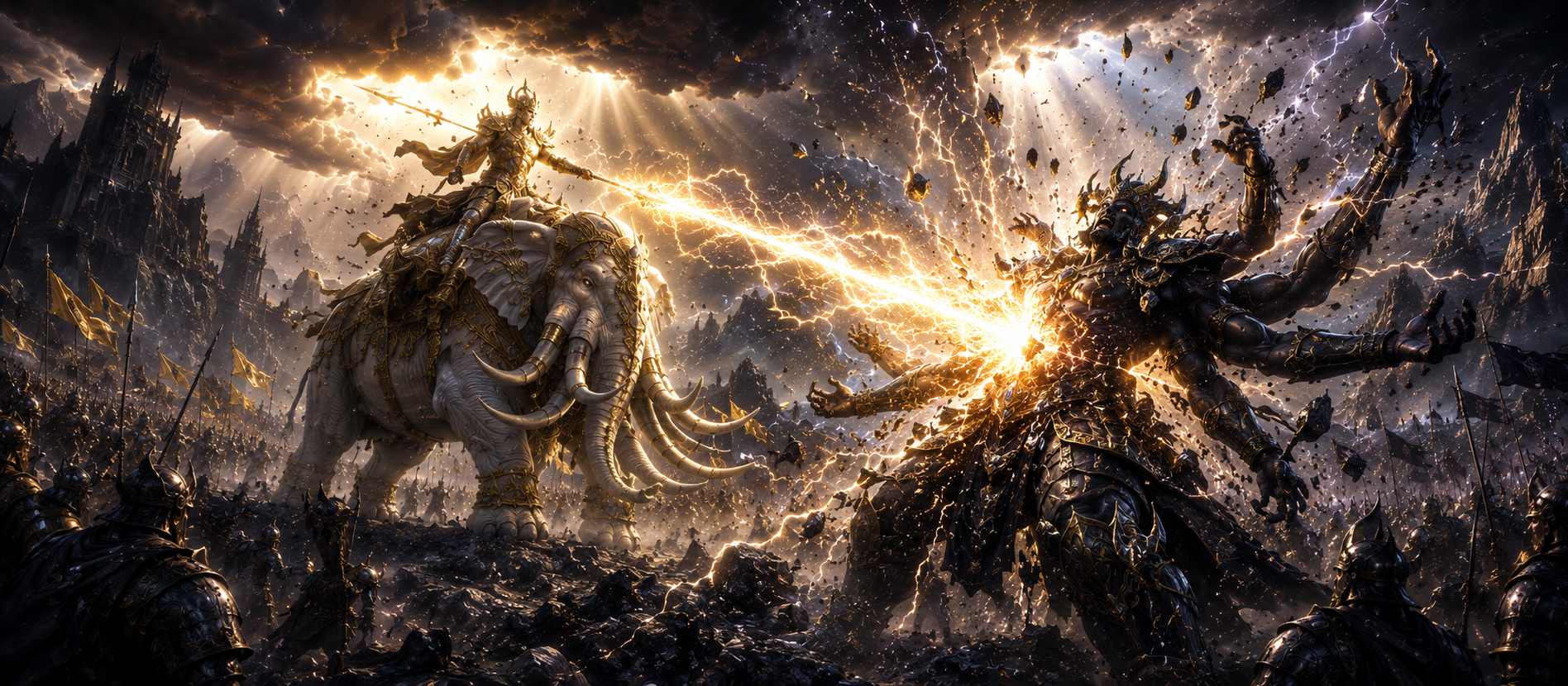
The final blow — Indra's Vajra finding Vipracitti once the Maya has been stripped away. Force and truth together accomplish what force alone could not.
Outcome Summary
Military result: Decisive Deva victory. Vipracitti was slain by Indra's Vajra after the Maya constructs protecting the Danava forces were dismantled by Vishnu's Sudarshana Chakra and Brihaspati's strategic guidance. The Danava army was routed. The three worlds were restored to Deva governance.
Theological significance: The Dhvaja War introduces a new category of cosmic threat — not physical force, not boon-protected invincibility, not cosmic theft, but the weaponisation of perception itself. Vipracitti's Maya is the Puranic tradition's most sophisticated articulation of the idea that the greatest danger to cosmic order is not power but deception — the substitution of false reality for true. Indra's victory, achieved through the guru's wisdom and the truth-cutting weapon, establishes that divine discernment (viveka) is as essential to cosmic order as divine force.
Position in the sequence: The Dhvaja War marks the beginning of the final phase of the twelve conflicts — the two Indra wars (X and XI) that precede the last war and Kartikeya's assumption of cosmic generalship. They represent Indra's full testing as king of the gods: in War X he is tested by illusion; in War XI he will be tested by cosmic drought and the sacrifice of a sage.
Cosmic Significance
The Dhvaja War is the Puranic tradition's most developed treatment of Maya as a weapon — and by extension, its most developed treatment of the relationship between divine power and divine perception. The earlier wars in the sequence all involved adversaries whose power was essentially physical, even when supernaturally amplified: Hiranyaksha's brute force, Hiranyakashipu's boon-armour, Mahabali's dharmic leverage, the Tripurasuras' architectural invincibility. Vipracitti's Maya is something qualitatively different: a weapon that does not attack the body or the power of the opponent but attacks their relationship with reality.
This positions the Dhvaja War as a philosophical inflection point in the twelve-war sequence. It asks: what is the nature of divine knowledge? If the gods can be deceived by sufficiently sophisticated illusion, what does that say about the reliability of divine perception? The war's resolution — Brihaspati's counsel to trust the weapon over the eyes, Vishnu's Chakra cutting through false construction — suggests that divine truth-cutting capacity (the Chakra) and divine wisdom (Brihaspati) are what the gods possess that no Maya can finally overcome.
Vipracitti's Maya also carries a resonance with the broader philosophical tradition of Hindu thought, in which Maya — cosmic illusion — is presented as the fundamental condition of the manifest world. In the Advaita Vedanta tradition, the entire phenomenal universe is understood as a kind of cosmic Maya. The Dhvaja War, read through this lens, becomes a cosmological parable: the gods themselves must fight through the Maya of false perception to reach the truth beneath it, just as the seeking individual must pierce the Maya of the phenomenal world to reach Brahman.
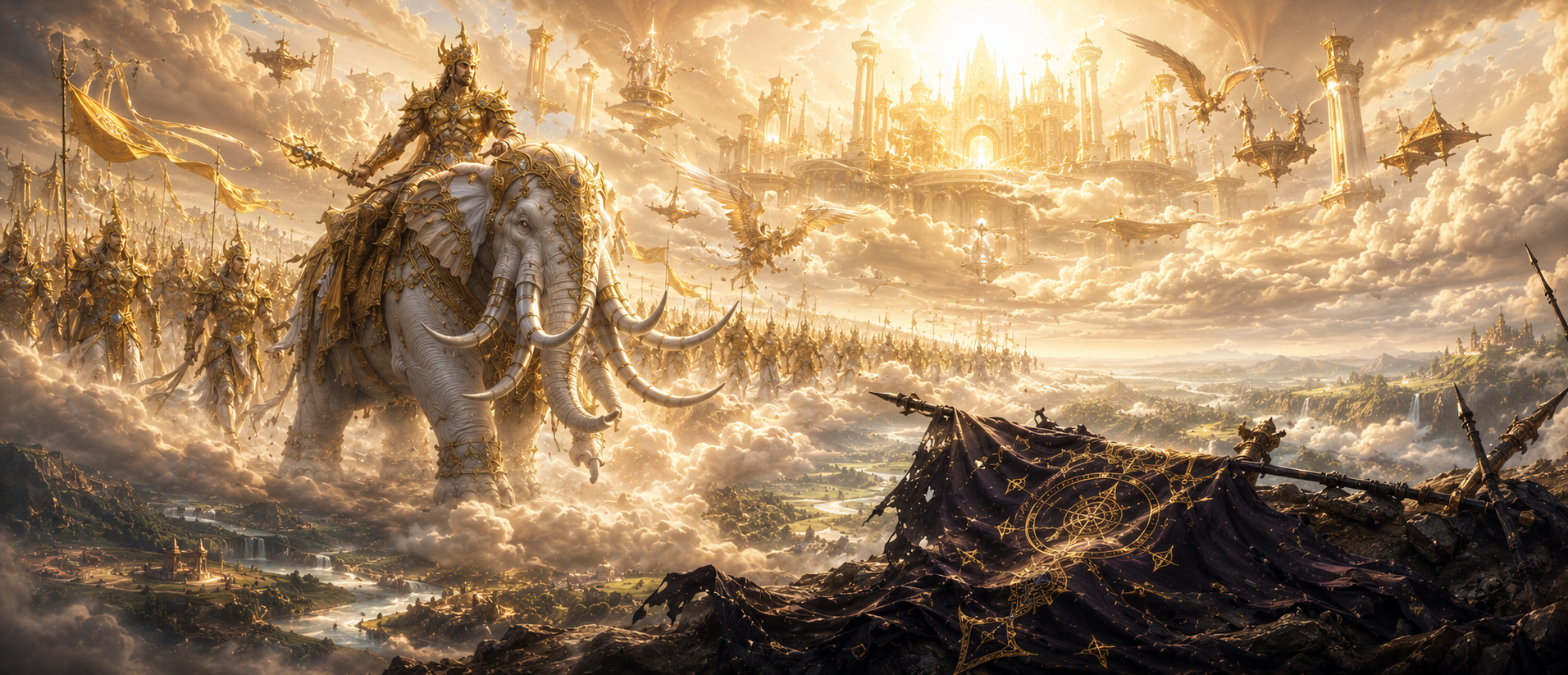
The restoration of the three worlds after the Dhvaja War — the illusions dissolved, the Danava banner fallen, the cosmic order re-established under Indra's governance.
Textual Sources & Variants
The Dhvaja War is attested in the Brahmanda Purana and referenced in the Bhagavata Purana, primarily in genealogical and narrative contexts involving Vipracitti's lineage. It is one of the less elaborately narrated of the twelve wars in the surviving textual tradition — fewer detailed battle descriptions compared to the Narasimha, Traipura, or Samudra Manthana accounts. The Maya-warfare element is attested but not always described with the specificity that some other sources give to the Traipura chariot or the Andhaka blood-crisis.
| Source | Detail | Variant / Note |
|---|---|---|
| Brahmanda Purana |
Dhvaja War named tenth in the twelve-war list of the Varaha Kalpa. Vipracitti identified as the adversary; Indra as the champion. Maya as the primary Danava weapon attested. War's outcome — Vipracitti's death — confirmed. | Primary framework source. The most explicit naming of this conflict as "the Dhvaja War" in the canonical twelve-war sequence. Narrative detail is present but less elaborate than the Shaiva-war accounts. |
| Bhagavata Purana Skandha VI |
Vipracitti appears in genealogical context — son of Kashyapa and Danu, father-in-law of Hiranyakashipu, father of Sinhika (mother of Rahu). His conflict with Indra referenced. | Genealogical framing rather than battle narrative. Confirms Vipracitti's position in the Danava lineage and his relationship to other figures of the twelve wars. |
| Vishnu Purana Book I |
Vipracitti listed among the senior Danavas; his mastery of Maya noted. Conflict with the Devas referenced in the context of Deva-Danava wars. | Not narrated as a distinct war; Vipracitti's Maya-craft is attested but the specific Dhvaja War episode is not elaborated independently here. |
| Mahabharata various parvas |
Vipracitti referenced as one of the great Danava kings; his power and Maya-craft known to the epic tradition. No extended battle narrative for the specific Dhvaja War. | Confirms Vipracitti's canonical status. The Mahabharata's treatment is allusive — the war is presumed knowledge rather than narrated history. |
References
Primary Sources
- Brahmanda Purana — Varaha Kalpa section (Dhvaja War named tenth in the twelve-war list; Vipracitti identified as adversary; Maya-warfare attested)
- Bhagavata Purana — Skandha VI, genealogical sections (Vipracitti's lineage; connection to Hiranyakashipu and Rahu)
- Vishnu Purana — Book I (Vipracitti listed among senior Danavas; Maya-craft noted)
- Mahabharata — Various parvas (Vipracitti referenced as great Danava king)
Secondary Sources
- Mani, Vettam. Puranic Encyclopaedia. Motilal Banarsidass, 1975. Entries: "Vipracitti," "Dhvaja War," "Maya (cosmic illusion)."
- Tagare, G. V. (trans.). The Brahmanda Purana. Ancient Indian Tradition and Mythology Series, Motilal Banarsidass, 1983.
- Tagare, G. V. (trans.). The Bhagavata Purana. Motilal Banarsidass, 1976. Skandha VI.
- Wilson, H. H. (trans.). The Vishnu Purana. Trübner & Co., 1865. Book I (Danava genealogies).
- Gonda, Jan. Change and Continuity in Indian Religion. Mouton, 1965. (On Maya as cosmic principle and its role in Puranic warfare narratives.)