
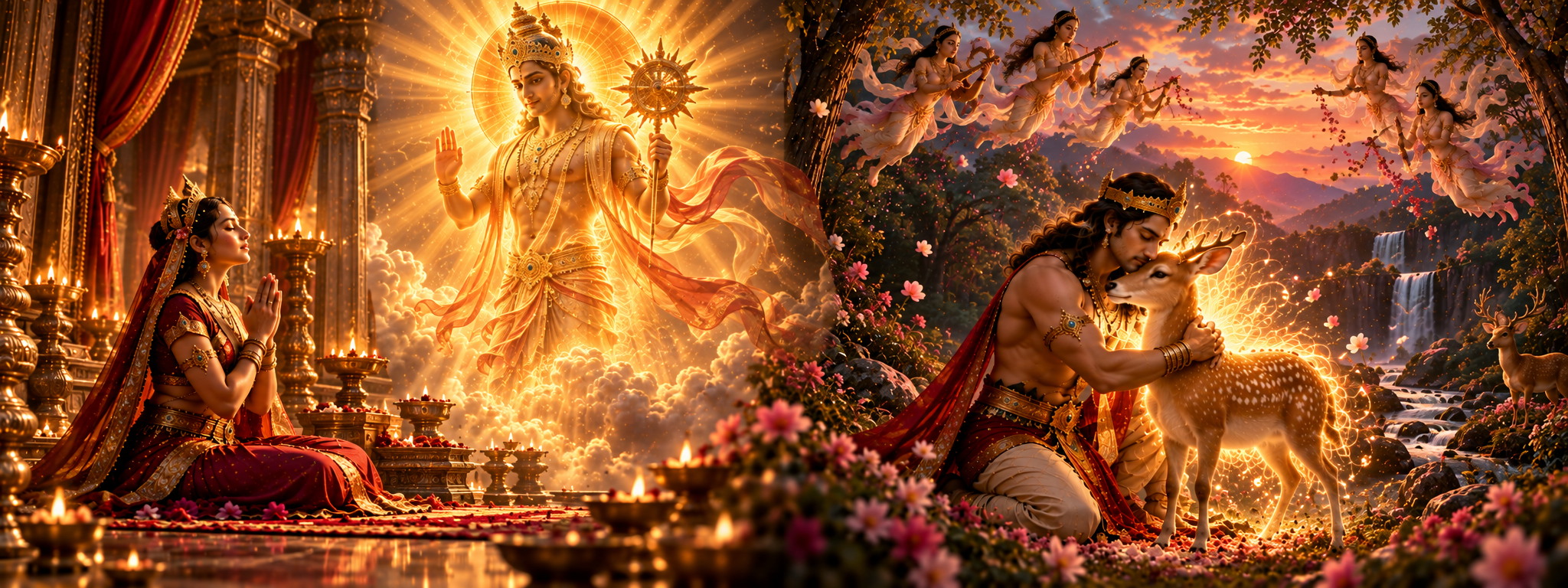
Every mechanism so far in this series has involved some physical substitute for an ordinary conception — a vessel, an animal, a churned ocean, a ritual substance, a deity's own body. This Part covers something different again: cases where a boon, a word, or a touch substitutes for the act of conception itself, with no physical medium standing in at all. In one cluster, the boon simply removes the need for a father's physical presence, and an ordinary pregnancy follows. In another, a sage's touch and a prophecy are enough. In the last, the boon collapses the entire process — conception and birth arrive in the same instant, triggered by nothing more than an embrace and a wish granted. Two further cases, Hanuman and Shikhandi, show the boon working on a child's paternity and on a child's sex and past life rather than on the act of conception itself.
Kunti and Madri's Six Sons
The sage Durvasa, pleased with Kunti's service to him in her youth, grants her a mantra with which she may invoke any deva and receive a son by him, without physical union. Out of curiosity alone, before her marriage, she tests it once — invoking Surya, the sun — and conceives Karna, whom she bears in secret and sets adrift on a river, unable to explain an unmarried pregnancy to her household.
After her marriage to King Pandu, who is under a curse that forbids him physical union with either wife on pain of death, the mantra becomes the couple's only route to an heir. At Pandu's request, Kunti invokes Dharma and bears Yudhishthira; invokes Vayu and bears Bhima; and, after Pandu himself undertakes a year of austerities to win Indra's favor directly, invokes Indra and bears Arjuna. Kunti then teaches the mantra to Pandu's second wife, Madri, who invokes the twin Ashwini Kumaras (Nasatya and Dasra) together and bears twins of her own, Nakula and Sahadeva.
In every one of the six cases, the sequence described by the Adi Parva is the same: invocation, the god's assent, and a pregnancy that proceeds without further incident to an ordinary birth. The five sons born after Karna are explicitly sequential — each request follows the previous child's birth — which only holds together if each pregnancy ran its normal course. There is no indication anywhere in this sequence that Karna's own conception, using the identical mantra for the identical purpose, worked by any different process.
Some condensed and devotional retellings of Karna's birth specifically — though not, notably, of his five brothers' — describe the birth as instantaneous, or even describe the god as simply handing over an already-formed child with no conception or pregnancy at all. Karna's episode carries a narrative pressure his brothers' do not: it happens in secret, before marriage, and needs to move quickly from invocation to a hidden birth to an infant set adrift, all within one compressed passage. That pressure plausibly explains why retellings skip over the months in between, rather than reflecting a genuine second textual tradition running alongside the Adi Parva's own account. Since the mechanism — mantra in place of union — is identical for all six sons, this piece treats Karna's gestation as following the same ordinary course as his brothers', with the instantaneous framing noted as a popular simplification rather than an equally weighted variant.
Svarochisha Manu: Born the Instant He Was Willed
On a hunting expedition, the vidyadhara Swarochi comes upon a doe fleeing a boar and moves to kill the boar in her defense. The doe, defenseless, begs him instead to kill her outright, explaining that dying at his hands would let her be reborn to marry a man such as him. When Swarochi hesitates, she asks him instead simply to embrace her once, promising that a miracle will follow by the grace of the Vana Devata, the deity of the forest. Swarochi embraces her, and the doe instantly gives birth — no seed, no gestation, no interval of any kind between the embrace and the child's arrival — to a son who grows up to become Svarochisha Manu, the second of the fourteen Manus. The event is marked, in the telling, by celestial drums, a shower of fragrant flowers, and Gandharvas and apsaras celebrating the birth from the sky above.
Anga, Vanga, Kalinga, Pundra, and Suhma: Conceived by a Touch
King Bali — a king of the eastern Anga region, not the asura of the same name — has no sons, and calls on the blind sage Dirghatamas to father heirs on his queen, Sudeshna. What follows first is a substitution, not a birth of this Part's kind: Sudeshna, unwilling to lie with an aged, blind ascetic, sends her maidservant in her place, and the sons born of that arrangement are a separate story, covered in this project's Children of Deception material. When the deception comes to light, Bali sends the queen herself.
The Adi Parva is explicit about what happens next: the sage, by merely touching her person, tells Sudeshna that she will bear five sons — and names them on the spot: Anga, Vanga, Kalinga, Pundra, and Suhma, each destined to found a kingdom bearing his own name. There is no union in the ordinary sense, only a touch and a word — a still smaller substitute for the act than a mantra or an embrace.
The Adi Parva gives the touch and the prophecy but does not state whether the five births follow at once or after an ordinary term; this piece does not assume either. What it does establish is that conception here is triggered by touch alone, and that all five sons arrive as a single, foretold set — a case of multiple birth with no dividing agent, unlike the split-and-fused births of Part VI.
Hanuman: A Child of the Wind, Several Ways
Hanuman is born to Anjana, wife of the vanara Kesari, but in the oldest telling not to Kesari: Valmiki's Ramayana names Vayu, the wind-god, as his father, and does not dwell on how. Later traditions supply the how in different ways. One, tied to Shiva, has Vayu carry a portion of Shiva's energy to Anjana, so that Hanuman is at once the wind's son and an expression of Shiva. The Brahma Purana's account has Vayu unite with Anjana directly. And a much later account, the sixteenth-century Bhavartha Ramayana of Eknath, has a kite carry a portion of the divine payasam meant for Dasharatha's queens and drop it into Anjana's hands as she prays, so that Hanuman is conceived from the same sacred food that produces Rama and his brothers in Part V.
What ties him to this Part is that in every version his paternity is granted or transmitted rather than simply begotten: a wind, a borne energy, a dropped offering.
The accounts do not reconcile, and this piece does not try to. Valmiki's Vayu-as-father is the earliest layer; the Shiva-energy and Brahma Purana accounts are Puranic elaborations of it; the payasam-and-kite version is the latest and is included as a later tradition rather than an equal one.
Shikhandi: A Boon That Reverses Itself
King Drupada, wanting a son who can kill Bhishma, wins a boon from Shiva, and it comes with a condition he did not ask for: the child will be born a daughter, who will later become a man. That daughter is Shikhandini. She is also Amba, the princess wronged by Bhishma, who vowed to be the cause of his death and, dying, was reborn into Drupada's house carrying that vow with her.
Drupada and his queen raise the girl as a boy, and later a yaksha, Sthunakarna, exchanges his sex with hers, leaving her a man. That later life this piece does not follow, beyond noting that it fulfils the boon exactly. What matters here is the birth: a boon that fixes in advance a child's sex, purpose, and even previous identity. Ila, in Part V, is the series' other figure whose sex changes; where Ila's change follows a ritual error and a curse, Shikhandi's arrives as a condition on a granted boon. Drupada's other children, Dhrishtadyumna and Draupadi, are born from fire in Part I.
The first three cases in this Part remove physical union as the cause of conception and put something smaller in its place — an invoked god's assent, a touch and a prophecy, an embrace and a boon. Where they diverge is what happens next. Kunti and Madri's sons are conceived by invocation but carried to term the ordinary way. Dirghatamas's five sons are conceived by touch and announced together, with the text silent on gestation. Svarochisha Manu's case skips the middle step entirely: the boon replaces gestation as well, collapsing the whole process into the moment of the embrace. The doe is, in the fullest sense, simply a mother — what's unusual is not her role but the total absence of any interval between conception and birth. Hanuman and Shikhandi carry the same principle into other parts of a birth: in Hanuman's case, who the father is; in Shikhandi's, what the child will be.
This Part's five cases mark the far end of a spectrum this series has been tracing from Part I onward: a full substitution of divine or sacred will for the ordinary biological process. Kunti and Madri's sons keep one half of an ordinary pregnancy intact — only conception is unusual, not gestation. Dirghatamas's five sons shrink the conceiving act itself to a touch. Svarochisha Manu removes the ordinary process altogether, leaving nothing between the wish and the child but a single embrace. Hanuman and Shikhandi show the same substitution reaching beyond conception: one grants a child its parentage, the other fixes a child's sex and past life before birth.
References
Primary Sources
- Mahabharata, Adi Parva — for Durvasa's boon to Kunti, the invocations of Surya, Dharma, Vayu, and Indra, and the births of Karna, Yudhishthira, Bhima, and Arjuna.
- Mahabharata, Adi Parva, and Vana Parva (Kundalaharana episode) — for the fuller account of Karna's secret birth and the sequence of Kunti and Madri's later sons, including Madri's invocation of the Ashwini Kumaras for Nakula and Sahadeva.
- Markandeya Purana and later Manvantara tradition — for the account of Swarochi, the doe, the Vana Devata's boon, and the birth of Svarochisha Manu.
- Mahabharata, Adi Parva (Sambhava Parva) — for Dirghatamas's touch and prophecy over Sudeshna, and the naming of Anga, Vanga, Kalinga, Pundra, and Suhma.
- Valmiki Ramayana, Kishkindha Kanda; Brahma Purana; Shiva Purana; and Eknath's Bhavartha Ramayana (sixteenth century, noted as a later tradition) — for Hanuman's birth to Anjana and the competing accounts of Vayu's part in it.
- Mahabharata, Udyoga Parva — for Shiva's boon to Drupada, Amba's rebirth as Shikhandini, and the yaksha Sthunakarna's exchange of sex.
Popular and devotional retellings that compress Karna's birth into an instantaneous event, or describe it as a direct gift of a child with no conception involved, are treated here as narrative compression rather than a competing textual tradition, since no such distinction is drawn for his five brothers under the identical mechanism. The payasam-and-kite account of Hanuman's birth is a sixteenth-century retelling and is treated as a later layer, not an equal one.